Can a Dental Implant Post Be Removed?
The dental implant is designed and marketed as a permanent solution. The titanium post is placed with the express intention that it will osseointegrate and remain fused to your jawbone for a lifetime. This is the goal and the overwhelmingly likely outcome. But you are asking a critical and advanced question: can this seemingly permanent post be removed if something goes wrong? The answer is a qualified yes. A dental implant post can be removed, but it is not a simple, trivial procedure. It is a surgical act called explantation, and it requires a specific set of skills, tools, and a carefully planned approach. This guide will explore the legitimate reasons for implant removal, the techniques a surgical specialist uses to remove an integrated implant with as little trauma as possible, and what happens to the site afterward.
The False Assumption: It’s “Just Unscrewing It”
A common and dangerously incorrect assumption is that removing a dental implant is as simple as unscrewing it from the bone, in reverse of how it was placed. This is a complete misunderstanding of the biology of osseointegration. A successfully integrated implant is not a screw in a piece of wood. It is a piece of titanium that has been biologically fused to living bone at a microscopic level. There is no gap. There is no mechanical release by simply applying a reverse torque. The bone must be separated from the implant surface. Attempting to simply wrench an integrated implant out with a ratchet would result in a catastrophic, uncontrolled fracture of the surrounding jawbone. The removal of a dental implant is an explantation surgery. It involves deliberately and carefully cutting a controlled margin of bone around the implant to break the osseointegration, so the implant can be delivered without destroying the ridge.
Legitimate Reasons for Implant Removal
A dental implant is only removed when there is a clear clinical reason that makes its retention a threat to the patient’s health or an impossible restorative challenge. The reasons fall into biological and mechanical categories. The most common reason is early implant failure. The implant never integrated in the first place. The patient presents with a mobile, painful implant. By definition, a mobile implant is a failed implant. The connective tissue has formed a fibrous encapsulation instead of a bony fusion. In this case, removal is often very simple because the bone-implant connection is nonexistent.
The second major reason is catastrophic, late biological failure due to advanced peri-implantitis. A chronic, progressive bacterial infection has destroyed so much of the supporting bone that the implant is losing integration. The implant is either already mobile or is surrounded by a deep, infected crater that cannot be predictably regenerated. The implant must be removed to fully debride and disinfect the infected bone so that a future graft and replacement are possible. The third reason is a mechanical fracture of the implant body itself. If the titanium post snaps below the bone level, it cannot be restored and must be retrieved. Other reasons include an implant that is so severely malpositioned that it cannot be restored and is causing damage to adjacent teeth or nerves, and the rare case of a patient who desires removal due to a perceived systemic illness they attribute to the implant, a controversial and complex diagnosis often labeled as “metal hypersensitivity,” though, as discussed, this is exceptionally rare.
The Explantation Procedure: How It’s Done
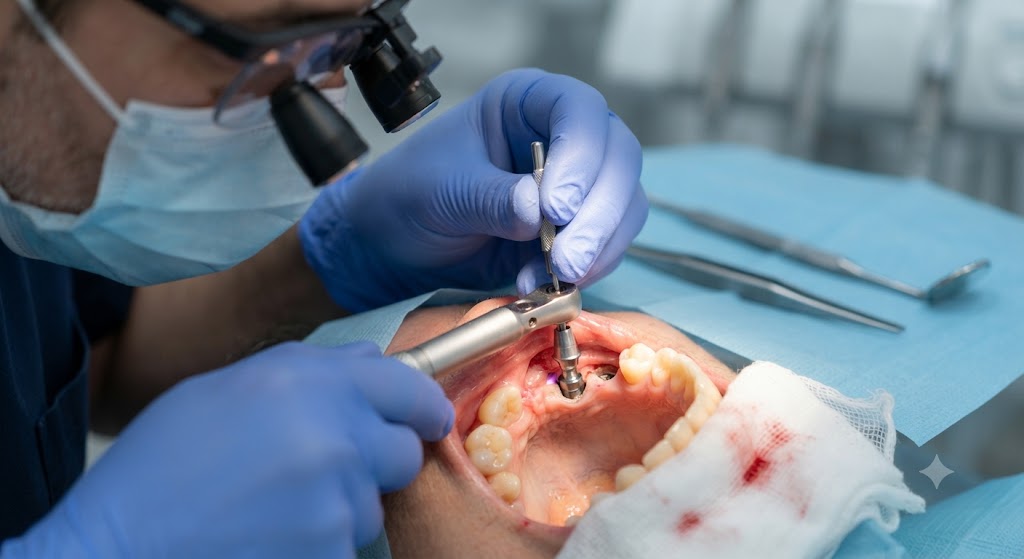
The surgical technique for removing an integrated implant is a meticulous, precise, and bone-sparing procedure. The surgeon will create a flap to expose the top of the implant and the surrounding bone. The goal is to remove a minimal, controlled amount of bone around the implant to break the osseointegration while preserving as much of the patient’s healthy jawbone as possible for future reconstruction. The primary tool for this is often a trephine bur. This is a hollow, cylindrical, tube-like drill with a cutting edge on its tip. The surgeon selects a trephine with an internal diameter slightly larger than the implant body. The trephine is placed over the implant and used to carefully core out a thin, circular collar of bone that is fused to the implant surface. The implant is then removed within this core of bone. This is a highly skilled technique, often done under copious sterile saline irrigation to prevent heat damage to the surrounding bone.
If the implant is in a delicate location, near a major nerve or a thin sinus floor, the surgeon may use a piezoelectric surgical unit. This is an ultrasonic device that uses high-frequency micro-vibrations to precisely cut bone while minimizing the risk of damaging soft tissues like the nerve. It is a more time-consuming but exceptionally safe technique for removing an implant from a high-risk anatomical site. Once the implant is removed, the surgeon will thoroughly curette and debride all inflammatory granulation tissue from the bony defect. The site is then ready for reconstruction.
What Happens After Removal: The Reconstruction
Removing the implant is only the first part of solving the problem. You are now left with a bony defect. The goal is to regenerate the bone so that a new implant can eventually be placed, or so the ridge will support a conventional restoration. Immediately after explantation, the surgeon will almost always pack the defect with bone graft material. This can be a combination of allograft and xenograft. A barrier membrane will be placed over the graft to protect it, and the gum tissue is closed primarily to allow for a quiet, undisturbed healing period of four to six months. During this time, the bone graft will be replaced by the patient’s own living bone. After the healing period, a new CBCT scan is taken. If adequate bone volume has been regenerated, a new, often larger-diameter and meticulously planned implant can be placed. The entire process of explantation, graft, healing, and reimplantation is a year-long journey.
The Simple Removal: A Failed, Non-Integrated Implant
It is a relief to know that the most common reason for implant removal is also the simplest to manage. If the implant has failed early and is mobile, there is no osseointegration to break. The surgeon can often grasp the implant with a removal tool, rotate it, and it simply lifts out with minimal resistance and minimal bone trauma. The site is curetted, a graft is placed to preserve the ridge volume, and the site heals quickly. The patient is often profoundly relieved because the painful, mobile source of anxiety is gone. The surgical experience and post-operative pain are minimal.
Conclusion
Yes, a dental implant post can be surgically removed through a procedure called explantation, which is a precise, bone-sparing surgery that uses a trephine bur or piezoelectric instrument to carefully cut a microscopically thin margin of bone around the integrated implant, allowing its atraumatic removal. The most common reasons for this are early failure to integrate or late catastrophic bone loss from peri-implantitis, both of which leave a defect that is immediately grafted to prepare for a future replacement. A mobile, non-integrated implant is the simplest to remove, while a solidly fused implant in a high-risk anatomical zone is the most technically demanding.
Frequently Asked Questions
Is implant removal more painful than placement?
The post-operative discomfort is generally very comparable to the original implant placement surgery. The procedure is performed under local anesthesia and is painless. The recovery involves managing a dull ache and swelling for a few days, managed effectively with anti-inflammatories.
Will insurance cover the removal of a failed implant?
Medical and dental insurance coverage for explantation is complex. If the removal is medically necessary due to a documented infection, pathology, or fracture, your medical plan may cover the surgical removal and the bone graft. If it is an elective replacement, the cost is often the patient’s responsibility. A pre-treatment estimate is essential.
Can a new implant be placed at the same time as the old one is removed?
This is rarely possible. An immediate reimplantation is only considered if the old implant failed for purely mechanical reasons (like a fracture) and there is no infection and the surrounding bone is pristine and thick. In the vast majority of cases, the site requires a thorough debridement and a bone graft with a delayed healing period of several months before a new implant can be placed.
How do they remove a broken piece of an implant deep in the bone?
This is one of the most challenging scenarios in implant dentistry. The surgeon must access the fragment, often using a surgical guide made from a CBCT scan. A trephine bur or a piezoelectric tip is used to create a window in the bone to access the fragment, which is then mobilized and retrieved. It is a complex surgical retrieval.
What if I want my implant removed because I just don’t want it anymore?
An elective explantation of a healthy, integrated implant is an ethically complex request. A surgeon will counsel you extensively about the significant and irreversible bone loss that will occur from the removal. You have the right to have the implant removed, but the surgeon has the right to insist on a thorough informed consent process that ensures you understand you are creating a new, significant bony defect.
Additional Resource: Link
For a scientific overview of the management of failed and ailing dental implants, including explantation techniques, you can review the position papers published by the Academy of Osseointegration. Visit the Academy of Osseointegration