
Are Dental Implants Created To Order?
You are considering dental implants. You know they are not “one size fits all.” You have a unique mouth, unique bone structure, and a unique smile. The question arises: Are dental implants created to order?
The answer is nuanced. There are two parts to every implant restoration: the fixture (the titanium screw) and the prosthesis (the crown, bridge, or denture).
The fixture is not custom-made for you. It comes in standard sizes from a manufacturer. The prosthesis is absolutely custom-made for you. It is fabricated specifically to fit your mouth, your bite, and your aesthetic needs.
This guide will break down the manufacturing process. We will explain what is “off the shelf” and what is “made to order,” and how modern technology has revolutionized the customization of dental restorations.
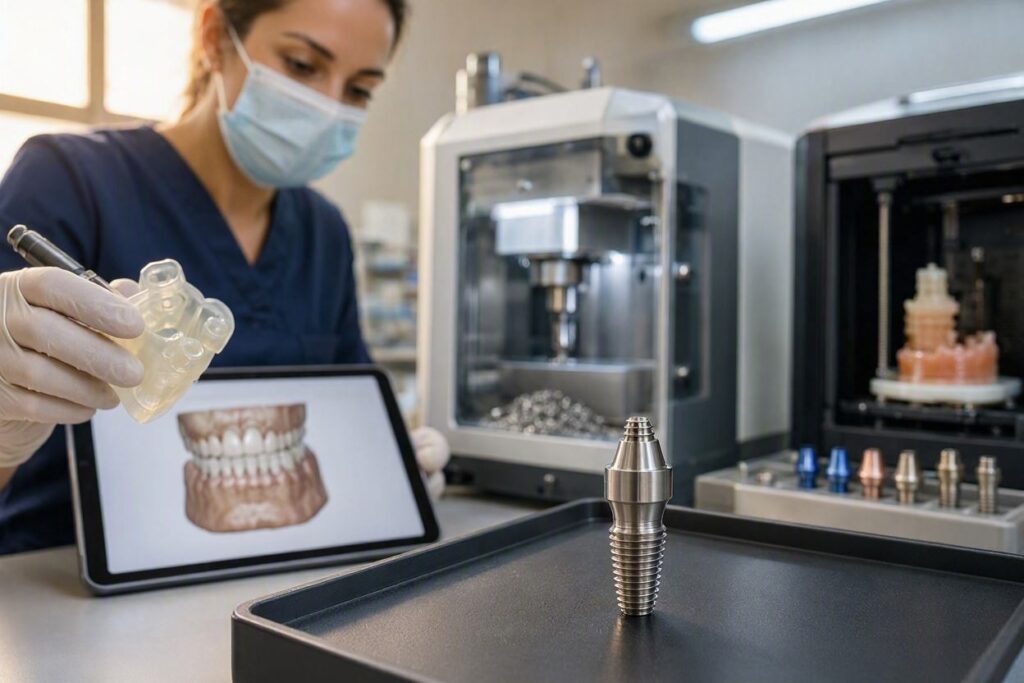
The Implant Fixture: Standardized but Not “One Size Fits All”
Let’s start with the part that goes into the bone.
How It Is Made
Dental implant fixtures are manufactured in factories. They are made to precise engineering standards. Brands like Straumann, Nobel Biocare, and Zimmer produce thousands of identical implants.
Why Standardization?
The design of the implant fixture is based on decades of research. The thread pattern, the surface texture, and the diameter are optimized for osseointegration (bone fusion). The manufacturing process is highly regulated.
How Your Dentist “Chooses” Your Fixture
Even though the fixture is not custom-milled for you, your dentist selects it specifically for you. It is like buying a high-end shoe. The shoe is not custom-made, but you try on different sizes and widths to find the perfect fit.
Factors the dentist considers:
- Diameter: How wide is the space in your bone?
- Length: How deep is the bone?
- Platform: What type of abutment will attach to it?
- Surface: Some surfaces are more aggressive for softer bone.
The Verdict on Fixtures:
The titanium screw is a standardized medical device. It is not “created to order” in the sense of being sculpted from a block of metal for you personally. However, the selection of the right size and type is a critical part of the customization process.
The Abutment: The Bridge Between Standard and Custom
The abutment is the connector that screws into the fixture. It is the foundation for the crown.
Standard (Stock) Abutments
These are pre-fabricated by the manufacturer. They come in various shapes and angles. The dentist can choose the one that best fits the situation.
- Pros: Cheaper and faster.
- Cons: May not fit perfectly. May not match the ideal gum contours.
Custom (CAD/CAM) Abutments
These are milled specifically for you. The dentist scans your mouth, and a machine (or a lab technician) mills the abutment from a block of titanium or zirconia.
- Pros: Perfect fit. Ideal emergence profile (the way the tooth emerges from the gum). Better aesthetics.
- Cons: More expensive. Takes longer.
The Trend:
Custom abutments are becoming the standard of care for front teeth where aesthetics are critical. For back teeth, stock abutments are often sufficient.
The Crown and Bridge: The True “Made to Order” Part
This is where the artistry and customization truly happen. The visible tooth (or teeth) is 100% unique to you.
The Old Way: Lost Wax Casting
For decades, crowns were made using a technique called lost wax casting. The dentist made an impression, poured a plaster model, and a lab technician sculpted the tooth out of wax. The wax was then melted away and replaced with metal or porcelain.
- Time: 2-3 weeks.
- Customization: High, but dependent on the technician’s skill.
The Modern Way: Digital Design and Milling (CAD/CAM)
This is the current state of the art. It represents the ultimate in “created to order” technology.
The Process:
- Scanning: The dentist uses an intraoral scanner to take a digital impression of your mouth. No more goopy trays.
- Design (CAD): The scan is uploaded to software. The dentist or a lab technician digitally designs the crown. They adjust the shape, size, and color to match your adjacent teeth and your bite.
- Milling (CAM): The design is sent to a milling machine. The machine carves the crown from a solid block of ceramic (zirconia or lithium disilicate) or a block of titanium.
- Sintering and Staining: The milled crown is placed in an oven to harden. A ceramist then hand-stains and glazes it to match the exact color and translucency of your natural teeth.
The Result:
A crown that fits your mouth with micron-level precision. It is designed on a computer screen and milled by a machine, but the final touches are applied by a human artist.
The Full Arch Customization (All-on-4/6)
For full mouth restorations, the customization is extensive.
The Framework (The Bar)
A metal bar connects the implants. This bar is custom-milled from titanium to fit the exact angle and position of your implants.
The Teeth and Gums
The teeth are arranged digitally. The dentist will show you a “wax-up” or a 3D preview of what your new smile will look like. You can approve the design before it is fabricated.
The Customization Options:
- Tooth Shape: Square, oval, rounded.
- Tooth Color: From Hollywood white to natural ivory.
- Gum Color: Pink tones can be matched to your skin and natural gums.
- Lip Support: The flange can be adjusted to plump your lips.
The Verdict
Are dental implants created to order?
Partially. The titanium fixture is a standardized, precision-engineered screw. However, everything attached to it—the abutment, the crown, and the bridge—is custom-designed and fabricated specifically for your mouth.
The process has evolved from manual artistry to digital precision. Today, your new tooth is likely designed on a computer and milled by a robot, then hand-finished by a skilled ceramist.
When you pay for a dental implant, you are not just paying for a screw. You are paying for the engineering of the fixture, the skill of the surgeon, and the artistry of the lab that created a tooth that looks, feels, and functions like it belongs to you.
Frequently Asked Questions
Q: How long does it take to make a custom crown?
A: With CAD/CAM technology, it can sometimes be done in a single visit (about 1-2 hours). If sent to a lab, it typically takes 2-3 weeks.
Q: Can I choose the color of my implant crown?
A: Yes. You and the dentist will select a shade together. The goal is usually to match your existing natural teeth. If you are getting a full set, you have more freedom to choose a brighter shade.
Q: What is the difference between a stock abutment and a custom abutment?
A: A stock abutment is pre-made. A custom abutment is milled specifically for your mouth. Custom abutments generally provide a better fit and a more natural gum line.
Q: Are all dental labs the same quality?
A: No. There is a huge variation. Some labs are “high volume” and produce generic-looking crowns. Others are “boutique” labs staffed by master ceramists. The quality of the lab is a major factor in the final appearance of your implant.
Additional Resource:
To understand the technology behind digital dentistry, visit the American College of Prosthodontists: https://www.prosthodontics.org/.

How long do implants last?