How Are Full Mouth Dental Implants Done?
Full mouth dental implants are a transformative solution for people who have lost most or all of their teeth. This comprehensive treatment replaces an entire arch of teeth with fixed, natural-looking restorations supported by dental implants. Understanding the process helps patients know what to expect and prepares them for the journey ahead.
This guide explains the full mouth dental implant procedure step by step. You will learn about the evaluation process, surgical techniques, healing period, and final restoration.
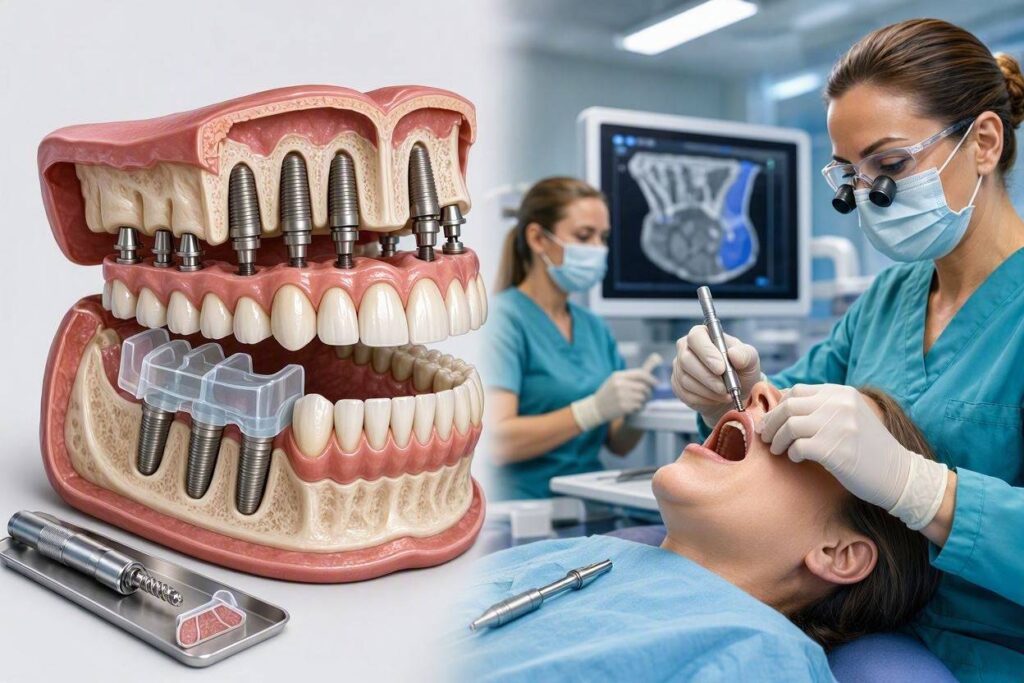
Understanding Full Mouth Dental Implants
Full mouth dental implants replace all the teeth in the upper jaw, lower jaw, or both. Unlike traditional dentures, which rest on the gums and can slip, full mouth implants are anchored securely to dental implants placed in the jawbone.
There are several approaches to full mouth dental implants. The most common are the All-on-4 and All-on-6 techniques, which use four or six implants per arch to support a fixed bridge. Implant-supported overdentures are another option, using implants to stabilize a removable denture.
Step One: Initial Consultation and Evaluation
The journey begins with a comprehensive evaluation. This step is critical for determining whether you are a candidate for full mouth implants and developing a personalized treatment plan.
Medical and Dental History Review
Your dentist reviews your medical history, including any chronic conditions, medications, and previous dental treatments. Certain conditions, like uncontrolled diabetes or autoimmune diseases, can affect healing and implant success.
Clinical Examination
The dentist examines your mouth, assessing the condition of your gums, remaining teeth, and jawbone. They look for signs of infection, bone loss, and other issues that could affect the procedure.
Imaging Studies
Advanced imaging is essential for planning full mouth implants. A cone beam CT scan provides three-dimensional images of your jawbone, showing bone density, nerve locations, and sinus positions. This information guides implant placement and helps avoid complications.
Treatment Planning
Based on the evaluation, your dentist develops a detailed treatment plan. This includes the number of implants, the type of restoration, the need for bone grafting, and the timeline for treatment.
Step Two: Preparatory Procedures
Some patients require preparatory procedures before implant placement. These procedures create a stable foundation for the implants.
Tooth Extractions
If you have remaining teeth that need removal, extractions are performed first. This may be done at the same time as implant placement or as a separate procedure.
Bone Grafting
If your jawbone is too thin or soft to support implants, you may need a bone graft. This procedure adds bone material to the jaw, creating a stronger foundation. Bone grafts take three to six months to heal before implants can be placed.
Sinus Lift
For implants in the upper jaw, a sinus lift may be necessary. This procedure raises the sinus membrane and adds bone to the area. Like other grafts, it requires a healing period before implant placement.
Treatment of Gum Disease
Active gum disease must be treated before implant placement. Infection can interfere with healing and increase the risk of implant failure.
Step Three: Implant Placement Surgery
The implant placement surgery is the core of the full mouth implant procedure. This is typically performed under local anesthesia, IV sedation, or general anesthesia.
Anesthesia Administration
The type of anesthesia depends on the complexity of the case and patient preference. IV sedation is common for full mouth implants because it provides deep relaxation while allowing the patient to remain responsive.
Incision and Flap Creation
The surgeon makes incisions in the gum tissue to expose the jawbone. The gum tissue is gently lifted to create a flap, providing access to the bone.
Implant Site Preparation
Using precise measurements from the treatment plan, the surgeon drills holes into the jawbone at the predetermined locations. Surgical guides created from 3D scans may be used to ensure accuracy.
Implant Placement
The titanium implant posts are carefully inserted into the prepared sites. Each implant is checked for stability. The implants are placed at specific angles to maximize contact with the bone and provide optimal support.
Closure
The gum tissue is closed around the implants with sutures. In some cases, the implants are left exposed above the gum line. In other cases, they are completely covered and allowed to heal beneath the gums.
Step Four: Temporary Restoration
One of the advantages of modern full mouth implant techniques is the ability to place temporary teeth on the same day as surgery.
Immediate Loading
With immediate loading, a temporary bridge or denture is attached to the implants on the day of surgery. This means you leave the office with a full set of teeth, even though they are temporary.
Benefits of Immediate Loading
Immediate loading provides aesthetic and functional benefits. You can eat soft foods and smile with confidence during the healing period. It also helps shape the gum tissue for the final restoration.
Limitations
The temporary restoration is not as strong as the final restoration. You must follow a soft food diet and avoid putting excessive pressure on the implants.
Step Five: Healing and Osseointegration
After implant placement, the healing process begins. This is a critical phase that determines the long-term success of the implants.
Osseointegration
Osseointegration is the process by which the implant fuses with the jawbone. Bone cells grow and attach to the titanium surface, creating a strong bond. This process takes three to six months.
Healing Period
During the healing period, you must follow your dentist’s instructions carefully. This includes maintaining good oral hygiene, avoiding smoking, and following dietary restrictions.
Monitoring
Your dentist monitors the healing process through follow-up visits. X-rays may be taken to check bone integration.
Step Six: Final Restoration
Once osseointegration is complete, the final restoration is fabricated and placed.
Impressions
Your dentist takes impressions or digital scans of your mouth. These are used to create the final bridge or denture.
Try-In Appointment
Before the final restoration is completed, you may have a try-in appointment. The restoration is placed temporarily to check the fit, bite, and aesthetics. Adjustments are made as needed.
Final Placement
The final restoration is attached to the implants. For fixed bridges, the restoration is screwed or cemented onto the implants. For overdentures, attachments are placed that allow the denture to snap onto the implants.
Bite Adjustment
Your dentist checks your bite and makes any necessary adjustments. The restoration should feel comfortable and function properly.
Types of Full Mouth Implant Restorations
There are several types of restorations used in full mouth implant treatment.
Fixed Implant Bridges
A fixed implant bridge is permanently attached to the implants. It cannot be removed by the patient. This is the most natural-feeling option and provides excellent function.
Implant-Supported Overdentures
An overdenture is a removable denture that snaps onto the implants. It is more stable than a traditional denture but can be removed for cleaning.
Hybrid Prostheses
A hybrid prosthesis combines a fixed bridge with a denture-like base. It is fixed to the implants but has a design similar to a denture.
Cost of Full Mouth Dental Implants
Full mouth dental implants are a significant investment. The cost varies depending on the number of implants, the type of restoration, and geographic location.
Average Costs
Full mouth implants typically cost between $25,000 and $60,000 per arch. Both arches together can cost $50,000 to $120,000 or more.
Factors Affecting Cost
The number of implants, the need for bone grafting, the type of restoration, and the experience of the provider all affect the cost.
Insurance and Financing
Dental insurance provides limited coverage for implants. Many practices offer payment plans and financing options.
Important Notes for Patients
- Full mouth dental implants require a significant time commitment, often six to twelve months from start to finish.
- Smoking significantly increases the risk of implant failure. Quitting is strongly recommended.
- Good oral hygiene is essential for long-term success.
- Choose a provider with extensive experience in full mouth implant treatment.
- Ask about the total cost, including all preparatory procedures and restorations.
Frequently Asked Questions
How long does full mouth dental implant treatment take?
The entire process takes six to twelve months. This includes the healing period for osseointegration. Some practices offer same-day temporary teeth.
Is full mouth implant surgery painful?
The surgery is performed under anesthesia, so you should not feel pain. After the procedure, you may experience discomfort for several days, which is manageable with medication.
How many implants are needed for a full mouth?
Most full mouth treatments use four to six implants per arch. The All-on-4 technique uses four implants. The All-on-6 technique uses six implants for additional support.
Can I get full mouth implants if I have bone loss?
Yes, but you may need bone grafting first. Advanced techniques like angled implants can also help in cases of moderate bone loss.
What is the success rate of full mouth implants?
Full mouth implants have a success rate of 95% or higher. With proper care, they can last decades.
Can I eat normally with full mouth implants?
Yes, after the healing period, you can eat a wide variety of foods. Fixed implant bridges provide chewing function similar to natural teeth.
How do I care for full mouth implants?
Brush and floss daily, just like natural teeth. Regular dental visits are essential for monitoring the implants and maintaining oral health.
Are full mouth implants better than dentures?
Full mouth implants offer superior stability, function, and comfort compared to traditional dentures. They also prevent bone loss and preserve facial structure.
Conclusion
Full mouth dental implants are a comprehensive solution for replacing all teeth in one or both arches. The process involves evaluation, preparatory procedures, implant placement surgery, temporary restoration, healing, and final restoration. The treatment takes six to twelve months and costs $25,000 to $60,000 per arch. With proper care, full mouth implants provide a permanent, natural-looking, and functional smile.
Additional Resource
For more information on full mouth dental implants and finding a qualified provider, visit the American Academy of Implant Dentistry at www.aaid.com. This professional organization offers patient education resources and a directory of credentialed implant dentists.