Are Cadaveric Dental Implants?
You are researching dental implants. You come across a strange term: “cadaveric dental implants.” It sounds alarming. It conjures images of doctors taking teeth from deceased donors and screwing them into your jaw. This raises an important question: Are cadaveric dental implants a real thing?
The short answer is no, but there is a grain of truth behind the confusion. Dental implants themselves are never made from cadaver tissue. They are made of titanium or zirconia. However, the bone graft material often used during implant surgery can sometimes come from human donors (cadavers).
This guide will clarify the difference between the implant fixture and the bone graft. We will explain where “cadaveric” materials come from, how they are processed, and what your alternatives are if you are uncomfortable with the idea.
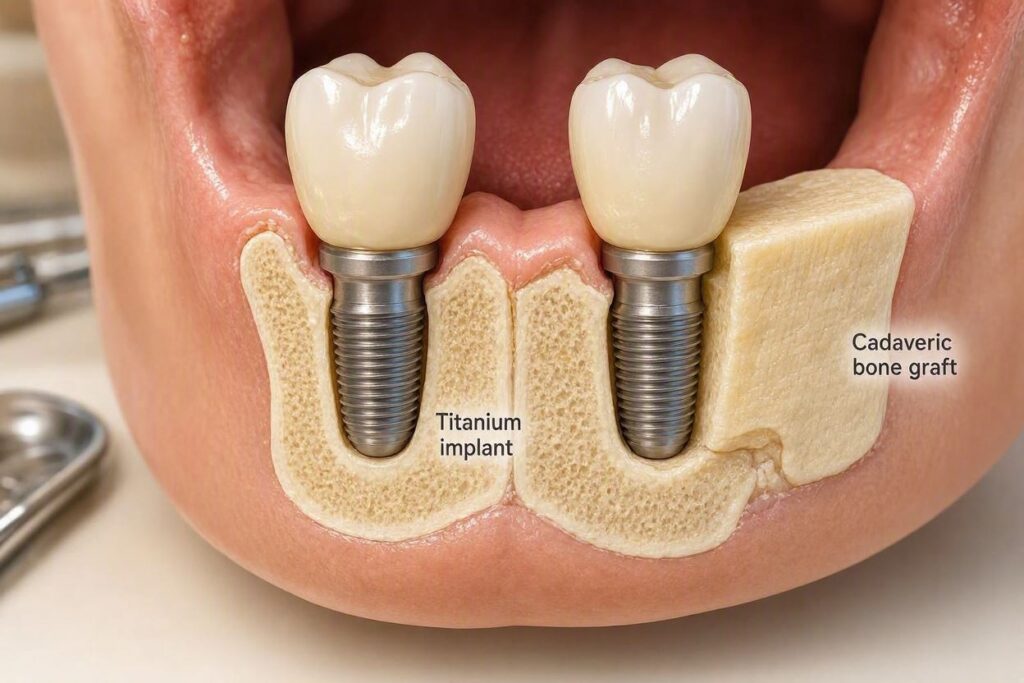
The Confusion: Implants vs. Bone Grafts
The term “cadaveric dental implants” is a misnomer. It mixes up two completely different things.
What Is a Dental Implant?
A dental implant is the titanium or zirconia screw that replaces the tooth root. It is manufactured in a factory. It is sterile. It has never been inside another human body.
- Material: Medical-grade titanium alloy or ceramic.
- Origin: Synthetic. Created from metals and minerals.
What Is a Bone Graft?
A bone graft is a material used to rebuild the jawbone when there is not enough bone to hold the implant. When you lose a tooth, the bone shrinks. The graft acts as a scaffold, encouraging your body to grow new bone.
- Material: This can be synthetic, animal-derived, or human-derived.
- Origin: This is where the “cadaveric” part comes in.
The Key Point:
You will never receive a “cadaver implant.” But you might receive a “cadaver bone graft” to support your implant.
Understanding Human-Derived Bone Grafts (Allografts)
If your dentist says you need a bone graft, they might offer several options. One of them is an allograft.
What Is an Allograft?
An allograft is bone tissue taken from a human donor (a cadaver). It is processed and sterilized to make it safe for implantation.
Where Does It Come From?
The bone comes from accredited tissue banks. These are similar to organ donation programs. When a person dies, they (or their family) may have chosen to donate their tissues for medical use. The bone is harvested, rigorously tested for disease, and processed.
How Is It Processed?
The bone is treated to remove all cellular material and DNA. It is sterilized using radiation or chemical processes. What remains is a mineral scaffold. This scaffold is biocompatible and encourages the patient’s own bone cells to grow into it.
Is It Safe?
Yes. The processing is highly regulated by the FDA and organizations like the American Association of Tissue Banks (AATB). The risk of disease transmission from a processed allograft is astronomically low—estimated at less than one in a million.
The Alternatives to Cadaveric Bone
If you are uncomfortable with the idea of receiving bone from a deceased donor, you have other options. You should discuss these with your dentist.
1. Synthetic Bone Grafts (Alloplasts)
These are made entirely in a laboratory. They contain no human or animal tissue.
- Materials: Calcium phosphate, hydroxyapatite, or bioactive glass.
- Pros: Zero risk of disease transmission. No ethical or religious concerns.
- Cons: They may take slightly longer to integrate with your natural bone.
2. Animal-Derived Bone Grafts (Xenografts)
These come from animals, usually cows (bovine).
- Materials: The mineral portion of cow bone is processed to remove all organic material.
- Pros: Very effective. Readily available.
- Cons: Some patients have ethical or religious objections (e.g., Hindu patients avoiding bovine products).
3. Your Own Bone (Autografts)
This is considered the “gold standard.” The bone is taken from another part of your body, usually the jaw, chin, or hip.
- Pros: It is your own living tissue. It contains growth factors and cells that promote healing. No risk of rejection or disease.
- Cons: Requires a second surgical site. More pain and recovery time.
The “Cadaver Teeth” Myth: Why It Persists
Why do people search for “cadaveric dental implants”? The confusion likely stems from a misunderstanding of the terminology. In some very rare and controversial cases, dentists have used donated human teeth to replace missing teeth (a procedure called tooth transplantation). However, this is not the same as a dental implant.
The Bottom Line:
- Dental Implant (Titanium/Zirconia): Never human. Always synthetic.
- Bone Graft (Allograft): Can be human. Also can be synthetic or animal.
The Verdict
Are cadaveric dental implants real?
No. The titanium or zirconia post that goes into your jaw is a manufactured medical device. It has no biological origin.
However, if you need a bone graft to support your implant, you may be offered an allograft, which is derived from human donor tissue. This is a safe, common, and highly regulated procedure.
If you are not comfortable with this, simply tell your dentist. You can request a synthetic bone graft instead. There is always an alternative.
The key is communication. Ask your dentist exactly what materials they plan to use. You have the right to know what is going into your body and to choose the option that aligns with your personal values.
Frequently Asked Questions
Q: Can I get a disease from a cadaver bone graft?
A: The risk is extremely low. Tissue banks screen donors rigorously for HIV, hepatitis, and other infectious diseases. The bone is also sterilized. The risk is estimated to be less than one in a million.
Q: Does the body reject cadaver bone?
A: No. Allograft bone is processed to remove the cells that would trigger an immune response. It acts as a scaffold, and your body slowly replaces it with your own bone over time.
Q: What is the cost difference between synthetic and cadaver bone grafts?
A: The costs are often similar. Synthetic grafts can sometimes be slightly more expensive, but the difference is usually minor in the context of the total implant cost.
Q: Can I donate my own bone for a graft?
A: Yes. This is called an autograft. The dentist can harvest bone from your lower jaw or chin during the same surgery. This eliminates any risk of disease transmission.
Additional Resource:
For information on tissue donation and safety standards, visit the American Association of Tissue Banks: https://www.aatb.org/.