What Is The Cost Of The Pure Sleep Mouthguard?
Snoring is more than just a nuisance; it disrupts sleep for both the snorer and their partner. In some cases, it is a symptom of a more serious condition called Obstructive Sleep Apnea (OSA), where breathing repeatedly stops and starts during sleep.
For those diagnosed with mild to moderate sleep apnea, or for those who snore heavily without apnea, a dental device can be a lifesaver. One of the most well-known brands in this space is the PureSleep mouthguard.
Unlike custom-fitted devices from a dentist, PureSleep is a direct-to-consumer product. But what is the cost of the Pure Sleep mouthguard? And how does it compare to the cost of a professional dental appliance?
This guide provides a realistic look at the financial side of snoring treatment, comparing the over-the-counter option with professional solutions.
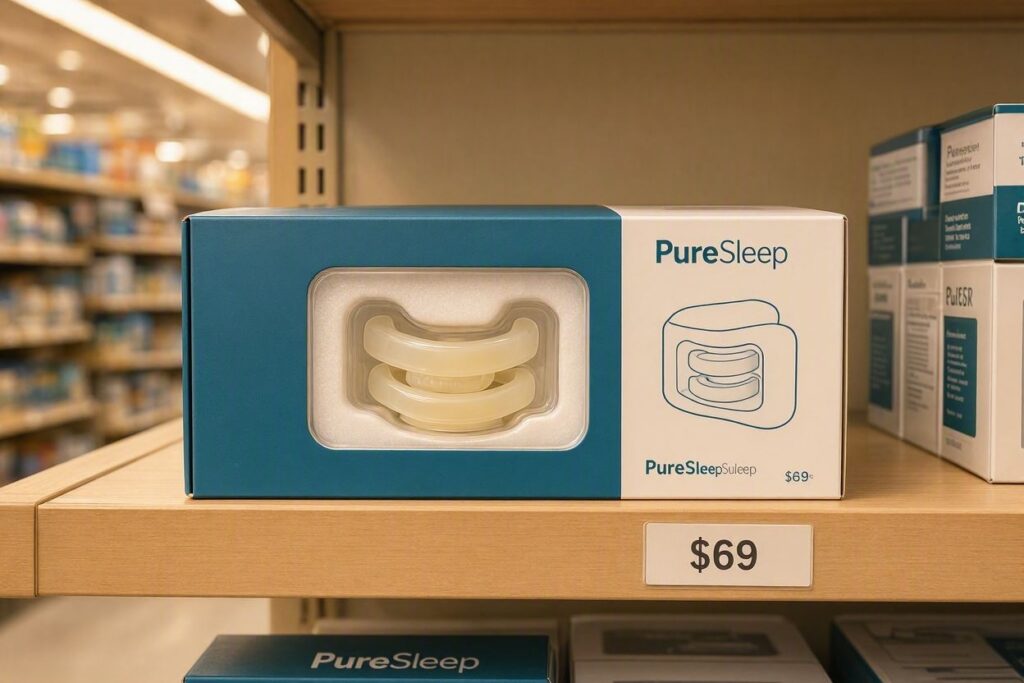
What is the PureSleep Mouthguard?
The PureSleep mouthguard is a Mandibular Advancement Device (MAD). It works by repositioning the lower jaw (mandible) slightly forward during sleep. This forward shift helps open the airway at the back of the throat, reducing the vibration of soft tissues that causes snoring.
The Key Difference:
- Custom-Fitted (from a Dentist): The dentist takes impressions of your teeth and sends them to a lab. The device is crafted to fit your mouth precisely.
- PureSleep (Boil-and-Bite): You buy the device online or at a pharmacy. You heat it in boiling water, place it in your mouth, and bite down to create an impression of your teeth. It is a “semi-custom” fit.
The Cost of the PureSleep Mouthguard
The PureSleep device is marketed as an affordable alternative to a dentist visit.
Current Pricing (2024):
- Retail Price: The official website and retailers like Amazon typically sell the PureSleep mouthguard for $60 to $80 USD.
- What’s in the Box: Usually includes one device, a storage case, and instructions. Some packages include two devices (one for backup).
The “Trial” and Shipping:
- Shipping: Often adds $10-$15.
- Replacement Schedule: The manufacturer recommends replacing the device every 6 to 12 months, depending on wear. This means an ongoing cost of $60-$80 per year.
The Professional Alternative: Dentist-Fitted Oral Appliances
To understand if PureSleep is a good deal, you must compare it to the “gold standard.”
The Cost of a Custom Oral Appliance:
- Consultation and Exam: $100 – $250.
- The Appliance (e.g., SomnoDent, ProSomnus, Silent Nite): $1,800 – $3,500.
- Total: $2,000 – $4,000 USD.
Why is the dentist version so expensive?
- Precision: The device is calibrated to move your jaw forward by exact millimeters. The dentist adjusts the setting to find the sweet spot that stops snoring without causing jaw pain.
- Materials: Medical-grade acrylic or nylon that is durable and resistant to grinding.
- Follow-up: You have multiple appointments to titrate (adjust) the device.
The Insurance Factor:
If you have been diagnosed with Obstructive Sleep Apnea (OSA), your medical health insurance (not dental) might cover a portion of the custom appliance. The PureSleep device is rarely covered because it is not a medical treatment for OSA; it is an over-the-counter aid for snoring.
The Value Comparison: Is PureSleep Worth It?
Here is a realistic breakdown of the pros and cons from a financial perspective.
| Feature | PureSleep (OTC) | Custom Dental Appliance |
|---|---|---|
| Upfront Cost | $60 – $80 | $2,000 – $4,000 |
| Insurance Coverage | Rarely | Often (if diagnosed with OSA) |
| Fit | Boil-and-bite (generic) | Precision fit |
| Adjustability | Limited (you can trim the boil-and-bite, but not micro-adjust) | Micrometer adjustments by the dentist |
| Durability | 6-12 months | 3-5 years |
| Risk of Jaw Pain | Higher (due to poor fit) | Lower (calibrated to your bite) |
| Risk of Tooth Movement | Higher | Lower (fits securely over teeth) |
The Hidden Cost of the Cheaper Option:
While $70 seems like a bargain compared to $3,000, the long-term cost can be higher.
1. Jaw Pain (TMD)
If the PureSleep device forces your jaw into an unnatural position, you might wake up with severe jaw pain, headaches, or clicking in the jaw joint. Treating TMD at a dentist can cost hundreds or thousands of dollars.
2. Tooth Movement
A poorly fitting oral appliance can exert pressure on the teeth, causing them to shift over time. This can ruin your bite and require orthodontics to fix.
3. It Might Not Work
If the device doesn’t fit well, it might fall out at night, or it might not advance the jaw enough to stop the snoring. You might waste $70, plus the cost of trying other OTC remedies.
Quote from a Sleep Dentist: “I see patients who have tried every gadget on Amazon. They bring in their PureSleep and it’s chewed up, warped, and ill-fitting. They are still snoring. By the time they come to me, they’ve spent $200 on gadgets and still need the $3,000 appliance. Sometimes, going straight to the professional is the cheaper route.”
Who is a Good Candidate for PureSleep?
Despite the risks, PureSleep is not inherently bad. It can be a viable “entry-level” test.
Try PureSleep if:
- You snore but have not been diagnosed with sleep apnea.
- You want to see if a MAD (jaw advancement) approach reduces snoring before investing in a custom device.
- You are on a very tight budget.
Do NOT try PureSleep if:
- You have been diagnosed with moderate to severe Obstructive Sleep Apnea. You need a CPAP machine or a custom appliance calibrated by a doctor. Using an ill-fitting device for severe apnea is dangerous.
- You have dentures, loose teeth, or significant jaw joint problems.
- You grind your teeth heavily (bruxism); you will destroy the OTC device quickly.
The CPAP Factor
For severe sleep apnea, the medical standard is a CPAP (Continuous Positive Airway Pressure) machine. This is not a mouthguard, but it is the most common treatment.
The Cost:
- CPAP Machine: $800 – $2,000.
- Mask and Supplies: $200 – $500 per year.
- Insurance: Often covered by medical insurance for diagnosed OSA.
The Comparison:
If you have severe apnea, a mouthguard (PureSleep or custom) is usually not sufficient. You need CPAP.
How to Save Money on Snoring Treatment
If the PureSleep is too cheap to trust and the custom appliance is too expensive, consider these middle-ground options.
1. Online Custom Labs (e.g., SnoreRx, ZQuiet)
There is a category of “online custom” mouthguards that are a step up from PureSleep but cheaper than a dentist.
- How it works: They send you an impression kit. You take a mold of your teeth and mail it back. They make a device based on your mold.
- Cost: $150 – $300.
- Value: Better fit than boil-and-bite, but without the dentist’s clinical diagnosis and adjustment.
2. Dental Schools
If you live near a university with a dental school, they often run “sleep clinics.” You can get a custom appliance made by a resident under supervision.
- Cost: Often 40-50% cheaper than a private specialist.
3. FSA/HSA Funds
If you have a Flexible Spending Account or Health Savings Account, you can use those pre-tax dollars to pay for a custom dental appliance (and sometimes even OTC devices if you have a Letter of Medical Necessity).
FAQ
Q: Does PureSleep cure sleep apnea?
A: No. It is designed to reduce snoring. While it might help mild apnea by moving the jaw, it is not a substitute for a medical diagnosis or a CPAP machine for moderate to severe cases.
Q: How long does the PureSleep mouthguard last?
A: With nightly use, about 6-9 months. If you grind your teeth, it might crack sooner.
Q: Is PureSleep safe?
A: For healthy individuals with good dental health, short-term use is generally safe. However, long-term use without professional supervision can lead to bite changes and jaw pain.
Q: Can I use my dental insurance for PureSleep?
A: Generally, no. Dental insurance covers appliances made by a dentist. Some medical insurers might reimburse you for an OTC device if you have a diagnosis of sleep apnea and a prescription, but this is rare.
Additional Resource
For more information on snoring and treatment options, visit the American Academy of Dental Sleep Medicine: aadsm.org
Conclusion
In summary, the cost of the PureSleep mouthguard is a modest $60 to $80, offering an accessible entry point for snorers. However, its generic fit carries risks of jaw pain and tooth movement, and it often lacks the adjustability of a $2,000+ custom dental appliance. For chronic snorers or those with sleep apnea, investing in professional care may ultimately save money and protect your long-term health.