The Cost Of A Minor Dental Restoration? A Complete Guide To Prices And Options
You are brushing your teeth, and you feel it. A sharp edge. A small hole. Or maybe you are eating something crunchy, and you feel a sudden jolt of pain in one spot. It is not a major emergency, but you know something is wrong. You likely need a minor dental restoration.
The good news is that minor dental restorations are common and relatively affordable. The bad news is that the cost can still catch you off guard if you are not prepared. Prices vary widely depending on what needs to be done, where you live, and whether you have insurance.
This guide will break down the cost of minor dental restorations. We will cover fillings, bonding, and other small repairs. We will look at why prices differ, how insurance helps, and what you can do to keep costs down. By the end, you will have a clear picture of what to expect when you sit in that chair.
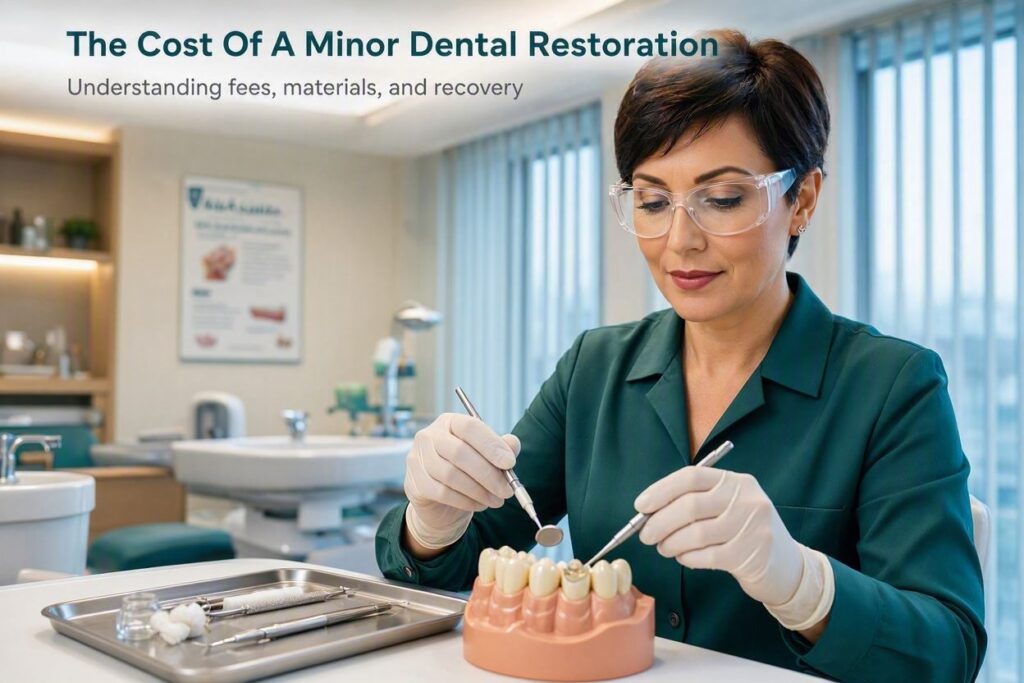
What Counts As A Minor Dental Restoration?
The term “minor dental restoration” covers a range of procedures. The common thread is that they repair small areas of damage without rebuilding the entire tooth. They are usually done in a single visit and do not require a specialist like an oral surgeon.
Here are the most common types of minor restorations.
Dental Fillings
This is the most familiar restoration. A dentist removes decayed tooth material and fills the hole with a material like composite resin, amalgam, or glass ionomer. Fillings treat cavities.
Dental Bonding
Bonding uses a tooth-colored resin to repair small chips, cracks, gaps, or discoloration. The dentist applies the resin, shapes it, and hardens it with a special light. It is a cosmetic and functional repair.
Minor Crown Repair
Sometimes a small piece of an existing crown chips or breaks. A dentist can repair it with composite resin without replacing the entire crown. This is less expensive than a full crown replacement.
Sealants
Sealants are a preventive restoration. They are thin plastic coatings applied to the chewing surfaces of back teeth to protect them from decay. They are most common in children but can be used in adults.
Small Inlay Or Onlay
An inlay or onlay is a custom-made restoration that fits into or over a portion of a tooth. It is more extensive than a filling but less than a full crown. It is sometimes called an “indirect filling.”
Average Costs Of Minor Dental Restorations
Let’s get to the numbers. These are average prices in the United States without insurance. Your actual cost will depend on your location and the dentist you choose.
Table: Average Cost Of Minor Dental Restorations
| Procedure | Average Cost Range (USD) | Typical Time In Chair |
|---|---|---|
| Amalgam Filling (Silver) | $50 – $150 | 20 – 30 minutes |
| Composite Filling (Tooth-Colored) | $90 – $250 | 30 – 45 minutes |
| Dental Bonding (Per Tooth) | $100 – $400 | 30 – 60 minutes |
| Sealant (Per Tooth) | $30 – $75 | 10 – 15 minutes |
| Inlay or Onlay | $250 – $600 | 2 visits |
| Minor Crown Repair | $100 – $300 | 30 – 45 minutes |
Important Note: Prices are higher for back teeth (molars) because they are harder to reach and the filling is larger. Front teeth are usually less expensive.
Why Composite Fillings Cost More Than Amalgam
You may have noticed that silver (amalgam) fillings are cheaper than tooth-colored (composite) fillings. There is a reason for that.
Amalgam Fillings
Amalgam is a mixture of metals, including silver, tin, copper, and mercury. It has been used for over 150 years. It is durable, strong, and relatively cheap to produce. However, it is silver in color, so it is visible. Some people also have concerns about the mercury content, though the American Dental Association considers it safe.
Composite Fillings
Composite resin is a mixture of plastic and glass. It is tooth-colored, so it blends in. It bonds directly to the tooth, which means the dentist does not have to remove as much healthy tooth structure. However, the material is more expensive, and the procedure takes longer because the dentist has to layer and cure the resin.
The Trade-Off: You pay more for composite, but you get a better-looking, more conservative restoration. Many patients find it worth the extra cost.
Factors That Change The Price Of A Minor Restoration
The cost of a filling or bonding is not one-size-fits-all. Several things push the price up or down.
1. The Size Of The Restoration
A small cavity on a front tooth might cost $90. A large cavity on a molar that involves multiple surfaces (called a “multi-surface filling”) can cost $250 or more.
2. The Number Of Surfaces
Dentists bill by the number of surfaces involved. A tooth has five surfaces: mesial, distal, buccal, lingual, and occlusal. A one-surface filling is cheaper than a three-surface filling.
3. The Location Of The Tooth
Back teeth (molars and premolars) are harder to work on. They are further back in the mouth, and the dentist has to maneuver around the tongue and cheeks. This takes more time and skill, so it costs more.
4. The Dentist’s Location
A filling in rural Mississippi might cost $80. The same filling in downtown Chicago could cost $200. Overhead costs like rent, staff salaries, and taxes drive up prices in cities.
5. The Dentist’s Experience
A seasoned dentist with decades of experience may charge more than a new graduate. You are paying for their expertise and efficiency.
6. The Type Of Practice
A boutique dental spa with massage chairs and noise-canceling headphones will charge more than a basic family practice. You are paying for the amenities.
How Insurance Covers Minor Restorations
Dental insurance usually covers minor restorations, but not always at 100%. Most plans classify fillings and bonding as “basic restorative care.”
Here is a typical breakdown.
The Typical Insurance Structure
- Preventive Care (Exams, Cleanings, X-rays): Covered at 100%
- Basic Restorative (Fillings, Bonding): Covered at 70% to 80%
- Major Restorative (Crowns, Bridges, Implants): Covered at 50%
So, if you have a composite filling that costs $200, your insurance might pay $140 to $160. You pay the remaining $40 to $60.
Deductibles And Maximums
Remember that you usually have to meet an annual deductible before insurance pays anything. The deductible is typically $50 to $100. Once met, insurance kicks in.
Also, your plan has an annual maximum benefit, usually $1,000 to $1,500. If you have already used most of that on other treatments, you will pay for the filling out of pocket.
Table: Example Of Insurance Coverage For A Filling
| Amount | |
|---|---|
| Dentist’s Fee | $200 |
| Annual Deductible (Unmet) | $50 |
| Amount Subject To Coverage | $150 |
| Insurance Pays (80%) | $120 |
| You Pay (Deductible + 20%) | $80 |
What If You Don’t Have Insurance?
If you are paying cash, you have options to reduce the cost.
1. Ask For A Cash Discount
Many dentists offer a 5% to 10% discount for payment in full on the day of service. Always ask.
2. Dental Schools
Dental schools offer fillings at a fraction of private practice prices. A composite filling might cost $50 to $80. The trade-off is time. Appointments are longer because students are learning.
3. Community Health Centers
Federally Qualified Health Centers (FQHCs) provide dental care on a sliding scale based on income. If you qualify, a filling could cost as little as $20.
4. Dental Membership Plans
Many private practices offer in-house membership plans. You pay an annual fee (e.g., $300) and get cleanings, exams, X-rays, and a discount on other treatments like fillings.
The Cost Of Not Treating A Minor Restoration
It is tempting to ignore a small cavity or chip to save money. This is a mistake. A minor problem will become a major one.
Let’s look at the progression.
- Stage 1: Small Cavity
- Treatment: Composite Filling
- Cost: $150
- Stage 2: Cavity Reaches The Nerve
- Treatment: Root Canal + Crown
- Cost: $1,500 – $2,500
- Stage 3: Tooth Cannot Be Saved
- Treatment: Extraction + Implant
- Cost: $3,000 – $5,000
The Lesson: Spending $150 now saves you thousands later. A minor restoration is an investment in avoiding pain and expense.
Frequently Asked Questions
Q: How long does a composite filling last?
A: A composite filling lasts an average of 5 to 7 years. With good oral hygiene, it can last 10 years or more. Amalgam fillings last 10 to 15 years.
Q: Does getting a filling hurt?
A: The dentist numbs the area with local anesthetic before starting. You will feel pressure but not pain. After the numbness wears off, you may have mild sensitivity for a few days.
Q: Can I eat after a filling?
A: If you had a composite filling, you can eat as soon as the numbness wears off. If you had an amalgam filling, you should wait 24 hours before chewing on that side because the metal needs time to fully set.
Q: What is the difference between bonding and a filling?
A: A filling treats decay (a cavity). Bonding repairs chips, cracks, or gaps. The materials are similar, but the purpose is different.
Q: Will my insurance cover a filling if I already had one on the same tooth?
A: Insurance companies usually pay for one filling per tooth surface every few years. If you need a replacement filling too soon, they may deny the claim. Your dentist may need to send a narrative explaining why the replacement is necessary.
Q: Are silver fillings safe?
A: The FDA and ADA consider amalgam fillings safe for adults and children over six. Some people are allergic to mercury or prefer to avoid it for personal reasons. In those cases, composite is the alternative.
Conclusion
The cost of a minor dental restoration is manageable for most people, especially when compared to the cost of ignoring the problem. A simple filling or bonding procedure usually costs between $90 and $400. Insurance often covers 70% to 80% of that cost. If you do not have insurance, options like dental schools and cash discounts can help. The most important thing is to act early. A small restoration today prevents a major, painful, and expensive problem tomorrow.
Additional Resources
For more information on dental restorations and materials, visit the American Dental Association (ADA) at ada.org. They offer patient resources on fillings, bonding, and other common procedures.