Are Dental Implants Covered by Medicare?
Medicare and Dental Implants
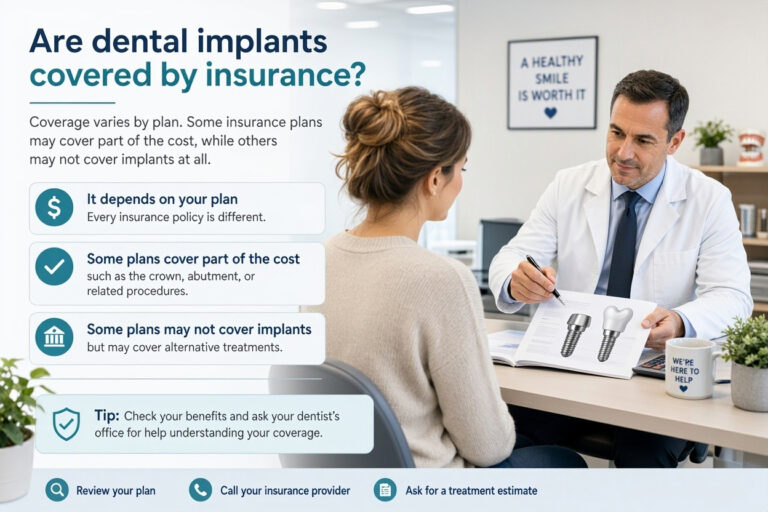
Medicare covers a lot—doctor visits, hospital stays, prescriptions. But dental care? That’s a different story. Many beneficiaries are surprised to learn that Medicare offers limited dental coverage, and implants are rarely included.
This article explains Medicare’s dental coverage, what it means for implant patients, and what options exist for affording implants under Medicare.
Medicare Basics
What Is Medicare?
Medicare is federal health insurance for people 65 and older and certain younger people with disabilities. It has several parts:
Part A (Hospital Insurance)
Covers hospital stays, skilled nursing facility care, hospice, and some home health care.
Part B (Medical Insurance)
Covers doctor visits, outpatient care, preventive services, and some medical equipment.
Part C (Medicare Advantage)
Private insurance plans that provide Part A and B benefits, often with extra coverage (like dental).
Part D (Prescription Drug Coverage)
Covers prescription medications.
Does Medicare Cover Dental?
Original Medicare (Parts A and B):
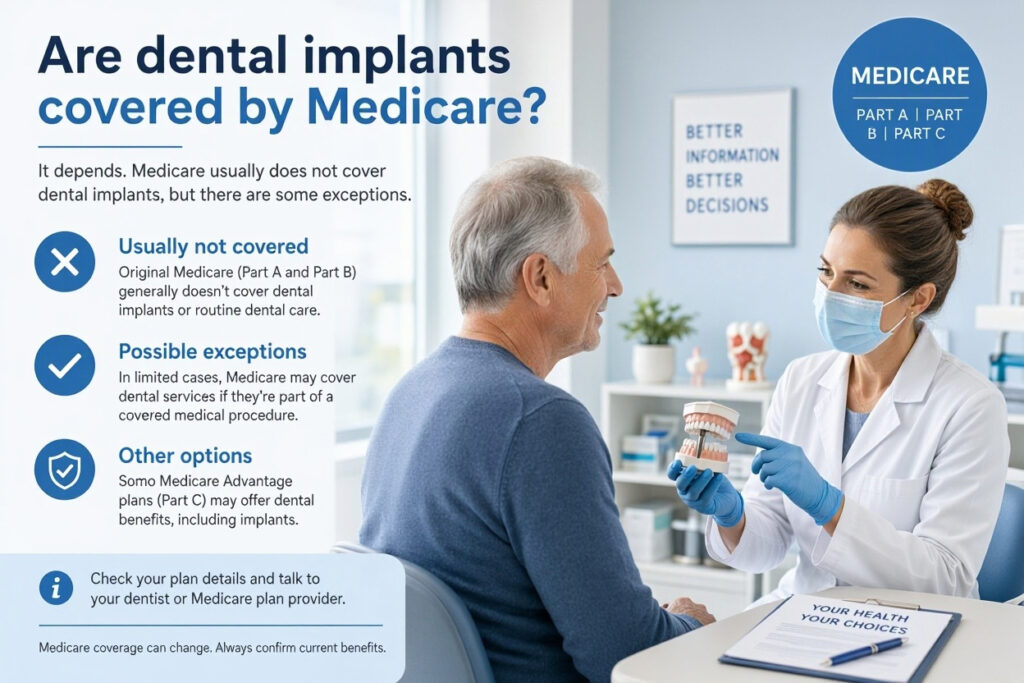
Generally, no. Original Medicare doesn’t cover routine dental care, dentures, or dental implants. There are rare exceptions for certain medically necessary procedures.
Medicare Advantage (Part C):
Many Medicare Advantage plans offer dental coverage as an extra benefit. Coverage varies by plan.
“Medicare’s exclusion of dental care is a significant gap. Many beneficiaries don’t realize until they need dental work that they’re on their own.” — Medicare advocate
Original Medicare and Dental Implants
The General Rule
Original Medicare (Parts A and B) does not cover dental implants in most cases. Dental care is largely excluded from Medicare coverage.
Rare Exceptions
Medically Necessary Procedures
If an implant is deemed medically necessary due to an accident or injury, Medicare may cover related costs. For example, if you’re hospitalized after a facial injury and implants are part of reconstructive surgery, some costs may be covered.
Hospital-Based Procedures
If implant surgery occurs in a hospital setting and is deemed medically necessary, Part A might cover hospital costs. However, the implant itself and dentist fees are typically not covered.
Certain Medical Conditions
In rare cases, implants may be covered if related to a covered medical condition (e.g., treatment of a jaw tumor). These are exceptions, not the rule.
What’s Not Covered
- Routine dental exams and cleanings
- Fillings, crowns, bridges
- Dentures and partials
- Dental implants for tooth replacement
- Extractions (unless medically necessary)
Important Note: Don’t assume Medicare will cover your implants. Check with Medicare directly and get pre-authorization if you believe your case qualifies for an exception.
Medicare Advantage and Dental Coverage
A Different Story
Medicare Advantage (Part C) plans are offered by private insurers. Many include dental coverage as an extra benefit. Coverage varies dramatically by plan and insurer.
What Medicare Advantage Plans Might Cover
Preventive Dental
Cleanings, exams, X-rays—often covered at 100%.
Basic Dental
Fillings, extractions—covered at a percentage.
Major Dental
Crowns, bridges, dentures—sometimes covered, but often with annual maximums.
Dental Implants
Rarely covered. When covered, typically limited to a small portion up to an annual maximum.
What to Check
If you have Medicare Advantage, review your plan’s dental benefits:
- Does it cover implants?
- What’s the annual maximum?
- Are there waiting periods?
- Which dentists are in-network?
- What’s the pre-authorization process?
Table: Medicare Coverage for Implants
| Medicare Type | Implant Coverage | Notes |
|---|---|---|
| Original Medicare (A & B) | Rarely (exceptions only) | Dental generally excluded |
| Medicare Advantage (C) | Sometimes (varies) | Check plan details |
| Medigap (Supplemental) | No | Doesn’t add dental coverage |
| Part D (Prescriptions) | No | Doesn’t cover dental procedures |
Medicare Advantage Dental Plans: What to Expect
Typical Coverage Levels
Low-Coverage Plans:
- Preventive care only
- No major procedures
- Annual maximum: $0-$500
Mid-Coverage Plans:
- Preventive and basic care
- Limited major coverage
- Annual maximum: $1,000-$2,000
High-Coverage Plans:
- Comprehensive dental care
- Some implant coverage
- Annual maximum: $2,000-$5,000
The Annual Maximum Problem
Even with Medicare Advantage dental coverage, annual maximums limit what’s paid. Since implants cost $3,000-$6,000, a $1,000-$2,000 maximum covers only a fraction.
Waiting Periods
Many Medicare Advantage plans have waiting periods for major procedures (6-12 months). You must be enrolled for a period before implants are covered.
“Medicare Advantage dental coverage sounds good on paper, but annual maximums make implants largely out-of-pocket. Read the fine print.” — Insurance counselor
Alternatives for Affording Implants Under Medicare
If Medicare Doesn’t Cover Implants
Dental Schools
Dental schools offer reduced-cost implants with supervised student treatment. Costs can be 30-50% less than private practice.
Community Health Centers
Some community health centers offer sliding-scale dental services based on income.
Payment Plans
Many dental offices offer in-house financing. Ask about terms.
Third-Party Financing
Companies like CareCredit offer healthcare financing with various terms.
State Assistance Programs
Some states offer dental assistance for low-income seniors. Check your state’s programs.
Medicaid
If you qualify for both Medicare and Medicaid (dual eligible), check Medicaid dental coverage in your state. Some states cover implants for specific cases.
HSAs (If Applicable)
If you have an HSA-eligible plan (some Medicare Advantage plans qualify), you can use HSA funds for implants.
Clinical Trials
Dental schools sometimes conduct implant studies. Participants may receive reduced-cost or free treatment.
Table: Funding Alternatives
| Option | How It Helps | Best For |
|---|---|---|
| Dental schools | Reduced-cost treatment | Budget-conscious patients |
| Community health centers | Sliding-scale fees | Low-income patients |
| Payment plans | Spread costs over time | Patients who can pay monthly |
| Third-party financing | Loans for healthcare | Larger amounts |
| State programs | Assistance for seniors | Low-income seniors |
| Medicaid (dual eligible) | May cover some dental | Dual-eligible patients |
What About Medigap?
Medigap Doesn’t Cover Dental
Medigap (Medicare Supplemental Insurance) helps with out-of-pocket costs for Medicare-covered services. It does not add dental coverage.
If you want dental coverage, you need a separate dental insurance policy or a Medicare Advantage plan with dental benefits.
Standalone Dental Insurance
You can purchase standalone dental insurance to supplement Medicare. These plans vary in cost and coverage. Implants are often excluded or limited.
Shopping Tips:
- Compare annual maximums
- Check implant coverage
- Review waiting periods
- Verify provider networks
State-Specific Programs
Where to Look
Some states offer dental assistance programs for seniors:
State Pharmaceutical Assistance Programs (SPAPs)
Some SPAPs include dental benefits.
State Dental Associations
Many offer resources for low-cost dental care.
Area Agencies on Aging
Local agencies can connect you with dental resources.
211 Service
Dial 211 to connect with local health and human services.
Research Your State
Check with your state’s department of health or aging services for specific programs. Resources vary widely by location.
Note: Don’t assume you’re out of options. Research local resources—you may find assistance you didn’t know existed.
Planning Ahead for Implants
If You’re on Medicare and Need Implants
Review Your Coverage
Check your Medicare Advantage plan’s dental benefits. Call and ask specifically about implants.
Get Pre-Authorization
If implants might be covered, get pre-authorization before treatment.
Explore All Funding Options
Dental schools, payment plans, financing—exhaust all possibilities.
Consider Timing
If you have an annual maximum, timing treatment across calendar years maximizes benefits.
Ask About Discounts
Some dentists offer senior discounts or cash-pay discounts.
Consider Dental Tourism
Some patients travel to countries with lower dental costs. (Research carefully—quality varies.)
The Reality Check
Medicare coverage for implants is minimal. Most patients pay out-of-pocket. Plan accordingly.
Real Patient Experiences
Frank’s Story
“I was shocked to learn Medicare doesn’t cover implants. I assumed it would. I ended up going to a dental school for treatment—saved about 40%. It took longer, but the work was good.”
Helen’s Story
“My Medicare Advantage plan covers cleanings, but not implants. I needed two implants and paid out-of-pocket. I used a payment plan to spread the cost. It wasn’t easy, but I’m glad I did it.”
George’s Story
“I’m a veteran, so I checked VA benefits. They covered my implants because my tooth loss was service-related. If you’re a vet, check your VA benefits.”
Dorothy’s Story
“I couldn’t afford implants on my fixed income. I got a bridge instead. It’s not perfect, but it works. I wish Medicare covered dental—it’s a real gap.”
The Future of Medicare Dental Coverage
Advocacy and Change
There’s ongoing advocacy to add dental coverage to Medicare. Some legislative proposals aim to expand Medicare benefits to include dental care. However, change is slow.
Current Status:
As of now, Original Medicare doesn’t cover routine dental care. Medicare Advantage plans may offer dental benefits, but coverage varies.
What You Can Do:
- Contact your representatives to advocate for Medicare dental coverage
- Join advocacy organizations
- Stay informed about legislative changes
“Medicare dental coverage is a pressing issue for millions of seniors. Advocacy efforts continue, but for now, patients must navigate limited options.” — Senior advocacy group
Frequently Asked Questions
Does Medicare cover dental implants?
Original Medicare generally does not cover dental implants. Medicare Advantage plans may offer limited coverage, but annual maximums are low. Check your specific plan.
Is there any way Medicare covers implants?
In rare cases, if implants are medically necessary due to an accident, injury, or specific medical condition, Medicare might cover some related costs. These are exceptions, not the rule.
Does Medicare Advantage cover implants?
Some Medicare Advantage plans offer dental benefits, but implant coverage is rare and limited. Check your plan’s details carefully.
What if I can’t afford implants without Medicare coverage?
Explore dental schools, payment plans, third-party financing, community health centers, and state assistance programs. Don’t give up—options exist.
Can I buy separate dental insurance?
Yes. Standalone dental insurance is available, but implant coverage is often limited or excluded. Compare plans carefully.
Does Medicaid cover implants for seniors?
Medicaid dental coverage varies by state. Some states offer limited dental benefits for dual-eligible patients. Check your state’s program.
Are there grants for dental implants?
Rarely. Some organizations offer dental assistance grants, but they’re limited. Research local resources and nonprofit organizations.
Can veterans get implants through VA benefits?
Yes, if tooth loss is service-related. VA dental benefits cover implants in qualifying cases. Check with your VA office.
Does Medigap cover dental implants?
No. Medigap (Medicare Supplemental Insurance) doesn’t cover dental care. You need separate dental coverage.
How can I afford implants on a fixed income?
Dental schools, payment plans, community health centers, and state programs can help. Explore all options and ask your dentist about discounts or financing.
Conclusion
Medicare offers minimal coverage for dental implants. Original Medicare excludes most dental care, and Medicare Advantage plans offer limited benefits with low annual maximums. Patients typically pay out-of-pocket.
In summary: Medicare generally does not cover dental implants, with Original Medicare excluding most dental care and Medicare Advantage plans offering limited coverage that rarely includes implants. Patients must explore alternative funding options including dental schools, payment plans, third-party financing, community health centers, and state assistance programs. Veterans may qualify for VA dental benefits if tooth loss is service-related. Planning ahead and researching all options helps make implants accessible despite Medicare’s limitations.
Additional Resource
For Medicare coverage information, visit the official Medicare website at www.medicare.gov.