Are Dental Implants Covered by Insurance?
Dental implants are expensive. When you’re facing a $3,000-$6,000 bill per tooth, insurance coverage becomes a critical question. Will your plan help? How much will you pay out of pocket?
The answer is complicated. Dental insurance varies widely, and implant coverage is often limited or excluded. This article breaks down the insurance landscape, helping you understand what to expect and how to maximize your benefits.
How Dental Insurance Works
The Basics
Dental insurance typically operates on a yearly maximum benefit—usually $1,000-$2,000. This is the most your plan pays per year, regardless of procedure costs.
Key Terms:
- Annual Maximum: The cap on what your insurance pays yearly
- Deductible: What you pay before insurance kicks in
- Coinsurance: The percentage you pay after deductible
- Waiting Period: Time before certain procedures are covered
- Pre-authorization: Approval required before treatment
Typical Coverage Categories
Preventive Care (cleanings, exams, X-rays)
- Covered at 80-100%
- Usually no deductible
- No waiting period
Basic Restorative (fillings, extractions)
- Covered at 70-80%
- After deductible
- May have waiting periods
Major Restorative (crowns, bridges, implants)
- Covered at 50% or less
- After deductible
- Often has waiting periods (6-12 months)
- May have annual maximum limitations
“Dental insurance is designed to cover routine care, not major procedures. Implants often exceed annual maximums, leaving patients with significant out-of-pocket costs.” — Dental insurance specialist
Does Dental Insurance Cover Implants?
The Short Answer
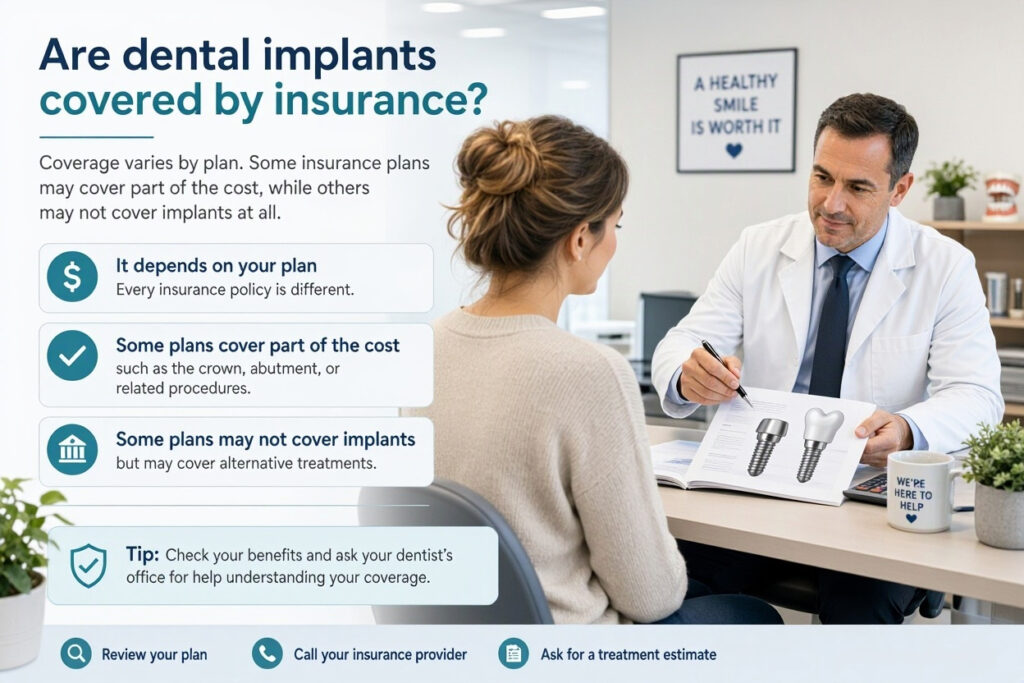
Sometimes, but often with limitations. Coverage varies dramatically by plan.
When Implants Are Covered
Medically Necessary Cases
If implants are deemed medically necessary (not just cosmetic), some plans cover a portion.
Implant-Supported Dentures
Some plans cover implant-supported dentures as an alternative to traditional dentures.
Accident or Injury
If tooth loss results from an accident, some plans cover implants as restorative treatment.
Specific Plan Provisions
Some plans explicitly include implant coverage, typically at 50% with annual maximum limitations.
When Implants Are Excluded
Cosmetic Exclusion
Many plans classify implants as cosmetic and exclude them entirely.
Alternative Coverage Only
Some plans cover the cost of a bridge or denture (the “alternative” treatment) but not the higher cost of implants. You’d pay the difference.
Annual Maximum Limitations
Even when covered, annual maximums ($1,000-$2,000) fall far short of implant costs.
Waiting Periods
Many plans require 6-12 months before covering major procedures, including implants.
Table: Typical Insurance Coverage for Implants
| Scenario | Coverage Likely? | Notes |
|---|---|---|
| Cosmetic replacement | Rarely | Often excluded |
| Medically necessary | Sometimes | Requires documentation |
| Accident-related | Often | May cover as restorative |
| Implant-supported dentures | Sometimes | Considered alternative to dentures |
| Full implant restoration | Rarely | Exceeds annual maximums |
Important Note: Always get pre-authorization before implant treatment. This confirms what your insurance will pay and prevents surprises.
Types of Dental Insurance Plans
DHMO (Dental Health Maintenance Organization)
How It Works:
You choose an in-network dentist. Services are provided at set copays.
Implant Coverage:
- Rarely covered
- If covered, limited to specific dentists
- May offer discounted rates
Pros: Lower premiums, predictable costs
Cons: Limited provider network, minimal implant coverage
DPPO (Dental Preferred Provider Organization)
How It Works:
You can see any dentist, but in-network dentists offer lower costs.
Implant Coverage:
- Varies widely by plan
- Often covers 50% up to annual maximum
- May have waiting periods
Pros: Flexibility, broader coverage
Cons: Higher premiums, annual maximums limit major procedures
Indemnity Plans
How It Works:
Traditional fee-for-service plans. You see any dentist, and the plan reimburses a portion.
Implant Coverage:
- More likely to cover implants than DHMO plans
- Typically 50% coverage
- Annual maximums still apply
Pros: Maximum flexibility
Cons: Higher premiums, still limited by annual maximums
Table: Plan Types and Implant Coverage
| Plan Type | Implant Coverage | Provider Flexibility | Premium Cost |
|---|---|---|---|
| DHMO | Rarely | Limited network | Low |
| DPPO | Sometimes (50%) | Moderate | Moderate |
| Indemnity | More likely (50%) | Full | High |
Maximizing Your Insurance Benefits
Before Treatment
Get Pre-Authorization
Submit a pre-treatment estimate to your insurance. They’ll tell you what they’ll pay before you commit.
Review Your Plan
Read your policy carefully. Look for:
- Annual maximum
- Deductible
- Waiting periods
- Implant exclusions
- Alternative treatment clauses
Ask About Alternative Coverage
Some plans cover the cost of a bridge or denture (the “alternative”) even if they don’t cover implants. You’d pay the difference.
Time Your Treatment
If you need multiple implants, consider spreading them across calendar years. This maximizes annual maximums.
Use Flexible Spending Accounts (FSAs)
FSAs let you set aside pre-tax dollars for medical expenses. Implants often qualify.
Use Health Savings Accounts (HSAs)
If you have an HSA-eligible high-deductible health plan, HSA funds can cover implants.
During Treatment
Submit Claims Promptly
Don’t delay claim submission. Insurance companies have deadlines.
Keep Documentation
Maintain records of all procedures, X-rays, and payments. You may need them for appeals.
Ask About In-Network Discounts
Even if implants aren’t covered, in-network dentists may offer discounted rates.
Negotiate Payment Plans
Many dental offices offer interest-free or low-interest payment plans.
After Treatment
Appeal Denials
If your claim is denied, appeal. Provide documentation of medical necessity. Sometimes denials are reversed.
Check for Reimbursement
If you paid out-of-pocket, submit receipts. Some plans reimburse a portion even if not pre-authorized.
Coordinate Benefits
If you have multiple insurance plans (e.g., through a spouse), coordinate benefits to maximize coverage.
“Don’t assume your insurance won’t cover implants. Read your policy, ask questions, and appeal denials. Sometimes persistence pays off.” — Dental office manager, 15 years experience
What If Insurance Doesn’t Cover Implants?
Alternative Funding Options
Payment Plans
Most dental offices offer in-house financing. Ask about terms and interest rates.
Third-Party Lenders
Companies like CareCredit offer healthcare financing with various terms, including interest-free periods.
Dental Schools
Dental schools offer reduced-cost implants with supervised student treatment. Costs can be 30-50% less.
Clinical Trials
Some dental schools and research institutions conduct implant studies. Participants may receive reduced-cost or free treatment.
Health Savings Accounts (HSAs)
If you have an HSA-eligible health plan, you can use pre-tax dollars for implants.
Flexible Spending Accounts (FSAs)
FSAs let you set aside pre-tax dollars for medical expenses, including implants.
Medical Insurance
In rare cases, medical insurance may cover implants if deemed medically necessary (e.g., after facial trauma). Check with your medical plan.
Negotiate with Your Dentist
Some dentists offer discounts for cash payment or multiple implants. Ask.
Table: Funding Options
| Option | How It Works | Best For |
|---|---|---|
| Payment plans | Monthly payments to dentist | Patients who can pay over time |
| Third-party lenders | Healthcare financing | Larger amounts, longer terms |
| Dental schools | Reduced-cost supervised treatment | Budget-conscious patients |
| HSAs/FSAs | Pre-tax dollars | Patients with these accounts |
| Medical insurance | May cover trauma-related cases | Accident/injury cases |
| Cash discounts | Dentist offers reduced rate | Patients who can pay upfront |
Insurance Coverage by State
Why Location Matters
Insurance regulations vary by state. Some states mandate implant coverage in certain circumstances. Others don’t.
States with Mandates:
A few states require dental insurance plans to cover implants when medically necessary. Check your state’s regulations.
State-Specific Programs:
Some states offer assistance programs for low-income patients needing dental care, including implants. Research local resources.
Medicaid:
Medicaid coverage for dental implants varies dramatically by state. Most states offer limited or no adult dental coverage. Some cover implants for specific cases.
Note: Check with your state’s insurance department or dental association for specific coverage requirements in your area.
Understanding Your Explanation of Benefits (EOB)
Reading the Fine Print
After treatment, you’ll receive an Explanation of Benefits from your insurance. This document shows:
- What was charged
- What insurance paid
- What you owe
- Why certain amounts were denied
Review Carefully:
Check for errors. Insurance companies make mistakes. If something looks wrong, call and ask.
Appeal if Needed:
If your claim was denied, you have the right to appeal. Follow the instructions on your EOB.
Frequently Asked Questions
Do dental implants get covered by insurance?
Sometimes, but coverage varies widely. Many plans exclude implants as cosmetic or limit coverage to 50% with annual maximums. Get pre-authorization to know for sure.
How much will insurance pay for implants?
Typically, 50% of the cost up to your annual maximum ($1,000-$2,000). Since implants cost $3,000-$6,000, insurance covers a small portion or none at all.
Can I use my HSA or FSA for dental implants?
Yes. Dental implants qualify as medical expenses for HSA and FSA funds. Use pre-tax dollars to save money.
What if my insurance denies my implant claim?
Appeal the denial. Provide documentation of medical necessity. Sometimes denials are reversed. Also ask about alternative coverage (bridge or denture cost).
Are there dental insurance plans that cover implants?
Some plans explicitly include implant coverage. Shop around during open enrollment. Look for plans with higher annual maximums and implant provisions.
Does Medicaid cover dental implants?
Rarely. Medicaid dental coverage varies by state, and most states offer limited or no adult dental coverage. Check your state’s Medicaid program.
Can I get implants if I don’t have insurance?
Yes. Many patients pay out-of-pocket. Explore payment plans, third-party financing, dental schools, and HSA/FSA funds.
Is it worth getting dental insurance just for implants?
Probably not. Annual maximums are too low to cover implant costs. However, insurance helps with routine care and may cover a portion of implant-related procedures.
Do I need pre-authorization for implants?
Yes, always get pre-authorization. This confirms what insurance will pay before you commit to treatment.
Can I switch dentists if my insurance doesn’t cover my current one?
Yes. Choose an in-network dentist to maximize benefits. Ask your insurance for a list of covered providers.
Conclusion
Dental insurance coverage for implants is limited and varies widely. Many plans exclude implants entirely or cover only a portion up to annual maximums. Understanding your plan, getting pre-authorization, and exploring funding options helps you manage costs.
In summary: Dental implants are sometimes covered by insurance, but coverage is often limited to 50% up to annual maximums, with many plans excluding implants entirely as cosmetic. Patients can maximize benefits through pre-authorization, timing treatment across calendar years, using HSA/FSA funds, and exploring payment plans, dental schools, and third-party financing. Always review your policy carefully and appeal denials—persistence sometimes pays off.
Additional Resource
Check your state’s insurance regulations at the National Association of Dental Plans at www.nadp.org.