Are Dental Implants Better Than Bridges?
Implants vs. Bridges: Which Wins?
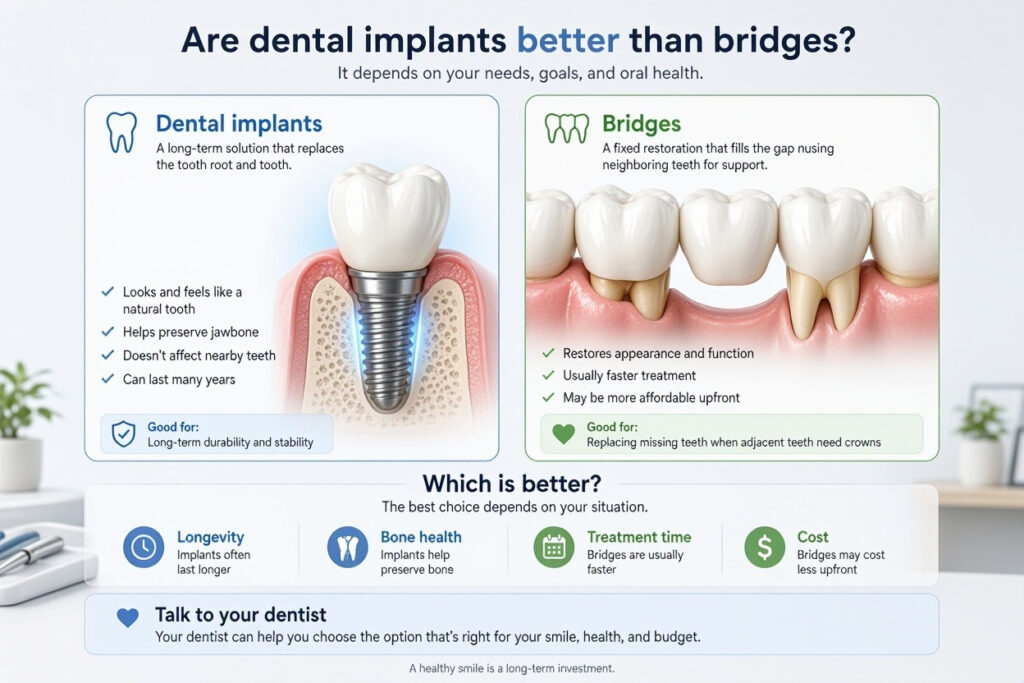
When you lose a tooth, two popular replacement options stand out: dental implants and bridges. Both restore your smile and chewing function, but they work very differently. Implants replace the tooth root and crown. Bridges replace the crown only, anchoring to adjacent teeth.
Which is better? The answer depends on your specific situation. This article compares implants and bridges across every important factor, helping you make the right choice for your smile.
Understanding the Options
What Is a Dental Bridge?
A bridge is a fixed dental restoration that replaces one or more missing teeth. It consists of:
Pontic (Artificial Tooth)
The replacement tooth that fills the gap.
Abutments (Supporting Teeth)
The adjacent teeth on either side of the gap. These teeth are prepared (ground down) to support the bridge.
Crowns (Caps)
The abutment teeth are capped with crowns, which hold the pontic in place.
How Bridges Work:
A traditional bridge is cemented permanently. It relies on adjacent teeth for support. The bridge doesn’t replace the tooth root—it only replaces the visible crown.
What Are Dental Implants?
Implants are titanium posts surgically placed in the jawbone. They replace the tooth root and support a crown. Implants don’t rely on adjacent teeth—they’re self-supporting.
How Implants Work:
The implant integrates with bone through osseointegration. It then supports a crown, bridge, or denture. Implants replace the entire tooth structure—root and crown.
The Fundamental Difference
The key difference is root replacement. Bridges replace the crown only, relying on adjacent teeth for support. Implants replace the root, providing independent support. This distinction drives all the differences in outcomes.
Head-to-Head Comparison
Impact on Adjacent Teeth
Bridges:
Bridges require grinding down healthy adjacent teeth to support the bridge. This irreversible procedure weakens those teeth and increases their risk of decay, root canals, and eventual loss.
Implants:
Implants don’t affect adjacent teeth at all. They stand alone, preserving the health of neighboring teeth.
Winner: Implants
Bone Preservation
Bridges:
Bridges don’t stimulate bone. Without a root, the jawbone in the gap area shrinks over time. This bone loss can cause the bridge to fail and complicates future dental work.
Implants:
Implants stimulate bone through chewing forces, just like natural tooth roots. This prevents bone loss and preserves jaw structure.
Winner: Implants
Longevity
Bridges:
Bridges last 10-15 years on average. Some last longer, but most need replacement eventually. The supporting teeth may fail first, requiring a new bridge or implants.
Implants:
Implants last 25 years or longer—often a lifetime. The crown may need replacement after 10-15 years, but the implant remains stable.
Winner: Implants
Success Rate
Bridges:
Bridges have a 10-year success rate of about 85-90%. Failures occur due to decay in supporting teeth, gum disease, or bridge fracture.
Implants:
Implants have a 10-year success rate of 95-97%. Failure is uncommon, usually due to peri-implantitis or failed osseointegration.
Winner: Implants
Appearance
Bridges:
Modern bridges look natural, but the pontic may appear slightly bulky. The gum line can look less natural because there’s no root underneath.
Implants:
Implants look completely natural. The crown matches your teeth, and the gum line looks realistic because the implant stimulates bone and tissue.
Winner: Implants
Comfort
Bridges:
Bridges are cemented in place and don’t move. However, they can feel bulky, and food can get trapped underneath. Sensitivity in supporting teeth is common.
Implants:
Implants feel like natural teeth. No bulky feeling, no food trapping (when properly fitted), no sensitivity (no nerve).
Winner: Implants
Chewing Function
Bridges:
Bridges restore about 70-80% of natural chewing function. Hard foods may be challenging.
Implants:
Implants restore nearly 100% of natural chewing function. You can eat anything.
Winner: Implants
Cost
Bridges:
Bridges cost $2,000-$5,000 for a three-unit bridge. Lower upfront cost than implants.
Implants:
Implants cost $3,000-$6,000 per tooth. Higher upfront cost.
Winner: Bridges (upfront)
Cost Over Time
Bridges:
- Initial cost: $3,000
- Replacement after 12 years: $3,500
- Replacement after 24 years: $4,000
- Root canal on supporting tooth: $1,500
- 30-year total: $12,000
Implants:
- Initial cost: $4,500
- Crown replacement after 15 years: $1,500
- 30-year total: $6,000
Winner: Implants (long-term)
Treatment Time
Bridges:
Bridges can be completed in 2-3 appointments over 2-3 weeks. No surgery required.
Implants:
Implants take 3-9 months from surgery to final crown. Requires surgery and healing time.
Winner: Bridges
Surgery Required
Bridges:
No surgery. Non-invasive (except for tooth preparation).
Implants:
Requires surgery. Healing time and risks involved.
Winner: Bridges
Table: Complete Comparison
| Feature | Bridges | Implants | Winner |
|---|---|---|---|
| Adjacent tooth impact | Damages teeth | None | Implants |
| Bone preservation | No | Yes | Implants |
| Longevity | 10-15 years | 25+ years | Implants |
| Success rate | 85-90% | 95-97% | Implants |
| Appearance | Good | Excellent | Implants |
| Comfort | Good | Excellent | Implants |
| Chewing function | 70-80% | ~100% | Implants |
| Upfront cost | Lower | Higher | Bridges |
| Long-term cost | Higher | Lower | Implants |
| Treatment time | 2-3 weeks | 3-9 months | Bridges |
| Surgery | None | Required | Bridges |
“For single tooth replacement, implants are almost always the better choice. They preserve adjacent teeth and bone. Bridges have their place, but implants are the gold standard.” — Dr. Emily Roberts, Implant Dentist
When Bridges Make Sense
Bridges Might Be Better If…
You Need a Fast Solution
Bridges can be completed in weeks. Implants take months.
You Want to Avoid Surgery
Bridges don’t require surgery. If surgery is risky for you, bridges are safer.
Adjacent Teeth Already Need Crowns
If the teeth next to your gap already need crowns, a bridge makes sense. You’re not damaging healthy teeth—you’re restoring teeth that need restoration anyway.
You Have Insufficient Bone
Without adequate bone for implants, bridges may be your only fixed option. (Though bone grafting can sometimes help.)
Budget Is Very Tight
Bridges cost less upfront. If implants are out of reach financially, bridges restore function and appearance.
The Bridge Advantage
Bridges are a proven, reliable option. They’ve helped patients for decades. When used appropriately—especially when adjacent teeth need crowns anyway—they deliver good outcomes.
When Implants Are the Clear Winner
Implants Are Better If…
You Have a Single Missing Tooth
Implants preserve adjacent healthy teeth. Bridges require grinding them down.
You Want a Permanent Solution
Implants last decades. Bridges need replacement every 10-15 years.
You Want to Preserve Bone
Implants prevent bone loss. Bridges don’t.
You Want Natural Function
Implants restore nearly full chewing function. Bridges restore 70-80%.
You’re a Good Surgical Candidate
With good health and sufficient bone, implants offer superior outcomes.
You Want to Protect Adjacent Teeth
Implants don’t affect neighboring teeth. Bridges damage them.
The Implant Advantage
Implants represent the gold standard in tooth replacement. They offer unmatched longevity, bone preservation, and natural function. For most patients with single tooth loss, they’re the best investment.
Real Patient Experiences
Lisa’s Story
“I had a bridge for 12 years. It worked fine at first, but then one of the supporting teeth developed decay. I needed a root canal, and eventually the whole bridge failed. I wish I’d gotten an implant from the start. Now I have an implant that feels like a real tooth.”
David’s Story
“I needed a tooth replaced quickly before a job interview. A bridge was faster and cheaper. It’s worked well for five years. I know implants last longer, but the bridge was right for my situation at the time.”
Karen’s Story
“My dentist recommended a bridge because the teeth on either side of my gap needed crowns anyway. It made sense—why grind down healthy teeth when these teeth needed work? The bridge has been great.”
Tom’s Story
“I got an implant after losing a molar. It was more expensive upfront, but I wanted to protect my other teeth. Five years later, I forget I even have it. Best dental decision I’ve made.”
Making Your Decision
Questions to Ask Yourself
- Do the adjacent teeth need crowns anyway?
- Can I afford the upfront cost of implants?
- Am I a good candidate for surgery?
- How important is preserving adjacent teeth to me?
- What’s my timeline—do I need a quick fix?
Questions to Ask Your Dentist
- Am I a candidate for implants?
- What are the pros and cons of each option for my situation?
- What’s the total cost, including maintenance over time?
- How long will each option last?
- What are the risks of each option?
The Bottom Line
Implants are generally better than bridges for single tooth replacement—they preserve adjacent teeth, prevent bone loss, and last longer. But bridges remain a valid option for patients who can’t have surgery, need a quick solution, or have adjacent teeth that need crowns anyway.
Discuss both options with your dentist to make an informed decision based on your unique situation.
Frequently Asked Questions
Are implants always better than bridges?
Not always. Implants are superior for longevity, bone preservation, and protecting adjacent teeth. But bridges are better for patients who can’t have surgery, need a quick solution, or have adjacent teeth that need crowns.
Can a bridge be replaced with an implant later?
Yes. Many patients transition from bridges to implants. Your dentist assesses bone health and plans treatment. Bone grafting may be needed if bone has shrunk from bridge use.
Do bridges damage adjacent teeth?
Bridges require grinding down adjacent teeth, which is irreversible. This increases their risk of decay, root canals, and eventual loss. Implants don’t affect adjacent teeth.
How long do bridges last compared to implants?
Bridges last 10-15 years on average. Implants last 25 years or longer—often a lifetime.
Are bridges cheaper than implants?
Upfront, yes. Bridges cost $2,000-$5,000 for a three-unit bridge. Implants cost $3,000-$6,000 per tooth. Long-term, implants are usually more cost-effective.
Can I eat normally with a bridge?
Bridges restore about 70-80% of chewing function. Hard foods may be challenging. Implants restore nearly 100% of function.
Do bridges cause bone loss?
Yes. Bridges don’t stimulate bone, so the jaw shrinks over time in the gap area. Implants prevent this bone loss.
Which option is more comfortable?
Implants feel more like natural teeth. Bridges can feel bulky and may trap food. Sensitivity in supporting teeth is common with bridges.
Can I get an implant if I have a bridge?
Yes, but the bridge must be removed first. Your dentist assesses bone health and places the implant. A new crown or bridge is then made.
What if I can’t afford either option?
Discuss all options with your dentist. Some dental schools offer reduced-cost services. Financing and payment plans can help. Don’t sacrifice your oral health—explore all possibilities.
Conclusion
Dental implants outperform bridges in most categories—longevity, bone preservation, adjacent tooth protection, and natural function. But bridges remain a valuable option for patients who can’t have surgery, need a quick solution, or have adjacent teeth needing crowns.
In summary: Dental implants are generally better than bridges because they preserve adjacent teeth, prevent bone loss, last decades longer, and restore nearly full chewing function. However, bridges are a valid choice for patients who need a fast, non-surgical solution, have adjacent teeth requiring crowns, or face financial or health barriers to implants. Discuss both options with your dentist to determine the best choice for your unique situation.
Additional Resource
Learn about tooth replacement options at the American Dental Association at www.mouthhealthy.org.