A Complete Set Of Dental Implants?
You have lost most or all of your teeth. You are tired of dentures. You want a permanent solution. You have heard about getting “a complete set of dental implants.” But what does that actually mean?
The term “complete set” sounds simple, but the reality is more complex. It does not mean getting one implant for every missing tooth. That would be incredibly expensive and often impossible due to bone limitations.
A complete set of dental implants refers to a full arch restoration. It means replacing all the teeth on your top jaw, bottom jaw, or both, using a strategic number of implants to support a fixed bridge.
This guide will explain the different options for full mouth restoration, the number of implants required, the cost considerations, and what to expect from the procedure.
The Concept: Strategic Placement vs. One-for-One Replacement
Let’s clear up the biggest misconception first. You do not need 14 implants to replace 14 teeth in an arch (jaw).
Why Not?
- Cost: 14 implants per arch would cost a fortune (potentially $100,000+).
- Bone Availability: There is rarely enough bone in the jaw to place that many implants safely.
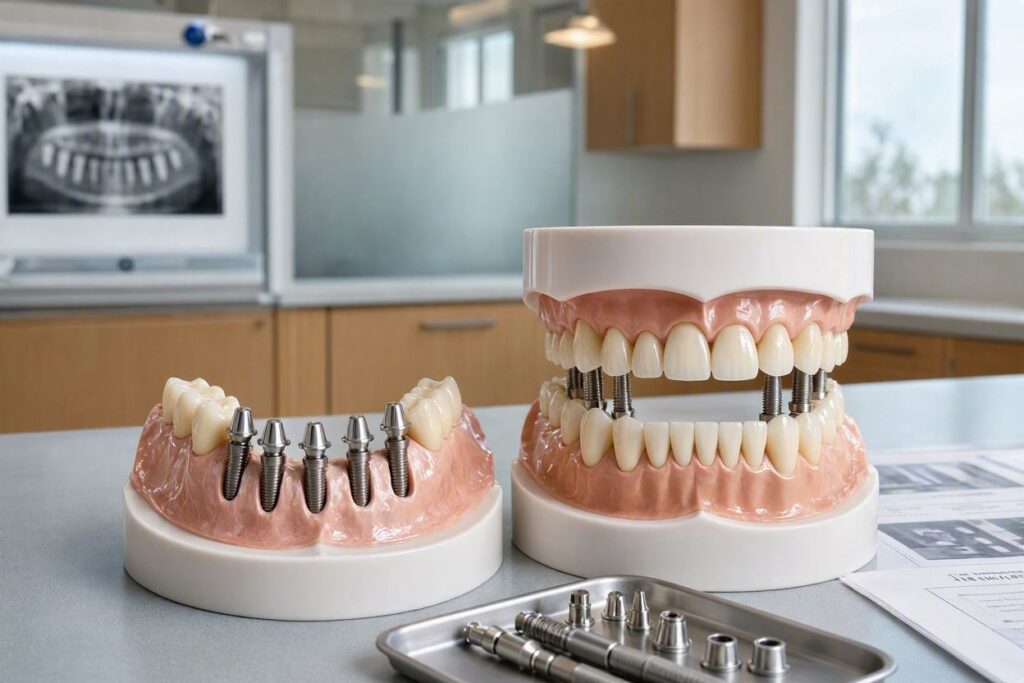
- Biomechanics: Modern implant dentistry relies on the principle of strategic support. A few well-placed implants can support a full bridge of teeth, much like the pillars of a bridge support the roadway.
The “All-on-4” and “All-on-6” Concepts
These are the most common protocols for a complete set of implants.
- All-on-4: Four implants are placed in the jaw. Two are placed vertically in the front, and two are placed at an angle in the back (to avoid the sinus in the upper jaw and the nerve in the lower jaw).
- All-on-6: Six implants are used. This provides more support and is often recommended for the upper jaw, which has softer bone.
The Result:
These 4 to 6 implants support a fixed, screw-retained bridge containing 12 to 14 teeth. The bridge does not come out. It feels and functions like natural teeth.
The Two Main Types of Complete Sets
There is a critical distinction between “removable” and “fixed” when it comes to full mouth implants.
Option 1: The Fixed Bridge (Permanent Teeth)
This is the “gold standard.” The bridge is screwed onto the implants. It can only be removed by a dentist.
Pros:
- Maximum stability.
- Feels most like natural teeth.
- No palate coverage (you can taste your food).
- No movement or clicking.
Cons:
- Highest cost.
- Requires meticulous cleaning underneath the bridge.
- If a tooth chips, the whole bridge may need repair.
Option 2: The Implant-Retained Overdenture (Snap-On)
This is a removable denture that snaps onto implants.
Pros:
- Lower cost than a fixed bridge.
- Easier to clean (you can take it out to brush).
- More stable than a traditional denture.
Cons:
- It still covers the palate (for upper arch).
- It may still move slightly when chewing.
- You must remove it at night to clean it.
Which is right for you?
The fixed bridge is best for patients who want the ultimate in comfort and function. The overdenture is a good compromise for patients who want better stability but cannot afford a fixed bridge.
The Cost of a Complete Set
This is the big one. A complete set of dental implants is a significant financial investment.
Average Costs (Per Arch):
- Snap-On Overdenture (2-4 implants): $8,000 – $20,000.
- Fixed Bridge (All-on-4): $20,000 – $35,000.
- Fixed Bridge (All-on-6 with Zirconia teeth): $30,000 – $50,000.
Full Mouth (Both Arches):
You are looking at a range of $40,000 to $80,000 or more for a top-tier fixed restoration.
What does this price include?
- The surgical placement of the implants.
- The anesthesia or sedation.
- The temporary bridge.
- The final bridge (the teeth).
- The follow-up visits for the first year.
What might be extra?
- Extractions (removing existing teeth).
- Bone grafts or sinus lifts.
- Sedation (if you choose IV sedation over local anesthesia).
- Night guards (to protect the bridge from grinding).
The Timeline for a Complete Set
Getting a complete set of implants is a journey. It is not a one-day event, despite the marketing.
Phase 1: The Surgical Day
- Remaining teeth are extracted.
- Implants are placed.
- A temporary bridge is attached (if immediate loading is used).
Phase 2: Healing (3-6 Months)
- The bone fuses to the implants.
- You follow a soft food diet.
- The temporary bridge is checked and adjusted.
Phase 3: The Final Bridge (Month 4-6)
- Impressions are taken.
- The final bridge is fabricated in a lab.
- The temporary bridge is removed.
- The final bridge is screwed into place.
Phase 4: Maintenance (Lifelong)
- Regular dental visits.
- Cleaning under the bridge with a water flosser.
- Potential replacement of the bridge after 10-15 years.
The Verdict: Is a Complete Set Right for You?
A complete set of dental implants is a life-changing procedure. It restores function, aesthetics, and confidence.
You are a good candidate if:
- You have lost most or all of your teeth.
- You have adequate bone volume (or are willing to get bone grafts).
- You are committed to excellent oral hygiene.
- You can afford the investment.
You may not be a good candidate if:
- You are a heavy smoker.
- You have uncontrolled diabetes.
- You are unable to clean your mouth properly.
- You are looking for a “cheap” fix.
If you are considering this treatment, do your research. Interview multiple dentists. Ask to see before-and-after photos of their actual cases. Ask about the materials they use. Get a written treatment plan with all costs itemized.
A complete set of implants is not a scam. It is a sophisticated medical procedure that requires skill and high-quality materials. If it sounds too good to be true—if a clinic is offering a “complete set” for $5,000—run away. You get what you pay for.
Frequently Asked Questions
Q: How many implants do I need for a full set of teeth?
A: Typically 4 to 6 implants per arch. The exact number depends on your bone density and the type of restoration (fixed vs. snap-on).
Q: Can I get a complete set on just the bottom?
A: Yes. Many patients choose to do the lower arch first because lower dentures are notoriously unstable. The upper arch can often be managed with a traditional denture or done later.
Q: What are the teeth made of?
A: The two main materials are acrylic (plastic) and zirconia. Acrylic is cheaper but more prone to wear and staining. Zirconia is much stronger, more natural-looking, and lasts longer, but it costs more.
Q: Will I be without teeth at any point?
A: Usually not. In the “Teeth in a Day” protocol, you leave the office with a temporary bridge. If immediate loading is not possible, you may wear a temporary denture during the healing phase.
Additional Resource:
For information on prosthodontic care and full mouth rehabilitation, visit the American College of Prosthodontists: https://www.prosthodontics.org/.