Is A Dental Implant Covered In Braces?
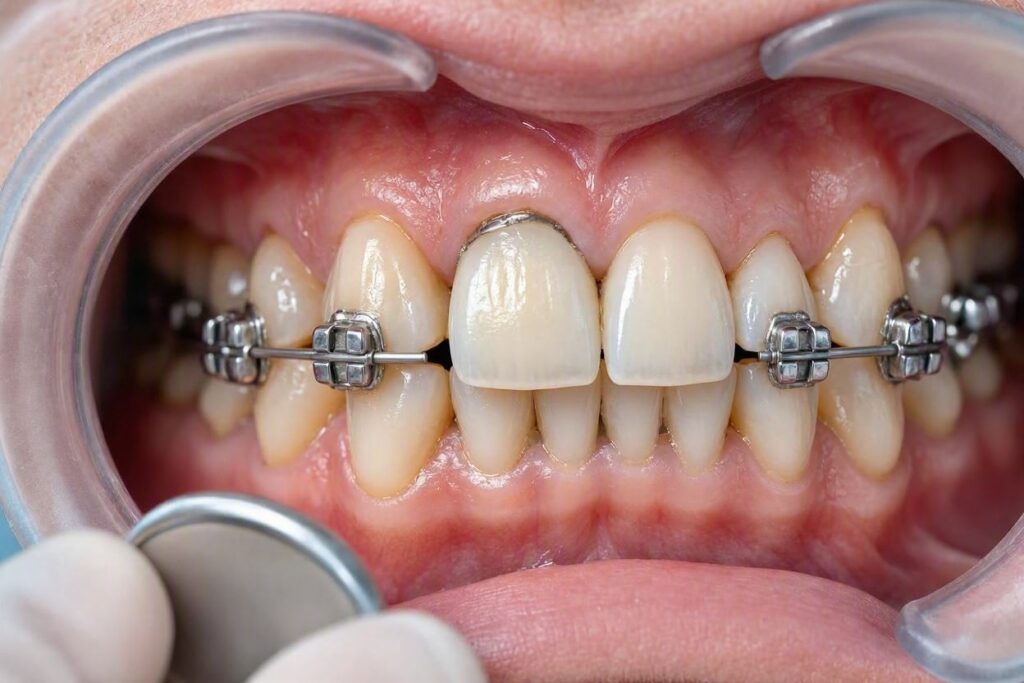
You are considering straightening your teeth. You have braces or are planning to get them. But you also have a missing tooth, or you already have a dental implant. The question arises: Is a dental implant covered in braces?
The answer is nuanced. The term “covered” can mean two different things in this context. It can mean “covered by insurance,” or it can mean “physically covered by the braces hardware.”
Let’s address both interpretations.
First, regarding insurance: No, a dental implant is not covered by orthodontic insurance. They are separate categories of treatment. Orthodontic insurance covers braces, aligners, and retainers. Dental implants fall under prosthodontic or surgical coverage.
Second, regarding the physical hardware: No, braces cannot move a dental implant. The brackets and wires of braces are attached to natural teeth. A dental implant is fused to the bone and cannot be shifted like a natural tooth.
This guide will explore the complex relationship between orthodontics and implants. We will explain why the order of treatment matters and how to plan for both.
The Fundamental Difference: Movement vs. Stability
To understand why implants and braces interact the way they do, you must understand the biology.
How Braces Work on Natural Teeth
Natural teeth are held in the jawbone by a ligament (the periodontal ligament). This ligament is like a hammock. When braces apply pressure to a tooth, the ligament stretches on one side and compresses on the other. This triggers the body to dissolve bone on the compressed side and build new bone on the stretched side. The tooth moves.
How Implants Behave
A dental implant has no ligament. It is fused directly to the bone (osseointegration). It is rigid. It is essentially part of your skeleton.
The Critical Point:
If you try to move an implant with braces, the bone will not remodel. The implant will not move. Instead, you will either:
- Break the braces hardware.
- Cause damage to the bone around the implant.
- Cause the implant to fail.
The Rule of Thumb:
Dental implants are anchors. They do not move. If you need to move your teeth, you must do it before placing the implant, or you must design the braces to work around the implant.
The Correct Sequence: Orthodontics First, Implants Second
In almost all cases, the recommended treatment sequence is: Braces first, then implants.
Why This Order?
- Space Management: If you have a missing tooth, the neighboring teeth often drift into the gap. Braces are used to “open up” the space. They push the adjacent teeth back to their correct positions, creating the perfect-sized hole for the future implant.
- Bite Alignment: Braces correct the bite. Once the bite is straight, the dentist knows exactly where the implant should go to function properly.
- Avoiding Interference: If you place an implant first, the braces wire might press against it, or the brackets might pop off. The implant becomes a stubborn obstacle.
The “Temporary Tooth” During Braces:
If you are undergoing orthodontic treatment and have a missing tooth, you do not have to walk around with a gap. Options include:
- A temporary flipper: A removable single-tooth denture.
- A Maryland Bridge: A temporary wing of plastic or porcelain attached to the back of the adjacent tooth.
- A space maintainer: A simple wire that holds the space open.
These temporary solutions maintain your appearance while the braces do their work.
When the Implant Is Already There
What if you already have a dental implant and now you want braces? Is this possible?
Yes, it is possible, but it requires a specialist.
How It Works
The orthodontist will use the implant as an “anchor.” They will attach the braces wire to the implant (or a special abutment on the implant) to use it as a stable point of resistance. The natural teeth will move, but the implant will stay put.
The Challenges:
- Bracket Attachment: You cannot glue a standard bracket to a porcelain implant crown easily. It may require a special surface treatment or a band that wraps around the tooth.
- Finite Anchorage: The implant is rigid. This is actually a benefit. It allows the orthodontist to move specific teeth without affecting others.
The Risk:
If too much force is applied to the implant, the bone around it can be stressed. A skilled orthodontist will monitor this closely.
The Insurance Reality: What Is Covered?
Let’s be clear about the financial side.
- Braces Insurance: Covers a portion of the orthodontic treatment (usually 50% up to a lifetime maximum).
- Implant Insurance: Covers a portion of the implant surgery and crown (if your medical or dental plan includes it).
The Gap:
These are two distinct line items on your insurance plan. Getting braces does not mean your implant is free. They are billed separately.
The “Pre-Approval” Process:
If you are getting braces and you know you will need an implant later, you should file a pre-treatment estimate for the implant as soon as possible. This locks in the coverage (if any) before your plan changes.
The Timeline: A Case Study
Let’s look at a typical patient journey to see how this works in practice.
Patient: A 25-year-old with crooked teeth and a missing lower molar.
Phase 1: Consultation (Month 1)
The orthodontist and the implant dentist meet. They agree on a plan. The orthodontist will move the teeth first. The implant will be placed later.
Phase 2: Braces (Months 1-18)
The braces are placed. The orthodontist opens the space where the molar was. The bite is corrected.
Phase 3: Implant Surgery (Month 19)
The braces are removed. The implant is placed. A temporary crown or flipper is worn.
Phase 4: Healing (Months 19-22)
The bone heals around the implant.
Phase 5: Final Crown (Month 23)
The permanent crown is placed.
Total Time: Nearly 2 years. This is a marathon, not a sprint.
The Verdict
Is a dental implant covered in braces?
Physically, no. A dental implant is a fixed anchor that braces cannot move. Financially, no. They are billed as separate procedures.
The key is coordination. You must find a dentist who works well with an orthodontist. They must plan the treatment together. If you skip the planning and just get an implant randomly, you might find yourself unable to get the braces you want later.
The smart sequence is: Straighten first, then replace. Straighten your teeth, create the ideal space, and then place the implant in the perfect position.
If you follow this rule, you can enjoy the benefits of both a straight smile and a permanent replacement for your missing tooth.
Frequently Asked Questions
Q: Can Invisalign be used if I have a dental implant?
A: Yes, often. Invisalign (clear aligners) can work around an implant. However, the aligner must be designed to account for the fact that the implant will not move. The implant acts as an anchor.
Q: Will my dental insurance pay for braces and an implant at the same time?
A: They are separate claims. However, if you are actively in braces and need an implant, the timing might coincide. Your insurance will process the claims separately based on your plan limits.
Q: Can a dental implant be used to close a gap instead of braces?
A: Sometimes. If the gap is small, an implant is a great way to fill it. However, if the surrounding teeth are also crooked, an implant alone will not fix the alignment. You need braces for that.
Q: What if I get braces and then decide I do not want the implant?
A: You have options. The orthodontist might close the space by moving the adjacent teeth together, or you can choose a dental bridge. You are not locked into an implant just because you had braces.
Additional Resource:
For information on orthodontic treatment and coordination with other dental specialists, visit the American Association of Orthodontists: https://www.aaoinfo.org/.