Are Veneers Done In One Day?
The fantasy is irresistible: walk into a dental office in the morning with chipped, stained, or gapped teeth, and walk out that same afternoon with a flawless, camera-ready smile. No temporaries. No second numbing appointment. No weeks of waiting with plastic nubs while a distant lab technician sculpts your porcelain. This is the promise of “same-day veneers,” a term that has become a powerful marketing engine for dental practices across the country. Patients searching “Are veneers done in one day?” are often hoping the answer is a clean, unqualified yes. The reality is a conditional, technology-dependent, and clinically limited maybe.
Yes, a specific type of veneer can be fabricated, bonded, and polished in a single appointment lasting a few hours. But—and this is the critical distinction—this only applies to a narrow category of restorations milled from solid ceramic blocks using in-office CAD/CAM systems like CEREC. It does not apply to the meticulously layered, hand-crafted porcelain veneers that represent the cosmetic gold standard. Understanding the difference between a same-day monolithic veneer and a traditional layered veneer is the key to not making a permanent, irreversible aesthetic mistake in pursuit of instant gratification. This article dissects the technology that makes one-day dentistry possible, the material limitations that dictate the result, the clinical cases that are appropriate for the rapid workflow, and the artistic compromises that are silently made when a machine replaces a master ceramist.
The Technology Enabling Same-Day Veneers: CEREC and CAD/CAM
The “one-day” claim is almost exclusively powered by a specific piece of hardware: the in-office CAD/CAM milling unit. The dominant brand is CEREC, an acronym for Chairside Economical Restoration of Esthetic Ceramics, developed in the 1980s and now in its fifth generation of refinement. Competitor systems include Planmeca’s PlanCAD and E4D. Regardless of the brand, the workflow is conceptually identical and profoundly transformative.
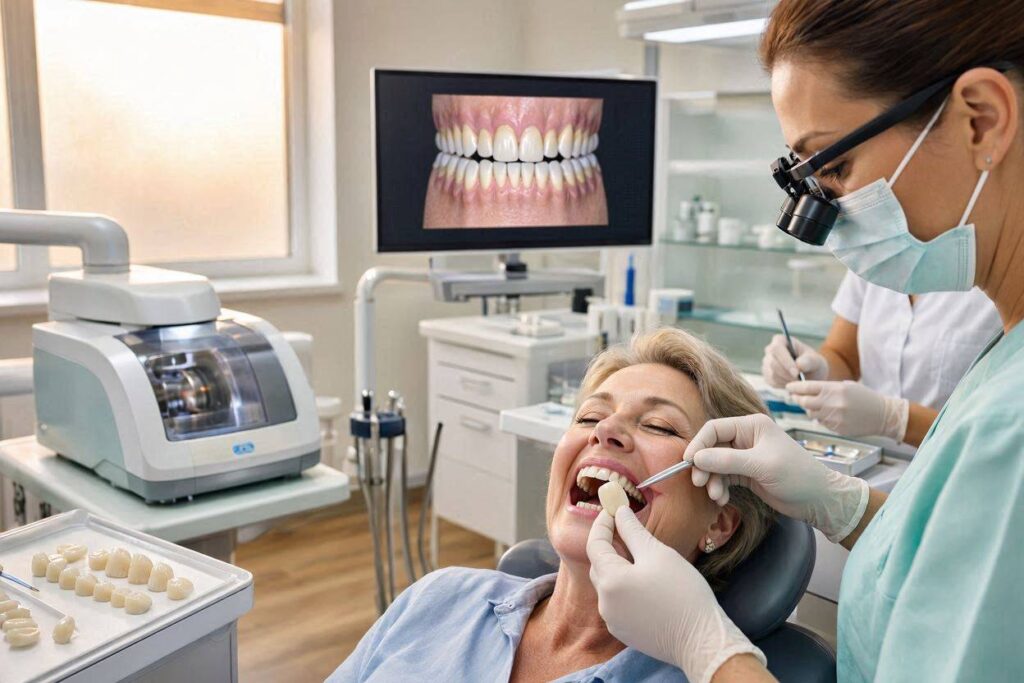
The process begins with an intraoral optical scanner. Instead of gooey, gag-inducing impression material, the dentist waves a small wand over the prepared teeth, capturing thousands of images per second that are digitally stitched into a high-resolution 3D model. This scan is the digital die. The dentist then designs the veneer on a computer screen, using CAD (Computer-Aided Design) software to set the contours, the contact points, and the occlusion. Once the design is finalized, the file is sent to an in-office milling chamber—a miniaturized CNC machine that carves the restoration from a solid puck of pre-crystallized ceramic, usually a lithium disilicate block (IPS e.max) or a leucite-reinforced glass ceramic. The milling process takes 10 to 20 minutes. The raw restoration is then stained, glazed, and fired in a small porcelain oven adjacent to the chair, followed by a try-in, adhesive bonding, and final polish. Total chair time: roughly 2 to 4 hours. The patient leaves with a finished restoration that replaced the temporary step entirely.
This workflow is a genuine engineering marvel. It eliminates the lab courier, the stone model, the wax-up, the investment casting, and the multiple-week turnaround time of the analog workflow. However, the restoration produced by this process is fundamentally different from a laboratory-fabricated porcelain veneer, and the differences are aesthetic, structural, and tactile.
The Material Difference: Monolithic vs. Layered Porcelain
The core limitation of a same-day veneer is that it is milled from a single, monochromatic block of ceramic. Think of it like sculpting a statue from a block of marble. The statue is the color of the marble, all the way through. To add artistic detail—depth, translucency, internal color variation, a subtly darker cervical third, a translucent incisal edge—the restoration must be painted with surface stains and fired. Those surface stains are superficial. They live on the outermost 50 to 100 microns of the veneer and are subject to wear, abrasion from toothbrushing, and gradual fading over the years.
A laboratory-fabricated veneer, by contrast, is built from the inside out by a human ceramist using a layered technique. The technician starts with a thin refractory die, builds up dentin-colored porcelain on the core, overlays translucent enamel porcelain, adds blue, gray, or amber internal characterization effects between the layers, and fires each layer individually in a calibrated vacuum oven. The result is a three-dimensional optical structure that mimics natural enamel’s depth because the color comes from within the restoration, not from a surface stain. Light enters the veneer, penetrates through translucent layers, bounces off the deeper dentin layer, and reflects back out, just as it does in a natural tooth. A monolithic milled veneer, even with masterful surface staining, lacks this volumetric depth. It looks flat under certain lighting angles. It may look acceptable in diffuse office light but artificial under the direct, harsh beam of an LED headlamp or camera flash.
This is the central trade-off: speed versus depth. A same-day veneer can be beautiful, but it will rarely approach the optical complexity of a layered, lab-fabricated porcelain. For a premolar or a lower incisor that is largely hidden, the difference is negligible. For a maxillary central incisor—the focal point of the smile—the difference can be the line between a restoration that looks like a very good fake and one that is completely imperceptible, even to a close observer.
Chair Time and Patient Tolerance: The Physical Cost of Speed
A same-day veneer appointment is a marathon, not a sprint. Four hours in a dental chair with your mouth propped open, your lips retracted, and your jaw aching from maintaining a static position is physically punishing for the patient. The dentist is working under time pressure, navigating the complex software interface, milling, staining, and glazing, all while managing the patient’s comfort and the biological clock of the prepared tooth, which should not be left exposed to oral fluids for excessive time.
For a single veneer, this is manageable. For a full smile makeover of 8 to 10 veneers, same-day dentistry becomes a logistical near-impossibility. Each veneer must be designed, milled, and characterized sequentially. The appointment could stretch to 8 or 10 hours. The patient’s tolerance, the precision of the bonding protocol across a full arch, and the risk of contamination of the prepared tooth surfaces over such a long window all degrade the clinical outcome. Most dentists who advertise “same-day veneers” are referring to one to four anterior teeth, not a full arch transformation. The patient who wants a complete smile redesign in one day is asking for something that, at the current technological limits, results in a compromised product. The reputable answer is: “We can do your consultation, smile design mock-up, and tooth preparation in one visit, but the final restorations will take two to three weeks of lab work.” The full-arch, one-day veneer case is a marketing fantasy, not a standard of care.
The “Preview” Smile: Diagnostic Mock-Up vs. Final Restoration
There is a legitimate, highly valuable one-day procedure in cosmetic dentistry that is often conflated with same-day veneers: the diagnostic mock-up. This is not a permanent restoration. It is a temporary acrylic or composite resin prototype that the dentist sculpts directly onto the teeth—without any drilling, preparation, or anesthesia—to give the patient a three-dimensional preview of the proposed smile design.
The mock-up is a communication tool. The patient goes home, looks at the temporary smile in the mirror, takes selfies, and shows family and friends. Feedback is collected. “The laterals are too long.” “The canines look too pointy.” “I want more tooth show at rest.” The dentist adjusts the mock-up or transmits the feedback to the lab. The mock-up visit and the feedback loop are one-day events, but they are the beginning of the veneer journey, not the end. Patients must understand that a same-day mock-up is a trial run in cheap plastic, not the final porcelain. Some practices blur this distinction in their marketing, leaving the patient disappointed when the “one-day smile” they saw advertised turns out to be a temporary prototype that will be replaced in three weeks.
Clinical Indications: When Same-Day Veneers Are an Excellent Choice
Same-day CAD/CAM veneers are not inferior in all contexts. In specific clinical scenarios, they are the optimal treatment modality, and the speed is a genuine clinical advantage, not just a convenience.
- Single Tooth Trauma: A young patient fractures a maxillary central incisor on a Friday evening. A major life event—a wedding, a graduation, a job interview—is scheduled for Monday. A same-day ceramic veneer restores the fractured tooth to cosmetic acceptability in a single visit, preventing the social catastrophe of facing a milestone event with a broken tooth. In this context, the speed is medically and psychologically necessary.
- Function Over Form in the Posterior: For premolars and first molars that are visible but not the primary aesthetic focus, a same-day monolithic e.max overlay or partial crown provides a durable, tooth-colored restoration that outperforms a composite filling in longevity and wear resistance. The aesthetic demands are lower, so the limitations of monolithic material are irrelevant.
- Medically Compromised Patients: For patients with severe gag reflexes, physical disabilities, or medical conditions that make multiple dental visits burdensome or dangerous, consolidating treatment into a single visit reduces anesthetic exposure, chair time trauma, and logistical strain.
- Dental Tourism Temporaries: Some international clinics use same-day CAD/CAM to fabricate immediate temporaries that are more durable than acrylic, allowing the tourist patient to return home and wear a functional, aesthetic prototype while a domestic lab fabricates the final layered porcelain.
In these contexts, the same-day technology is a gift. It solves acute problems. It is not, however, the default standard for elective cosmetic smile design.
The “No-Prep” Same-Day Illusion
A particularly deceptive marketing variant is the “no-prep same-day veneer.” This phrase combines two appealing concepts that become clinically dangerous when fused. A true no-prep or minimal-prep veneer is a very thin shell—often 0.2 to 0.3 millimeters—bonded to the facial surface of the tooth with little to no enamel removal. These restorations are technically demanding and highly dependent on the lab technician’s skill to avoid an over-contoured, bulky appearance.
When a no-prep case is forced into a same-day CAD/CAM workflow, the limitations compound. The monolithic block milled to 0.3 millimeters is fragile, prone to fracture during milling and during function. The color is limited by the block’s intrinsic shade because the thinness leaves almost no room for meaningful surface characterization. The result is often a veneer that is too opaque (to hide the underlying discolored tooth) or too bulky (to achieve adequate strength), defeating the cosmetic purpose of the no-prep philosophy. A no-prep veneer is best executed in a laboratory with a master ceramist who can hand-laminate the porcelain at a thickness that balances strength and translucency. Rushing this delicate restoration through a one-day mill is a recipe for an aesthetic failure that is permanently bonded to the tooth.
The Laboratory Veneer Timeline: What You Are Paying For
To appreciate the compromise of same-day, one must understand what happens in the laboratory during the traditional 2–3 week turnaround. The process is artisanal, slow, and expensive:
- Day 1-2: The impression arrives. The technician pours a master stone model, trims the die, and mounts the case on an articulator to simulate jaw movement.
- Day 3-5: A diagnostic wax-up is sculpted by hand to the dentist’s prescription. A silicone matrix is made from this wax-up to guide the final porcelain build-up.
- Day 6-10: The refractory dies are fabricated. The ceramist applies opaque dentin porcelain, fires it, applies translucent enamel porcelain in successive layers, fires each, and adds internal characterization stains. The veneer is cut back, contoured, and re-fired multiple times.
- Day 11-14: The final contours are adjusted with fine diamond burs. The surface texture—perikymata, developmental lobes, and a subtle gloss—is sculpted by hand. A final glaze firing gives the restoration its luster. The veneer is inspected under multiple light sources, polished, and shipped.
Each of these steps involves a human decision, an artistic judgment, and a kiln firing. The value proposition of the traditional veneer is not about the material cost of the porcelain powder; it is about the hours of highly skilled labor. The same-day veneer substitutes machine time and software algorithms for human craftsmanship. For patients who value the absolute highest level of aesthetic mimicry, the labor-intensive path remains the gold standard. The machine is excellent. The human master ceramist, for the most visible teeth, is superior.
Comparative Table: Same-Day CAD/CAM Veneer vs. Traditional Layered Lab Veneer
| Feature | Same-Day (CEREC/Planmeca) | Traditional Lab-Fabricated |
|---|---|---|
| Appointments Required | 1 (single visit). | 2–3 (prep, try-in, delivery). |
| Temporaries Needed | None. | Worn for 2–3 weeks. |
| Material Structure | Monolithic, single-shade block. | Layered, multi-shade porcelain build-up. |
| Aesthetic Depth | Surface stains only; flat translucency. | Internal color, volumetric depth, incisal halo. |
| Customization | Software-driven, limited by block. | Hand-sculpted by a ceramist. |
| Strength | High (solid lithium disilicate). | High (layered to a metal or ceramic core). |
| Best For | Single teeth, premolars, emergencies. | Full smile makeover, highly visible centrals. |
| Cost | Slightly less expensive (no lab fee). | More expensive (significant lab fee). |
| Longevity | 10–15 years. | 15–20+ years with care. |
| Warranty/Remake Risk | Higher remake risk if aesthetic expectations unmet. | Lower remake risk due to iterative try-in and lab communication. |
The table confirms that the choice is not “good versus bad” but “appropriate versus aspirational.” A single fractured central incisor in an otherwise non-cosmetic mouth is a perfect same-day case. A full upper arch of centrals, laterals, and canines in a patient paying premium fees for a Hollywood smile is a laboratory case. The mistake is applying the rapid workflow to the cosmetic arch.
The Cost Differential: Is Same-Day Cheaper?
Patients often assume that eliminating the lab and reducing appointments must reduce the price. This is partially true. A same-day veneer may cost 10–20% less than a lab-fabricated veneer from the same practice because the dentist avoids the laboratory fee, which can be $200–$400 per unit. However, the dentist also invested $100,000–$150,000 in the CAD/CAM hardware, software licenses, and ongoing block inventory. Some practices amortize this capital investment into the fee schedule, negating the lab savings.
The out-of-pocket cost to the patient varies by market and practice philosophy. A same-day e.max veneer might range from $1,200 to $1,800 per tooth, while a layered lab porcelain veneer might be $1,600 to $2,500 per tooth. The savings are modest. For a single tooth, saving $400 and avoiding a temporary is a clear win. For a full smile makeover of 10 teeth, saving $4,000 in exchange for a discernibly flatter aesthetic may not be a wise economy. The patient should ask for a portfolio of the dentist’s own same-day veneer cases—not stock photography from the CEREC marketing department—and assess whether the aesthetic result meets their personal standard.
Important Note: The “Try-In” Step and Why It Matters
A critical quality-control checkpoint in traditional veneer delivery is the try-in appointment. The lab-fabricated veneers are placed on the teeth with a water-soluble try-in paste in various shades. The patient and dentist evaluate the color, shape, and fit in natural light. If something is off—the midline is rotated, the incisal edges are too square, the chroma is too yellow—the case goes back to the lab for adjustment. With same-day veneers, this iterative feedback loop is compressed or eliminated. The dentist mills, stains, and bonds. The patient sees the final result only after the cement is cured. At that point, removing a bonded veneer requires grinding it off, damaging the underlying tooth, and starting over. The try-in step is the safety net that catches aesthetic failures, and same-day dentistry removes it.
Conclusion
Veneers can technically be done in one day using in-office CAD/CAM systems like CEREC that design, mill, and bond a monolithic ceramic restoration in a single marathon appointment, but this rapid workflow is ideally suited for single-tooth emergencies and posterior restorations rather than full smile makeovers. The aesthetic depth of hand-layered, laboratory-fabricated porcelain with internal color and volumetric translucency remains superior for highly visible anterior teeth, and the 2–3 week lab process includes a critical try-in appointment that prevents irreversible aesthetic errors. Patients seeking instant smiles must understand that they are trading the master ceramist’s layered artistry for a machine-milled, surface-stained monolith.
FAQ
Q: Is a same-day veneer made of the same material as a traditional lab veneer?
A: It can be, but the structure is different. Both can be made from lithium disilicate (e.max), which is an excellent ceramic. However, the same-day veneer is milled from a single-shade block and stained on the surface. The lab veneer is hand-built with multiple shades of porcelain layered to create depth. The core material may be the same, but the optical architecture is fundamentally different.
Q: Can I get 10 upper veneers done in one day?
A: Technically possible but clinically inadvisable. The chair time would be 6–10 hours, which is physically exhausting for patient and dentist. The bonding protocol across 10 teeth requires meticulous isolation of each tooth from saliva and blood, and rushing this step increases the risk of bond failure, marginal leakage, and decay. Full-arch smile makeovers are best staged across two or more appointments, even if the temporaries are eliminated via a digital workflow. Reputable cosmetic dentists will strongly discourage a same-day full-arch permanent veneer case.
Q: Do same-day veneers last as long as traditional veneers?
A: The material longevity is comparable—lithium disilicate is highly fracture-resistant. However, aesthetic longevity may be shorter. Surface stains applied to a monolithic veneer can wear away over 5–10 years, leaving the restoration looking flat and monochromatic. A layered lab veneer’s color is intrinsic and will not fade. Additionally, the marginal fit of a milled restoration is generally excellent, but the lack of a try-in step increases the risk of a poorly contoured contact point that traps food or an occlusal interference that causes fracture. Properly executed, both can last 10–15 years, but the lab veneer has a longer track record and a lower remake rate.
Additional Resource
For a technical explanation of the CEREC workflow, material science comparisons, and case examples, visit the Academy of Chairside CAD/CAM Dentistry at www.aacd.com/cad-cam-resources.