Are You Awake During Dental Implants?
The thought of having a titanium screw drilled into your jaw can be terrifying. One of the first questions patients ask is: “Will I be asleep for this?”
The answer depends on the complexity of the case and your personal anxiety level. Most patients are awake during dental implant surgery, but they are completely numb. However, various sedation options exist to make you feel relaxed or even asleep.
This article explains the different levels of consciousness available during implant surgery and helps you decide which is best for you.
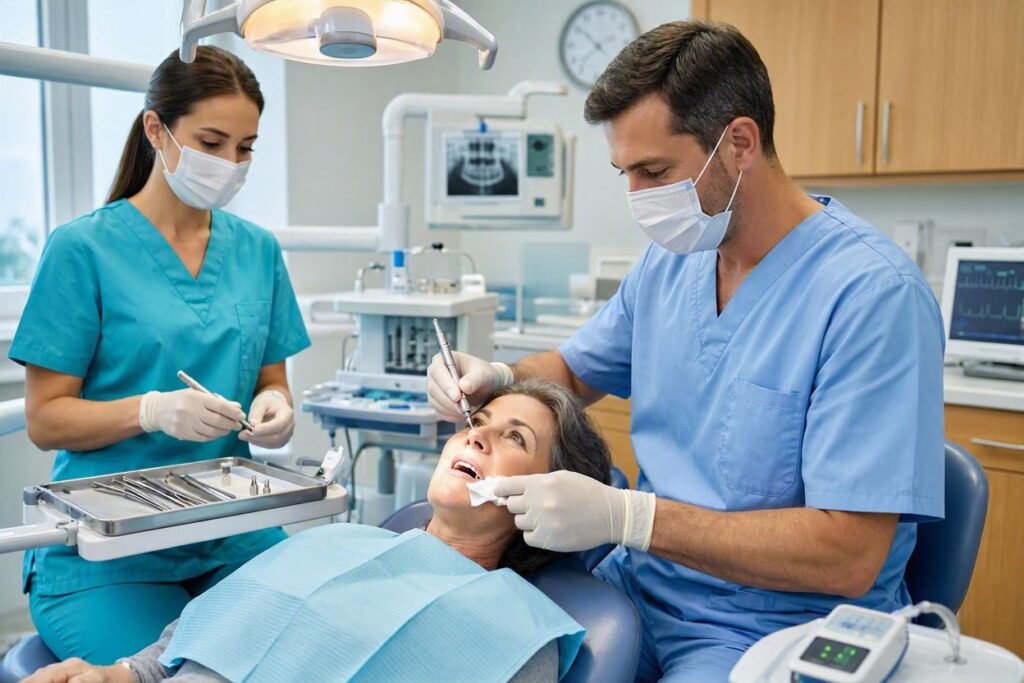
The Standard: Local Anesthesia (Awake)
This is the most common method. It is used for simple single-tooth implants.
What It Is
The dentist injects a local anesthetic (like Lidocaine or Articaine) into the gum tissue around the surgical site. This is the same numbing shot you get for a filling.
What You Feel
- Pressure: You will feel pushing and vibrating. The drill creates vibrations in the bone. It is often described as feeling like someone is “pressing” on the jaw.
- No Pain: You should not feel any sharp pain. If you do, you must tell the dentist immediately so they can give more anesthetic.
The Pros
- Safety: You are fully conscious and can communicate.
- Cost: It is the cheapest option (no anesthesiologist fee).
- Convenience: You can drive yourself home.
The Cons
- Anxiety: You hear the sounds (drilling, suction).
- Awareness: You know what is happening in your mouth.
Option 2: Nitrous Oxide (Laughing Gas) – Awake but Relaxed
This is a mild sedative.
What It Is
You breathe a mixture of nitrous oxide and oxygen through a mask placed over your nose.
What You Feel
- Warm and Fuzzy: You feel calm, tingly, and euphoric. You might not care that the dentist is working in your mouth.
- Time Distortion: The procedure seems to go by very fast.
The Pros
- Quick Recovery: The gas wears off in minutes. You can drive home.
- Adjustable: The dentist can increase or decrease the level.
The Cons
- You are still technically awake.
Option 3: Oral Sedation (Conscious Sedation) – Drowsy
What It Is
You take a pill (like Halcion or Valium) about an hour before the procedure.
What You Feel
- Drowsiness: You are very sleepy. You might fall asleep, but you can be easily woken up.
- Amnesia: Many patients do not remember much of the procedure afterward.
The Pros
- Great for Anxiety: It takes the edge off for nervous patients.
- No needles (for the sedation): Just a pill.
The Cons
- You need a ride: You cannot drive for 24 hours.
- You must be monitored: Blood pressure and oxygen levels need checking.
Option 4: IV Sedation (Twilight Sleep) – Asleep
What It Is
An anesthesiologist or trained dentist administers sedative drugs directly into your bloodstream through an IV.
What You Feel
- Nothing. You are in a “twilight” state. You are technically conscious enough to breathe on your own, but you have no memory of the surgery. For all intents and purposes, you feel like you were asleep.
The Pros
- Total comfort: No anxiety, no awareness.
- Efficiency: The dentist can work fast.
The Cons
- Cost: This is expensive ($500 – $1,500+).
- Risk: Requires monitoring of vital signs.
- Recovery: You are groggy for the rest of the day.
Table: Sedation Options for Implants
| Method | Consciousness | Pain Relief | Amnesia | Driver Needed? |
|---|---|---|---|---|
| Local Only | Fully Awake | Yes | No | No |
| Nitrous Oxide | Awake/Relaxed | Yes | Maybe | No |
| Oral Sedation | Drowsy | Yes | Yes | Yes |
| IV Sedation | Asleep | Yes | Yes | Yes |
Which Should You Choose?
- Simple back tooth, not anxious: Local only.
- Mildly nervous: Nitrous Oxide.
- Very nervous, multiple implants: Oral Sedation or IV Sedation.
- Complex surgery (bone grafts, full arch): IV Sedation is often recommended.
Conclusion
You do not have to be awake for dental implants if you prefer not to be. While local anesthesia is sufficient for most patients, options like oral sedation and IV sedation allow you to sleep through the procedure comfortably. Discuss your anxiety levels with your dentist to choose the safest and most effective option for your situation.
Additional Resource
For more on sedation dentistry, visit the Dental Organization for Conscious Sedation at www.docseducation.org.