Are You Awake For Veneers?
The phrase “getting veneers” sounds deceptively simple, like getting a haircut or a manicure. You walk in, you sit down, and you walk out transformed. The reality involves a dental handpiece, a fine-grit diamond bur, and the systematic removal of a thin layer of irreplaceable enamel from the front surfaces of your teeth. For many patients, the question that overshadows the excitement of the new smile is not about shade or shape, but about consciousness. “Are you awake for veneers?” The answer is almost always yes—but that “yes” is loaded with nuances about local anesthesia, the distinction between pressure and pain, the option of sedation for the anxious, and the specific sensory experience of the preparation appointment versus the bonding appointment.
Veneer placement is not a surgical procedure in the traditional sense. It does not involve incisions, sutures, or general anesthesia. It is a restorative dental procedure performed under local anesthetic, with the patient fully conscious and able to communicate, swallow, and breathe normally. However, the length of the appointment, the sound of the drill, and the vibration transmitted through the jaw can challenge even the calmest patient. This article explores the exact sensory timeline of a veneer appointment, the pharmacology of the numbing agents used, the no-prep exception where anesthesia may be omitted, the sedation options for dental phobics, and the critical distinction between the preparation visit and the cementation visit.
The Preparation Appointment: The Main Event
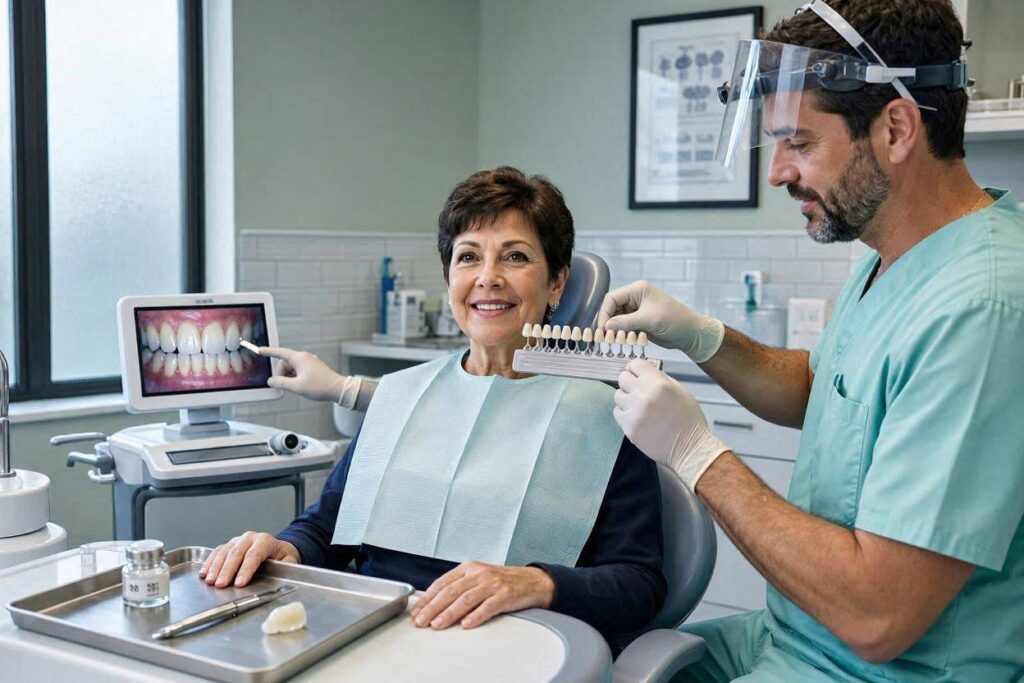
The veneer process involves two main clinical appointments. The first—the preparation or “prep” appointment—is the one that concerns patients because it involves enamel reduction. The second—the delivery or bonding appointment—is generally far more comfortable and often requires little to no anesthetic. Understanding this distinction is essential.
During the preparation appointment, the dentist removes approximately 0.3 to 0.7 millimeters of enamel from the facial and incisal surfaces of the teeth to create space for the porcelain shells. This is a delicate, controlled reduction using a high-speed handpiece with a diamond bur, accompanied by a stream of water spray for cooling. The enamel itself has no nerve endings. It is a crystalline, acellular structure. The discomfort does not come from the enamel being shaved; it comes from the vibration, the heat generated by friction, and the proximity of the bur to the dentin layer, which contains the nerve fibers of the odontoblastic processes. If the reduction stays entirely within the enamel, theoretically no pain signal is generated. In practice, the vibration and sound are uncomfortable enough that almost all dentists and patients elect for local anesthesia. The preparation of 8–10 teeth is a prolonged procedure, often taking 2–3 hours. Being awake for that duration with your mouth propped open, lips retracted, and a drill humming millimeters from your gumline is an endurance test. Local anesthesia makes it a tolerable, even boring, experience.
Local Anesthesia: The Numb Mouth Reality
The standard protocol for veneer preparation is infiltration of a local anesthetic, most commonly 2% lidocaine with epinephrine or 4% articaine with epinephrine. The epinephrine is a vasoconstrictor that reduces bleeding and prolongs the duration of numbness. The injection is administered into the vestibule—the soft tissue above the upper front teeth or below the lower front teeth—targeting the terminal branches of the infraorbital nerve (for the upper arch) or the mental nerve (for the lower arch).
The upper anterior infiltration is one of the easiest and least painful injections in dentistry. The bone over the upper incisors is thin and porous, allowing the anesthetic to diffuse easily to the nerve endings. The patient feels a brief pinch, a few seconds of burning as the solution enters the tissue, and then a rapidly spreading numbness that encompasses the upper lip, the base of the nose, and the front teeth. Within 3–5 minutes, the teeth are profoundly numb. The patient can feel touch and pressure—those sensations are transmitted by different nerve fibers that are not blocked by local anesthetics—but they cannot feel sharp pain or temperature.
For the lower arch, the infiltration is somewhat less profound because the mandibular anterior bone is denser. Some dentists supplement with a mental nerve block or use articaine, which has enhanced bone penetration. The lower lip and chin will become numb, and the patient may feel a sensation of swelling that is not anatomically real—a bizarre but harmless side effect of the nerve blockade.
The Sensation of Pressure Without Pain
This is the key sensory experience that un-sedated patients must understand: you are awake, and you feel things, but it does not hurt. The high-speed handpiece creates a vibration that resonates through the skull. You feel the water spray pooling in the back of your throat and the suction tip vacuuming it away. You feel the dentist’s fingers pressing against your lip and cheek. You may feel a sensation of “pushing” or “tugging” on the tooth, particularly during the packing of retraction cord into the gum sulcus to expose the margin of the preparation. This pressure sensation can be alarming if you are not prepared for it.
Pressure is not pain. The nerve fibers that transmit sharp, aching, hot, and cold sensations are successfully blocked by the lidocaine. The proprioceptive fibers and pressure receptors in the periodontal ligament are not. The patient must cognitively reframe the experience: “I will feel the dentist working. I will not feel pain. If I feel a sharp or zinging sensation, that is a signal that the anesthesia is insufficient, and I should raise my hand immediately.” A responsible dentist tells the patient before starting: “You will feel me pushing and pulling. You will hear loud noises. You will feel vibration. If any of that crosses the line into sharpness or pain, you raise your left hand and I stop instantly and give you more anesthetic. Do not try to tough it out.” This verbal contract is essential to patient comfort.
The No-Prep or Minimal-Prep Veneer Exception
A specific category of veneers—often called no-prep, minimal-prep, or prepless veneers—may be placed with little or no enamel reduction. These are very thin shells (0.2–0.3 millimeters) bonded directly to the intact enamel surface. Companies like Lumineers marketed aggressively on the promise of “no shots, no drilling.”
For these cases, the preparation appointment is essentially skipped. There is no drilling, no anesthetic injection, and no temporaries. The teeth are lightly etched, bonded, and the veneers are seated. The entire process is more akin to a lengthy bonding procedure than a restorative one. The patient is fully awake, comfortable, and experiences none of the vibration and noise of traditional preparation.
However, the no-prep approach is only suitable for specific cases: teeth that are already aligned well, with sufficient space, and a facial profile that does not become overly bulky with the addition of a 0.3-millimeter shell. Patients with protrusive teeth or significant discoloration are poor candidates. The vast majority of aesthetically excellent veneer cases require some degree of enamel reduction to create space, avoid a “horse-teeth” look, and achieve proper contour. If a patient selects a no-prep path primarily to avoid anesthesia and drilling, they may end up with bulky, unnatural-looking veneers that protect them from the drill but condemn them to a disappointing smile. The avoidance of anesthesia is not a sufficient reason to choose an inappropriate clinical technique.
Sedation Options: When Awake is the Problem
For patients with dental phobia, a severe gag reflex, or a history of traumatic dental experiences, being “awake but numb” is an insufficient comfort strategy. The psychological distress of the sounds, vibrations, and prolonged mouth opening can be genuinely debilitating. For these patients, sedation dentistry offers a bridge between full consciousness and general anesthesia.
Nitrous Oxide (Laughing Gas): The most accessible and commonly used sedation for veneer preparation. A small nasal mask delivers a mixture of nitrous oxide and oxygen. Within minutes, the patient experiences a warm, floating, detached sensation. Anxiety dissolves. The sounds of the drill become distant and insignificant. Time perception alters, and the 2-hour appointment feels like 20 minutes. Crucially, the patient remains conscious, responsive to verbal commands, and maintains all protective reflexes. They can breathe, swallow, and communicate. After the procedure, 100% oxygen is administered for 5 minutes, the nitrous oxide is flushed from the system, and the patient can drive themselves home. This is an ideal adjunct for the mildly to moderately anxious veneer patient.
Oral Conscious Sedation: A prescribed sedative pill—usually a benzodiazepine like triazolam (Halcion) or diazepam (Valium)—taken an hour before the appointment. The patient arrives drowsy, relaxed, and often with significant amnesia for the procedure. They are conscious but profoundly sedated. Local anesthesia is still required. The patient requires a driver for transportation. This is appropriate for moderate anxiety.
IV Sedation (Twilight Sleep): For severe dental phobia, extensive full-mouth veneer cases, or patients with medical conditions exacerbated by stress, intravenous sedation administered by a dental anesthesiologist or trained dentist provides deep sedation. The patient is on the edge of consciousness, responsive to deep stimulation, breathing spontaneously. They have no memory of the procedure. Continuous monitoring of heart rate, blood pressure, oxygen saturation, and end-tidal CO2 is required. This is the most profound sedation short of general anesthesia and is typically reserved for complex surgical cases, but it is available for veneer preparation in appropriately equipped practices.
General Anesthesia: For veneer preparation, general anesthesia is exceptionally rare and generally considered disproportionate to the surgical stimulus. Veneer preparation is a minimally invasive, non-surgical procedure. The risks of general anesthesia—intubation, aspiration, malignant hyperthermia—are not justified for a cosmetic dental procedure that can be comfortably performed under local anesthesia with or without minimal sedation. A dentist offering general anesthesia for a routine 8-unit veneer case is an outlier, and the patient should question the medical necessity and the safety of that approach.
The Bonding Appointment: The Comfortable One
The second major appointment—the delivery of the final porcelain veneers—is significantly more comfortable than the preparation. The temporaries are removed, the teeth are cleaned of provisional cement, and the porcelain shells are tried in with a water-soluble try-in paste to check fit, shade, and contour. The patient looks in a hand mirror, evaluates the smile, and approves the aesthetics.
Once the shade and fit are confirmed, the teeth are isolated (often with a rubber dam or a retraction cord), etched with phosphoric acid, rinsed, and dried. The veneers are internally etched with hydrofluoric acid in the lab, silanated to chemically bond to the resin cement, and then bonded to the teeth with a light-cured resin cement. The excess cement is meticulously cleaned from the margins, the bite is checked and adjusted, and the margins are polished.
The entire bonding appointment, which may take 2–3 hours for a full arch of 8–10 veneers, often requires no local anesthetic at all. The teeth are not being drilled. The etching and bonding agents can cause transient sensitivity, but it is typically mild and brief. If the patient has particularly sensitive teeth or if the dentist needs to adjust the occlusion with a fine diamond bur, a small amount of topical anesthetic or a limited infiltration may be used, but full-mouth profound numbness is rarely needed. The bonding appointment is the reward for enduring the preparation appointment.
Temporaries and the Numbness Gap
A frequently overlooked aspect of the “awake” experience is the period between the preparation and bonding appointments, during which temporary veneers are worn. The temporaries are made either from a pre-operative diagnostic wax-up matrix or a direct composite resin mock-up. They are bonded with a temporary cement that allows easy removal at the bonding visit.
The temporaries are functional but fragile. The patient must eat cautiously—no biting into hard or sticky foods—because the temporaries can fracture or dislodge. The teeth underneath, having been reduced, are sensitive to temperature and air. The temporaries protect them, but if a temporary comes off, the exposed dentin can be exquisitely sensitive. This is one of the few painful experiences in the veneer process: the dislodged temporary and the exposed, freshly cut dentin. The patient should contact the dentist immediately for re-cementation. Delaying this turns a mild inconvenience into a painful one.
Important Note: The “I Could Feel Everything” Panic
A small subset of patients metabolize local anesthetics rapidly, have anatomical variations in nerve innervation, or have inflamed pulp tissue that is resistant to anesthesia (hot tooth phenomenon, though this is more relevant to endodontics than veneer preparation). If the patient feels pain during preparation despite the anesthetic, the procedure should stop immediately. The dentist should administer additional anesthetic, try a different agent (e.g., switching from lidocaine to articaine), or consider an intraligamentary injection (injecting directly into the periodontal ligament space). A patient should never be told to “just bear with it” during a veneer preparation. Pain during enamel reduction indicates inadequate anesthesia, and persisting despite patient complaint is both medically unnecessary and a violation of patient autonomy.
Comparative Table: Anesthesia and Sensation by Veneer Phase
| Phase | Anesthesia Required? | Sensations | Duration | Post-Appointment State |
|---|---|---|---|---|
| Consultation/Smile Design | None. | Visual, verbal; no physical discomfort. | 1 hour. | No restrictions. |
| Preparation (Prep) Appointment | Local anesthetic (infiltration). | Vibration, pressure, water spray; no sharp pain. | 2–3 hours. | Numb lip; wear temporaries; sensitivity if temporary dislodged. |
| Temporary Phase | None (unless temporary lost). | Mild to moderate thermal sensitivity; protection by temporaries. | 2–3 weeks. | Dietary restrictions; soft food. |
| Bonding (Delivery) Appointment | Usually none; topical if needed. | Etching solution taste; mild sensitivity; pressure from seating. | 2–3 hours. | No numbness; immediate aesthetic result; mild gum soreness. |
| Post-Bonding Adjustment (Follow-up) | None. | Mild occlusal adjustment vibration; no pain. | 30 minutes. | No restrictions. |
Conclusion
You are fully awake during the entire veneer process—consultation, preparation, and bonding—with the preparation appointment performed under profound local dental anesthesia that eliminates sharp pain while leaving non-painful sensations of vibration, pressure, and water spray fully perceptible. Patients with dental anxiety can safely layer nitrous oxide, oral sedation, or IV sedation over the local anesthetic to achieve a calm, detached, or amnestic state while remaining conscious and maintaining protective reflexes. The bonding appointment, where the final porcelain shells are cemented, is typically the most comfortable phase, often requiring no anesthetic at all.
FAQ
Q: Will I feel the injection for the veneer anesthetic?
A: Yes, but it is one of the mildest injections in dentistry. The upper anterior infiltration is a quick, shallow injection into loose, non-adherent tissue. Most dentists apply a topical numbing gel to the injection site for 1–2 minutes beforehand, reducing the pinch to near zero. The entire injection takes 10–15 seconds. The lower anterior injection is slightly more noticeable due to the dense bone, but it is still a brief, tolerable discomfort. The trade-off is 2–3 hours of completely painless drilling.
Q: Can I drive myself home after the veneer preparation appointment?
A: If only local anesthetic was used (no sedation), yes. The numbness in your lip and nose does not impair cognitive function, motor skills, or reaction time. If nitrous oxide was used, you can also drive after 5–10 minutes of post-procedure oxygenation, as the gas is eliminated rapidly from the body. If you took an oral sedative pill or received IV sedation, you must have a driver. Do not drive under the influence of benzodiazepines or post-IV sedation.
Q: What if I have a severe gag reflex? Can I still get veneers without being put under?
A: Yes. A severe gag reflex is primarily managed by careful technique and appropriate anesthesia. A profound palatal or lingual nerve block can suppress the gag trigger. Nitrous oxide sedation is often sufficient to blunt the reflex. In extreme cases, IV sedation may be considered. General anesthesia is almost never necessary. The gag reflex is triggered by stimulation of the soft palate and posterior tongue; veneer preparation is focused on the anterior teeth, far from the trigger zones. Good suction technique and allowing the patient to breathe through the nose are often enough.
Additional Resource
For a detailed explanation of local anesthesia pharmacology, dental sedation options, and patient comfort protocols, the American Dental Association’s patient education portal MouthHealthy.org provides evidence-based guides at www.mouthhealthy.org.