Can Dental Implants Cause Brain Tumors?
The human mind naturally seeks patterns, and when a serious health condition like a brain tumor arises, patients and families often look for a cause. If a person with dental implants is diagnosed with a brain tumor, it is a human instinct to wonder if the two are connected. This question, “Can dental implants cause brain tumors?”, requires a direct, unequivocal, and scientifically grounded answer.
The answer is no. There is absolutely no credible scientific or medical evidence that dental implants cause brain tumors. This is not a matter of debate or an area of ongoing controversy. It is a settled fact in the medical and dental scientific community. This article will explain the origins of this unfounded fear, the rigorous science of implant materials, the established risk factors for brain tumors, and the critical distinction between correlation and causation that dispels this myth.
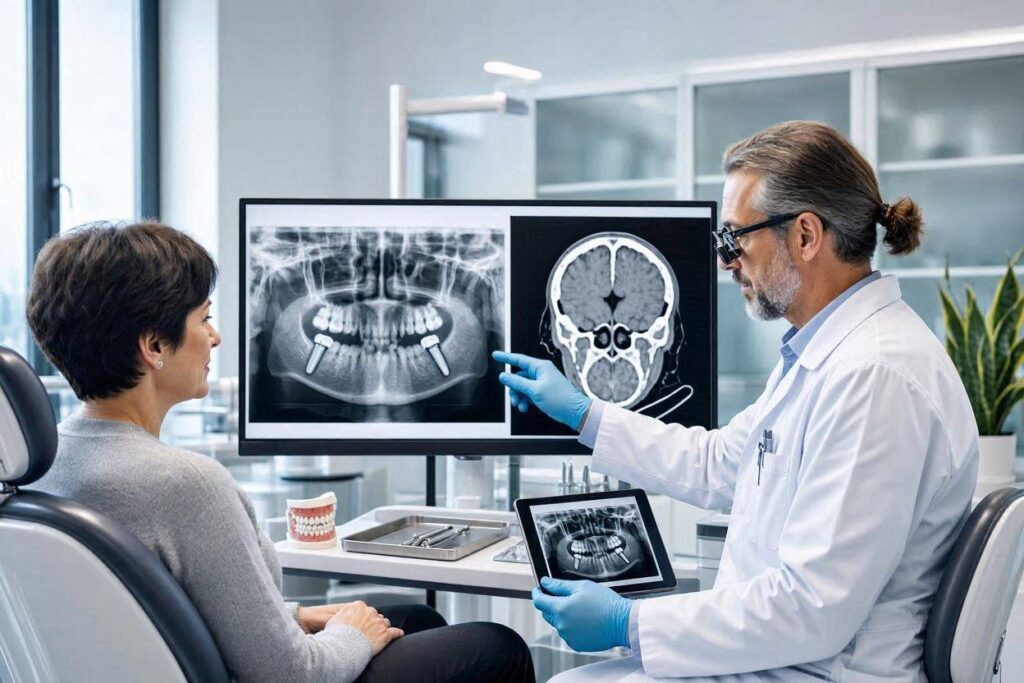
The Origin of the Myth: A Confusion of Materials and Distant Anatomy
This question does not arise in a vacuum. It is a persistent internet myth fueled by a fundamental misunderstanding of two entirely different things: dental materials and brain pathology.
The Titanium Truth
Dental implants are made of medical-grade titanium alloy or, in some cases, zirconia ceramic. Titanium is the most biocompatible metal used in the human body. It is completely non-toxic, non-carcinogenic, and chemically inert in the biological environment. The International Agency for Research on Cancer (IARC), an agency of the World Health Organization, has not classified titanium as a human carcinogen. There is no known biological mechanism by which a solid, inert titanium screw in the jawbone could initiate or promote a neoplastic process (a tumor) in the distant, isolated, and highly protected tissues of the brain. The two anatomical locations are separated by multiple layers of bone, the dura mater, the blood-brain barrier, and the cerebrospinal fluid. The implant sits in the mandible or maxilla. The brain resides in a completely sealed, sterile vault. They do not interact.
The Misunderstood “Metal” Risk
The confusion likely originates from legitimate concerns about other metals in the body and from debunked claims about dental amalgam fillings (which contain mercury). Amalgam is not used for implants. Some patients also confuse implants with the speculative and scientifically discredited claims linking root canal-treated teeth to brain tumors, a theory that has been thoroughly investigated and rejected by the scientific community. An implant is a sterile, inert root replacement. It is not a source of chronic infection or chemical toxicity.
The Established Biological Risk Factors for Brain Tumors
To understand why an implant is not a risk factor, you must understand what actually is. The scientific consensus on the etiology of brain tumors points to a combination of genetic and environmental factors that have been rigorously studied.
The established risk factors for brain tumors include:
- Inherited Genetic Syndromes: A small percentage of brain tumors are associated with rare genetic conditions, such as neurofibromatosis, tuberous sclerosis, and Li-Fraumeni syndrome.
- Ionizing Radiation: The most well-established environmental risk factor is prior exposure to high-dose, therapeutic ionizing radiation to the head, typically from radiation treatment for a previous cancer like childhood leukemia. This is not the low-dose radiation from a single dental CBCT scan or an airplane flight.
- Family History: Having a first-degree relative with a brain tumor is associated with a slightly elevated risk in some studies.
- Compromised Immune System: Individuals with severely suppressed immune systems, such as those with AIDS or on immunosuppressant drugs post-transplant, have a higher risk of primary central nervous system lymphoma.
No national cancer institute, no neurological society, and no surgical academy lists titanium dental implants as a risk factor for glioma, meningioma, or any other brain neoplasm. The risk factors are genetic, radiogenic, and immunological, not mechanical or dental.
Correlation Is Not Causation: A Critical Thinking Error
The human mind is a pattern-recognition machine. When a person with a dental implant receives a brain tumor diagnosis, the two facts coexist in the same patient. They are correlated in that person’s life. The error is to leap from a co-occurrence to a causal claim.
Millions of people have dental implants. Brain tumors, while devastating, are relatively rare. Statistically, there will be a large number of people who have both a dental implant and a brain tumor, simply by the laws of probability. This does not mean the implant caused the tumor. To use an obvious analogy, millions of people with brain tumors also wear shoes. The shoes did not cause the tumor. The titanium post in the jaw is as unrelated to the cranial neoplasm as the shoes on the feet.
“A post hoc, ergo propter hoc fallacy—after this, therefore because of this—is the enemy of clear medical reasoning. A dental implant that precedes a brain tumor diagnosis in time did not cause it. The science of oncology and biomaterials science are in complete agreement on this point.”
What the Science Says When Actively Studied
Researchers have investigated potential links between dental materials and systemic disease. When a hypothesis is raised, scientists test it. Cohort studies tracking the long-term health outcomes of patients with dental implants have not identified an increased incidence of brain cancer. Systematic reviews of the literature, which examine all available high-quality evidence, have found no association between titanium dental implants and the development of any form of malignancy at a site distant from the implant, including the brain.
The rigorous regulatory process for medical devices in the United States, governed by the FDA, requires extensive biocompatibility testing. The materials used in dental implants have passed these stringent tests and are classified as safe for permanent human implantation. The scientific safety record of these materials, with decades of clinical data, is overwhelmingly clean.
Conclusion
Dental implants do not cause brain tumors. This is not a matter of opinion but a statement of established medical science. The myth persists due to a misunderstanding of the biocompatible and inert nature of titanium, a confusion with other dental materials, and a logical fallacy that conflates the coincidental co-occurrence of two conditions with a causal link. The known risk factors for brain tumors are genetic predisposition, prior high-dose ionizing radiation to the head, and certain immune conditions, none of which are related to the presence of a sterile, surgically placed dental implant in the jawbone. Patients can be fully confident that the decision to restore their oral health with a dental implant does not introduce any risk of developing a brain tumor.
FAQ
1. Is there any metal in a dental implant that can cause cancer?
No. Dental implants are made of medical-grade titanium alloy, a metal with an exceptional safety profile that is not classified as a carcinogen by the International Agency for Research on Cancer.
2. Can an infection from a dental implant spread to my brain?
A severe, untreated dental infection in the jaw can, in very rare instances, spread and cause a brain abscess. This is a complication of an active, uncontrolled infection, not of a sterile, well-maintained implant. This is a bacterial infection of the tissue, not a tumor.
3. Do dental implants increase your risk of any type of cancer?
No. Large-scale, long-term clinical studies have not found any increased risk of any form of cancer, including oral cancer or brain cancer, in patients with titanium dental implants.
4. What should I do if I have a brain tumor and dental implants?
Your treatment for a brain tumor will be directed by your oncologist and neurosurgeon. The presence of dental implants is generally not a factor in your cancer treatment, though you should always inform all your doctors of any implanted medical devices.
5. Where did the myth about teeth and brain tumors come from?
It is a persistent piece of internet misinformation, often an offshoot of the scientifically discredited theory that root canals cause systemic disease, a theory that has been exhaustively investigated and rejected by the scientific community.
Additional Resource
For authoritative, evidence-based information on the causes and risk factors for brain tumors, visit the official patient information page of the American Brain Tumor Association (ABTA).