Can You Drink Tea When Whitening Teeth?
You have just finished a whitening treatment. Your smile looks brighter, and you feel a boost of confidence. Then the morning rolls around, and you crave the familiar comfort of a warm cup of tea. Your hand hovers over the kettle, and a sudden panic sets in. You ask yourself the question that millions of people ask every single day: Can you drink tea when whitening teeth?
If you have invested time and money into achieving a brilliant smile, the last thing you want to do is ruin it. The fear is real. One wrong sip feels like it could undo all that hard work. The internet offers a confusing mix of strict warnings and casual advice that seems too good to be true.
This guide cuts through the noise. We will explore the science behind tooth staining in detail, dissect the vulnerability of your enamel during the whitening process, and provide a practical, day-by-day roadmap. We are not here to lecture you or demand you give up your beloved ritual. We are here to find a balance. You can enjoy a bright smile and still appreciate the ritual of tea. It simply requires a smart and informed strategy.
By the end of this article, you will know exactly how to navigate the post-whitening period without letting your smile dim. We will cover the dreaded “white diet,” compare tea to coffee, and reveal techniques that minimize staining. Forget the generic restrictions. This is the definitive, nuanced answer for tea enthusiasts who care about their teeth.
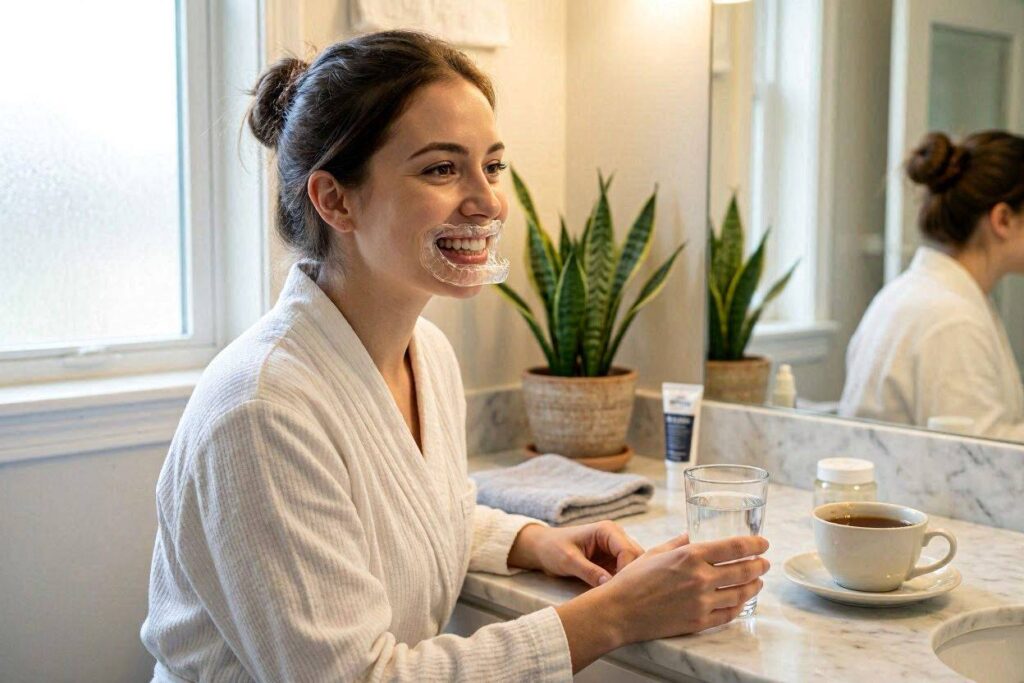
Understanding the Crucial Post-Whitening Window
You cannot simply treat a teeth-whitening session like a simple cosmetic fix. You must understand what actually happens to your teeth during the procedure. The science explains why the “can you drink tea when whitening teeth” question matters so critically in the first few days. Ignoring this science is the primary reason people see their results fade in under a week.
The Science of Enamel Porosity
Your teeth are not solid, impenetrable pieces of bone. The outer layer, called enamel, consists of tightly packed mineral crystals. Under a microscope, these crystals look like a mesh or a network of microscopic rods. This structure is naturally strong, but it is not perfectly smooth. It contains tiny pores.
During a whitening treatment, whether it involves hydrogen peroxide or carbamide peroxide gel, the active ingredients do not just sit on the surface. The oxygen molecules from the whitening agent penetrate these microscopic pores. They travel down through the enamel to reach the dentin layer beneath. There, these molecules break apart the complex, dark-colored stain compounds into smaller, colorless pieces.
This oxidation process effectively bleaches the tooth from the inside out. The immediate result is a visibly lighter tooth. But a critical side effect occurs simultaneously. The process of opening the enamel pores to release the stain molecules leaves those pores temporarily open and exposed.
Think of your enamel like a sponge. A dry, tight sponge has a dense surface. A whitening treatment is like soaking that sponge in a cleaning solution. The sponge expands, and its holes open wide to release the trapped dirt. Afterward, it takes time for that sponge to contract and close its pores again. Your teeth need that same recovery time.
The Immediate Risk of Chromogens
While your enamel pores are in this widened state, they act like open doorways. Any pigmented substance you consume can waltz right in and lodge itself deep within the enamel structure. These pigment molecules are called chromogens.
Tea is a powerhouse of chromogens, specifically a group called tannins. Tannins are the polyphenolic compounds that give tea its rich color and characteristic astringent, drying mouthfeel. They are excellent at binding to surfaces. When you drink tea while your enamel pores are open, tannins dive deep into the microscopic channels.
This process causes a phenomenon dentists call “re-staining.” It is not just a surface stain that sits on top of the tooth. It is a deep, intrinsic stain that gets trapped inside the enamel as the pores begin to close. The result is often more severe than the original stain. The teeth can take on a darker, more stubbornly embedded shade. The whitening process, in effect, backfires. You have just swapped old stains for new, potentially deeper ones.
Important Note: This hyper-vulnerability is temporary. It does not mean your teeth are permanently damaged. But it does mean your choices in the first 24 to 48 hours are the most significant factor in determining your final result.
How Long Does the Risk Last?
The most intense period of porosity lasts for approximately 24 to 48 hours after a whitening treatment. This is the non-negotiable window where dentists strongly advise patients to adhere to what is known as the “White Diet.” During this time, the enamel is actively re-mineralizing. Saliva, your body’s natural defense mechanism, provides calcium and phosphate ions that help fill in the gaps and close the pores.
However, the risk does not abruptly end at the 49th hour. The enamel continues to mature and harden over several days. For the next week, your teeth remain more susceptible to staining than they were before the treatment. A gradual reintroduction of colored foods and drinks is the safest path. Diving back into a routine of black tea on day three will still compromise your long-term results, albeit less drastically than on day one.
Tea vs. Your White Smile: A Deep Analysis
Asking “can you drink tea when whitening teeth” is not a simple yes-or-no question because “tea” is not a single substance. It is a vast and diverse category of beverages. A delicate white tea presents a different threat level than a strong, malty black tea brewed for five minutes. The color of the tea is the most obvious indicator, but the chemical composition is the true culprit.
The Tannin Factor Explained
Tannins are the primary enemy of a white smile. Their natural ability to cling to proteins makes them cling readily to the protein-based pellicle layer on your tooth surface. From there, they work their way into the enamel. The concentration of tannins varies dramatically based on the type of tea leaf and how it is processed.
Oxidation is the key process here. It is the same word used for whitening, but it means something completely different in the world of tea. When tea leaves are exposed to air after picking, enzymes cause them to brown and develop complex, darker flavor and color compounds. This is a controlled process, not the bleaching action of peroxide.
- The Oxidation Link: Black tea leaves are fully oxidized. This process creates a high concentration of complex theaflavins and thearubigins, which are extremely potent pigment compounds. Green tea leaves, in contrast, are heated shortly after picking to halt oxidation. This preserves their green color and results in a lower concentration of these intensely staining byproducts.
A Comparative Stain Potential Table
To truly gauge your risk, you need to see a comparison. This table ranks common beverages by their relative stain potential, focusing on chromogen content and acidity, both of which drive staining.
| Beverage | Stain Potential | Key Chromogens | Acidity Level | Risk to Whitened Teeth (First 48 Hours) |
|---|---|---|---|---|
| Black Tea | Very High | Theaflavins, Thearubigins | Moderate | Extreme. Public enemy number one. |
| Coffee | High | Tannic Acid, Melanoidins | High | Extreme. Stain risk similar to black tea. |
| Red Wine | Very High | Anthocyanins, Tannins | High | Extreme. A triple threat of color, tannin, and acid. |
| Green Tea | Moderate | Catechins (colorless but can oxidize) | Low-Moderate | High. Less immediate color, but can create invisible stains. |
| Cola | High | Caramel Coloring, Phosphoric Acid | Very High | Extreme. Acid etches enamel, color sinks in. |
| White Tea | Low | Minimal oxidized tannins | Low | Moderate. The safest traditional tea. |
| Herbal Tea | Variable (Low to High) | Varies wildly (hibiscus is very high) | Varies wildly | High for dark-colored herbals like berry or hibiscus. |
| Rooibos Tea | Low | No tannins, natural reddish pigment | Low | Low-Moderate. A gentle option. |
| Plain Water | None | None | Neutral | Safe. Your best friend during recovery. |
This table makes one thing clear: Black tea sits at the pinnacle of stain risk. Its deep color and heavy tannin load make it a direct threat to freshly whitened enamel.
The Unexpected Role of Acidity
Staining is not just about color. Acidity plays a powerful supporting role in the crime. Acidic drinks temporarily soften and microscopically erode the enamel surface. This roughens the texture, creating more surface area for chromogens to grip. Even a lightly colored but highly acidic drink, like a clear soda, can prime your teeth to pick up stains from other foods eaten later.
Tea, even green and white varieties, is mildly acidic. When you drink it during the post-whitening sensitivity phase, you are not just bathing your teeth in pigment. You are etching the already-porous enamel, making it an even better canvas for the tannins to paint on. This dual-action assault is why the caution against tea is so stringent.
The 48-Hour Rule: Your Non-Negotiable Protocol
You must embrace a strict reality: the first 48 hours after any whitening session form the bedrock of your result. This is the critical period where the “White Diet” governs every sip and bite. There are no cheat days. There are no exceptions. A single slip-up can cause visibly duller teeth. This section defines what you absolutely cannot drink and what safe alternatives you can enjoy without constant fear.
Defining the Absolute No-Go Zone
The rule is simple: if a drink can stain a white cotton shirt on contact, it will stain your vulnerable teeth. During this 48-hour window, your mouth is a stain magnet. Your goal is to consume only items that are entirely devoid of dark pigments.
This is the list of absolute prohibition. Read it, memorize it, and post it on your fridge if you have to.
- Any Type of Black Tea: This includes English Breakfast, Earl Grey, Darjeeling, Assam, and Chai blends.
- Any Type of Green Tea: Yes, even the light green brew. Its invisible catechins can oxidize on the tooth surface and become stain-promoting.
- Coffee, in Any Form: No espresso, no latte, no cold brew. Even a light roast is a staining agent.
- Red Wine: An obvious but devastating staining agent.
- Dark-Colored Soft Drinks: Cola, root beer, and Dr. Pepper are rich in caramel coloring and acid.
- Dark Fruit Juices: Grape, cranberry, pomegranate, and cherry juice are pure concentrated stains.
- Dark Sauces on Food: As you eat your white diet, remember that soy sauce, ketchup, balsamic vinegar, and curry are liquid stains in food form.
- Colored Mouthwash: Many commercial mouthwashes contain artificial dyes that can stain porous teeth. Use a clear, alcohol-free rinse or plain salt water.
A Safe Beverage Guide for the First 48 Hours
Now for the part that offers relief. You will not be dehydrated. There is a clear list of safe, satisfying beverages you can drink without compromising your whitening investment. This is the official “White Diet” drink menu.
| Safe Beverage | Why It’s Safe | Tips for Consumption |
|---|---|---|
| Plain, Still Water | Zero chromogens, zero acid, aids re-mineralization. | Drink it constantly. Swish it around after any other drink. |
| Sparkling Water (Clear) | Generally safe, but check for citric acid. | Be cautious if you have extreme sensitivity; the carbonic acid can be an irritant. |
| Milk (Dairy or Soy) | The protein casein helps protect enamel and re-mineralize. | A great base for safe smoothies. |
| Coconut Water (White) | Clear and hydrating. | Ensure it is the plain, white variety, not the pink-tinged or chocolate-flavored kind. |
| White Hot Chocolate | Made with milk and white chocolate, which contains no cocoa solids (the staining part of chocolate). | Ensure it contains no added artificial colors. A decadent comfort drink. |
| Clear Apple Juice | A pale, filtered version without pulp is acceptable. | Dilute it with water to reduce the sugar and acidity. |
| Banana Smoothie | Made with milk, plain yogurt, and banana. | A filling, stain-free meal replacement. |
Key Practice: The Timed Replacement Strategy
For a tea lover, the physical warmth of a mug in your hands is a deeply missed ritual. Here is a psychological trick to help. Don’t just drink water. Find a specific, white-diet-approved substitute for your tea moment. Boil a kettle and fill a beautiful mug with hot water and a slice of peeled lemon. Or heat up a creamy mug of white hot chocolate. Replacing the ritual, not just the beverage, is critical to succeeding for 48 hours. The lemon in water is safe, as the white pith and clear juice of a peeled lemon slice lack the potent pigmented oils found in the zest.
Navigating Day 3 to Day 7: A Gradual Reintroduction
When you hit the 49th hour, you have not received a magic ticket to guzzle a mug of builder’s brew. You have simply moved from a critically restricted phase to a cautious recovery phase. Your enamel pores are closing, but they are not yet tight. This week is about strategic experimentation.
The golden rule for this period is dilution and speed. Your objective shifts from absolute avoidance to minimized contact.
- The Latte Transition: A cup of black tea is still a bad idea. However, a heavily milk-diluted latte is a viable first step. The casein protein in the milk binds to some of the tea’s tannins, preventing them from binding to your teeth. The sheer volume of milk also dilutes the pigment concentration. Make it mostly milk with just a splash of tea.
- The Cooling Method: Heat accelerates chemical reactions. A piping hot cup of tea bathes your teeth in a more volatile, stain-active solution. Letting your tea cool to a warm or lukewarm temperature before you drink it is a scientifically sound way to reduce the staining kinetic energy. Iced tea, in this context, is a safer choice than a steaming mug, though still not safe in dark varieties.
- End the Day with Water: During this week, you should still be sipping water constantly. After every tea or non-white food, take a large gulp of water and actively swish it around your teeth for 5-10 seconds. This dislodges chromogens before they can settle and helps balance your mouth’s pH.
The Long-Game Strategy for Tea Lovers
You have made it through the critical first week. Your smile is still bright, and your willpower is intact. But how do you live a normal life that includes daily tea drinking without sliding back to a dull, stained reality? A lasting white smile is not a one-time achievement. It is a maintenance program. For a tea drinker, this means adopting permanent, habit-based modifications.
Technique Trumps Willpower
Drinking tea in a way that protects your teeth does not require monk-like self-denial. It simply requires a more efficient drinking technique that minimizes liquid-to-tooth contact.
- Ditch the Slow Sip: The traditional way of cradling a hot mug and taking small, lingering sips is the worst thing for your teeth. It provides a constant, low-level bath of tannins. Each sip renews the stain film on your teeth.
- The Straw Revolution: This is the single most transformative change you can make. For any tea that is not scalding hot, use a straw. Position the straw far back in your mouth, beyond your front teeth. This drastically reduces the volume of tea that washes over your smile’s prime real estate. A reusable metal or glass straw is an eco-friendly tool for a white smile. Iced tea through a straw is a near-zero-contact event for your front teeth.
- Time-Box Your Tea Consumption: Do not let a single cup of tea last for an hour. A prolonged sipping session is a prolonged staining session. Decide to finish your tea within a 20-30 minute window. This concentrates the exposure to a manageable block of time, after which you can immediately begin your cleansing routine.
The Critical Post-Tea Rinse Ritual
What you do immediately after you swallow your last sip of tea is more important than what you drank. This ritual is the cornerstone of long-term maintenance. It is a non-negotiable three-step process.
- The Water Swish: Do not wait. Do not get distracted. The moment you finish your tea, take a mouthful of plain, still water. Swish it aggressively for a full 30 seconds. Force the water between your teeth and across all surfaces. This mechanical action dislodges tannins and pigments before they can set.
- The 30-Minute No-Brush Zone: This is the most counterintuitive and most important rule. Do not brush your teeth immediately after drinking tea. Remember the acidity factor. Tea has softened your enamel. If you scrub it with a toothbrush in this softened state, you are actively eroding microscopic layers of enamel. This causes more long-term dullness and sensitivity than the tea itself. You must wait a minimum of 30 minutes. This allows your saliva to naturally neutralize the acids and re-harden the enamel.
- The Gentle Brushing: After the 30-minute window has passed, you can brush. Use a soft-bristled toothbrush and a non-abrasive, whitening-safe toothpaste. Do not scrub with force. Brush gently and methodically, ensuring you cover the gum line where a plaque-pellicle film, loaded with tannins, tends to accumulate.
Harnessing the Power of Remineralization
Your saliva is your natural repair system. You can boost its effectiveness by actively introducing remineralizing agents into your daily routine. This keeps your enamel dense, smooth, and less receptive to chromogen penetration.
- Xylitol Products: Chewing a gum or sucking on a mint sweetened with 100% xylitol after your water rinse (and during the 30-minute wait) is a powerful move. Xylitol stimulates a rapid flow of mineral-rich saliva and raises the mouth’s pH, speeding up the acid-neutralization process.
- MI Paste or Tooth Mousse: These professionally recommended products contain Recaldent (CPP-ACP), a milk-derived protein that delivers bio-available calcium and phosphate directly to the enamel surface. Applying a small amount to your teeth after brushing, and leaving it on, can drastically reduce stain uptake and sensitivity. It fills in the microscopic pores that stains would otherwise occupy.
The Comprehensive Guide to Tea Types and Your Teeth
Let’s go beyond the simple black-versus-green comparison. A true tea lover knows the world of Camellia sinensis is wonderfully complex. Each category of tea presents a unique staining profile due to its specific level of oxidation and processing. You can build a long-term tea-drinking strategy by understanding this hierarchy.
The High-Risk Zone: Fuels of the Staining Fire
These are the teas that you must enjoy with the most caution. They offer the most potent flavor but demand the most rigorous post-drinking hygiene.
- Black Tea (Full Oxidation): As discussed, this is the apex predator of stains. The full oxidation process transforms simple catechins into complex theaflavins and thearubigins. These molecules give black tea its desirable malty and brisk character, but they also have a massive molecular structure that loves to latch onto and darken tooth enamel. Chai, with its added spices, often sits in this category too.
- Dark Oolong (High Oxidation): Oolongs exist on a spectrum. A dark, heavily oxidized oolong like a Da Hong Pao or a Wuyi rock tea can rival black tea in its staining power. The long roasting and oxidation produce intensely dark, rich liquors that demand the same respect as black tea.
The Moderate-Risk Zone: The Deceptive Middle Ground
Here lies the tricky territory where a light-colored drink is not necessarily a safe one. Never let the pale color of the brew fool you.
- Green Tea (No Oxidation): Green tea’s pale green-yellow liquor seems innocent. Its primary compounds are catechins, which are essentially colorless. The danger is latent. These catechins are highly unstable and eagerly react with metals or other compounds. On the tooth surface, they can oxidize over time, polymerizing into brownish stains that are invisible at first but accumulate into a dingy yellow film. It is a delayed-action stain.
- Dark Herbal Blends: These teas contain no actual tea leaves (they are not from Camellia sinensis), but they can be deadly for a white smile. Any blend rich in bright red or purple ingredients, such as hibiscus, rosehip, dried berries, or butterfly pea flower, is packed with intensely pigmented anthocyanins. A deep ruby hibiscus tea can stain teeth faster than a cup of English Breakfast.
The Low-Risk Zone: The Safer Harbors
You can enjoy these teas with a significantly lighter mental load. They still require basic rinsing, but their inherent staining capacity is much lower.
- White Tea (Minimal Processing): White tea, like Silver Needle or White Peony, is the least processed of all teas. It is simply plucked and withered. It undergoes virtually no oxidation. Its liquor is the palest, and its tannin content is the lowest. It represents the safest traditional tea choice for a stain-conscious drinker.
- Rooibos (No Tannins): This is the holy grail. Rooibos, or red bush, comes from a South African shrub and is not tea at all. It contains absolutely zero tannins and zero caffeine. Its characteristic reddish-brown color comes from a completely different, non-staining pigment. It offers a full-bodied, earthy, slightly sweet brew that satisfies the craving for a dark, comforting mug without any of the staining power. A cup of rooibos with milk can become a cornerstone of your maintenance diet.
- Chamomile and Peppermint: These classic, pale herbal infusions are not made from tea leaves and do not contain staining tannins. The liquor is light yellow to clear. They are wonderful, safe choices, especially in the evening when you want a calming ritual without risk.
Beyond the Mug: Whitening Methods and Maintenance
Your choice of whitening method dramatically influences the “can you drink tea when whitening teeth” equation. The post-treatment vulnerability is not the same across the board. Professional treatments create a different sensitivity profile than at-home strips, and sustained maintenance requires a smarter lifestyle approach.
Comparing Vulnerability: Professional vs. At-Home Whitening
The open-pore window we described is most severe and predictable with professional-grade peroxide gels. A dentist-supervised treatment uses a higher concentration of active ingredient, often with a light or laser to accelerate the process. This creates a powerful oxidative burst, resulting in dramatic whitening but also maximal, albeit temporary, enamel porosity.
At-home strips or gel trays use a lower peroxide concentration. The whitening process is slower and less aggressive. While this reduces the immediate peak of sensitivity and porosity, it lengthens the exposure time. You are applying the whitening agent for days or weeks in a row. The enamel is in a constant, low-grade state of openness. The risk of a single cup of tea ruining all progress in one dramatic moment is lower, but the risk of a slow, cumulative re-staining over the two-week course of treatment is much higher. Consistency in the white diet is paramount for the entire duration of an at-home regimen.
The Crucial Role of Your Dentist
Before you even boil a kettle for your first post-whitening cup, you need a clean canvas. Whitening gel on a tooth coated in plaque or tartar will not work. It is like applying paint to a dirty wall. A professional cleaning is a must.
More importantly, you must address your intrinsic susceptibility to tea stains. After a cleaning, ask your dentist about a procedure called micro-abrasion or a simple polishing to remove the acquired pellicle. The pellicle is a thin, invisible film of salivary proteins that coats your teeth within minutes of cleaning. Tannins love this film. If your dentist can remove it, and you seal your teeth with a remineralizing agent, you start your whitening journey with a more resilient enamel surface. Discuss this proactive step.
Maintenance Bleaching: The Long-Term Plan
Think of whitening like painting your nails. The initial job is beautiful, but it requires regular touch-ups. For a tea drinker, a maintenance schedule is essential. Do not wait for your teeth to become noticeably dark again.
A simple protocol is to use a low-concentration whitening gel in a custom tray for just one night, once every month or two. Alternatively, use a strip once a week. This “maintenance bleaching” constantly oxidizes new tea stains while they are still superficial, before they have a chance to bury deep into the enamel. It is infinitely more effective than trying to do a full whitening overhaul once a year. A consistent, light touch-up routine is the secret weapon of a lifetime white smile.
Common Mistakes and How to Fix Them
Even with the best intentions, mistakes happen. You might slip up, or a well-meaning friend might hand you a drink without thinking. Recognizing the error and acting fast is key. Panicking and doing the wrong thing can turn a minor mistake into a major setback.
Mistake 1: The Instant Scrubbing Panic
You accidentally drank a black tea. Your immediate instinct screams, “Scrub my teeth right now!” You grab your toothbrush and toothpaste and brush with aggressive, panicked force.
- Why It’s Wrong: This is the single worst reaction you can have. The tea has just bathed your teeth in mild acid, softening the enamel. Your whitening treatment has already made them porous. By scrubbing them in this state, you are physically sanding away a micro-layer of your precious enamel. You are not removing the stain; you are driving it deeper and creating a rough, matte surface that future stains will cling to with even greater tenacity.
- The Smart Fix: Immediately rinse your mouth with plain water. Swish for 30 seconds. Then, if you have it, chew a xylitol gum. This stimulates saliva, the only safe, natural cleaning agent for softened enamel. Wait 30 minutes, and then brush gently with a soft brush and a non-abrasive, fluoride-containing toothpaste. Finally, apply a remineralizing paste like MI Paste and leave it on. This sequential protocol neutralizes the acid, safely removes surface pigment, and delivers minerals back into the enamel to re-seal it.
Mistake 2: The “Just a Little Bit” Rationalization
During the 48-hour white diet, you convince yourself that a small, “light-colored” green tea or a weak, “mostly-milk” black tea will be fine. You believe the quantity is too small to matter.
- Why It’s Wrong: The 48-hour rule is not a sliding scale. It is binary. The enamel pores are wide open like a gate. A large cup of tea and a small sip of tea will both pass through that gate. The tannins do not know the difference. A single sip is enough to deposit a layer of chromogens that become trapped as the pores seal up over the next few hours.
- The Smart Fix: Re-commit to the absolute purity of the white diet. Visualize your enamel pores as open doors. The only thing that should walk through them is water or remineralizing agents. Refer back to the safe beverage guide and order a white hot chocolate or a clear sparkling water. Your psychological craving for the ritual of tea is often more powerful than the physical need for a sip. Acknowledge this and use a safe placebo.
Mistake 3: Ignoring the “Invisible” Stains of Clear Foods
You strictly avoid all dark drinks, but you don’t think twice about a salad with a balsamic vinaigrette or a plate of pasta with a pale, but acidic, white wine cream sauce.
- Why It’s Wrong: The white diet applies to all consumables. Balsamic vinegar is a dark, clinging, acidic staining agent. White wine, while colorless, is highly acidic. It etches the enamel, priming it perfectly to catch any stray pigments from other sources, even trace amounts. The pellicle layer on your teeth becomes a sticky, acid-etched landing pad.
- The Smart Fix: Keep a glass of water at the table with you at all times. Take a bite of food, then immediately follow it with a sip of water. The goal is to constantly wash the enamel, preventing any substance, colored or clear, from sitting on the tooth surface for any length of time. This “chase-every-bite” strategy is tedious but highly effective during the recovery week.
Frequently Asked Questions About Drinking Tea and Teeth Whitening
Can I drink decaffeinated tea during the 48-hour window?
No. The decaffeination process has no effect on the level of staining tannins in the tea leaf. Decaf black and green teas possess the same dark pigments and stain potential as their caffeinated counterparts. Avoid them completely during the white diet period.
What about matcha? It’s a powder I consume whole. Is it worse?
Yes, matcha is arguably worse for staining. When you drink matcha, you are not just consuming a water infusion of the leaf. You are ingesting the entire, pulverized leaf. This delivers a massive, concentrated dose of chlorophyll and other pigment-packed plant material directly to your teeth. The fine powder also clings physically to the irregular surfaces of your enamel, prolonging contact time.
If I add milk, does it truly make tea safe to drink?
Milk does not make tea “safe,” but it makes it “safer.” The protein casein in milk binds to tea tannins and prevents some of them from adhering to your teeth. This reduces the staining capacity, potentially by a significant margin. However, a milk-diluted tea is still a pigmented liquid. It reduces the risk from extreme to high. It is a good long-term strategy, but it’s not a free pass during the initial 48-hour window.
I use a whitening toothpaste. Does that protect me enough to drink tea?
No. Whitening toothpaste is a maintenance tool, not a shield. It works primarily through mild abrasives to polish off surface stains, not to block new ones from penetrating. It cannot prevent the deep intrinsic staining that happens when your pores are open. In fact, immediately brushing with a whitening toothpaste after acidic tea can cause more wear and tear on your enamel.
Is it safe to drink tea after using a charcoal-based whitening product?
You should be extremely cautious. Charcoal products are highly abrasive. They whitened by physically scrubbing off the surface layer of enamel and stain. This can leave your enamel raw, scratched, and more porous than ever. Drinking a tannin-rich tea after a charcoal treatment is a recipe for deep, rapid, and often irreversible staining. The risk window is as significant as, if not more than, a peroxide-based treatment.
Additional Resource: The Professional’s Perspective
For a deeper dive into the science from a trusted dental authority, you can review the official guidance from the American Dental Association on whitening treatments and their aftercare. Understanding the chemical process at an expert level reinforces why every rule in this guide exists. You can find their resources on oral health topics, including whitening, by visiting the ADA’s official website and searching their MouthHealthy section for “whitening.”
Conclusion
You can absolutely still enjoy a life filled with tea and maintain a brilliantly white smile. The secret lies not in permanent sacrifice but in strategic timing and smart consumption habits. The 48-hour white diet is your non-negotiable foundation, while a long-term routine of rinsing, straws, and mindful tea selection will protect your smile for years. Your kettle and your teeth can coexist in perfect, radiant harmony.
Frequently Asked Questions (FAQ)
How long after teeth whitening can I drink normal tea?
You should wait a minimum of 48 hours before having any pigmented tea. After that, reintroduce it cautiously over the next week, using plenty of milk, drinking through a straw, and rinsing with water immediately afterward.
Will a single cup of tea ruin my teeth whitening results completely?
One cup during the critical first 48 hours can cause noticeable re-staining because your enamel pores are wide open. It won’t completely revert your teeth to their original state, but it will significantly dull the immediate brilliance you achieved. A single slip-up on day 10 is far less damaging than one on day one.
Is green tea really a safer choice for my white teeth?
In the long run, green tea is slightly less aggressively staining than black tea due to its lighter color. However, it contains catechins that can oxidize and create a dull yellow film over time. It is not a “safe” option; it simply carries a moderate risk instead of a high one.
What is the absolute best tea to drink if I want to protect my white smile?
Rooibos tea is the best option. It contains no staining tannins and has a rich, satisfying body that mimics black tea. For a true tea from the Camellia sinensis plant, a high-quality white tea has the lowest stain potential due to its minimal processing and pale liquor.
Can I use a straw to drink hot tea without damaging the straw or myself?
You should never use a plastic straw that can melt or leach chemicals into a very hot liquid. Use a reusable straw made of borosilicate glass or stainless steel, both designed for high temperatures. Always let the tea cool from scalding to hot before sipping to protect your mouth from burns and the straw from damage.