What is Teeth Whitening Gel Made Of?
We all want a brighter, more confident smile. Walk down the oral care aisle, and you will see kits promising dazzling results in days. Scroll through social media, and influencers rave about life-changing gel pens. But when you hold that tiny syringe or peel back the foil on a strip, a question often stops you in your tracks: what exactly is inside this stuff?
Understanding the chemistry behind the gel is the difference between wasting money and getting real results. It is also the key to protecting your enamel and avoiding that dreaded zinging pain. The world of teeth whitening can feel like a maze of percentages, LED lights, and marketing hype.
This guide cuts through the noise. We are going to crack open the formula and look at every single ingredient. You will learn why some gels work fast and why others barely make a dent. You will discover the hidden ingredient that protects your gums and the specific desensitizers that calm your nerves.
By the time you finish reading, you will know exactly what to look for, what to avoid, and how to brighten your smile without damaging your teeth. This is your definitive, science-backed manual on teeth whitening gel.
The Core Mechanism: Oxidation, Not Abrasion
Before we list the ingredients, we have to destroy a massive myth. Whitening gel does not scrub stains off the surface of your teeth. This is the most common misunderstanding in cosmetic dentistry.
If you think the gel works like sandpaper on stained wood, erase that image. Whitening toothpastes scrub. Whitening gel floats.
The “Scrubbing” Misconception
Surface stain removal is the job of abrasives. Silica, baking soda, and charcoal physically scrape off extrinsic stains from coffee, red wine, and tobacco. These materials polish the enamel.
Whitening gel, however, performs a chemical reaction deep within the tooth structure. It does not rely on friction. It relies on penetration.
Important Note: If you use a gritty toothpaste and expect deep whitening, you are only cleaning the outside. True color change happens below the surface.
The Penetration Process
Your tooth enamel might feel smooth and solid, but microscopically, it resembles a tightly packed sponge. It is porous. The tiny tubules and spaces between enamel rods allow clear fluids to pass through.
When you apply whitening gel, the active ingredient soaks through these microscopic pores. It travels past the enamel rods and down into the dentin layer beneath. Dentin is the thick, bony tissue that gives teeth their color. For most people, dentin has a yellowish or grayish hue. Stains that have seeped into the tooth over years of coffee drinking and smoking live here, trapped inside the dentinal tubules.
The gel bypasses the surface. It enters the chamber and clears the discoloration from the inside out. This is why you can’t simply wipe away deep stains. You have to chemically break them apart.
Breaking the Carbon Double Bonds
This is where the magic happens. Complex organic molecules cause stains. These molecules possess long chains of alternating single and double carbon bonds, called chromophores. Chromophores absorb specific wavelengths of light. When they absorb blue light, they reflect a dark yellow or brown color back to our eyes.
The active ingredient in whitening gel is an oxidizing agent. When it enters the dentin, it encounters these stained molecules. The oxidizer triggers a rapid chemical reaction. It steals electrons from the chromophore, shattering the carbon double bonds.
The long, light-absorbing chains snap into smaller, invisible molecules. The chemical structure that reflected yellow light no longer exists. Once those bonds break, the tooth reflects all light evenly, appearing white and colorless.
This process is called oxidation. It is the same chemical reaction that turns an apple brown when exposed to air, or that a laundry bleach uses to destroy colored stains on a white shirt. The gel creates a controlled, localized oxidation event inside your tooth.
Understanding the science helps you spot scams. If a product claims to whiten teeth but contains no oxidizing agent, it cannot change the internal color of your teeth. It can only remove surface grime. Knowing “what is teeth whitening gel made of” empowers you to ignore the hype and focus on chemistry that actually works.
The Active Agents: Peroxide Powerhouses
Now we get to the beating heart of the formula. When you ask, “what is teeth whitening gel made of?”, the answer hinges on the oxidizing agent. Two chemical cousins dominate the market: hydrogen peroxide and carbamide peroxide. A third, lesser-known agent, sodium perborate, exists for specific clinical uses.
Every effective whitening gel relies on one of these three to dismantle stains. They are not just similar ingredients; they are precision tools with distinct release profiles, strengths, and ideal applications. Let’s break down the molecular difference.
Hydrogen Peroxide (H2O2)
This is the pure weapon. Hydrogen peroxide is a clear, reactive liquid composed of two hydrogen atoms and two oxygen atoms (H₂O₂). It is the active whitening molecule. It does not need to break down or convert; it is ready to attack stains the moment it touches your teeth.
Direct Action and Concentration Ranges
Because hydrogen peroxide is inherently unstable, it decomposes rapidly into water (H₂O) and a single, highly reactive oxygen free radical. This free radical is the bullet that shatters the carbon double bonds in stains.
Since it acts instantly, formulators use it in lower concentrations for direct-to-consumer products. Over-the-counter gels typically range from 3% to 12% hydrogen peroxide. You will find this in most whitening strips and paint-on pens.
In a dental office, the game changes. Dentists use “chairside bleaching” with concentrations ranging from 25% to 40% hydrogen peroxide. These high-octane gels often arrive in a syringe as a thick, colored liquid that the dentist applies directly to isolated teeth. Because the peroxide is so potent and moves so fast, the dentist must protect your gums with a rubber dam or a hardened, light-curable barrier resin. A stray drop of 40% H₂O₂ on soft tissue causes an instant chemical burn.
The speed of hydrogen peroxide creates both an advantage and a risk. It produces visible shade changes in a single 30-minute session. But that rapid oxygen release also saturates the pulp chamber quickly, which can trigger intense, immediate sensitivity.
Stabilization Chemistry
You might wonder why a bottle of hydrogen peroxide doesn’t just fizz away in your medicine cabinet. In a whitening gel, manufacturers have to tame this chemical beast. They add stabilizers.
Pure hydrogen peroxide degrades in the presence of light, heat, and metal ions. To prevent the gel from decomposing on the shelf or during shipping, chemists introduce chelating agents like EDTA or etidronic acid. These ingredients act as bodyguards. They scavenge the metal ions and prevent the peroxide from reacting prematurely.
Stabilized gels have a longer shelf life, but the trade-off is crucial: once the gel enters your mouth and mixes with the warmer temperature and salivary proteins, the stabilizers lose control, and the rapid oxidation blast begins.
Carbamide Peroxide (CH6N2O3)
Carbamide peroxide is the gentle giant of whitening. It is a water-soluble white crystal composed of roughly one-third hydrogen peroxide and two-thirds urea. When you buy a take-home tray gel from your dentist, you are almost certainly buying carbamide peroxide.
The critical difference is pharmacokinetics. Carbamide peroxide is not active on its own. It requires a chemical conversion.
The Time-Release Breakdown
When carbamide peroxide touches water—specifically the moisture in your saliva—it undergoes a hydrolysis reaction. It splits into its constituent parts: hydrogen peroxide and urea.
Think of carbamide peroxide as a slow-release capsule. It does not dump 100% of its peroxide payload into your teeth instantly. It metabolizes slowly over hours. At the 10-minute mark, only about 10% of the active peroxide has broken down. By 30 minutes, roughly 30% is available. The complete breakdown takes 2 to 4 hours.
This makes carbamide peroxide the preferred choice for overnight whitening. A dentist prescribes a 10% carbamide peroxide gel. While you sleep, the gel steadily converts into roughly 3.35% hydrogen peroxide. This low concentration bathes the teeth for an extended period, creating a cumulative whitening effect without the aggressive oxidative spike.
The Role of Urea in the Formula
The urea byproduct in the breakdown is not just inert waste. Urea offers a hidden dental health benefit. It rapidly hydrolyzes further into ammonia and carbon dioxide. This increase in ammonia raises the pH of the oral environment, neutralizing the acids produced by cavity-causing bacteria.
Furthermore, urea acts as a protein denaturant. It helps break down the pellicle layer (a thin film of salivary proteins) on the teeth, allowing the peroxide to penetrate more easily. Some studies even suggest that urea-based products can inhibit plaque formation and reduce caries risk during the treatment period. When patients ask “what is teeth whitening gel made of?”, the mention of urea often surprises them because it positions the gel as not just a cosmetic substance but a contributor to oral hygiene.
A Comparative Look: 10% vs 16% vs 35%
The concentration percentage defines the clinical protocol.
| Concentration | Chemical Name | Common Use | Wear Time | Sensitivity Profile |
|---|---|---|---|---|
| 10% | Carbamide Peroxide | Overnight tray bleaching | 2–4 hours (or overnight) | Lowest |
| 16% | Carbamide Peroxide | Daytime tray bleaching | 1–2 hours | Mild |
| 35% | Carbamide Peroxide | “In-office” take-home hybrid | 30 minutes (under supervision) | Moderate |
A 35% carbamide peroxide gel sounds extremely strong. However, remember it breaks down into about 11% hydrogen peroxide. A 16% carbamide yields about 5.7% hydrogen peroxide. This slower release allows the body’s reparative pulpal processes to keep up, often making 16% carbamide peroxide more tolerable than a 12% hydrogen peroxide strip that attacks violently fast.
Sodium Perborate
You will rarely see this on a drugstore shelf. Sodium perborate is a white, odorless powder used almost exclusively for internal bleaching. Dentists employ this technique for a “non-vital” tooth—a tooth that has had a root canal.
When a tooth dies, blood products and necrotic tissue seep into the dentinal tubules, causing severe darkening from the inside. You cannot fix this with external strips.
The dentist drills an access cavity into the back of the dark tooth. They pack sodium perborate powder mixed with distilled water (or fresh hydrogen peroxide) into the internal pulp chamber. They seal the tooth with a temporary filling. The oxidizing agent works from the inside out, bleaching the dentin directly. The patient returns in a week. If the tooth hasn’t reached the desired shade, the dentist repeats the process. This procedure, called “walking bleach,” leverages sodium perborate’s stability and long decomposition time to safely restore the tooth’s color without external light or heat.
The Supporting Cast: What Makes It a “Gel”?
A bright smile requires more than a peroxide bath. If you simply swished diluted hydrogen peroxide over your teeth, you would burn your gums, choke, and the liquid would run away in seconds. This is where the vehicle, the delivery system, becomes as critical as the drug itself.
When you squeeze that syringe, notice the consistency. It is thick, viscous, and sticky. It does not drip. It stays precisely where you place it. This physical structure is the gel matrix. The “what is teeth whitening gel made of” question often ignores these architecture ingredients, yet they dictate the treatment’s safety and efficacy.
The Thickening Architecture
To turn a watery peroxide solution into a sticky gel, chemists add high-molecular-weight polymers. These are long-chain molecules that tangle together, trapping the water and peroxide in a semi-solid cage.
Carbomer/Carbopol
Carbomer, sold under the trade name Carbopol, is the gold standard in professional whitening gels. It is a cross-linked polyacrylic acid polymer. In its raw state, it looks like a fluffy white dust. When dispersed in water, it hydrates and swells, dramatically increasing the solution’s viscosity.
But Carbomer’s true genius lies in its “yield value.” When you apply the gel to a tray, it behaves like a thick solid. It doesn’t flow. However, when you apply shear force (squeezing the syringe), it thins out and flows easily. It then reforms its structure instantly in the tray. This “shear-thinning” property allows for easy dispensing and precise placement.
Carbomer also serves as an excellent bioadhesive. It clings to the tooth enamel, resisting the flushing action of saliva. This ensures the trapped peroxide stays against the surface for the required contact time. Without Carbomer, the gel would dilute and float away within minutes.
Polyvinylpyrrolidone (PVP)
Many strip-based products use PVP as the primary adhesive polymer. PVP is a water-soluble polymer that forms transparent, flexible films. If you have ever touched a wet whitening strip, you felt the slippery, hydrogel coating of PVP.
PVP’s main job is stickiness and hydrogen bonding. It adheres the peroxide layer directly to the enamel without the need for a plastic tray. Manufacturers often cross-link it with polyvinyl acetate (PVAc) or other co-polymers to control the peroxide release rate and prevent the strip from sliding around.
Silica and Cellulose Derivatives
Not all thickeners are synthetic acrylics. Some “natural” or “clean” whitening brands substitute Carbomer with cellulose gum (carboxymethyl cellulose) or fumed silica. Cellulose gum creates a slightly stringier, less tacky gel. Fumed silica creates a thixotropic paste, similar to a toothpaste texture. These alternatives work, but they generally lack the elegant shear-thinning and salivary washout resistance of a high-grade Carbomer. They also exhibit lower peak adhesion. Expect a runnier, messier experience if the gel relies solely on plant gums.
H2O: The Universal Solvent
Water serves as the activation medium. A typical gel formula contains anywhere from 50% to 80% water, depending on the polymer load and peroxide concentration. The hydrogen peroxide is dissolved in this aqueous phase. When you open a tray syringe and see a slight condensation or a separation of clear liquid on top, you are seeing the water phase separating from the polymer network. A quick shake or knead of the syringe re-disperses the components.
The water content also affects the speed of action. Dehydrated gels, often used for in-office laser bleaching, slow down the fluid exchange to keep the peroxide near the enamel. High-water gels feel more hydrating on the gums but may require more frequent reapplication because saliva dilutes them faster.
Humectants and Moisture Lock
Have you ever left a glob of gel out on the counter? A cheap gel dries out and crusts over in minutes. Glycerin and propylene glycol solve this problem. These humectants are hygroscopic; they pull moisture from the air to keep the gel from evaporating.
In a closed-mouth tray, glycerin keeps the Carbomer matrix soft. Without it, the gel would dehydrate into a brittle film, losing contact with the enamel. Propylene glycol also acts as a co-solvent, ensuring the peroxide and flavoring oils stay uniformly mixed rather than separating into oily droplets.
Flavoring Chemistry
Peroxide doesn’t taste good. At high concentrations, it has a metallic, bitter bite. To mask this, manufacturers add intense food-grade flavorings. Spearmint and peppermint oil remain the classic choices for professional gels. Fruit punch, bubblegum, and watermelon varieties target the consumer and teen market.
It is not just about taste. Strong menthol and mint oils serve a secondary psychological purpose. The cooling sensation tricks the brain into perceiving a “clean” experience. Sweeteners like sodium saccharin or sucralose balance the bitterness without adding sugar, which would feed cavity bacteria. A few luxury brands add xylitol, a natural sugar alcohol that actively inhibits Streptococcus mutans bacteria and adds a smooth, sweet mouthfeel without causing dryness.
Sensitivity Savers: Desensitizing Agents
This section separates a premium gel from a painful one. Whitening inevitably causes sensitivity. The peroxide radicals easily pass through the enamel and dentin and enter the microscopic tubules connected to the pulp. Here, they trigger a transient inflammatory response and an influx of fluid, which stimulates the nerve endings. The result is a sharp, electric “zing.”
When readers ask “what is teeth whitening gel made of?” they are often silently asking, “Why does it hurt?” The answer lies in the absence or presence of specific nerve-blocking and tubule-sealing compounds.
Potassium Nitrate: The Nerve Calmer
Potassium nitrate is the most clinically validated weapon against whitening pain. You will find it listed as the active ingredient in desensitizing toothpastes like Sensodyne, but it also appears in high-end whitening gels.
The mechanism is elegant. The nerve cell inside the pulp has a resting membrane potential. When a stimulus (like an osmotic change from peroxide) triggers the nerve, sodium ions rush in, causing a depolarization spike that fires a pain signal.
Potassium nitrate dissolves into potassium ions. The gel drives these potassium ions down the dentinal tubules. As the concentration of potassium builds up outside the nerve cell, it depolarizes the cell slightly. This sounds contradictory, but a sustained, slight depolarization actually inactivates the sodium channels. The nerve becomes refractory. It cannot fire a pain signal even when the peroxide irritates it.
To work effectively, potassium nitrate must be in the gel formula at concentrations of 3% to 5%. It requires continuous contact, which is why it works beautifully in overnight tray gels. The gel keeps the potassium bath steady for hours, building up a protective nerve blockade that lasts even after you remove the tray.
Sodium Fluoride: The Enamel Shield
Fluoride serves a dual purpose in a whitening gel. First, it strengthens the enamel matrix. Second, it physically blocks the tubule openings.
Whitening inevitably leaches a minuscule amount of mineral content from the enamel surface. This transient demineralization softens the outer layer microscopically, making it more porous. Sodium fluoride (at around 0.25% to 0.5%) provides free fluoride ions that immediately bind to the calcium and phosphate in saliva, forming a fluorapatite precipitate.
This precipitate acts like a biological concrete sealant over the tubule openings. It shrinks the doorway size, physically blocking the bulk flow of peroxide toward the nerve and reducing thermal sensitivity. Some gels now use stannous fluoride instead, which creates a thicker, more robust acid-resistant deposit but introduces a risk of temporary yellow staining if the tin ion oxidizes improperly.
Calcium Phosphate Technologies (ACP and n-HA)
This is the cutting edge of remineralizing whitening. If you see “Enamel Safe” or “Zero Sensitivity” on a box, look for these ingredients.
Amorphous Calcium Phosphate (ACP) is a soluble pre-cursor to tooth mineral. When you apply an ACP-containing gel, the calcium and phosphate ions diffuse into the enamel lesions. In the tubules, they precipitate into hydroxyapatite crystals, literally rebuilding the tooth structure lost during acid attacks or bleaching. ACP systems often use a dual-barrel syringe. One barrel holds the peroxide gel; the other holds the ACP gel. You mix them just before application because ACP is unstable in acidic, aqueous solutions.
Nano-Hydroxyapatite (n-HA) is a synthetic version of the mineral that makes up 97% of your enamel. The particles measure 20 to 80 nanometers, small enough to fit into a dentinal tubule. Unlike fluoride, which just seals the top, n-HA particles flow deep and plug the entire highway. Once plugged, the n-HA acts as a scaffold, attracting salivary minerals to fuse it permanently. This not only stops sensitivity instantly but also repairs “white spot” lesions and gives the teeth a glassy, smooth luster after bleaching.
Pro Tip: If you plan to whiten often, choose a gel containing n-HA or ACP. The initial cost is higher, but you are treating the stain and upgrading the tooth structure simultaneously.
pH Balancers: Neutral is Non-Negotiable
Whitening chemistry is a race against acid. Pure hydrogen peroxide is extremely acidic, often registering a pH below 3.5. If you put a highly acidic gel on your teeth, you would etch the enamel rods before the whitening started. The surface would look frosty, dull, and chalky. This damage is permanent.
The “what is teeth whitening gel made of” exploration must emphasize pH adjusters. The pH of a responsible final product must be near neutral (pH 6.5–7.5).
Acidic vs. Alkaline Activation
Historically, dentists noticed that acidic gels broke down peroxide into radicals faster, giving a quick, dramatic “pop” of whitening. However, the collagen matrix of the tooth dissolved slightly, leading to a brittle surface.
Modern formulations aim for an alkaline or neutral environment. At a neutral pH, the peroxide decomposition is slightly slower but significantly kinder to the hard tissue. An alkaline gel (pH 8–9) actually facilitates the oxygen radical release in a targeted way that oxidizes stains without dissolving enamel mineral.
Common Buffering Salts
Formulators use buffers to resist the pH drop caused by the breakdown of peroxide and the carbon dioxide in the mouth. You will see ingredients like sodium hydroxide (a strong base used in micro-drops to titrate the mixture) or sodium phosphate. Sodium stannate is a specific buffer used to stabilize the gel formula and prevent tin precipitation.
When you open a cheap, unregistered whitening pen, it might smell aggressively sour. That is the sign of an uncontrolled, acidic pH. A well-formulated gel smells neutral or slightly sweet from the glycerin. The buffer system confirms that the manufacturer prioritized your long-term enamel health over a single shade score.
The “Inside the Syringe” Design
The packaging is not just a container; it is a preservation system. Peroxide dies in light and air. The delivery method directly impacts the chemical freshness of the active ingredients.
The Airless Dispenser
Premium professional gels use airless syringes with a piston mechanism. As you push the plunger, the gel exits, but no air enters the back end. This prevents the oxidation of the peroxide by atmospheric oxygen. It also prevents contamination from the saliva-covered tip of the syringe. If you twist off a cap and see a foil heat-seal, that manufacturer invested in keeping the gel stable until the moment you apply it.
Photosensitive Coatings
Hydrogen peroxide absorbs UV light, which accelerates its dissociation into useless water and oxygen gas. High-concentration syringes often come in opaque black or orange housings. The plastic isn’t just colored for branding; it filters out specific wavelengths of visible and UV light. If you buy a kit where the gel comes in a clear, un-tinted tube, the peroxide is likely degrading rapidly on the shelf. Buy kits stored in dark, cool boxes.
Professional vs. Over-the-Counter Ingredients Comparison
It is time to talk about the money. Why does a dentist charge $400 for custom trays while a box of strips costs $40? The answer lies in the ingredient cost, the concentration, and the accessory polymers.
The following table lays bare the chemical differences between a prescription-strength take-home kit and a drugstore box.
| Ingredient Category | Professional Gel (15–35% Carbamide) | OTC Strips (6–10% H2O2) | OTC “Peroxide-Free” Pens |
|---|---|---|---|
| Active Agent | High-purity carbamide peroxide crystals | Pre-diluted, low-viscosity H₂O₂ | Phthalimidoperoxycaproic acid (PAP) or sodium bicarbonate |
| Thickener | Carbomer 980 (high yield value) | PVP/Polyvinyl Acetate adhesive matrix | Cellulose gum or Xanthan gum |
| Desensitizer | 3–5% Potassium Nitrate + Fluoride | Usually none (or trace amounts) | Aloe vera, potassium citrate |
| pH Buffer | Sodium hydroxide, phosphate systems | Often omitted; can be acidic | Citric acid (often very acidic) |
| Humectant | High-grade anhydrous glycerin | PEG-8, propylene glycol | Vegetable glycerin |
| Stability | Airless syringe, UV-block packaging | Foil-sealed laminate pouch | Unshielded pen barrel |
| Residual Activity | 2–4 hours (overnight safe) | 30 minutes (rapid spike) | 0 minutes (surface wipe only) |
The “Peroxide-Free” column requires a reality check. If a pen claims to whiten with PAP or sodium bicarbonate, it is mechanically scrubbing off plaque protein, not oxidizing dentin chromophores. It whitens in the same way a cotton swab whitens a dirty countertop. It is a temporary illusion. Understanding the chemical distinction in this table ensures you never pay surgical prices for a cleaning wipe.
Risks, Myths, and the Chemistry of Safety
The question “what is teeth whitening gel made of?” often stems from fear. You have heard rumors. “It melts your enamel.” “It makes your teeth see-through.” Let’s confront these fears with organic chemistry.
Myth 1: “The Gel Eats Away Enamel”
Reality: Peroxide is an oxidizing agent, not a strong demineralizing acid (like citric acid in lemon juice). When formulated at a neutral pH, the gel does not etch the enamel surface in the way acid erosion does. Electron microscope studies show that 10% carbamide peroxide causes no significant change in enamel surface topography after weeks of treatment. However, if the gel is poorly buffered and falls to a pH of 4, it causes a very mild surface softening that salivary minerals repair within hours. You must distinguish between irreversible acid erosion (demolition) and the temporary protein pellicle removal (cleaning) achieved by the urea component.
Myth 2: “Higher Percentage Equals Whiter Teeth”
Reality: Percentage is just the speedometer. A 10% carbamide gel worn for 6 hours achieves the same maximum whiteness as a 35% gel worn for 30 minutes. The final destination is identical; the 35% vehicle just drives you there faster. However, the high-speed drive (high concentration) is bumpier. It causes significantly more fluid displacement in the dentinal tubules, leading to sharp pain. The slower, lower-concentration route gives the pulp time to adapt without screaming.
The “Whitening Burn” on Gums
Soft tissue contact with high-potency gel causes a chemical burn. The peroxide immediately oxidizes the surface epithelial cells, leaving a white, blanched patch. This looks alarming.
The white patch is temporary ischemia (oxygen gas bubbles trapped in the tissue) and epithelial sloughing. It usually resolves in 20 minutes without scarring, but it hurts. Carbomer thickeners help prevent this by stopping the gel from liquifying and running onto the gums. If you feel stinging, wipe the gums immediately with a clean finger. The safety of the gel relies as much on the thickener’s physical barrier as the chemical composition.
Catalase and the Body’s Defense
Your saliva contains an enzyme called catalase. It decomposes hydrogen peroxide into water and oxygen. This is your natural defense. When the gel leaks out of the tray, your saliva rapidly neutralizes it, causing the fizzing foam you feel. If you have dry mouth (xerostomia), your catalase levels may be lower, making you hypersensitive. In this case, look for a gel with a higher urea or glycerin content to trap moisture and compensate for the lack of salivary rinsing.
The Final Formulation: A Sample Ingredient List Decoded
Let’s look at a realistic ingredient list from a high-quality professional gel and decode every line. This is the best way to answer “what is teeth whitening gel made of?” in a practical, shopping-savvy context.
Hypothetical Ingredient List:
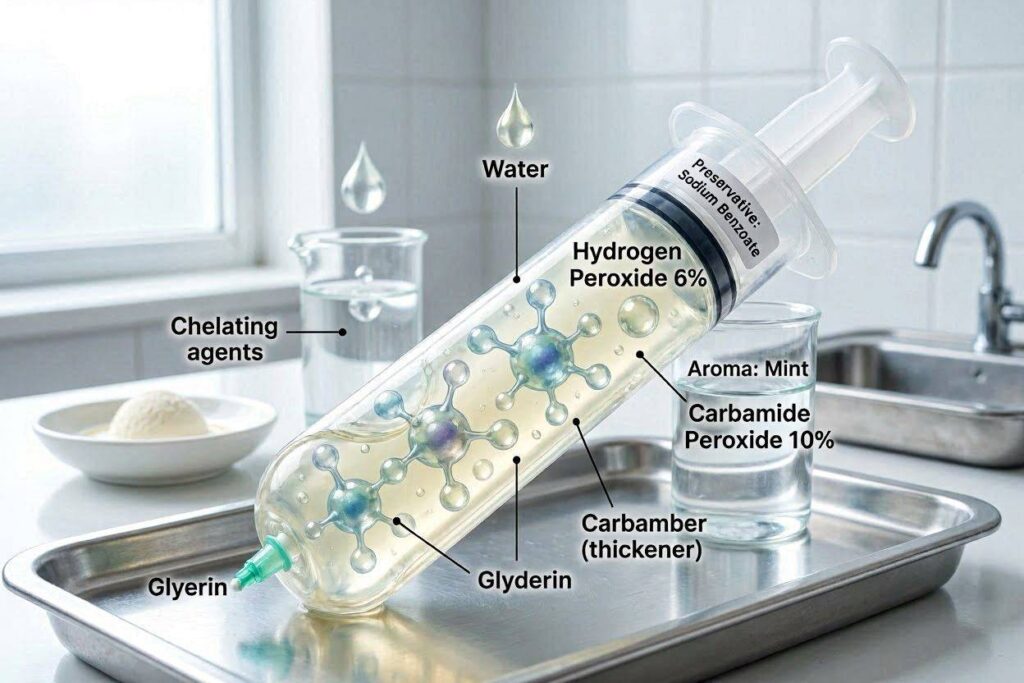
Water, Glycerin, Carbamide Peroxide, Carbomer, Potassium Nitrate, Sodium Hydroxide, Xylitol, Sodium Fluoride (0.25%), Peppermint Oil, EDTA, Sodium Saccharin.
- Water (Solvent): The carrier liquid that activates the carbamide peroxide.
- Glycerin (Humectant): Prevents crusting and keeps the gel moist against the gumline.
- Carbamide Peroxide (Active): The actual whitening molecule; slow-release breakdown.
- Carbomer (Thickener): Creates the sticky tray viscosity and prevents saliva washout.
- Potassium Nitrate (Desensitizer): Depolarizes the nerve to stop zingers.
- Sodium Hydroxide (pH Adjuster): Counteracts the acidic nature of the raw materials to bring the gel to a safe neutral pH.
- Xylitol (Sweetener/Anti-cavity): Inhibits bacterial plaque and masks urea bitterness.
- Sodium Fluoride (Remineralizer): Forms fluorapatite to seal open tubules.
- Peppermint Oil (Flavor): Provides the cooling, anesthetic sensation and clean taste.
- EDTA (Stabilizer): Chelates metal ions to stop the peroxide decomposing in the tube.
- Sodium Saccharin (Sweetener): Non-cariogenic intense sweetener to kill bitter aftertaste.
If a product label lists these items clearly, with the peroxide concentration prominently displayed, you are likely holding a legitimate, scientifically sound whitening system.
Conclusion
Teeth whitening gel is a carefully orchestrated system of oxidation, stabilization, and biocompatibility. It relies on hydrogen peroxide or carbamide peroxide to penetrate enamel and chemically snap the carbon bonds of stains, transforming the tooth from the inside out without scrubbing. The surrounding gel matrix of thickeners, pH balancers, and humectants controls the delivery speed, ensuring the peroxide stays safely against the tooth rather than leaking onto your gums. To choose wisely, you must prioritize formulas that include proven desensitizing agents like potassium nitrate and fluoride, giving you a brighter smile without sacrificing your comfort or long-term enamel health.
Frequently Asked Questions
Can I just use household hydrogen peroxide to save money?
No. The brown bottle of 3% peroxide from the drugstore is a disinfectant, not a dental gel. It lacks a thickener to keep it on your teeth, lacks a pH buffer (it’s very acidic), and lacks a desensitizer. It will quickly run off your teeth onto your gums and tongue, causing chemical burns and a massive sensitivity spike without providing significant contact time for whitening.
Why did my gel turn into a watery liquid?
The viscosity broke down due to heat or age. Carbomer networks collapse under extreme heat (like being left in a hot car) or over time due to ionic contamination. Once the polymer network breaks, the water phase separates. A watery gel is dead gel. The peroxide might still be active, but the delivery system is destroyed, meaning it will leak off the teeth and provide almost no whitening effect.
What does “peroxide-free” whitening gel use instead?
Most use Phthalimidoperoxycaproic acid (PAP). This is an organic peroxy acid, chemically distinct from hydrogen peroxide. It generates peroxy radicals to bleach stains. However, PAP chemistry is newer and less clinically validated for penetrating deep dentin compared to the decades of data on carbamide peroxide. It often requires blue LED light activation to work, and even then, results typically fade faster.
Why does whitening gel need to be refrigerated?
Some high-concentration, professionally dispensed gels must be refrigerated to slow the thermodynamic decomposition of the peroxide. If you leave a 35% carbamide peroxide syringe at 80°F for a month, the urea-peroxide bond breaks down spontaneously, reducing the concentration to something far weaker. Refrigeration extends the active shelf life.
Can whitening gel fix a dead tooth?
No topical gel on the outside can fix internal necrosis. A tooth that has darkened from the inside out requires “internal bleaching” with sodium perborate, placed inside the tooth chamber by a dentist. External gels cannot reach the inside of a calcified, non-vital pulp chamber.
Additional Resource:
For visual guidance on how to apply carbamide peroxide gels evenly and avoid common mistakes that cause gum burns, view the detailed clinical technique on the American Dental Association’s consumer resource platform: ADA.org MouthHealthy Whitening Guide
Disclaimer: This article provides educational chemistry insights based on published dental materials science. It does not constitute medical advice. Consult with a licensed dentist before beginning any teeth whitening regimen, especially if you have restorations, gum disease, or are pregnant.