Can You Get Dental Implants With Gum Disease?
If you are missing teeth and also dealing with swollen, bleeding, or tender gums, you have probably asked yourself a very important question: can you get dental implants with gum disease?
It is a fair question. Dental implants are a fantastic solution for missing teeth. They look, feel, and function like natural teeth. But they are also a significant investment in your health. You want to get it right.
Here is the honest, no-nonsense truth.
You cannot safely place dental implants while active gum disease is present. However, that does not mean you are disqualified forever. In most cases, you can absolutely get implants after your gum disease is treated and controlled.
Think of it like building a house. You would not build a beautiful new home on a shaky, flooded foundation. The house would fail. Your jawbone and gums are the foundation for your implants. If they are infected and inflamed, the implants will likely fail.
This guide will walk you through everything you need to know. We will cover why gum disease is a problem, how to treat it, how long you need to wait, and what success looks like. Let us get started.
Understanding Gum Disease: The Silent Enemy of Implants
Before we talk about solutions, we need to understand the problem. Gum disease is not just “a little bleeding when you brush.” It is a serious infection.
What is Gum Disease?
Gum disease, also known as periodontal disease, is an infection of the tissues that hold your teeth in place. It is caused by poor brushing and flossing habits. When plaque—a sticky film of bacteria—builds up on your teeth, it hardens into tartar. This bacteria irritates your gums.
There are two main stages:
- Gingivitis: This is the early, mild stage. Your gums may be red, swollen, and bleed easily. The good news? Gingivitis is reversible with professional cleaning and good home care. At this stage, the bone is not yet damaged.
- Periodontitis: This is the advanced stage. The inner layer of the gum and bone pulls away from the teeth, forming pockets. These pockets collect debris and become infected. Your body’s immune system fights the bacteria, but the process also breaks down the bone and connective tissue that hold teeth in place. This damage is permanent without treatment.
Why Gum Disease Destroys Implants
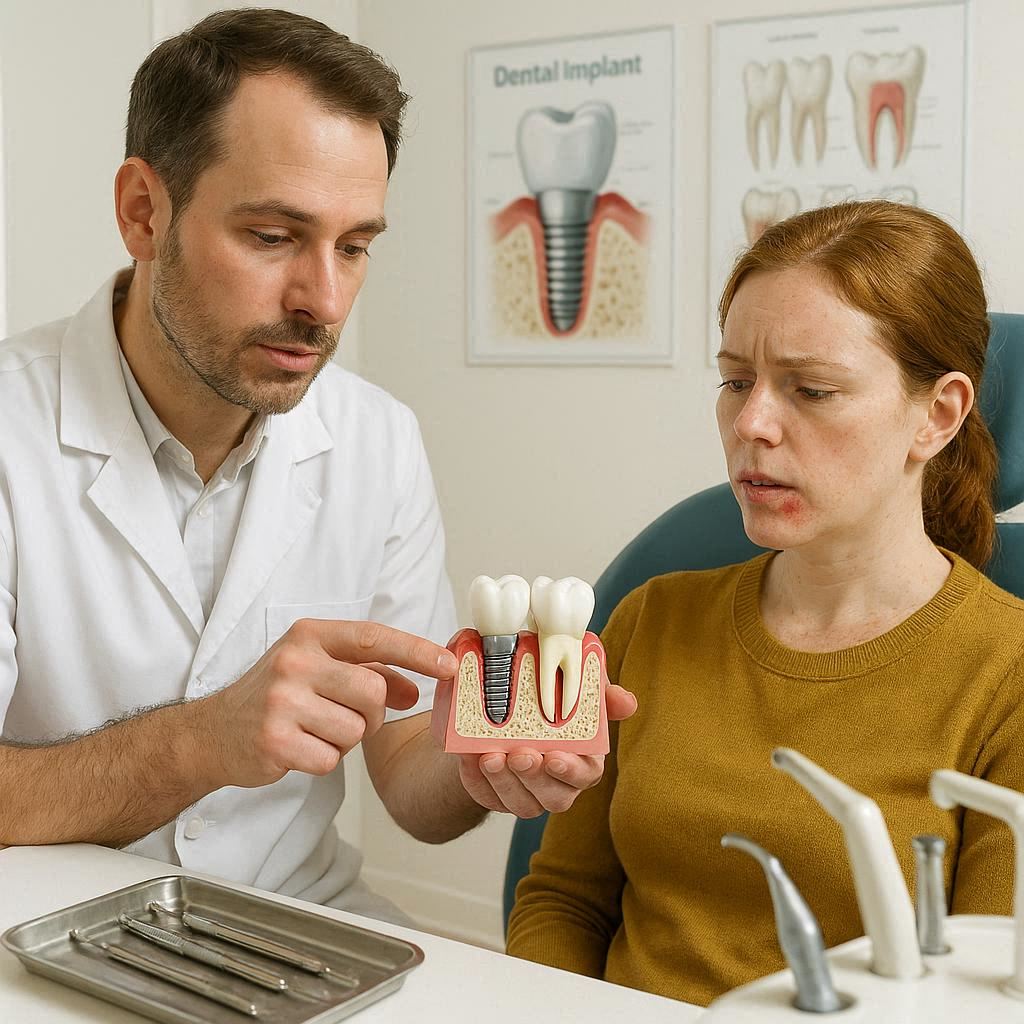
Dental implants are made of titanium. They are surgically placed into your jawbone. Over time, your bone grows around the implant. This process is called osseointegration. It is the secret to why implants are so strong.
Gum disease interferes with this process in three major ways:
- Bone Loss: Periodontitis destroys jawbone. If you do not have enough healthy bone, the implant has nothing to grip. It would be like trying to plant a tree in sand.
- Active Infection: Placing an implant into infected gum tissue is dangerous. The bacteria can contaminate the implant site. This leads to a condition called peri-implantitis. This is essentially gum disease for implants. It causes bone loss around the implant and often leads to implant failure.
- Poor Healing: Gum disease keeps your body in a constant state of inflammation. This weakens your immune response. When you get an implant, your body needs to heal quickly and effectively. Chronic inflammation makes that very difficult.
Important Note: Many dentists consider active, untreated periodontitis a complete contraindication for dental implants. That is a medical way of saying “do not do this.”
Can You Get Dental Implants With Gum Disease? The Direct Answer
Let us get straight to the point.
| Condition | Can you get implants? | What needs to happen? |
|---|---|---|
| Active, untreated periodontitis | No | You need immediate treatment to control the infection. |
| Mild gingivitis | Maybe, but not recommended | A professional cleaning and improved oral hygiene. Most dentists will ask you to wait a few weeks. |
| Treated, controlled gum disease | Yes | You are a candidate if you maintain excellent hygiene and regular maintenance visits. |
| History of gum disease with bone loss | Yes, with planning | You may need bone grafting or special implant techniques. |
So, the direct answer is: Not while it is active. But yes, after successful treatment.
A responsible dentist will never place an implant in a mouth with active gum disease. If someone offers to do that, consider it a major red flag. Run the other way.
The Step-by-Step Journey: From Gum Disease to Dental Implants
Getting from an infected mouth to a successful implant takes time. But the process is clear and proven. Here is how it works.
Step 1: The Comprehensive Evaluation
Your journey starts with a detailed exam. Your dentist will not just look at your missing tooth. They will examine your entire mouth.
- Periodontal probing: Your dentist uses a small ruler to measure the pocket depths around your teeth. Healthy pockets are 1-3 mm deep. Pockets deeper than 4 mm suggest gum disease.
- X-rays: These show the health of your jawbone. Your dentist can see if you have lost bone from periodontitis.
- Medical history review: Some conditions like diabetes or habits like smoking can worsen gum disease and affect implant success.
Step 2: Active Gum Disease Treatment (Periodontal Therapy)
This is the most critical phase. You must stop the infection.
Your treatment plan may include one or more of these:
- Scaling and root planing (deep cleaning): This is the gold standard for initial treatment. Your dentist numbs your gums. Then, they scrape away plaque and tartar from above and below the gum line. They smooth the tooth roots to help gums reattach.
- Laser therapy: Some dentists use lasers to remove infected tissue and kill bacteria. It is less invasive than surgery.
- Antibiotics: Your dentist may place antibiotic fibers directly into infected pockets or prescribe oral antibiotics to control severe infection.
- Flap surgery: For advanced cases, a periodontist makes small incisions in your gums. They lift the tissue back, clean the tooth roots thoroughly, and then suture the gums in place.
- Bone grafting (preparatory): If you have lost significant bone from gum disease, you may need a bone graft before even thinking about implants. This graft creates a solid foundation.
Step 3: The Healing and Maintenance Phase (3-12 Months)
After your gum disease is treated, you are not ready for implants yet. Your gums and bone need time to heal.
- Re-evaluation: Your dentist will measure your pocket depths again after 4-6 weeks. They want to see pockets shrink and gums become firm and pink.
- Improved home care: You must prove you can keep your mouth clean. This means brushing twice a day, flossing daily, and possibly using special tools like water flossers or interproximal brushes.
- Regular maintenance cleanings: You will need cleanings every 3-4 months instead of every 6 months. This is critical. Gum disease is a chronic condition. It can come back.
- Waiting period: Most dentists will wait at least 3-6 months after successful gum disease treatment before placing implants. In cases with significant bone grafting, you may wait 9-12 months.
Step 4: Implant Placement
Once your periodontist or oral surgeon confirms that:
- Your gums are healthy (no bleeding, pockets 3mm or less).
- Your bone is dense and tall enough.
- You have maintained excellent oral hygiene for several months.
Then, you are cleared for implant surgery.
The procedure is straightforward:
- Your dentist numbs the area.
- They make a small cut in your gum.
- They drill a precise hole into your jawbone.
- They place the titanium implant post.
- They close the gum over the implant or attach a healing cap.
Step 5: Osseointegration and Restoration
You wait another 3-6 months for the implant to fuse with your bone. During this time, you must be extra careful with your oral hygiene. You do not want peri-implantitis.
Finally, your dentist attaches the abutment (connector) and your custom-made crown. You have a new tooth.
Factors That Improve Your Success Rate After Gum Disease
Not everyone with a history of gum disease has the same risk. Some people can have very high success rates. Others face an uphill battle.
Here are the key factors.
The Non-Negotiables
- Excellent oral hygiene: This is the biggest factor. You must be a model patient. No skipping flossing. No missing cleanings.
- Regular periodontal maintenance: You cannot go back to a 6-month cleaning schedule. You need visits every 3-4 months for life.
- Non-smoker: Smoking dramatically increases the risk of implant failure in people with a history of gum disease. If you smoke, you must quit. There is no way around this.
- Controlled systemic conditions: If you have diabetes, it must be well-managed. Uncontrolled blood sugar wrecks gum health and implant healing.
What the Research Says
Multiple studies show that people with treated gum disease can have implant success rates of 90-95% after 5-10 years. That is nearly as good as people with no history of gum disease.
However, the risk of peri-implantitis (the implant form of gum disease) is higher. One study found that patients with a history of periodontitis had a 20-30% higher risk of developing peri-implantitis over 10 years compared to healthy patients.
“Having gum disease in the past does not mean you cannot have implants. It means you must be more vigilant. You are trading a natural tooth for an implant. The implant has no ligament to sense infection. You will not feel pain until it is too late. Regular checkups are not optional; they are your insurance policy.” — Dr. Elena Martinez, Periodontist
Signs You Might Not Be Ready (And What To Do)
It helps to know when things are going wrong. Here are clear signs that your mouth is not ready for implants.
| Sign | What it means | What to do |
|---|---|---|
| Gums bleed when you brush or floss | Active inflammation | Go back to your dentist for another deep cleaning. Improve your home care. |
| You have loose teeth | Advanced bone loss from periodontitis | You need immediate periodontal treatment. Implants are not safe yet. |
| Your gums are receding | Loss of gum tissue and possibly bone | See a periodontist. You may need gum grafting before implants. |
| You have not seen a dentist for over a year | Unknown disease activity | Schedule a full exam and cleaning. Start with a clean slate. |
| You have pus coming from your gums | Active infection | This is an emergency. See a dentist within 24 hours. |
If you notice any of these, pause your implant plans. Focus 100% on getting your gums healthy first. This is not a failure. It is the smart, safe path.
Special Cases and Considerations
Let us look at some specific situations. These are common questions patients ask.
Case 1: “I had gum disease 10 years ago, but my gums are fine now.”
This is a good scenario. If you have maintained regular cleanings and have had no active disease for years, you are likely a good candidate. Your dentist will still examine you carefully. They will check for hidden bone loss from the past. You may still need a bone graft if the old disease destroyed bone.
Case 2: “I have gum disease, but only around my natural teeth. My missing tooth area looks healthy.”
This is tricky. Gum disease is a whole-mouth condition. The bacteria in your saliva travel everywhere. Even if the implant site looks healthy, the bacteria from other areas of your mouth can colonize the new implant. You must treat the entire mouth, not just one spot.
Case 3: “I have aggressive gum disease that runs in my family.”
Some people have a genetic tendency toward aggressive periodontitis. This does not disqualify you, but it changes the game. You will need more frequent maintenance (every 2-3 months). Your dentist may also recommend antimicrobial rinses or locally delivered antibiotics at the time of implant placement.
Case 4: “I have already lost several teeth to gum disease.”
You can still get implants, but you need a full-mouth rehabilitation plan. Your dentist will likely:
- Extract all hopeless teeth.
- Treat the remaining gum disease.
- Place multiple bone grafts.
- Wait for healing.
- Place multiple implants (like All-on-4 or full-arch fixed bridges).
This is a major, expensive process. But it works. Many people have gone from severe gum disease and tooth loss to a full set of implant-supported teeth.
A Comparative Table: Implant Success Rates Based on Gum Health
This table gives you a realistic picture of what to expect. These numbers are based on clinical studies.
| Patient Profile | 5-Year Implant Survival Rate | 10-Year Implant Survival Rate | Risk of Peri-Implantitis |
|---|---|---|---|
| Healthy gums, non-smoker | 97-98% | 94-96% | Low (5-10%) |
| Treated mild periodontitis, good maintenance | 95-96% | 90-93% | Moderate (10-15%) |
| Treated severe periodontitis, good maintenance | 92-94% | 85-90% | Moderate-High (15-20%) |
| Treated periodontitis, smoker | 80-85% | 70-75% | High (30%+) |
| Active, untreated periodontitis | Not applicable (implants not placed) | Not applicable | Not applicable |
| Poor maintenance after treatment | 70-80% | 50-60% | Very High (40%+) |
How to read this table: If you have a history of severe gum disease, your success rate is still very good (85-90% at 10 years) if you maintain excellent care. The moment you skip cleanings or ignore hygiene, your risk skyrockets.
Practical Steps You Can Take Today
You do not need to wait for a dentist to start improving your situation. Here is a checklist for right now.
Your At-Home Action Plan
- Look in the mirror: Are your gums pink or red? Do you see swelling? Note it.
- The floss test: Floss gently between all your teeth. Does the floss smell bad? Do you see blood? If yes to either, you have active gum inflammation.
- Upgrade your tools:
- Buy a soft-bristled toothbrush (never hard/medium).
- Get a water flosser (Waterpik style). It is excellent for gum disease.
- Buy interproximal brushes (little bottle brushes) if you have wide spaces between teeth.
- Start a log: Write down every time you brush and floss. This builds accountability.
- Call a dentist: If you have not seen one in over 6 months, make an appointment specifically for a “periodontal evaluation.” Do not say “I want an implant.” Say “I think I have gum disease and want to be evaluated.”
Common Myths About Implants and Gum Disease
Let us clear up some dangerous misunderstandings.
Myth 1: “My gums bleed because I floss too hard.”
Truth: Healthy gums do not bleed from normal flossing. Bleeding is a sign of infection. You are not flossing too hard; you have inflammation.
Myth 2: “Implants cannot get gum disease.”
Truth: False. Implants get peri-implantitis. It is faster and harder to treat than natural tooth gum disease. It often requires surgery and can lead to implant loss.
Myth 3: “A bone graft fixes everything.”
Truth: A bone graft replaces lost bone volume. It does not cure the bacterial infection. You can have a perfect bone graft and still lose it to active gum disease.
Myth 4: “I can get implants right after a deep cleaning.”
Truth: No. Your gums need time to heal and tighten around your teeth. Most dentists wait several months to ensure the disease is truly controlled.
The Financial Perspective
Treating gum disease and then getting implants is more expensive than just getting implants. But it is cheaper than failed implants.
Here is a realistic cost breakdown (USD estimates, varies by location):
| Procedure | Typical cost range | Notes |
|---|---|---|
| Comprehensive periodontal exam + X-rays | $150 – $350 | Required |
| Scaling and root planing (full mouth) | $500 – $2,000 | Often split into 2-4 appointments |
| Periodontal maintenance cleaning (every 3-4 months) | $100 – $250 per visit | For life |
| Bone grafting (single site) | $500 – $1,500 | Often needed after gum disease |
| Single dental implant (post + crown) | $3,000 – $6,000 | Varies widely |
| Peri-implantitis treatment (if implant fails later) | $1,000 – $4,000+ | Avoid this by being proactive |
Total estimated investment for one implant after gum disease treatment: $4,250 to $10,000+
It is a lot. But compare that to the cost of a failed implant (another $3,000-$6,000 to replace) plus the emotional and time cost. Treating gum disease first is the economical choice.
Long-Term Success: Your 10-Year Plan
Getting the implant is just the beginning. Here is your roadmap for long-term success.
Year 1 After Implant Placement
- Months 1-3: Be extremely gentle but thorough. Use a water flosser on low setting around the implant.
- Month 4: First maintenance cleaning after crown placement. Your dentist will take special X-rays to check bone levels around the implant.
- Month 6 & 12: Follow-up visits. Your dentist will check for bleeding around the implant.
Years 2-5
- Continue 3-4 month maintenance cleanings.
- Have your dentist measure pocket depths around the implant at least once per year.
- If you notice any bleeding or bad taste near the implant, do not wait. See your dentist immediately.
Years 5-10
- Annual X-rays to monitor bone levels.
- If you see any gum recession around the implant, get it evaluated. Recession can expose implant threads and lead to plaque buildup.
- Continue impeccable home care. Many patients get lazy after 5 years. Do not be one of them.
A Note for Life: Your implant has no periodontal ligament. In a natural tooth, that ligament senses pressure and pain. It tells you if you bite something too hard or if an infection is starting. Your implant has none of that. You are flying blind. Your only sensors are your dentist’s probe and your annual X-rays. Never skip them.
Frequently Asked Questions (FAQ)
1. Can I get a dental implant if I have receding gums?
Yes, but you may need a gum graft first. Receding gums expose tooth roots and implant threads. A periodontist can take tissue from your palate or use donor tissue to build up the gum around the implant site.
2. How long after gum disease treatment can I get an implant?
Typically, 3 to 6 months after your gums are declared healthy. If you needed bone grafting, wait 6 to 12 months.
3. What is peri-implantitis?
It is the implant version of gum disease. Bacteria infect the tissue around the implant, causing inflammation and bone loss. It is harder to treat than natural gum disease because the implant has no protective ligament. Early signs include bleeding when probing and redness.
4. Can I get implants if I have lost all my teeth to gum disease?
Yes. Full-arch solutions like All-on-4 are designed for this exact situation. Your dentist will remove any remaining infected teeth, treat the gum disease, place implants (often 4 or 6 per arch), and attach a fixed bridge. Many people have successfully done this.
5. Does insurance cover implants if I have gum disease?
Dental insurance rarely covers implants fully. However, most plans cover gum disease treatment (scaling, root planing, maintenance cleanings). Check your medical insurance as well; some medically necessary bone grafts or extractions may be partially covered.
6. Is it better to get a bridge instead of an implant if I have gum disease?
Not necessarily. A bridge requires crowning healthy adjacent teeth. Those teeth also have gum disease risk. Plus, bridges are harder to clean underneath, which can worsen gum disease. A well-placed implant after gum disease treatment is often the better long-term choice.
7. Can I use my Waterpik around my implant?
Yes, absolutely. Use it on a low to medium setting. Direct the water at a 90-degree angle to the gum line. Water flossers are excellent for cleaning around implants and under bridges.
Additional Resources
For more reliable, science-based information, visit the American Academy of Periodontology’s patient page.
👉 Perio.org / Gum Disease & Dental Implants
This resource offers:
- A “Find a Periodontist” tool.
- Detailed guides on peri-implantitis.
- Videos explaining scaling, root planing, and implant surgery.
- Printable oral hygiene logs.
Final Conclusion
You cannot get dental implants with active gum disease because the infection will likely cause implant failure. However, after professional treatment, healing, and a commitment to lifelong maintenance, most people with a history of gum disease are successful implant candidates. The key is to treat your gums first, then place the implant, and never skip your 3-4 month cleaning appointments.