Can You Remove Dental Implants Safely?
If you have a dental implant that is causing pain, feels loose, or simply does not seem right, you might be asking yourself a stressful question: can you remove dental implants safely?
The short answer is yes. Dental implants can be removed safely, but the procedure is more complex than taking out a natural tooth. It requires a skilled surgeon, the right tools, and a clear understanding of why the implant needs to come out.
This guide walks you through everything you need to know. You will learn why implants fail, how removal works, what recovery looks like, and how to protect your jawbone afterward. No fluff. No false promises. Just honest, practical information.
Why Would Someone Need an Implant Removed?
Dental implants have a success rate of over 95% when placed correctly and cared for properly. However, complications do happen. Understanding the “why” helps you recognize early warning signs.
Peri-Implantitis (Infection Around the Implant)
This is the most common reason for removal. Peri-implantitis is an inflammatory condition that affects the gum and bone surrounding an implant. Bacteria build up below the gum line, leading to bone loss. Over time, the implant loses support and becomes loose.
Signs include:
- Bleeding when brushing near the implant
- Pus around the gum line
- Deep pocketing (measured with a dental probe)
- Visible bone loss on X-rays
If caught early, peri-implantitis can be treated without removal. But in advanced stages, removing the implant is the only way to stop bone destruction.
Implant Fracture or Mechanical Failure
Implants are strong, but they are not indestructible. A fracture in the implant body itself is rare but serious. More often, the connecting parts fail: the abutment screw breaks, the crown cracks, or the threads strip.
When the implant body breaks below the bone level, removal becomes urgent. Leaving a fractured implant in place can lead to chronic infection and pain.
Nerve Damage or Persistent Pain
Sometimes an implant is placed too close to the inferior alveolar nerve (the main nerve in the lower jaw). This can cause:
- Numbness or tingling in the lip, chin, or gum
- Chronic, unexplained pain
- A burning sensation that does not go away
If symptoms do not improve after several months, the implant may need to be removed to relieve pressure on the nerve.
Poor Aesthetics or Positioning
An implant that is placed at the wrong angle can look unnatural. The crown might stick out, or the gum line might recede in an ugly way. While some cases can be fixed with a custom crown or gum grafting, severe positioning errors require removal.
Rejection (True Allergy or Foreign Body Reaction)
True implant rejection is extremely rare. Titanium allergies affect less than 1% of the population. However, some people develop a chronic inflammatory response to the implant material. Symptoms include persistent swelling, rash-like redness on the gum, and failure of the bone to attach to the implant surface.
Progressive Bone Loss
Even without obvious infection, some patients lose bone around an implant over time. Causes include:
- Bruxism (teeth grinding) creating excessive force
- Uncontrolled diabetes or other systemic conditions
- Smoking (which reduces blood flow to the bone)
When bone loss reaches a critical point, the implant becomes unstable and must be removed.
Can You Remove Dental Implants Safely? The Real Answer
Let us be direct. Yes, you can remove dental implants safely, but “safe” depends on three factors:
- The reason for removal – A loose, infected implant is easier to remove than a fully integrated one.
- The surgeon’s skill – An oral surgeon or periodontist with implant removal experience is essential.
- The removal technique used – Modern tools like piezoelectric surgery make removal much safer than older methods.
Important note: Never try to remove a dental implant yourself or go to a general dentist who has done only a few removals. This is a surgical procedure involving bone and nerve structures. Choose your provider carefully.
How Dentists Remove Implants: Step by Step
The removal process is not a single method. Surgeons choose a technique based on how well the implant has fused with the bone (a process called osseointegration).
Pre-Removal Assessment
Before any surgery, you will have:
- A CT scan (3D X-ray) to see the implant’s position relative to nerves, sinuses, and adjacent teeth
- A clinical exam to check mobility and infection levels
- A discussion of anesthesia options (local, sedation, or general)
Technique 1: Reverse Torque Removal (For Loose Implants)
If the implant has lost integration with the bone, removal can be surprisingly simple.
The surgeon:
- Numbs the area completely.
- Uses a special wrench or driver that fits into the implant’s internal hex or connection.
- Turns the implant counterclockwise (like unscrewing a bolt).
- Lifts the implant out of the socket.
This method takes five to ten minutes and causes minimal trauma to the bone.
Technique 2: Trephine Drilling (For Integrated Implants)
When the bone has grown tightly around the implant, unscrewing is not possible. The surgeon instead uses a trephine drill—a hollow, tube-shaped drill with cutting teeth on the end.
The process:
- The trephine drill fits over the implant like a sleeve.
- The surgeon drills around the implant, cutting a cylindrical core of bone.
- The implant comes out inside the bone core.
- The bone core can be used as graft material if it is healthy.
This method preserves as much bone as possible but requires precision.
Technique 3: Piezoelectric Surgery (The Modern Gold Standard)
Piezoelectric devices use ultrasonic vibrations to cut bone but not soft tissue. This is a game-changer for implant removal.
Benefits include:
- Cuts only mineralized tissue (bone), leaving nerves and blood vessels intact
- Excellent visibility because the field stays dry (no coolant spray)
- Very fine control, reducing bone loss
The surgeon creates a thin window in the bone around the implant, loosens it, and lifts it out. Recovery is faster than with traditional drills.
Technique 4: Lateral Window Approach (For the Upper Jaw)
If an implant in the upper jaw has penetrated the sinus cavity, a lateral window approach is used. The surgeon opens a small “window” in the side of the sinus bone, removes the implant from within the sinus, and then closes the window with a membrane.
This is a more advanced procedure but is very safe when performed by an experienced oral surgeon.
Comparative Table: Removal Methods at a Glance
| Removal Method | Best For | Procedure Time | Bone Loss | Recovery Difficulty |
|---|---|---|---|---|
| Reverse torque | Loose / non-integrated implants | 5–15 minutes | None | Mild |
| Trephine drill | Firmly integrated implants | 20–40 minutes | Small (2–3 mm) | Moderate |
| Piezoelectric surgery | Most implants, especially near nerves | 30–60 minutes | Minimal | Mild to moderate |
| Lateral window | Upper implants in sinus | 45–90 minutes | Moderate | Moderate to significant |
What to Expect During the Procedure
You will receive local anesthesia at minimum. For anxious patients or complex cases, IV sedation or general anesthesia is an option.
Most patients report feeling pressure and vibration but no sharp pain. If you feel pain at any point, tell the surgeon immediately so more anesthetic can be given.
The sound of drilling is normal, but it is usually quieter than you expect—especially with piezoelectric tools.
After the implant is out, the surgeon will:
- Clean the socket thoroughly (removing any infected tissue or granulation material)
- Irrigate with sterile saline
- Place bone graft material if needed
- Suture the gum closed (or leave it open to drain if infection was severe)
The entire appointment typically lasts 60 to 90 minutes for a single implant removal.
Recovery: What Happens After Removal
Recovery from implant removal is generally easier than recovery from the original implant placement. However, this varies depending on how much bone work was required.
First 24 Hours
- Bite on gauze for 30–60 minutes to stop bleeding.
- Apply an ice pack to the outside of your face (20 minutes on, 20 minutes off).
- Eat only cold or lukewarm soft foods (yogurt, smoothies, soup).
- Do not spit, use a straw, or smoke.
Days 2 to 7
- Swelling typically peaks at 48 hours, then begins to go down.
- Stick to soft foods. Avoid chewing near the extraction site.
- Gently rinse with warm salt water after meals (do not swish vigorously).
- Take prescribed pain medication or over-the-counter ibuprofen as directed.
Weeks 2 to 4
- The gum tissue heals over the socket.
- If bone graft was placed, avoid any pressure on the area for at least three months.
- You may feel small bone fragments working their way out of the gum. This is normal but let your surgeon know.
Complete Healing
Soft tissue healing: 4 to 6 weeks
Bone healing (if grafted): 4 to 9 months
Important note: Do not rush to place a new implant. Your surgeon will monitor bone healing with periodic X-rays. Placing a new implant too early is a common cause of second failure.
Risks and Complications of Implant Removal
Any surgery carries risks. Being honest about them helps you make an informed decision.
Common (But Usually Minor)
- Pain and swelling – Manageable with ice and medication.
- Bleeding – Usually stops within a few hours.
- Infection – Rare if you follow post-op instructions; antibiotics may be prescribed.
Less Common but Serious
- Nerve injury – Removal can stretch or damage the inferior alveolar nerve, potentially worsening numbness or tingling. A CT scan before surgery minimizes this risk.
- Jaw fracture – Extremely rare. Occurs only when the implant is very large or the bone is severely weakened by infection.
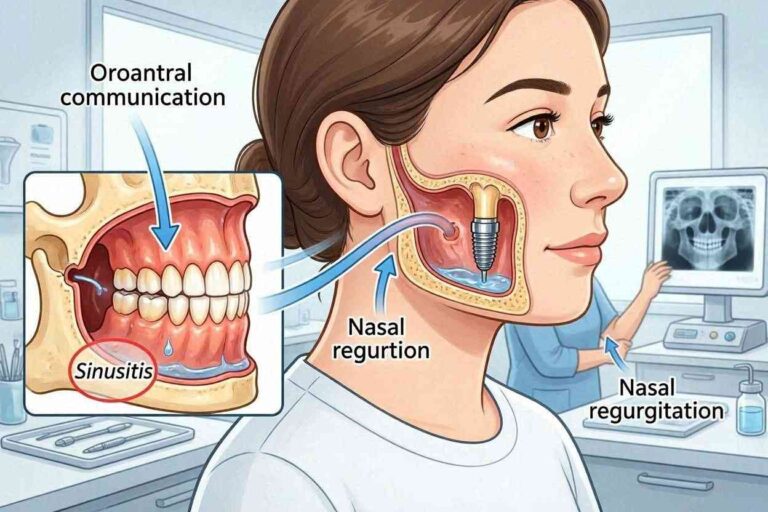
- Sinus communication – A hole between the mouth and sinus cavity in upper jaw removals. Most heal on their own, but some require surgical closure.
- Loss of adjacent teeth – If the implant was fused to a neighboring tooth root, removal could loosen that tooth. This is why pre-removal imaging is critical.
When to Call Your Surgeon Immediately
- Bleeding that soaks through more than one gauze pad per hour
- Fever over 101°F (38.3°C)
- Swelling that worsens after 48 hours instead of improving
- Numbness that spreads or becomes more severe
- Difficulty breathing or swallowing (extremely rare, seek emergency care)
What Happens to the Bone After Removal?
This is one of the most important questions patients forget to ask.
When an implant is removed, it leaves a hole in the bone called a defect. The size of the defect depends on:
- How long the implant was in place (longer = more bone adaptation)
- Whether infection was present (infection destroys bone)
- The removal method used
Small Defects (Under 3 mm)
These often fill in with new bone on their own within four to six months. No grafting is needed.
Moderate to Large Defects (3 mm to 10 mm)
These require bone grafting. The surgeon packs the socket with either:
- Allograft (donated human bone from a tissue bank)
- Xenograft (bovine or porcine bone)
- Synthetic bone (calcium phosphate materials)
The graft acts as a scaffold. Your body replaces it with living bone over time.
Severe Defects (Over 10 mm or with sinus involvement)
A more complex bone reconstruction may be needed, such as a sinus lift (for upper jaw) or block grafting (taking bone from your chin or hip).
Key takeaway: Do not assume you can simply remove an implant and place a new one in the same appointment. Most patients need at least four months of healing before a new implant can be placed.
Can You Replace a Removed Implant with a New One?
Yes, in the vast majority of cases. However, the timeline matters.
Immediate Replacement (Same Appointment)
Only possible if:
- The removed implant was not infected
- The bone defect is very small (under 2 mm)
- There is excellent primary stability for the new implant
This is rare. Most surgeons prefer to wait.
Early Replacement (2 to 4 Months)
The bone defect has filled with soft callus (early bone). A new implant can be placed, but it may need to be slightly wider or longer to get good grip.
Delayed Replacement (4 to 9 Months)
The bone has fully remodeled. This offers the highest success rate for the new implant. The downside: you wait longer without a tooth in that spot.
Your surgeon will help you decide based on your specific bone quality and the reason the first implant failed.
Cost of Implant Removal
Prices vary widely by location, surgeon experience, and complexity. Below are typical ranges in the United States (as of 2026).
| Removal Complexity | Cost (Without Insurance) | Cost (With Dental Insurance)* |
|---|---|---|
| Simple reverse torque | $250 – $500 | $50 – $200 |
| Trephine or piezoelectric | $600 – $1,200 | $300 – $700 |
| Lateral window (sinus) | $1,500 – $3,000 | $800 – $1,800 |
| With bone grafting | Add $400 – $1,000 | Add $200 – $600 |
*Insurance coverage varies. Some plans cover removal of a failed implant. Others consider it elective. Always get a pre-authorization.
Money-saving tip: If the original implant surgeon caused the failure (e.g., poor placement, wrong size), many reputable surgeons will remove it at a reduced fee or for free. Do not be afraid to ask.
How to Choose the Right Surgeon for Removal
Not all dentists are equal when it comes to implant removal. Look for:
- Board certification in oral and maxillofacial surgery or periodontics.
- Experience – Ask directly: “How many implant removals have you done?” A good answer is more than 50.
- Piezoelectric equipment – If they do not have it, ask why not. It is the safer standard.
- On-site CT scanner – Removing an implant without a 3D scan is risky.
- Reviews mentioning complications – Read negative reviews carefully. How did the surgeon handle problems?
Red Flags to Avoid
- A surgeon who promises immediate replacement without examining your CT scan
- A quote that seems too low (under $200 for a complex removal)
- A dentist who says “it’s just like pulling a tooth” (it is not)
Preventing Implant Failure: What You Can Do
If you still have your implant and want to keep it, focus on these four areas.
1. Professional Maintenance
See your dentist or hygienist every three to six months for peri-implant probing and cleaning. Regular tooth cleaning tools cannot reach below the gum line around implants.
2. Home Care
- Use a soft-bristled toothbrush.
- Clean between implants with superfloss or interdental brushes (not regular string floss).
- Consider a water flosser on a low setting.
- Avoid abrasive toothpastes (they scratch the implant surface, encouraging bacteria to stick).
3. Manage Bruxism
If you grind your teeth at night, get a custom nightguard. Grinding transfers excessive force to the implant, which can lead to screw loosening, crown fracture, or even bone loss.
4. Control Systemic Health
- Keep HbA1c under 7% if you have diabetes.
- Quit smoking (smokers have a 2- to 3-times higher failure rate).
- Limit alcohol (heavy use impairs bone healing).
Personal Stories (Anonymized)
*“My implant hurt for two years. Every dentist said it looked fine on X-rays. Finally, a surgeon did a CT scan and saw the implant was touching a nerve. Removal took 20 minutes with piezoelectric surgery. The relief was instant.”* – Sarah, 52
“Peri-implantitis took my implant. I ignored the bleeding gums because it didn’t hurt. By the time I saw a specialist, half the bone was gone. Removal was necessary. Now I have a bridge instead. I wish I had acted sooner.” – Michael, 47
“I broke my implant crown three times in two years. Turned out the implant itself was fractured below the gum line. Removal with a trephine drill was not fun, but I healed in a month. Second implant is doing great five years later.” – David, 61
These stories are realistic composites. They show that implant removal, while not pleasant, is often the right path to long-term oral health.
Alternatives to Implant Removal
In some cases, you can keep a problematic implant without removing it. Discuss these options with your surgeon.
- Peri-implantitis treatment – Deep cleaning (debridement), laser therapy, or surgical flap with bone grafting.
- Crown modification – A poorly angled crown can be cut off and replaced with a better one.
- Screw replacement – A loose or broken abutment screw can often be removed and replaced without touching the implant body.
- Soft tissue grafting – Receding gums around an implant can be augmented with a gum graft to improve aesthetics and hygiene access.
However, if the implant body itself is fractured, mobile, or causing nerve symptoms, these alternatives will not work. Removal becomes necessary.
Legal and Ethical Considerations
If your implant was placed by a dentist and failed within five years due to negligence (wrong position, improper sterilization, failure to treat peri-implantitis), you may have grounds for a complaint to your state dental board or a malpractice claim.
Most implant manufacturers offer warranties of 5 to 10 years on the implant component itself. However, these warranties typically only cover replacement of the part, not the surgical fees for removal and re-placement.
Always ask for:
- Your pre-op CT scan and X-rays
- Operative notes from the original placement
- Any post-op infection records
If you switch to a new surgeon for removal, they will want these records anyway.
Summary Table: When to Remove vs. When to Treat
| Condition | Can It Be Treated Without Removal? | Recommended Action |
|---|---|---|
| Mild peri-implantitis (no bone loss) | Yes | Deep cleaning + improved home care |
| Moderate peri-implantitis (up to 2 mm bone loss) | Possibly | Surgical debridement + grafting |
| Severe peri-implantitis (over 50% bone loss) | No | Remove implant |
| Loose crown or screw | Yes | Replace screw or tighten crown |
| Fractured implant body | No | Remove implant |
| Poor aesthetics (correctable with new crown) | Yes | New custom crown |
| Poor aesthetics (implant at wrong angle) | No | Remove and replace |
| Nerve symptoms lasting over 6 months | Rarely | Usually remove implant |
Final Thoughts on Safety
So, can you remove dental implants safely? Yes, when done by the right professional with the right tools. The key is not to wait. A problematic implant will not get better on its own. The longer you wait, the more bone you lose, and the harder (and more expensive) removal becomes.
If you are experiencing pain, mobility, or persistent infection around an implant, schedule a consultation with an oral surgeon who performs at least 20 implant removals per year. Bring any X-rays you have. Ask to see their piezoelectric equipment. And do not let fear of the removal process stop you from getting relief.
Many patients say the removal itself is less uncomfortable than living with a failing implant for months or years.
Conclusion
Dental implant removal is a safe, well-established procedure when performed by an experienced oral surgeon or periodontist. The main reasons for removal include advanced peri-implantitis, implant fracture, nerve involvement, and severe bone loss. Removal techniques range from simple reverse torque to piezoelectric surgery, with recovery typically lasting four to six weeks for soft tissue healing and several months for bone. Most patients can eventually receive a new implant after adequate healing and grafting if needed.
Frequently Asked Questions (FAQ)
1. Does removing a dental implant hurt?
During the procedure, you will be numb and should feel no sharp pain. Afterward, most patients describe mild to moderate soreness, similar to a tooth extraction. Pain is usually well-controlled with over-the-counter ibuprofen.
2. How long does implant removal take?
A simple removal takes 5 to 15 minutes. A complex removal (sinus involvement, fractured implant) can take 45 to 90 minutes.
3. Can a dental implant be removed and replaced on the same day?
Rarely. Most surgeons wait at least 4 months to allow bone to heal. Immediate replacement is only possible in very specific, infection-free cases with excellent bone quality.
4. Will I be left with a hole in my jawbone?
You will have a socket where the implant was. If the socket is large, the surgeon will place a bone graft to fill it. Small sockets fill in with natural bone over time.
5. Is it dangerous to leave a failing implant in place?
Yes. A failing implant can cause progressive bone loss, chronic infection, damage to adjacent teeth, and in rare cases, cyst formation or nerve damage. Do not ignore warning signs.
6. Can my general dentist remove my implant?
Some general dentists with advanced training can remove simple, loose implants. However, for integrated, fractured, or infected implants, you should see an oral surgeon or periodontist.
7. How much does implant removal cost without insurance?
Simple removal: $250–$500. Complex removal with bone grafting: $1,500–$4,000. Always get a written estimate before scheduling.
8. Will my dental insurance cover removal?
Many dental plans cover removal of a failed implant, especially if it was placed by an in-network provider. However, coverage varies. Call your insurer before the procedure.
9. Can I get a bridge or denture instead of a new implant?
Absolutely. After removal, you can choose a dental bridge, a partial denture, or simply leave the space empty (if it is not visible or functional). You are not forced to get another implant.
10. How do I know if my implant is failing?
Common signs: bleeding or pus around the implant, bad taste in your mouth, loosening, pain when chewing, or visible gum recession. See a dentist promptly if you notice any of these.
Additional Resource
For a deeper understanding of peri-implantitis prevention and home care, the American Academy of Periodontology offers a free patient guide:
Link: www.perio.org/consumer/dental-implants
This article is for informational purposes only and does not constitute medical advice. Always consult a qualified dental professional for diagnosis and treatment options specific to your situation.