Can You Implant Teeth After Extraction?
You sit in the dental chair, numbed and anxious, as the dentist prepares to extract a tooth that can no longer be saved. A question races through your mind: “Can you put the implant in right now, so I do not have to walk out of here with a gap?” It is a logical and common question. The idea of combining the extraction and the implant into one procedure is deeply appealing.
The answer is a qualified yes. It is indeed possible to place a dental implant immediately after a tooth extraction. This procedure is called immediate implant placement. However, it is not a universal “yes” for every tooth and every patient. There are strict biological requirements and specific risks. Understanding when immediate placement is possible, when it is not, and why the alternative delayed approach is often safer is essential for making an informed decision.
This guide will provide a complete overview of the relationship between extraction and implant placement. We will define the four timing protocols, explain the conditions required for immediate implantation, and outline the step-by-step process. By the end, you will understand your options and be prepared for a productive discussion with your surgeon.
The Four Timing Protocols: A Spectrum of Possibilities
When a tooth is extracted, the healing socket goes through a predictable series of biological phases. The timing of implant placement relative to these phases determines the classification of the procedure.
| Protocol | Timing After Extraction | Socket Status |
|---|---|---|
| Type 1: Immediate Placement | Same day as extraction | Fresh socket with blood clot |
| Type 2: Early Placement with Soft Tissue Healing | 4 to 8 weeks | Gum tissue has closed over the socket |
| Type 3: Delayed Placement with Partial Bone Healing | 12 to 16 weeks | Immature woven bone fills the socket |
| Type 4: Late Placement (Healed Ridge) | 6 months or more | Fully mature, mineralized bone |
Immediate placement, the focus of this article, is a Type 1 protocol. The implant is placed directly into the fresh extraction socket, the moment the tooth is out.
The Appeal of Immediate Implant Placement
Why would anyone want to put an implant into a fresh, bleeding socket? The advantages are significant.
1. Reduction in Surgical Procedures
You undergo one surgery instead of two. The extraction and the implant placement are combined into a single appointment. This means one recovery period, one course of post-operative discomfort, and less time away from work.
2. Shortened Total Treatment Time
By eliminating the three to four-month post-extraction healing wait, the overall implant journey is shortened by several months. The osseointegration period still takes three to six months, but the preparatory healing phase is skipped.
3. Alveolar Ridge Preservation
This is the most important biological advantage. After extraction, the thin facial plate of bone begins to resorb rapidly. Placing an implant immediately acts as an internal scaffold. It occupies the socket and, combined with a bone graft in the jump gap, helps preserve the natural contours of the ridge. This is critically important in the esthetic zone (front teeth), where a caved-in ridge creates a cosmetic disaster.
4. Improved Soft Tissue Esthetics
The gum tissue is supported from day one. The gingival architecture, the scalloped gumline, and the interdental papillae can be better preserved, leading to a more natural-looking final restoration.
The Critical Requirements: When Immediate Placement Is Possible
The success of an immediate implant hinges entirely on the health and integrity of the extraction socket. The surgeon must assess the following conditions before proceeding.
1. Intact Socket Walls
The most critical requirement is a complete, intact bony socket, especially the buccal (facial) plate. This thin wall of bone is vulnerable to fracture during extraction. If the buccal plate is cracked, fenestrated, or completely missing, immediate implant placement is generally contraindicated. The implant needs a bony envelope to stabilize it and to contain the bone graft.
A cone beam CT scan taken before the extraction is the gold standard for assessing the buccal plate thickness and integrity.
2. Absence of Active Infection
A tooth with a chronic, small, contained lesion at the root tip (periapical granuloma) can often be managed safely with immediate placement if the surgeon thoroughly curettes the socket and removes all infected tissue.
However, an acute abscess, purulent exudate (visible pus), cellulitis, or a large radiolucency is an absolute contraindication. Placing an implant into an actively infected environment is a recipe for immediate implant contamination, failure to osseointegrate, and potential spread of the infection.
3. Adequate Bone Beyond the Apex
The implant must achieve primary stability. In a fresh socket, the coronal (top) portion of the implant is surrounded by a gap, not bone. The implant can only engage native bone in the apical (bottom) portion and perhaps in the palatal wall. The surgeon needs at least 3 to 5 millimeters of sound bone beyond the apex of the extraction socket to achieve a tight mechanical lock. If the bone is insufficient, the implant will be unstable.
4. Ideal Three-Dimensional Positioning
The surgeon cannot simply drop the implant into the hole left by the root. The natural root position and angulation are often different from the ideal implant axis. The surgeon must carefully prepare a new osteotomy within the socket, intentionally engaging the palatal wall and the bone apically. This requires significant surgical experience.
5. Proper Management of the Jump Gap
The implant is always narrower than the extraction socket. A space, called the jumping distance or buccal gap, exists. If this gap is smaller than 2 mm and the buccal plate is thick, it may heal with bone alone. If the gap is larger, or the buccal plate is thin, the gap must be filled with a bone graft material to guide bone regeneration. Leaving an unfilled gap invites soft tissue infiltration instead of bone formation.
When Immediate Placement Is NOT Possible
There are clear situations where immediate placement is unsafe or ill-advised.
- Acute Infection: Visible pus, swelling, or draining fistula.
- Severely Compromised Buccal Plate: A large dehiscence or complete absence of the facial bone.
- Inability to Achieve Primary Stability: The implant feels mobile or has very low insertion torque.
- Unfavorable Socket Anatomy: Molar sockets with multiple divergent roots and inter-radicular bone present significant challenges. The inter-radicular septum is often thin and does not provide adequate stability for an implant placed into one of the sockets.
- Compromised Patient: Heavy smokers, uncontrolled diabetics, and immunocompromised patients are poor candidates for immediate placement due to their reduced healing capacity.
The Procedure Step-by-Step
If you are deemed a candidate for immediate placement, here is what the procedure entails.
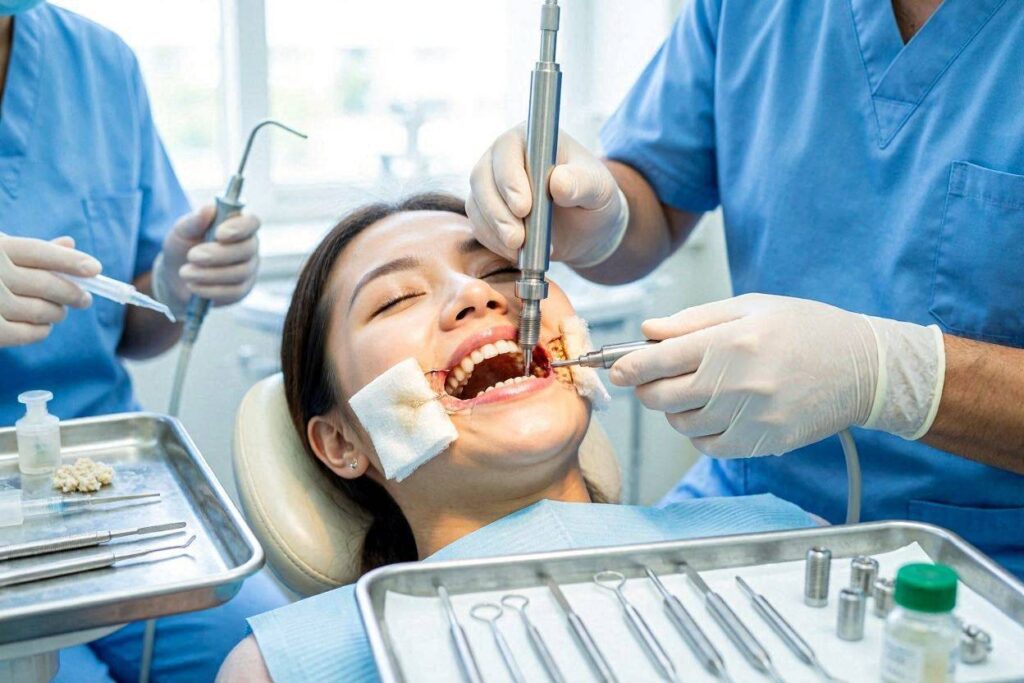
- Atraumatic Extraction: The tooth is removed with extreme care. Periotomes (thin blades) and gentle elevation techniques are used to sever the periodontal ligament fibers without fracturing the thin buccal bone.
- Socket Debridement: The empty socket is thoroughly curetted. All granulation tissue, cyst remnants, and infected material are meticulously removed. The socket is copiously irrigated with sterile saline.
- Osteotomy Preparation: The surgeon uses a sequence of drills to prepare a new bone channel. The implant bed is created predominantly in the palatal wall of the socket and extends 3-5 mm into the bone beyond the apex. The goal is to position the implant in the ideal prosthetic location, not merely where the root was.
- Implant Placement: The implant is placed into the prepared osteotomy and torqued into position. The surgeon measures the insertion torque. A value of at least 30-35 Ncm is desired for adequate primary stability.
- Jump Gap Grafting: The space between the implant and the buccal bone wall is packed with a bone graft material, typically a low-resorption xenograft.
- Membrane Placement: A resorbable collagen membrane may be placed over the graft to protect it and prevent soft tissue cell invasion.
- Suturing: The gum tissue is sutured around the implant. Depending on the plan, a healing abutment is placed that emerges through the gum, or a cover screw is placed, and the gum is closed over the implant.
- Immediate Provisional (Optional): If conditions are excellent and primary stability is very high, a temporary crown may be fabricated and attached to the implant at the same visit. This is immediate provisionalization. The temporary crown is adjusted to have absolutely no contact with the opposing teeth.
The Healing and Osseointegration Period
After immediate placement, the implant must heal undisturbed. The soft tissue heals over several weeks. The bone graft material in the jump gap provides a scaffold for new bone formation. The implant surface undergoes osseointegration over the next three to six months. During this entire period, the implant must not be loaded. If a temporary crown was placed, it is strictly for esthetics and must remain out of occlusion.
At the end of the healing period, the implant is tested for stability. If successful, the final abutment and crown are fabricated. If the implant was buried, a minor uncovering procedure is performed first.
The Alternative: Delayed Placement (The Safer, More Predictable Path)
For many teeth, particularly molars and infected teeth, the delayed protocol remains the standard of care. The tooth is extracted. The socket is thoroughly cleaned and often packed with a bone graft (ridge preservation). The gum heals over. The patient waits four months. A CBCT scan then confirms the site has mature, dense, infection-free bone. The implant is placed into this ideal environment.
This path is longer, but it is significantly more predictable and carries fewer biological risks. It is the safer choice for the majority of cases. An honest surgeon will recommend this path when the conditions for immediate placement are not ideal, even if the patient desires the faster option.
Conclusion
Yes, teeth can be implanted immediately after extraction in a procedure known as immediate implant placement. This approach is possible when the extraction socket walls are intact, there is no active infection, adequate apical bone exists for stability, and the surgeon meticulously manages the bone-implant gap. However, immediate placement is not suitable for infected sites or compromised sockets. When conditions are not ideal, the delayed protocol remains the safer, more predictable standard of care.
FAQ
1. Can I get a temporary tooth on the same day as an immediate implant?
In carefully selected cases with high primary stability, yes. The dentist can place a temporary crown that is screwed or cemented onto the implant. This crown must have absolutely no contact with the opposing teeth when you bite. It is for esthetics only. You must adhere to a strict soft diet and not chew on it.
2. Is immediate implant placement more painful than a standard extraction?
The immediate post-operative experience is similar to a standard extraction plus implant surgery. Because the procedure is more involved, there may be slightly more swelling and soreness. However, you avoid going through two separate surgical recoveries.
3. Is immediate implant placement more expensive?
The surgical fee for immediate placement is often similar to or slightly higher than a staged approach. However, because you avoid a separate implant surgery months later, the total overall cost may be lower. You also save on the cost of a separate bone graft, though grafting the jump gap is an added cost.
4. What happens if the immediate implant fails?
If the implant fails to integrate, it will become mobile and must be removed. The site is then allowed to heal, often with a bone graft to repair the defect. After several months of healing, a new implant can usually be placed using a delayed protocol.
Additional Resource
For more information on immediate implant protocols, consult the Academy of Osseointegration: https://www.osseo.org/