Common Misconceptions About Dental Implants
When you hear the words “dental implant,” what comes to mind? For many people, the first thoughts involve sharp pain, a scary surgical procedure, or a price tag that seems to belong to a luxury car. You might imagine a friend who had a “bad experience” or a grandparent whose dentures never fit right.
Truthfully, the world of modern dentistry has changed dramatically over the last decade. Yet, old stories and lingering fears continue to circulate. These misconceptions often stop people from exploring a solution that could genuinely improve their quality of life.
We will walk through the most common misunderstandings about dental implants. You will learn what is real, what is exaggerated, and what is simply false. By the end, you will have a clear, honest picture to help you make your own decisions.
Let us set the record straight—kindly, clearly, and without any confusing medical jargon.
What Exactly Is a Dental Implant? A Simple Refresher
Before we dive into the myths, let us quickly agree on what an implant actually is. You do not need a medical degree to understand this.
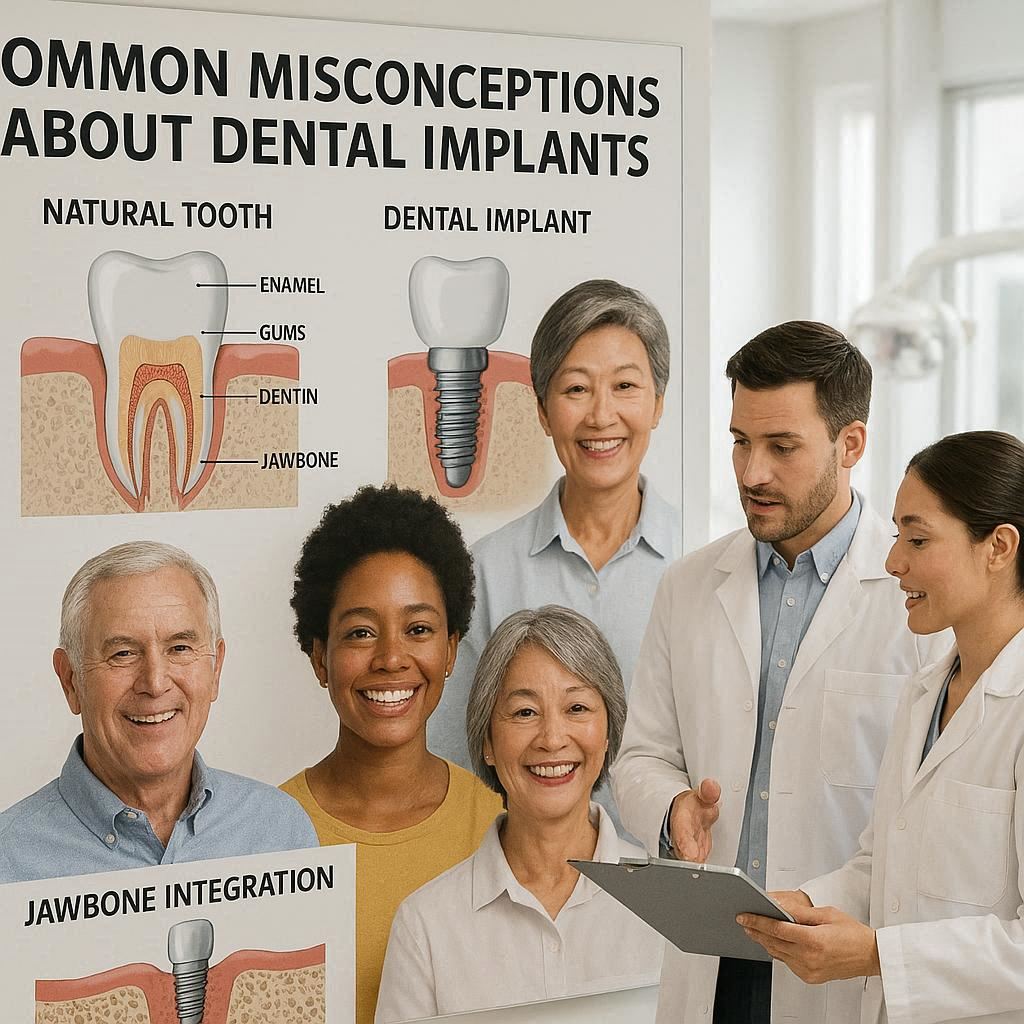
A dental implant is a small, screw-shaped post made from biocompatible material—usually titanium. A surgeon places this post into your jawbone, right where your natural tooth root used to be. Over a few months, your bone grows tightly around the implant. This creates a rock-solid anchor.
Once healed, your dentist attaches an abutment (a connector) and then a custom-made crown on top. The result looks, feels, and functions like a natural tooth.
Think of it this way:
- Implant = the new root
- Abutment = the connector piece
- Crown = the visible tooth
Now that we have the basics, let us tackle the stories you have probably heard.
Myth 1: “Dental Implants Are Extremely Painful”
This is, without doubt, the number one fear people bring into a dental office. The thought of a metal post going into your jawbone sounds like something out of a horror movie. But the reality is much kinder.
What the Research Shows
Modern implant surgery happens under effective local anesthesia. You feel pressure and movement—similar to having a cavity filled—but not sharp pain. Most patients report that the procedure itself is surprisingly comfortable.
The Recovery Truth
The days after surgery bring some soreness. You might compare it to the feeling after a tough workout or a minor bruise. Over-the-counter pain relievers like ibuprofen usually handle this discomfort very well.
Note from a real patient perspective:
“I was terrified before my implant surgery. I took the day off work expecting the worst. To be honest, the worst part was the numbing injection in my gum. After that, I just heard some sounds and felt gentle pushing. I had a sandwich for dinner—soft bread, but still.”
How It Compares to Tooth Extraction
| Procedure | Pain Level During | Pain Level After (Days 1-3) | Typical Medication |
|---|---|---|---|
| Simple Tooth Extraction | Minimal (numb) | Mild to moderate | Ibuprofen or acetaminophen |
| Wisdom Tooth Removal | Minimal (numb) | Moderate to significant | Prescription or OTC |
| Dental Implant Placement | Minimal (numb) | Mild to moderate | Ibuprofen usually enough |
Most people return to work the next day. You simply need to avoid chewing on that side for a little while.
Myth 2: “The Procedure Takes Forever”
When someone says “dental implant,” many picture a year-long ordeal involving countless visits and lots of waiting. This belief comes from older techniques that did take a long time. Today, the timeline is much more reasonable.
The Realistic Timeline
Here is a typical sequence for a single implant:
- Consultation and planning (1 visit)
- Implant placement surgery (about 60-90 minutes)
- Healing period (3 to 6 months—this is essential for bone growth)
- Abutment and crown placement (1 visit, about 30-60 minutes)
Yes, the healing period sounds long. But remember: during those months, you are not walking around with a gaping hole. You will have a temporary tooth or a comfortable partial denture if needed.
“Same-Day” Implants Are Real for Some People
For certain patients with good bone density, dentists can place a temporary crown on the same day as the implant. This is often called “teeth in a day.” However, it is not for everyone. Your dentist will tell you honestly if you qualify.
Why the Healing Time Matters
Your body needs time to perform a process called osseointegration (oh-see-oh-in-tuh-gray-shun). That is just a fancy word for your bone fusing with the implant. Rushing this step risks failure. So while the calendar might show several months, most of that time is passive healing. You simply live your normal life.
Quick summary:
- Active treatment days: Usually 2 to 3 visits
- Passive healing weeks: 12 to 24 weeks
- Total calendar time: 4 to 8 months on average
Myth 3: “Anyone Can Place Dental Implants”
This is a dangerous misconception. Because implant procedures have become more common, some people assume any dentist can do it. That is like saying any driver can race in Formula One.
Who Should Place Your Implant?
Two main types of dental professionals specialize in implants:
- Oral surgeons – Experts in bone, gum, and facial surgery
- Periodontists – Specialists in gum health and the supporting structures of teeth
Some general dentists also place implants after extra training. The key is to ask about their experience. A good rule of thumb: look for someone who places at least 50 implants per year.
What Happens When Placement Goes Wrong?
Poorly placed implants can lead to:
- Nerve damage (numbness in your lip or chin)
- Sinus problems (for upper jaw implants)
- Implant failure (the implant never fuses with bone)
- Aesthetic issues (the crown looks unnatural)
Questions to Ask Before Choosing a Provider
- How many implants have you placed in your career?
- What is your success rate?
- Do you use 3D imaging (CBCT) for planning?
- Will I see the final crown design before placement?
A skilled professional costs more upfront but saves you from expensive corrections later.
Myth 4: “Dental Implants Look Fake”
This myth likely started with the very first implants from decades ago. Early designs often looked bulky, too white, or mismatched in shape. Modern implants tell a completely different story.
The Art of Customization
Today, your dentist or a specialized lab technician designs your crown to match:
- The exact color of your neighboring teeth
- The subtle translucency of natural enamel
- The unique shape and size of your original tooth
You can even choose materials. Porcelain-fused-to-metal crowns are strong. Zirconia crowns look extremely natural and let light pass through like a real tooth.
Does Anyone Notice?
In almost all cases, no. Family members, friends, and coworkers will not see the difference unless you point it out. The only person who truly knows is you—and your dentist.
Here is a simple comparison:
| Feature | Natural Tooth | Modern Implant Crown |
|---|---|---|
| Color match | Your unique shade | Matched precisely to neighbors |
| Gum line | Natural contour | Designed to mimic natural tissue |
| Light reflection | Enamel-like | High-quality ceramic mimics this |
| Feel | Smooth | Smooth (no metal visible) |
What About the “Gum Shrinking” Problem?
Some people fear that over time, the gum around the implant will recede and expose a dark metal line. This used to happen with older systems. Today, most implants use platform switching and custom abutments that prevent this. Proper placement and good oral hygiene keep your gum line healthy and natural-looking.
Myth 5: “Implants Are Only for Older People”
Walk into any implant clinic today, and you will see a wide range of ages in the waiting room. People in their twenties, thirties, and forties regularly choose implants.
Why Younger Adults Choose Implants
Common reasons include:
- A sports injury that knocked out a tooth
- A failed root canal on a front tooth
- A congenital condition (missing adult tooth since birth)
- Severe decay that destroyed a tooth beyond repair
Is There a Minimum Age?
Yes, dentists typically wait until your jaw has finished growing. For most people, this happens around age 18 for females and 20-22 for males. Placing an implant too early could lead to it looking “sunken” as the jaw continues to develop.
And for Older Adults?
Age alone is never a barrier. Healthy 80 and 90-year-olds receive implants successfully. The more relevant factors are overall health and bone density—not the number on your birth certificate.
Myth 6: “Dental Implants Require Too Much Maintenance”
Some people worry that implants will demand special brushes, fancy rinses, or complicated routines. The truth is refreshingly simple.
The Daily Routine
Your implant needs the same care as your natural teeth:
- Brushing twice a day (a soft brush works fine)
- Flossing once a day (special implant floss or interdental brushes help)
- Regular check-ups every six months (your dentist will check the implant)
The One Extra Step
You might need to use a water flosser or a small brush called an interdental brush to clean under the crown. This takes about 30 seconds. That is it.
What You Do NOT Need
- No special expensive toothpaste
- No harsh mouthwashes (alcohol-based ones are fine to avoid)
- No complicated removal at night (implants are fixed, not removable)
Important note: Implants cannot get cavities. The crown material is artificial. However, the gum tissue around the implant can still get inflamed. This condition is called peri-implantitis. Good daily cleaning prevents it completely.
Myth 7: “Implants Always Fail Eventually”
You might have heard a story about someone whose implant “fell out” or “got loose” after a few years. These stories exist, but they represent a small minority.
The Real Success Rates
Clinical studies consistently show:
- 10-year success rate: 95% or higher
- 20-year success rate: 90-95% for healthy patients
- Failure risk factors: smoking, uncontrolled diabetes, poor oral hygiene
To put this in perspective, traditional dental bridges have a 10-year survival rate of around 75-80%. Implants actually outperform bridges over the long term.
What Causes Most Failures?
When implants fail, these are the usual reasons:
- Smoking – Nicotine reduces blood flow to the bone
- Poor oral hygiene – Leading to gum disease around the implant
- Uncontrolled medical conditions – Especially diabetes
- Clenching or grinding – Excessive force can overload the implant
- Insufficient bone – Implant placed without enough support
Can a Failed Implant Be Replaced?
Yes. If an implant fails, your dentist can usually remove it, let the area heal, and place a new implant. The success rate for second attempts is still very good.
Myth 8: “Dental Implants Are Not Worth the Cost”
Let us be honest: implants do cost more upfront than bridges or dentures. But “expensive” and “not worth it” are two completely different things.
Breaking Down the Long-Term Value
Consider this comparison over 20 years:
| Option | Upfront Cost | Average Lifespan | Replacement Costs | Maintenance | Total Estimated Cost (20 years) |
|---|---|---|---|---|---|
| Dental Implant | High | 20+ years (often lifetime) | None (if successful) | Regular check-ups | Moderate to high (one-time) |
| Traditional Bridge | Medium | 8-12 years | New bridge every 10 years approx. | Special flossing, check-ups | Higher long-term |
| Partial Denture | Low | 5-8 years | New dentures multiple times | Adhesives, cleaning solutions | Variable, often high |
Hidden Costs of Avoiding Implants
When you leave a gap or choose an alternative, other costs can appear:
- Neighboring teeth may shift into the gap
- Bone loss in the jaw (implants prevent this)
- Additional treatments for decay on bridge anchor teeth
- Frustration and time off work for denture adjustments
Making Implants Affordable
Many offices offer payment plans. Some options include:
- In-house financing (monthly payments with low or no interest)
- Third-party medical credit cards (CareCredit is common)
- Dental schools (lower fees for supervised students)
- Partial insurance coverage (some plans cover part of the crown)
One realistic perspective:
“I spent $600 on denture adhesives over five years. I also replaced my partial denture twice. In retrospect, the implant would have cost about the same total—with zero frustration.”
Myth 9: “The Surgery Is Dangerous”
Any surgery carries some risk. But calling implant placement “dangerous” compared to other common procedures is simply not accurate.
How Safe Is Implant Surgery?
You can think of it as safer than wisdom tooth removal. The area is small, the blood vessels are minimal, and the surgeon works with clear 3D images of your bone.
Serious complications—like severe infection, nerve damage that does not heal, or jaw fracture—occur in less than 1% of cases.
Who Should Be Extra Careful?
Certain conditions require special consideration:
- Uncontrolled diabetes – healing may be slower
- Bisphosphonate medications (bone drugs) – risk of osteonecrosis (rare)
- Active cancer treatment – may need to delay implants
- Heavy smoking – success rate drops significantly
Always share your complete medical history. A good dentist will not proceed if the risks are too high.
What Modern Technology Adds
Today, many clinics use:
- CBCT scans (3D X-rays) to map nerves and bone
- Surgical guides (3D-printed templates for perfect placement)
- Cone beam navigation (real-time guidance during surgery)
These tools make the procedure precise and predictable.
Myth 10: “You Cannot Have Implants if You Have Gum Disease”
This one contains a tiny grain of truth, but the full story is more hopeful.
The Real Situation
Active, uncontrolled gum disease (periodontitis) is a problem for implants. The bacteria that cause gum disease can also attack the tissues around an implant. However, this does not mean you are disqualified forever.
The Solution
Dentists treat gum disease first. This typically involves:
- A deep cleaning called scaling and root planing
- Possible laser or antibiotic therapy
- A healing period of 2-4 months
- Re-evaluation
Once your gum health stabilizes, you can proceed with implants. Many people with a history of gum disease have healthy, long-lasting implants.
Important Distinction
There is a difference between:
- Gingivitis (mild, reversible gum inflammation) – not a problem after treatment
- Moderate periodontitis (some bone loss) – manageable with good hygiene and maintenance
- Advanced periodontitis (significant bone loss) – may require bone grafting before implants
Your dentist will give you an honest assessment after examination.
Myth 11: “Healing Takes Many Months of Doing Nothing”
When people hear “healing period of 3-6 months,” they imagine a life on hold. No crunchy foods. No smiling. No normal activities. That is far from reality.
What Healing Actually Looks Like
Week 1 after surgery:
You eat soft foods (yogurt, soup, mashed potatoes). You avoid the surgical site when brushing. You take it easy on exercise for 2-3 days.
Weeks 2-4:
You gradually return to normal eating. You avoid only very hard or sticky foods directly on the implant site. You brush and floss normally everywhere else.
Months 2-6:
You live your regular life. The implant is quietly fusing with your bone. You do not feel this happening. You eat most foods, exercise, travel, and work as usual. The only restriction is that you will not have the permanent crown yet (you will have a temporary solution).
Does the Implant Look Weird During Healing?
No. You will have a temporary tooth. Depending on your situation, this could be:
- A temporary crown (looks almost like the final one)
- A flipper (a small removable partial denture)
- Nothing if the gap is in the back and not visible
You will never walk around with a metal post sticking out of your gum. That is a Hollywood myth.
Myth 12: “Implants Cause Headaches and Chronic Pain”
A very small number of people online claim that implants gave them chronic headaches or facial pain. This has led to a niche fear that the body “rejects” the implant by causing systemic pain.
What Evidence Shows
No scientific study has found a link between properly placed dental implants and chronic headaches. Implants do not connect to nerves or muscles involved in headache generation. The only exception would be a very rare case of nerve irritation during placement—and that causes numbness, not headaches.
Why Some People Might Experience Discomfort
If someone has pain after implant healing, the causes are usually:
- Bruxism (teeth grinding) – the force strains the implant
- An ill-fitting crown – the bite is uneven
- Peri-implantitis – gum infection causing dull ache
- Referred pain – the original problem (bad tooth) is gone, but the brain remembers pain
All of these are treatable. A dentist can adjust the crown, fit a nightguard, or treat the infection. In almost all cases, the pain resolves.
A Helpful Checklist: Are You a Good Candidate for Implants?
Let us simplify everything. Here is a quick self-assessment. Remember, only a dentist can give you the final answer, but this gives you an idea.
Good signs you are likely a candidate:
- You have one or more missing teeth
- Your gums are pink, firm, and do not bleed easily
- You do not smoke, or you are willing to quit during healing
- You have no uncontrolled medical conditions
- You are committed to daily brushing and flossing
- Your jawbone has reasonable height and width (dentist checks with X-ray)
Potential obstacles that can be overcome:
- You smoke → planning to reduce or use nicotine replacement
- You had gum disease → treat it first (2-4 months)
- You have low bone density → bone grafting may help
- You take blood thinners → coordinate with your doctor
- You have diabetes → better control for 3-6 months before surgery
Red flags (discuss carefully with your dentist):
- Active cancer radiation to the jaw
- Severe uncontrolled diabetes (A1C over 8.0)
- Heavy bisphosphonate use for more than 4 years
- Active drug or alcohol addiction
The Real Pros and Cons (Honest and Balanced)
No treatment is perfect for everyone. Here is a balanced look.
Advantages of Dental Implants
- Permanent solution – 95%+ last over 20 years
- Preserve jawbone – stops the bone loss that happens after tooth loss
- Natural look and feel – no clicking, slipping, or adhesives
- Independent from neighbors – does not damage adjacent teeth
- Eat normally – corn on the cob, steak, apples are all fine
- Easy cleaning – brush and floss like natural teeth
Disadvantages to Consider
- Higher upfront cost – 3,000to6,000 per implant on average
- Requires surgery – minor but still an invasive procedure
- Healing time – 3-6 months before the final crown
- Not for everyone – heavy smokers or uncontrolled diabetics face higher risk
- Possible additional procedures – bone grafting adds time and cost
- Insurance limits – many plans cover only part or none of the cost
The Financial Reality: What Do Implants Really Cost?
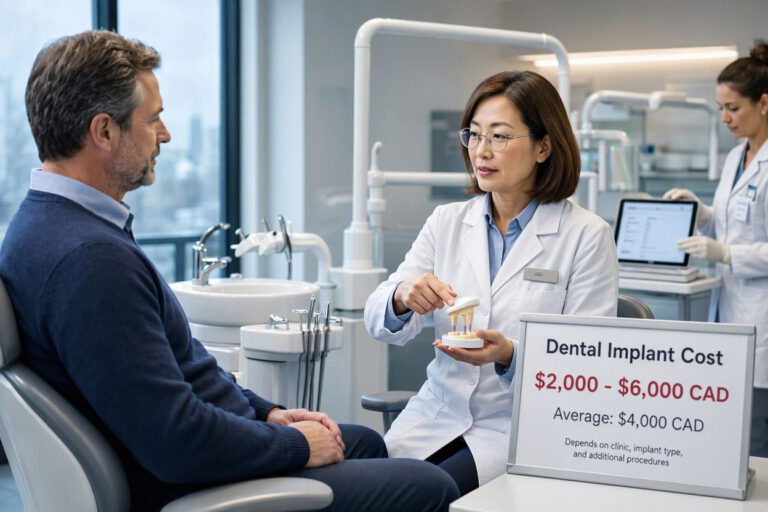
Let us talk numbers openly. Prices vary by region and provider, but these averages give you a realistic picture.
Typical Cost Breakdown (United States, 2025 averages)
| Component | Cost Range |
|---|---|
| Consultation and CBCT scan | 150−500 |
| Implant placement (surgery) | 1,500−3,000 |
| Abutment | 300−600 |
| Custom crown | 1,000−2,500 |
| Total for single implant | 3,000−3,000−6,000 |
Additional Procedures If Needed
| Procedure | Average Cost | Typical Cases |
|---|---|---|
| Bone grafting (small) | 500−1,500 | Low bone height |
| Sinus lift | 1,500−3,000 | Upper back teeth |
| Ridge augmentation | 1,000−2,500 | Narrow jawbone |
| Extraction of damaged tooth | 200−600 | Already missing? Not needed |
Saving Money Without Sacrificing Quality
- Dental schools – 30-50% lower fees. Supervised students perform the work.
- Dental tourism – Mexico, Costa Rica, Colombia offer 50-70% savings. Research the clinic carefully.
- In-house membership plans – Some clinics offer their own discount plans for uninsured patients.
- Negotiate cash pay – Ask if there is a discount for paying in full with cash or check.
One honest warning: If a price seems too good to be true (like $1,200 for a complete implant), it probably involves low-quality materials or insufficient training. Cheap implants often fail and cost even more to fix.
How to Choose the Right Implant Dentist
Your success depends heavily on the person placing the implant. Here is a practical guide.
Credentials to Look For
- Board certification in oral surgery or periodontics
- Hospital privileges (shows they meet high standards)
- Membership in the American Academy of Implant Dentistry (AAID) or equivalent
Technology to Ask About
Modern clinics should offer:
- CBCT machine (on-site is best)
- Intraoral scanner (no goopy impressions)
- Surgical guide printing (for precise placement)
Questions to Ask Before Booking
- How many implants do you place per year? (Look for 100+)
- What is your success rate? (Should be 95% or higher)
- Do you handle complications in-house or refer out?
- Can I speak to a past patient?
- What happens if my implant fails? (Warranty on work?)
Red Flags to Avoid
- No before-and-after photos to show
- Rushing you to schedule surgery without a treatment plan
- Vague answers about costs (“we will figure it out later”)
- No discussion of bone quality or gum health
Real Patient Stories (Anonymous, But True)
These profiles reflect typical experiences, not specific individuals.
Sarah, age 34, office manager
Missing lateral incisor from a childhood fall.
“I wore a flipper tooth for 15 years. It clicked when I talked. I was terrified of implants. My dentist walked me through every step. The surgery was easier than my wisdom teeth. Now I forget which tooth is the implant. I eat apples without thinking.”
Michael, age 62, retired teacher
Failed bridge on lower molars.
“My bridge lasted 9 years, then the anchor tooth decayed. I lost three teeth instead of one. The implant process took 7 months total. I used a partial denture during healing. It was annoying but tolerable. Two years later, those implants feel like my own teeth.”
Elena, age 48, smoker
Multiple missing teeth due to gum disease.
“My first implant failed after one year. I was smoking 15 cigarettes a day. My dentist was honest—she said quit smoking or stop wasting money. I switched to nicotine gum. The second implant worked. I wish I had listened sooner.”
David, age 26, athlete
Knocked out front tooth in a basketball game.
“Emergency dentist put a temporary flipper immediately. Three months of healing with a fake tooth on a retainer. Then the implant. It was expensive for my budget. I used a payment plan. Now I do contact sports with a custom mouthguard. No problems.”
Additional Resource
For unbiased, research-backed information on dental implants, visit the American Academy of Implant Dentistry (AAID) patient education page.
👉 Resource link: https://www.aaid.com/patients
This site offers:
- A “Find an Implant Dentist” tool
- Detailed procedure videos
- Answers to technical questions
- Information on the latest research
Frequently Asked Questions (FAQ)
Q1: How long do dental implants last?
A: With proper care, most implants last 20 years to a lifetime. The crown may need replacement after 10-15 years due to normal wear, but the implant post itself often lasts indefinitely.
Q2: Can I get an implant if I have no bone?
A: Possibly yes. Dentists can perform bone grafting to rebuild lost bone. This adds 3-6 months to your treatment timeline but makes implant placement possible for most people.
Q3: Do implants hurt more than extractions?
A: No. Most patients report less discomfort after implant surgery than after a complex tooth extraction. The recovery is generally milder.
Q4: Will my insurance cover any of this?
A: Some dental plans cover part of the crown and abutment. Few cover the implant post itself. Medical insurance may cover implants if tooth loss resulted from an accident or cancer treatment. Always ask for a pre-treatment estimate.
Q5: Can I smoke with implants?
A: You can, but smoking significantly increases failure risk. Smokers have success rates around 80-85% compared to 95%+ for non-smokers. If you smoke, talk to your dentist about strategies to reduce risk.
Q6: Are implants safe with MRI or CT scans?
A: Yes. Modern implants are non-magnetic titanium and are safe for MRIs and CT scans. Always tell the technician you have implants, but they pose no danger.
Q7: What is the alternative to implants?
A: Three main alternatives:
- Do nothing (teeth may shift into the gap)
- Removable partial denture (lower cost, less comfortable)
- Fixed dental bridge (grinds down adjacent teeth)
Q8: Can implants be done in one day?
A: For some people, yes. Immediate loading places a temporary crown the same day. Final crown comes 3-6 months later. Not everyone qualifies—you need good bone density.
Q9: Do implant crowns stain like real teeth?
A: High-quality ceramic crowns resist staining very well. Coffee, tea, and red wine do not penetrate the surface like natural enamel. However, the gum line may still stain if you do not clean properly.
Q10: What happens if I neglect cleaning my implant?
A: You risk peri-implantitis—gum infection around the implant. Early stages are reversible with professional cleaning. Advanced stages can cause bone loss and implant failure. Daily brushing and flossing prevent this entirely.
Conclusion: Three Essential Takeaways
Dental implants offer a reliable, long-lasting solution for missing teeth, with success rates above 95% and natural results that blend seamlessly with your smile. Most fears about pain, lengthy recovery, or unnatural appearance come from outdated information or rare exceptions. While the upfront cost is higher than other options, the durability and quality of life benefits often make implants a worthwhile investment when planned carefully with a qualified specialist.
Disclaimer: This article provides general educational information only. It does not constitute medical or dental advice. Every person’s oral health situation is unique. Consult a licensed dentist or oral surgeon for a professional evaluation before making any treatment decisions. The author and publisher are not liable for any actions taken based on this content.