Composite vs Porcelain Veneers Price
Imagine standing in front of the mirror, coffee in hand, practicing a smile you’re not quite confident sharing yet. You’ve been researching options, scrolling through before-and-after photos, and you keep circling back to the same question. What will this actually cost me? Not just in dollars, but in time, maintenance, and years of enjoyment? If you’re wrestling with the composite vs porcelain veneers price debate, you’re in the right place. We’ll walk this path together, unpacking every layer of the financial and personal investment.
The smile you see in your mind’s eye is achievable. But the route you take depends on understanding the numbers and what those numbers represent. We’ll skip the sales pitch. Instead, we’ll look at real-world figures, hidden expenses, longevity projections, and the subtle value factors that spreadsheets can’t always capture. By the end, you’ll know exactly which questions to ask your dentist and which path aligns with your life.
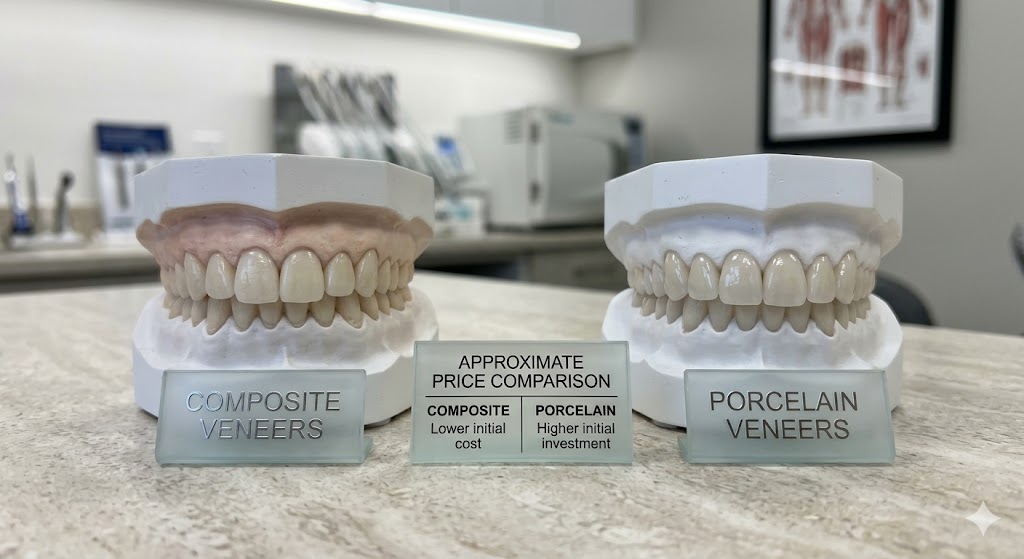
Setting the Stage: Understanding the Veneer Landscape
Before we place two price tags side by side, we need a solid foundation. Comparing composite and porcelain veneers is not like comparing two brands of the same product. It’s more like comparing a beautifully tailored suit you buy off the rack and have expertly fitted, versus a fully bespoke, hand-stitched garment crafted from rare fabric. Both make you look great. The experience, origin, and longevity differ immensely.
What Are Composite Veneers, Really?
Composite veneers are layers of a tooth-colored resin material. Think of a highly advanced, incredibly durable plastic that a skilled dentist sculpts directly onto your teeth. The process is often described as additive. The dentist applies the resin, shapes it, hardens it with a special light, and then polishes it until it gleams. The artistry happens chairside, in a single visit. You watch your new smile emerge in real-time.
This material is the same composite used for tooth-colored fillings. But when used for veneers, it’s all about aesthetic layering. The dentist can blend shades to mimic natural tooth gradients. The appeal is immediate. You walk in with a smile you dislike and walk out a few hours later with a transformed one. The price reflects this efficiency and material accessibility.
What Makes Porcelain Veneers Different?
Porcelain veneers are thin shells of ceramic, custom-crafted in a dental laboratory. The journey starts with your dentist carefully preparing your teeth, taking impressions, and placing temporary veneers. Those impressions go to a master ceramist who layers porcelain to create a restoration that mimics the light-reflecting properties of natural enamel. A week or two later, you return for the bonding appointment. The dentist tries in each shell, checks the fit and shade, and then bonds them permanently using a specialized cement.
Porcelain is a glass-like material. It’s inherently brittle in its raw form, but once bonded to a tooth, it becomes incredibly strong. It resists stains better than natural enamel. The laboratory process introduces a significant cost factor, but it also unlocks a level of translucency and depth that is exceptionally difficult to achieve chairside. This is the bespoke suit.
The Core Difference in Philosophy: Sculpting vs. Fabricating
Understanding the composite vs porcelain veneers price starts with grasping a fundamental philosophical difference. Composite is an additive, subtractive, and sculpting process done directly in the mouth. The tooth is the canvas, and the dentist is the painter and sculptor, working freehand.
Porcelain is an indirect fabrication. The canvas is a stone model of your tooth. The artist is a technician working under magnification, layering powders and firing them in a kiln. The dentist is then the precise installer. This difference in labor, time, materials, and artistry drives the initial price gap. One isn’t inherently superior in all cases; they solve different problems for different budgets and timelines.
The Initial Price Tag: Breaking Down the Numbers
Let’s get to the figures you’ve been searching for. We’ll look at national averages and then dig into the factors that push costs up or down. These aren’t abstract estimates; they’re grounded in what patients typically see on their treatment plans across different regions.
Composite Veneer Costs: Per-Tooth and Full-Smile Analysis
On average, in the United States, a single composite veneer costs between $250 and $1,500. That’s a wide range, isn’t it? Let’s clarify it. A simple, small veneer to fix a chipped edge by an inexperienced provider might land at the very bottom. A full-coverage, expertly layered, multi-shade veneer covering the entire front surface of a tooth by a top-tier cosmetic dentist will land at the upper end.
Most quality composite veneers fall in the $600 to $900 per tooth range. If you’re doing a full smile makeover, often referred to as “six to ten” veneers, you’re looking at a total investment of roughly $4,800 to $9,000 for the teeth that show when you smile broadly. This is the walk-out-today price. It includes the material, the dentist’s chair time, the shaping, and the polishing. There’s no separate lab bill.
Porcelain Veneer Costs: Per-Tooth and Full-Smile Breakdown
Porcelain veneers command a higher initial investment. The per-tooth range typically spans $900 to $2,500, with many respected cosmetic dentists charging between $1,500 and $2,200 per unit. That places a full smile of eight to ten porcelain veneers at a total cost of $12,000 to $22,000, sometimes more.
This price is a bundled package. It covers the diagnostic wax-up (a preview model), the tooth preparation, temporary veneers, the custom laboratory fabrication, and the final bonding appointment. The lab fee alone, which the dentist pays to the ceramist, can range from $150 to $500 per tooth. You’re paying for the collaborative expertise of two professionals.
Initial Price Comparison Table: A Snapshot
To visualize the out-of-pocket difference, a direct side-by-side helps.
| Feature | Composite Veneers | Porcelain Veneers |
|---|---|---|
| Cost Per Tooth (Avg.) | $600 – $900 | $1,500 – $2,200 |
| Full Smile (8 Teeth) Avg. | $4,800 – $7,200 | $12,000 – $17,600 |
| Lab Fees | None (chairside) | $150 – $500 per tooth |
| Number of Visits | 1, rarely 2 | 2 to 3, sometimes more |
| Anesthesia Cost | Often none or minimal | Often included in bundled fee |
| Temporaries | Not needed | Included, a significant step |
This table makes the decision look purely financial. Composite is cheaper upfront. End of story. But a price-conscious decision made only on this table would be a mistake. We have to look at what happens to these numbers over time.
A Note on Geographic Variance: Prices in major coastal cities can be 30-50% higher than in rural Midwestern areas. A $900 composite veneer in Manhattan might cost $500 in a smaller city. A $2,200 porcelain veneer in Los Angeles could be $1,400 elsewhere. Always get local consultations.
The Long Game: Durability, Longevity, and Hidden Lifetime Value
This is where the composite vs porcelain veneers price conversation gets truly interesting. The lowest initial cost does not automatically equal the best value. We must view the expense through the lens of a decade or more.
How Long Do Composite Veneers Really Last?
You’ll often read “5 to 7 years” online. In reality, this is highly variable. A well-cared-for composite veneer, placed by an artist, on a patient with great hygiene and no grinding habits, can last 8 to 10 years, or even longer. I’ve seen them looking good at year 12.
However, the more realistic, real-world average is 5 to 7 years before some intervention is needed. Composite is porous. It absorbs stains from coffee, red wine, and curry. Unlike teeth, it doesn’t whiten. Over time, the surface can lose its high polish and become dull. The edges can pick up micro-stains. Small chips can happen. The major maintenance expense is the regular repolishing—and eventually, replacement.
The Porcelain Longevity Advantage
Porcelain is a glass. It’s non-porous and stain-resistant. A well-made set of porcelain veneers can last 15 to 20 years, and many patients have them for much longer. The failure point for porcelain isn’t usually the ceramic itself, but the bond or the underlying tooth. Gum recession can expose a margin. A trauma can cause a fracture.
The 15-20 year lifespan is a realistic expectation. During that period, your maintenance costs are professional cleanings and checkups, the same as for natural teeth. You won’t be paying for repolishing or color corrections. This is where the lifetime value argument for porcelain gets its strength.
The Maintenance Ledger: A 15-Year Cost Simulation
Let’s simulate a 15-year journey for both options on a single tooth, assuming all goes reasonably well. This is a thought experiment to reveal hidden costs.
The Composite Path (15 Years):
- Year 0: Initial composite veneer: $800.
- Years 2, 4, 6: Professional repolishing and minor chip repair, averaging $150 per visit. Total: $450.
- Year 7: Veneer replacement due to staining and wear. $800 again.
- Years 9, 11, 13: Maintenance repolishing. $450 total.
- Year 14: Another potential replacement or major repair. $800.
- 15-Year Total: Approximately $3,300.
The Porcelain Path (15 Years):
- Year 0: Initial porcelain veneer: $2,000.
- Years 1-15: No special maintenance beyond regular hygiene cleanings (assume same as natural teeth, so not an added veneer-specific cost).
- Year 15: Veneer is likely still in good condition.
- 15-Year Total: $2,000.
In this realistic scenario, the “cheaper” option becomes significantly more expensive over a period when you’d likely own both. The initial savings erode with each repair and replacement cycle. This doesn’t make composite a bad choice; it just frames it as a different category of financial commitment—one with recurring payments rather than a single larger capital outlay.
The Staining Factor: Aesthetics Over Time
This cannot be overlooked. A major hidden cost of composite is an aesthetic one. If you enjoy a morning espresso or a glass of red wine, your $800 composite veneers will begin to look dull and yellowed relative to any porcelain crowns or veneers you might have, or even your natural teeth if you whiten them. The only fix is a repolish by the dentist, which removes a micro-layer of the stained resin. You can’t whiten them back. Porcelain sits there, gleaming, completely immune to that latte. The confidence cost of a smile that looks dingy after just a couple of years is real.
The Clinical Experience: What Happens in the Chair and Why It Costs Money
Price is a reflection of time, skill, and materials. Let’s walk through each procedure to understand where your money goes.
The Composite Procedure: A One-Day Artistic Marathon
You arrive, and often, no numbing is needed. The dentist isolates your teeth. This is a dry, controlled environment. They then apply a mild etching gel to create microscopic roughness for bonding. A bonding agent is painted on and cured. Now comes the art.
The dentist selects several shades of composite resin. They might place a more opaque shade to block dark underlying tooth structure, a body shade for the main color, and a translucent shade at the edge to mimic natural enamel. Each layer is carefully adapted, shaped, and light-cured. The final 45 minutes is pure sculpting and polishing. They use a series of discs, rubber polishers, and diamond pastes to achieve a glass-like finish. You’re paying for a 2-3 hour session of intense, neck-straining, highly skilled labor.
Direct Quote from a Cosmetic Dentist: “Placing a truly invisible composite veneer is one of the hardest procedures in dentistry. You’re creating a three-dimensional optical illusion on a tiny, wet, moving canvas, in one shot. Porcelain allows for a do-over at the lab; composite is live theater.”
The Porcelain Procedure: Collaboration and Precision
The porcelain journey is a deliberate, multi-step process. The first appointment is for preparation and design. The dentist may numb you, as a tiny amount of enamel—often just 0.3 to 0.5 millimeters—is removed to make space for the shell. This step is irreversible. Impressions are taken, either with a physical tray and gooey material or a digital scanner. You’ll wear temporary veneers for one to three weeks. These are a preview, but not a perfect replica of the final result.
In the lab, your model is mounted on an articulator, a device that mimics your jaw movements. A ceramicist builds your veneers using either a layering technique with feldspathic porcelain or a pressed ceramic technique using materials like e.max. These are fired in a kiln at high temperatures. The artistry here is profound. At the second visit, the temporaries are removed, and each porcelain shell is tried on. The dentist evaluates the fit, edges, and shade. They then use a series of try-in pastes to let you and them agree on the perfect cement shade. Finally, the teeth are etched, the veneers are etched, and a resin cement bonds them permanently. Every trace of cement is meticulously cleaned away.
Your payment covers the dentist’s skill in design and prep, the laboratory’s artistry, the high cost of the porcelain material, and the two appointments.
A Granular Decision Matrix: When to Choose Which
Price is a primary filter, but it’s not the only one. A set of personal and clinical factors should guide your final decision. Use this matrix as your compass.
| Your Situation & Priority | The Better Choice Likely Is | The Real-World Rationale |
|---|---|---|
| Upfront Budget is King | Composite | You can achieve a dramatic transformation for 50-60% less money out of pocket today. |
| Lowest Lifetime Cost | Porcelain | For patients planning to have their smile for 15+ years, porcelain’s durability wins. |
| Speed: Need a Smile by Friday | Composite | A full smile makeover is completed in a single, albeit long, afternoon. No temporaries, no wait. |
| Minimal Tooth Alteration | Composite | Often requires little to no removal of natural tooth structure. It’s the most conservative option. |
| Ultimate Stain Resistance | Porcelain | If you drink coffee, tea, red wine, or smoke, porcelain will not discolor over time. |
| Correcting Severe Discoloration | Porcelain | Porcelain can block out a very dark, tetracycline-stained tooth better than direct composite. |
| Minor Chips, Gaps, or Rotations | Composite | For fixing one or two small imperfections, composite is a brilliant, cost-effective tool. |
| Major Smile Reconstruction | Porcelain | When changing the entire smile architecture (length, width, bite), lab-fabricated porcelain offers more control. |
| You Grind or Clench Your Teeth | Porcelain | Porcelain is more wear-resistant to the forces of bruxism, though a night guard is essential for both. |
| Ability to Try Before You Buy | Composite | The process is additive and reversible in some cases. Porcelain prep is a one-way street. |
This matrix isn’t about declaring a universal winner. It’s about aligning the strengths of each material with your unique life, habits, and smile goals. A 22-year-old wanting to close a gap before a wedding next month has different needs than a 55-year-old wanting to rejuvenate their entire smile for the next two decades.
The Fine Print: Warranties, Repairs, and Insurance Realities
An honest guide to composite vs porcelain veneers price must address the unsexy, often-invisible costs and protections.
What Does a Dental Warranty Actually Cover?
No dental material comes with a lifetime guarantee against all mishaps. But reputable dentists often provide a warranty on their work for a defined period, typically one to five years. Read the fine print. A warranty usually covers catastrophic failure—debonding, fracture under normal use—but it won’t cover failure due to decay, lack of hygiene, or trauma from trying to open a beer bottle with your teeth.
For porcelain, a 5-year replacement warranty against breakage is a sign of a confident dentist and a high-quality lab. For composite, a 1-2 year warranty for debonding or chipping is common. What’s almost never covered? The aesthetic failure of composite—the staining and dulling. That’s considered normal wear and tear, and you’ll pay out of pocket for repolishing or replacement.
How Dental Insurance Views Veneers
Let’s be blunt. Dental insurance typically classifies veneers as an elective, cosmetic procedure. It will not contribute a penny toward the cost in the vast majority of plans. There is a very narrow exception. If a tooth is fractured, worn down from acid erosion, or has a congenital defect that makes a veneer the restorative solution, your plan might cover a portion, usually paying the benefit of the least expensive alternative treatment, which might be a composite filling. This is called the “downgrade” clause.
Never assume coverage. Get a pre-treatment estimate from your dentist, who will submit it to your insurance company. The response will arrive in plain language: “This procedure is not a covered benefit” or an assigned patient co-pay for a restorative alternative. Build your budget around the full fee, and treat any insurance reimbursement as an unexpected bonus.
The Repair-Replace Conundrum
What happens when one composite veneer chips on a front tooth? You can often have that single tooth repaired by adding more composite, repolishing it, and blending it. This is a huge advantage of composite: individual repairability. The repair cost might be $100-$250.
What happens when a porcelain veneer breaks? You cannot patch it invisibly. The entire shell typically needs to be removed and replaced. A replacement porcelain veneer is not cheaper than the original; it often costs the same or more, as removing the old one without damaging the tooth is a delicate, time-consuming process. This is a vulnerability. While porcelain is stronger, when it fails, the failure is more absolute and expensive to fix than composite’s minor chips.
The Intersection of Expertise and Geography: Why Your Neighbor Paid a Different Price
Online forums are filled with declarations like, “My composite veneers were $300 each and look amazing,” sitting right next to, “I paid $800 and they’re bulky.” This discrepancy drives the confusion in the composite vs porcelain veneers price search.
The Artist’s Eye vs. The Technician’s Hand
Placing a beautiful composite veneer is 90% artistry and 10% material science. A dentist who charges $900 per tooth is not using a more expensive composite gun than the one who charges $300. You are paying for their eye, their three-dimensional understanding of tooth anatomy, their ability to see light reflection and texture, and the time they dedicate to the meticulous finishing and polishing process. A fast, bulk-filled composite will always look like a patch. A layered, sculpted, and polished one becomes part of your tooth.
For porcelain, the dentist’s role is the architect. They design the smile, prepare the teeth, manage the bite, and select the lab. A top dentist uses a master ceramist who charges high lab fees. A budget-focused dentist might send impressions to a large, lower-cost production lab, sometimes overseas. The price difference in porcelain is often a direct reflection of the ceramist’s tier. A master ceramist creates each tooth with unique characterizations, translucency, and texture. A factory-line technician produces a more generic, though still functional, tooth shape.
Geographic Micro-Economies of Dentistry
Your dentist’s overhead shapes your price. Rent in a high-end retail district of a large city is exorbitant. That cost is factored into every procedure’s fee. A dentist in a suburban professional park with lower rent can charge less and still maintain a healthy practice. This doesn’t mean the suburban dentist is less skilled. It means their business model is different.
What about dental tourism? Seeing prices of $250 for porcelain veneers in international destinations is tempting. The cost savings can be enormous. The risks include the absence of continuity of care, difficulty in communication of subtle aesthetic goals, and the logistical nightmare—and expense—of dealing with a complication or failure when you’re back home. Many local dentists are hesitant to take over another dentist’s cosmetic case gone wrong, and if they do, the full fee applies. The true price of a failed dental tourism case can be paying twice: once abroad and again at home.
Financing the Dream: Making the Math Work for You
Seeing a $15,000 treatment plan can feel like a door slamming shut. But for many, the journey isn’t about having the lump sum right now; it’s about unlocking affordable monthly access.
The Landscape of Dental Financing
Third-party healthcare financing companies like CareCredit, Alphaeon, and LendingClub have become standard. They offer promotional periods—often 6, 12, or 18 months—with zero interest if the balance is paid in full within that time. This is a powerful tool. A $12,000 porcelain smile makeover can become an $1,000 monthly payment over 12 months. But the fine print is crucial: these are deferred-interest loans. If you’re a single day late or haven’t paid the full balance by the end of the promotional period, all the interest that would have accrued from day one is added to your balance, often at a high APR of 26.99%. This is the sharp edge of the “zero interest” sword.
In-House Membership Plans and Cash Discounts
A quiet revolution is happening in private dental practices. Many are now offering their own in-house membership plans, designed for the uninsured. For an annual fee, you receive preventive care and a flat discount, often 10-20%, on all other procedures, including cosmetic ones. This can directly and transparently reduce the composite vs porcelain veneers price. A practice might also offer a 5% discount for payment by cash or check, saving them the merchant processing fees.
Stacking Strategies for a Lower Effective Price
You can often combine strategies. Use an FSA (Flexible Spending Account) or HSA (Health Savings Account) to pay for the portion of the treatment that’s deemed medically necessary (the tooth-colored filling on a worn tooth, not the purely aesthetic component). Ask your dentist’s treatment coordinator to write a letter of medical necessity for the restorative portion. Then, use your HSA/FSA dollars tax-free for that amount, pay a cash-discounted portion for the rest, and finance the balance. This requires paperwork and patience but can lower your true, after-tax cost significantly.
The Clinic and the Lab: A Deeper Look at Materials and Craftsmanship
Let’s descend further into the technical, not to complicate, but to illuminate why two things that look similar on Instagram cost vastly different amounts.
The Composite Resin Universe: Not All Pastes Are Equal
The composite market is crowded. Brands like Filtek Supreme, Tetric EvoCeram, and Venus Diamond have different handling properties. Microhybrid composites are strong and polish well. Nanofilled composites offer the highest initial polish and gloss retention. A dentist who invests in a premium composite system and the specialized polishing pastes and brushes required is spending more on material per case. This cost, while not the dominant factor, contributes.
More importantly, the technique of warming the composite is a hallmark of a meticulous practitioner. Heating the composite compacts increases its flowability, allowing for better adaptation and fewer internal voids. This requires a specialized composite warmer, a small but telling investment in quality. A dentist who uses a warmer is signaling a commitment to outcome, and that thoroughness is embedded in their fee.
The Renaissance of Ceramics: Feldspathic vs. Pressed
In the porcelain world, you’ll hear terms like “feldspathic,” “pressed” (e.max), and “zirconia.” For veneers, feldspathic porcelain, hand-layered by a ceramist, is widely considered the aesthetic gold standard. It’s the most artistic, time-consuming, and expensive option. It mimics enamel’s optical properties uncannily well.
Pressed ceramic veneers, like IPS e.max, are created using a lost-wax technique. They are a single block of lithium disilicate ceramic that is milled and then hand-characterized with surface stains by the ceramist. They are incredibly strong and beautiful, often slightly less expensive than a fully layered feldspathic veneer, but still a premium lab bill. Knowing what type of porcelain is being proposed justifies the line item on your treatment plan. Ask: “Is this a hand-layered or a pressed veneer? Who is the lab?” A respected, local, artisan lab charges more, but the results are typically a step above a mass-production alternative.
A Closer Look at the Risks and the Undiscussed Downsides
An ethical guide requires a chapter on what can go wrong. The composite vs porcelain veneers price must be weighed against the cost of complications.
The Composite Downside: Wear, Tear, and the Monthly Microscope
Composite veneers demand daily attention. You will become aware of their edges. You might run your tongue over a slight junction where resin meets tooth. If the bond fails microscopically at the edge, that margin becomes a plaque trap, leading to decay you cannot see until it’s large. Composite is also more susceptible to chipping if you have a deep overbite or an edge-to-edge bite. The forces simply shear the resin.
The aesthetic longevity is the biggest gamble. A smoker will see their composite veneers turn an unsalvageable yellow-brown within months. A red wine lover will need more frequent repolishing visits. Each repolish is a minor expense but also a minor loss of the veneer’s original anatomy, as the polishing process wears down subtle textures. It’s a slow, graceful, but inevitable fading.
The Porcelain Downside: The Ireversible Step and the Opposing Wear
The moment your dentist’s drill touches healthy enamel for a porcelain veneer preparation, there is no going back. The tooth will forever require a restoration. If, ten years later, a veneer debonds and the tooth underneath is healthy but unprepared-looking, you cannot simply leave it. The shape will be slightly reduced. This is the psychological weight of the irreversible choice.
Another rarely discussed risk: porcelain can be abrasive to opposing natural teeth. If your bite is not perfectly managed, a hard porcelain surface grinding against a natural lower front tooth can cause accelerated wear of that natural tooth. A mindful dentist will meticulously polish the biting surface of the veneer or re-contour it to be harmless. An unmindful one leaves it rough. Over years, this wears down your natural teeth. The fix is expensive and affects teeth that were once perfectly healthy. This is a risk of porcelain that doesn’t exist with composite, which is softer and gentler on opposing teeth.
The Hygiene Economy: At-Home Care Costs Add Up
The ongoing maintenance of your investment happens in your bathroom twice a day. The products matter, and they have a cost.
For composite veneers, non-abrasive toothpaste is non-negotiable. A tube of a low-RDA (Relative Dentin Abrasivity) gel toothpaste, like those from Rembrandt or a prescription high-fluoride gel, costs more than a standard drugstore brand. You’ll go through a tube a month. More critically, you must floss with careful, gentle technique. A Waterpik water flosser becomes a wise investment of $70-$100 to clean margins without risking popping a veneer off with floss. These are small, recurring costs that belong in the composite ledger.
For porcelain, you will use any non-abrasive toothpaste. The risk is not to the porcelain but to the cement margin. You’ll need a custom night guard if you grind. A quality lab-made night guard costs $400-$700. Fail to wear it and the porcelain can fracture. This guard needs annual inspection and eventual replacement. This is a significant, recurring protective cost to protect your porcelain investment, a cost less critical for composite, which is cheaper to repair if chipped.
A Case for the “Combination Smile” Strategy
The composite vs porcelain veneers price debate often assumes a binary choice. An intelligent, nuanced solution exists: the hybrid approach. A skilled cosmetic dentist can plan a smile where the most visible, dominant front teeth—the central incisors—are restored with porcelain for unmatched, lasting beauty. The lateral incisors and canines, which are under different stresses and less visually prominent, can be built up with composite.
This strategy optimizes your budget. You get the spectacular, stain-proof center of your smile in porcelain, spending about $4,000 for the two center teeth. You then spend perhaps $2,400 to $3,600 for the other six teeth in composite. The total is $6,400 to $7,600—a number close to a full composite smile, but with a level of lasting, high-end aesthetics in the most important zone. This requires a dentist who excels at both mediums and can seamlessly blend the two materials. It’s an advanced concept, but one that can deliver outstanding value.
Navigating the Consultation: A Glossary of Empowered Questions
You’re the CEO of your smile. The consultation is your board meeting. Walk in with a printed list. The answers will reveal more about the true composite vs porcelain veneers price and value than any chart.
- “Can I see photos of your actual patients, at 5+ years, for both composite and porcelain?” A portfolio of close-up, high-resolution images tells the truth.
- “What composite system do you use, and what is your polishing protocol?” Listen for layered technique, multiple polishing steps, and specific brand names.
- “Which lab do you use for porcelain, and can I see samples of their work?” A good dentist proudly names their ceramist.
- “What percentage of my natural tooth structure will you remove for each option?” Let them quantify the conservation of enamel.
- “What is your specific warranty, in writing, on chipping, debonding, and staining for each?” Vague answers are a red flag.
- “In 10 years, what do you anticipate my maintenance costs and needs will be for each path?” Ask them to project the long view.
- “Am I a candidate for a ‘no-prep’ or minimal-prep approach?” For appropriate cases, this is game-changing.
- “If a porcelain veneer fails in year 12, what is the fee for a single replacement?” Understand the future cost.
A dentist who answers these questions with patience and precision is signaling a partnership. Their fee is a reflection of that standard of care.
The Psychology of the Price: Smile Value Beyond Currency
We’ve crunched numbers. Let’s speak human. The composite vs porcelain veneers price is a fee you pay a dentist. The value is a private, daily dividend. It’s the unconscious confidence to laugh at a joke without a hand flying to your mouth. It’s the professional headshot where you look genuinely happy, not self-conscious. It’s the date where you’re thinking about what they’re saying, not what they’re seeing.
This value is remarkably consistent whether you choose the $800 composite or the $2,200 porcelain path. For the first few years, the psychological and social returns are nearly identical. Both transform you. The difference is in how that feeling ages. Porcelain locks that feeling in for a decade and a half. Composite requires you to actively maintain and periodically reinvest in that feeling. Neither is wiser. One is a purchase of a long-term asset; the other is a subscription to a continuous service of aesthetic maintenance. Which model better suits your psychology and financial style? That’s the question only you can answer.
Summary and Final Recommendations
We’ve navigated the intricate, deeply personal terrain of composite vs porcelain veneers price. The numbers matter, but they are only the gateway to a conversation about time, artistry, and life stage. Here is the distilled wisdom.
Composite veneers are the accessible, transformative, one-day art form. Their lower upfront cost opens the door for many, but that door requires ongoing maintenance, polishing, and eventual re-entry fees. They are the right choice for those who need speed, prefer a minimally invasive start, or want to test-drive a smile design before committing to the permanence of porcelain. They are a beautiful subscription.
Porcelain veneers are the enduring, stain-defying, master-crafted investment. The higher initial price buys you a decade and a half of low-maintenance, color-stable confidence. It is the choice for those who have planned for the long term, value the optic depth of ceramic, and accept the irreversible preparatory step. It is a beautiful asset.
A hybrid strategy, combining porcelain at the center with composite on the periphery, can offer the best of both worlds, balancing a sensible total budget with premium aesthetics where it counts most.
Whichever path you choose, the value will be determined less by the material’s name and more by the human being holding the handpiece or the porcelain brush. Choose the clinician, not the commodity. A $600 veneer from an artist will outshine a $2,500 one from a technician, and vice versa.
Frequently Asked Questions
1. Can I whiten my composite or porcelain veneers?
No. Neither composite resin nor porcelain responds to whitening agents. You can only whiten your natural teeth. If you want a lighter smile, do any bleaching before your veneers are made so they can be matched to your new, brighter shade. Any future whitening will create a mismatch.
2. Why does my dentist recommend porcelain when composite is cheaper?
A dentist who truly believes in long-term value may recommend porcelain because they’ve seen composite fail aesthetically too soon in many mouths. They know you won’t want the cost and chair time of frequent repolishing. They are thinking about your satisfaction ten years out, not just your budget today. It’s a longevity and aesthetic argument, not an upsell.
3. Are there hidden costs after getting composite veneers?
Yes, the primary hidden cost is maintenance. Plan for a professional repolishing appointment every 12-24 months, costing $100-$250, to remove surface stains. Over a decade, this adds up. Also, a single chipped composite veneer, while repairable, comes with a small fee each time.
4. What happens to my teeth under porcelain veneers?
The teeth are still alive and susceptible to decay, especially at the margin where the porcelain ends and the natural tooth root begins. Diligent hygiene is paramount. If decay develops and is extensive, the veneer may need to be removed and the tooth restored with a larger, more expensive crown.
5. Is the pain different between the two procedures?
Typically, yes. Composite veneers are often placed without any anesthetic, as the process is minimally invasive, and there’s no drilling. Porcelain veneers usually require local anesthetic for the preparation appointment, as a thin layer of enamel is removed. The bonding appointment for porcelain is often anesthetic-free.
Additional Resource:
To research the materials and see clinical data, the American College of Prosthodontists provides excellent patient education resources on tooth restoration. Visit their site at: https://www.prosthodontics.org
Disclaimer:
This article provides general cost estimates and information for educational purposes only. It does not constitute medical or financial advice. Dental fees vary widely by location, provider skill, and individual case complexity. Always consult with a qualified dental professional for a personalized examination, diagnosis, and treatment plan tailored to your specific oral health needs and goals.