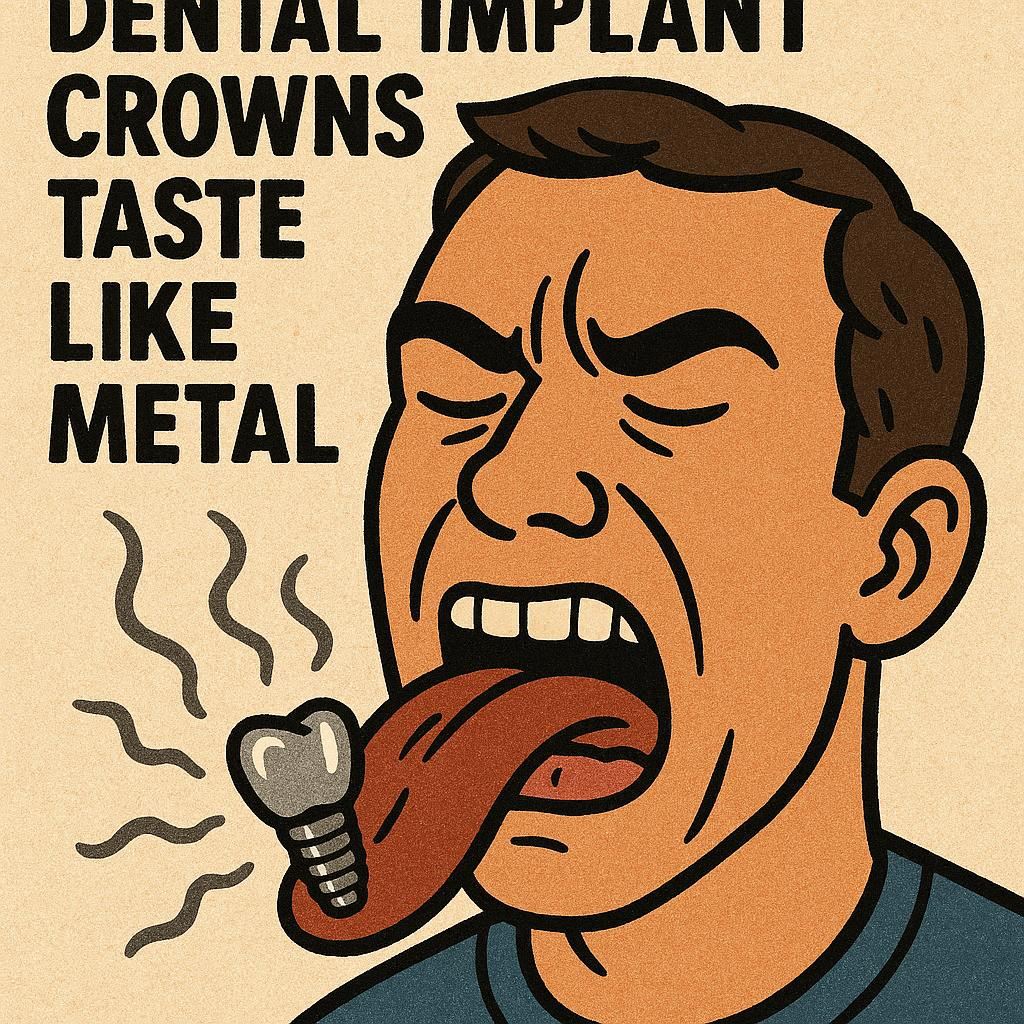
Dental Implant Crowns Taste Like Metal
You invested time, money, and energy into getting a dental implant. You expected comfort, confidence, and a natural feel. Instead, you keep noticing a strange, metallic taste whenever you eat, drink, or even just go about your day.
You are not alone.
Many people search online for answers because their dental implant crowns taste like metal. The good news? This is rarely an emergency. The better news? Most causes are fixable.
Let us walk through every possible reason for that metallic flavor, the solutions available to you, and exactly when to call your dentist.
Understanding Your Dental Implant Crown
Before we dive into why something tastes wrong, it helps to know what is actually inside your mouth.
A dental implant has three main parts:
- The implant post – a titanium screw placed into your jawbone.
- The abutment – a connector piece that sits on top of the post.
- The crown – the visible, tooth-like part that you chew with.
The crown itself can be made from different materials. Each material behaves differently inside your mouth.
Common crown materials
| Material | Metal content | Taste potential |
|---|---|---|
| Porcelain fused to metal (PFM) | High (metal base) | Moderate to high |
| Full porcelain or ceramic | None | Very low |
| Zirconia | None | Very low |
| Gold alloy | High (inert metal) | Low (rarely tastes) |
| Base metal alloys (nickel, chromium) | Very high | High |
Most patients with a metallic taste have either a PFM crown or a crown that uses a metal abutment.
Is a Metallic Taste Normal After Implant Placement?
In the first few days after surgery, yes. A temporary metallic taste is common.
During the healing phase, you might taste blood or the materials used during the procedure. Gauze, surgical instruments, and even the sterile saline rinse can leave a temporary flavor. This usually fades within one week.
But what if your implant healed months or even years ago? And suddenly, your dental implant crowns taste like metal?
That is different. And that deserves attention.
Seven Real Reasons Your Dental Implant Crown Tastes Like Metal
Let us get specific. Below are the most common culprits, ranked from harmless to urgent.
1. The Crown Material Itself
Some crowns simply taste metallic because they contain metal.
Porcelain-fused-to-metal crowns have a metal inner shell. This metal is usually covered by porcelain, but over time, the porcelain can wear down, chip, or develop microscopic cracks. Once the metal underneath becomes exposed to your saliva, your tongue will notice.
What it feels like: A mild, consistent metallic taste that worsens when you drink hot or acidic beverages.
What you can do: Have your dentist check for visible wear or cracks. A simple polishing or resealing may help short-term. A full crown replacement with ceramic or zirconia is the permanent fix.
2. A Failing Abutment Connection
Your abutment screws into the implant post. Your crown then attaches to the abutment. If any part of this junction becomes loose, bacteria, saliva, and food debris can seep into tiny spaces you cannot see.
When these materials break down, they release metal ions or produce byproducts that taste metallic.
What it feels like: The taste often appears after eating or brushing. You might also notice a slight click when biting down.
What you can do: Your dentist can tighten the abutment screw or replace the abutment entirely. This is a quick procedure in most cases.
3. Galvanic Currents (Battery Mouth)
This sounds strange, but it is real.
When two different metals sit in your mouth and come into contact with saliva, they can create a small electrical current. Think of a battery. That current can make your brain perceive a metallic taste.
This happens if you have:
- A metal crown on one tooth and a gold crown nearby
- A metal implant abutment next to a silver (amalgam) filling
- A metal partial denture touching your implant crown
What it feels like: A sharp, zingy metallic taste, sometimes accompanied by a faint electric sensation.
What you can do: Your dentist can replace one of the conflicting metals. Switching to a non-metal crown or ceramic abutment usually solves the problem.
4. Peri-Implant Mucositis or Peri-Implantitis
Here is where we need to be honest. A metallic taste can signal early infection.
Your implant crown itself does not decay like a natural tooth, but the gum tissue around it can become inflamed. This condition starts as peri-implant mucositis (gum inflammation without bone loss). If untreated, it progresses to peri-implantitis (inflammation with bone loss).
Infected tissues can produce fluids that taste metallic, salty, or sour.
Warning signs to watch for:
- Red or swollen gums around the implant
- Bleeding when you brush or floss
- A bad taste that gets worse over time
- A bad smell from that area
- The gum pulling away from the crown
What you can do: See your dentist immediately. Early-stage peri-implantitis is treatable with deep cleaning and improved home care. Advanced cases may require surgery.
Important note: Do not ignore a persistent metallic taste that comes with gum redness or bleeding. This is not normal, and waiting makes treatment harder.
5. Acid Reflux or Silent Reflux
Sometimes, the problem is not your implant at all. It is your stomach.
Acid reflux sends stomach acids and partially digested food up into your mouth. The acid can react with crown materials, even high-quality ones, releasing metal ions into your saliva.
What it feels like: The taste is often worse in the morning or after lying down. You might also experience heartburn, a sore throat, or a chronic cough.
What you can do: Talk to your primary care doctor. Many people manage reflux with diet changes, sleep position adjustments, or medication.
6. A Sinus Connection (Upper Implants Only)
If your dental implant crown is in the upper jaw, your sinus cavity sits just above it. In some cases, the implant can protrude slightly into the sinus space.
When that happens, fluid from the sinus can drain around the implant. This fluid sometimes carries a metallic or strange taste.
Additional clues: You feel pressure under your eye. The taste changes when you bend over or blow your nose. You have a history of sinus infections.
What you can do: An ear, nose, and throat specialist or your dentist can take a special x-ray called a CBCT to check the implant’s position.
7. A Cracked or Damaged Crown
Porcelain can chip. Zirconia can crack. Metal can corrode.
Even a tiny crack that you cannot see with your naked eye can trap food and bacteria. As those particles break down, they produce chemicals that taste metallic.
What you can do: Your dentist uses a special tool called an explorer to feel for cracks. A crown replacement is usually the answer here.
Comparative Table: Harmless vs. Serious Causes
| Characteristic | Usually Harmless | Needs Professional Attention |
|---|---|---|
| Taste duration | A few days to two weeks | More than two weeks |
| Gum bleeding | No | Yes |
| Visible damage | No | Yes (chipped crown, loose crown) |
| Pain or tenderness | No | Yes |
| Bad breath | No | Yes |
| Taste worsens over time | No | Yes |
If your situation looks more like the right column, call your dentist.
What You Can Try at Home First
Before you schedule an appointment, you can try a few simple things. These will not fix a broken crown or an infection, but they can rule out simple causes.
Step one: Upgrade your oral hygiene routine
- Brush twice daily with a non-metallic tasting toothpaste (avoid charcoal or highly abrasive pastes)
- Floss around the implant crown carefully using implant-specific floss or superfloss
- Use a water flosser on a low setting to clean the gumline
Step two: Change your mouthwash
Some mouthwashes contain ingredients that taste metallic when mixed with saliva. Try switching to an alcohol-free, neutral fluoride rinse for one week. See if the taste disappears.
Step three: Keep a taste diary
Write down:
- When the taste appears (morning, after meals, random)
- What you ate beforehand
- Any other symptoms (heartburn, headache, fatigue)
This diary helps your dentist make a faster diagnosis.
Step four: Hydrate
Dry mouth makes any taste stronger. Drink more water throughout the day. Chew sugar-free gum to stimulate saliva flow.
Professional Treatments Your Dentist Might Offer
If home fixes do not work, your dentist has several evidence-based options.
Diagnostic Tools
Your dentist will likely start with:
- Visual exam – checking for cracks, wear, or loose parts
- Probing – measuring gum pockets around the implant (healthy is 3mm or less)
- X-rays – looking for bone loss or loose screws
- Tapping test – a solid sound means good integration; a dull sound may mean loosening
Treatment Options by Cause
| Cause | Treatment |
|---|---|
| Worn or chipped PFM crown | Polish or replace with ceramic/zirconia |
| Loose abutment screw | Retighten with correct torque |
| Galvanic reaction | Replace one metal restoration |
| Peri-implant mucositis | Professional cleaning + improved home care |
| Peri-implantitis | Deep cleaning, possible laser therapy, or surgery |
| Cracked crown | Full crown replacement |
| Sinus involvement | Referral to ENT or implant repositioning |
Should You Replace Your Entire Implant?
This is a common fear. Most people worry that a metallic taste means the whole implant failed.
That is almost never the case.
The implant post itself (the part inside your bone) rarely causes taste issues. Titanium is highly biocompatible and does not generally release taste particles. When your dental implant crowns taste like metal, the crown or the abutment is almost always the source.
Replacing just the crown is a straightforward procedure. The implant post stays put.
Only in severe peri-implantitis with significant bone loss would a dentist discuss removing the entire implant. Most patients never reach that stage.
How to Talk to Your Dentist About a Metallic Taste
You want to be taken seriously. Use these exact phrases:
“I have a persistent metallic taste coming from my implant crown area. It has been [X days/weeks]. It is not going away.”
Then add:
- “I do/do not have gum bleeding or pain.”
- “The taste is worse when I eat [acidic foods / hot foods / nothing].”
- “I have/do not have acid reflux or sinus issues.”
This helps your dentist rule out causes quickly.
Preventing the Problem in the First Place
If you are planning to get an implant crown in the future, you can take steps now to avoid ever dealing with a metallic taste.
Choose the right materials
Ask your dentist for:
- A full ceramic crown (lithium disilicate or zirconia)
- A zirconia abutment instead of a metal one
- No metal anywhere in the restoration
These materials cost slightly more upfront, but many patients find the peace of mind worth the extra expense.
Maintain excellent gum health
Healthy gums stay sealed around the implant. A tight seal means no bacteria, no infection, and no strange tastes.
Visit your dentist every six months
Implant crowns need professional checks. Your dentist can spot a loose screw or a worn crown before you ever taste the difference.
When a Metallic Taste Is Actually a Good Sign
A small number of patients report a metallic taste immediately after their permanent crown is placed. They worry something is wrong.
In most of these cases, the taste fades within two weeks. Why? Your mouth is simply adjusting to a new surface. Saliva chemistry changes slightly when you add a new restoration. This is normal.
If the taste disappears on its own and you have no other symptoms, you can relax.
Real Patient Experiences (Anonymized)
“I had a PFM crown for eight years with no issues. Then suddenly, a metallic taste appeared. My dentist found a tiny chip in the porcelain. We replaced it with zirconia. The taste disappeared overnight.” – Richard, 54
“I thought I needed my implant removed. I was terrified. It turned out my abutment screw was loose. My dentist tightened it in ten minutes. No taste since.” – Maria, 41
“The metallic taste was from my acid reflux, not my implant. My doctor put me on a reflux medication. Problem solved.” – James, 62
These stories share one thing in common: the cause was found, and the solution worked.
A Note About “Metal Toxicity” Fears
You may have read online that titanium implants cause metal poisoning or autoimmune disease. Credible dental research does not support these claims for the vast majority of patients.
Titanium is one of the most biocompatible metals used in medicine. It is also used in hip replacements, knee replacements, and pacemakers.
That said, a small percentage of people have a true metal allergy or sensitivity. If you have a known allergy to nickel, chromium, or cobalt, tell your dentist before implant placement. They can use alternative materials like zirconia.
But a metallic taste alone is not proof of toxicity. It is almost always a local mechanical or chemical issue inside your mouth.
Frequently Asked Questions (FAQ)
1. Can a dental implant crown taste like metal years after placement?
Yes. This usually means something changed recently, like a loose screw, a cracked crown, or new gum inflammation.
2. Is a metallic taste from an implant dangerous?
Not usually. But if it comes with pain, bleeding, or swelling, you need a dental exam.
3. Can I fix a metallic taste myself?
You can improve oral hygiene and switch mouthwashes. But if the taste persists beyond two weeks, see your dentist.
4. Will my insurance cover a crown replacement if my crown tastes metallic?
It depends on the cause. If the crown is damaged or defective, many dental insurances cover replacement after a waiting period. If you simply want to upgrade from metal to ceramic, you may pay out of pocket.
5. How long does it take to replace a crown that tastes metallic?
Usually two visits. One to remove the old crown and take impressions. Another to place the new crown about two weeks later.
6. Can my dentist tell if a loose screw is causing the metallic taste?
Yes. A simple tightening test often confirms it. The taste usually disappears within 24 hours after tightening.
7. What if my dentist says nothing is wrong but I still taste metal?
Seek a second opinion from a prosthodontist (a specialist in restorations) or a dentist who uses a surgical microscope. Tiny cracks or leaks can be hard to see.
Additional Resource
For a deeper dive into implant crown materials and how to choose the right one for your budget and health needs, visit the American Academy of Implant Dentistry’s patient education page:
https://www.aaid.com/patients/
This resource offers unbiased, expert-reviewed information on implant types, material safety, and finding a qualified implant dentist near you.
Conclusion
A metallic taste from your dental implant crown is usually fixable and rarely an emergency. The most common causes are crown material wear, a loose abutment screw, or minor gum inflammation—not implant failure. See your dentist for a simple exam, and in most cases, the problem resolves with a quick adjustment or a crown replacement.