Cost Of Full Mouth Dental Implants San Francisco CA
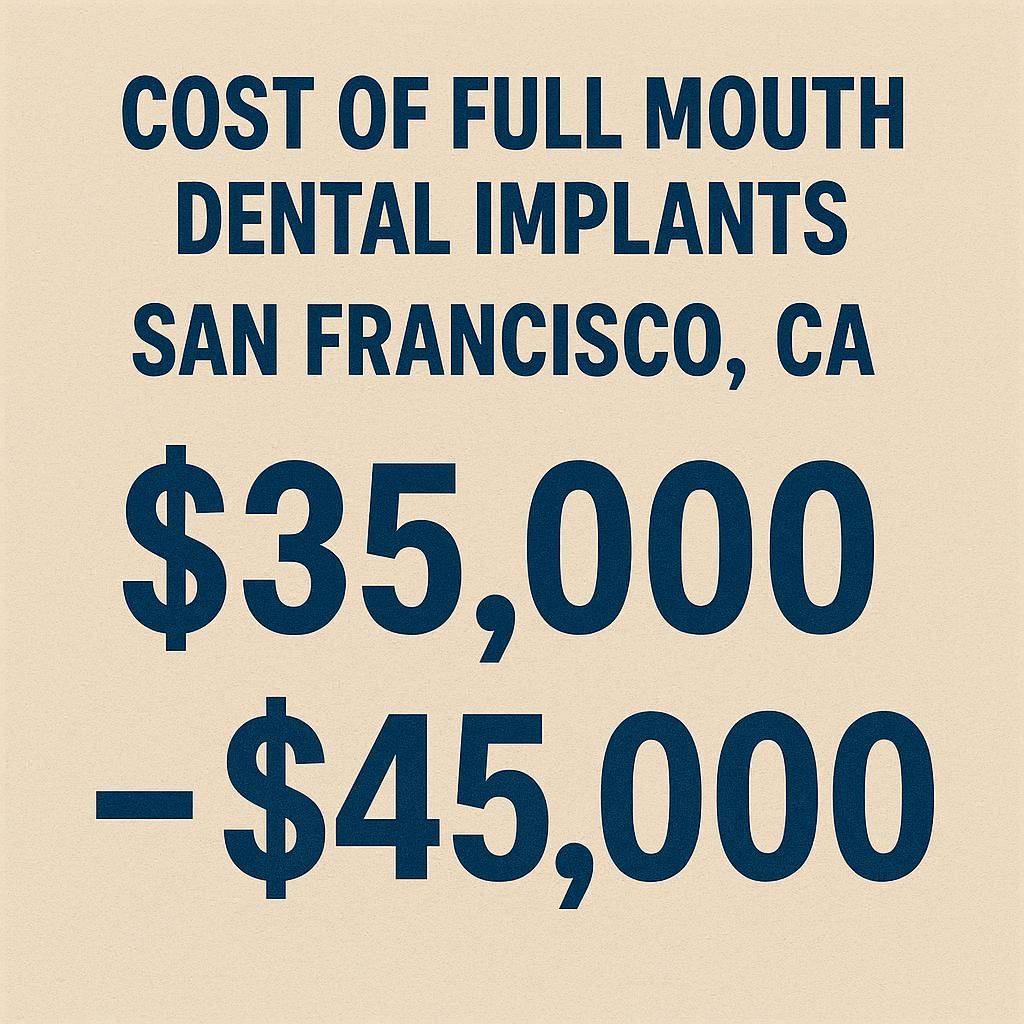
Losing most or all of your teeth affects more than your smile. It changes how you eat, how you speak, and how you feel about yourself. If you live in the Bay Area, you have likely searched for “Cost Of Full Mouth Dental Implants San Francisco CA” and felt overwhelmed by the numbers.
You are not alone.
Many people put off this conversation because they fear the price. Others have received quotes that seem to come from different planets. One clinic says $25,000. Another says $90,000. Who is telling the truth?
The short answer is: both can be correct.
But that does not help you make a decision. So let us walk through this together. By the end of this guide, you will understand exactly what influences the price, what you should expect to pay in San Francisco, and how to avoid overpaying while still getting safe, high-quality care.
Why San Francisco Has Unique Pricing for Dental Implants
San Francisco is not like other cities. The cost of living here drives almost everything upward, and dental care is no exception.
Rent for a dental office on Union Square or in the Financial District is astronomical. The wages for skilled oral surgeons, prosthodontists, and dental anesthesiologists are higher here than in most of the country. Lab fees for creating your final teeth also tend to run above national averages because many top-tier dental labs are located in or near the city.
That said, you are also paying for expertise. San Francisco is home to some of the most experienced implant dentists in the world. You will find specialists who have placed tens of thousands of implants. That experience reduces your risk of failure.
So when you look at the Cost Of Full Mouth Dental Implants San Francisco CA, remember: you are not just buying titanium screws and porcelain teeth. You are buying years of training, advanced technology, and local access to follow-up care.
Important note: Do not travel out of state for cheap implants without researching the hidden costs. If something goes wrong, your local San Francisco dentist may charge you extra to fix another provider’s work.
What Does “Full Mouth Dental Implants” Actually Mean?
Before we talk about money, let us clarify the procedure. Many people imagine individual implants for each missing tooth. That is rarely the case for a full mouth reconstruction.
A full mouth restoration with implants typically uses between four and ten implants per jaw. These implants support a fixed bridge or a removable denture. The two most common approaches are:
- All-on-4 or All-on-6: Four or six implants per arch hold a full fixed bridge. You cannot remove it at home. Your dentist cleans underneath it during checkups.
- Implant-supported overdenture: Two to four implants per jaw snap into a special denture. You can remove it for cleaning.
There is also the traditional approach: individual implants for each missing tooth. That can mean 24 to 28 implants. Most dentists do not recommend this. It is more expensive, more invasive, and harder to keep clean.
For the rest of this guide, when we say “full mouth dental implants,” we mean a permanent or semi-permanent solution to replace all teeth in both the upper and lower jaws.
The Real Cost Range in San Francisco (2026)
Let us get straight to the numbers. Based on current data from local oral surgeons, prosthodontists, and general dentists who focus on implants, here is what you can expect to pay in San Francisco.
| Procedure Type | Low-End Estimate | Mid-Range | High-End (Premium Care) |
|---|---|---|---|
| Full mouth implants (All-on-4 per arch) | $24,000 – $28,000 | $32,000 – $40,000 | $50,000 – $65,000 |
| Full mouth implants (All-on-6 per arch) | $32,000 – $38,000 | $45,000 – $55,000 | $65,000 – $85,000 |
| Implant-supported overdenture (full mouth) | $18,000 – $25,000 | $28,000 – $35,000 | $40,000 – $50,000 |
| Traditional individual implants (24+ implants) | $60,000 – $80,000 | $90,000 – $110,000 | $120,000+ |
These totals include:
- The surgical placement of implants
- The abutments (connector pieces)
- The final teeth (bridge or denture)
- Standard anesthesia (local or IV sedation in most cases)
These totals do not include:
- Extractions of remaining teeth (add $2,000 – $5,000)
- Bone grafting or sinus lifts (add $3,000 – $15,000)
- Temporary teeth during healing (add $1,500 – $4,000)
- CT scans and treatment planning (often $500 – $1,500)
So if you need extractions, bone grafts, and a premium material like zirconia for your final teeth, your final bill could reach $70,000 to $95,000 for both arches.
That sounds like a lot. And it is.
But here is what most websites will not tell you: many people pay much less than the highest quote. And almost nobody pays the lowest advertised price without any extra fees.
Breaking Down the Components of Your Bill
Let us look at each piece of the puzzle. This will help you read estimates from different clinics and understand why one quote is $30,000 and another is $60,000.
The Implants Themselves
The screws that go into your jawbone come from different manufacturers. Leading brands like Nobel Biocare, Straumann, and Zimmer Biomet charge more than lesser-known brands. A good San Francisco dentist will explain which brand they use and why.
Expect to pay $1,500 to $3,000 per implant before the final teeth are added. For an All-on-4 case (eight total implants), the implant cost alone can be $12,000 to $24,000.
The Abutments
Abutments connect the implant to the tooth. Stock abutments are cheaper. Custom-milled abutments are more expensive but fit better and look more natural. Many full mouth cases use multi-unit abutments specifically designed for All-on-4.
Budget $300 to $800 per abutment. For eight implants, that is $2,400 to $6,400.
The Final Teeth
This is where prices vary wildly.
- Acrylic teeth on a titanium bar: More affordable ($8,000 – $15,000 per arch). These look good initially but can stain and wear faster.
- Acrylic on a milled PMMA frame: Mid-range ($12,000 – $20,000 per arch). Stronger and longer-lasting.
- Full zirconia: Premium option ($20,000 – $30,000 per arch). Extremely durable, stain-resistant, and natural-looking. Does not wear down opposing teeth.
Surgical Fees
Your dentist or oral surgeon charges for their time, skill, and the operating room setup. In San Francisco, surgical fees for a full mouth case typically run $5,000 to $12,000.
Anesthesia
Simple local anesthesia is included in most surgical fees. But many full mouth cases require IV sedation. An anesthesiologist or a dentist with sedation training will charge $500 to $2,000 per session.
Hidden Costs First-Time Patients Often Miss
You have saved for months. You finally choose a clinic. Then the unexpected fees start appearing.
Let us help you avoid that surprise.
Diagnostic imaging
A panoramic X-ray is not enough for full mouth implants. You need a CBCT (3D scan). Some clinics include this in their consultation fee. Others charge $500 to $1,500 separately.
Temporary prostheses
Between the day of surgery and the day you receive your final teeth, you need something to wear. Temporary dentures or a temporary bridge can cost $1,500 to $4,000. Ask upfront if this is included.
Bone grafting
Almost everyone who has been missing teeth for years needs some bone grafting. When teeth are lost, the jawbone shrinks. A sinus lift for the upper back jaw is common. Small grafts cost $500 to $1,500 per site. Large grafts or sinus lifts cost $2,000 to $5,000 per side.
Soft tissue grafting
Some patients also need gum grafting to create a healthy foundation. That adds $1,000 to $3,000 per area.
Follow-up surgeries
Occasionally an implant does not integrate with the bone (it fails). Replacing one failed implant adds $2,000 to $4,000. Most reputable clinics offer a warranty, but read the fine print.
Final adjustments
After you receive your permanent teeth, you will likely need several adjustment appointments. A good clinic includes these for the first year. A less transparent clinic charges per visit.
Reader tip: Always ask for a “turnkey quote.” That means one all-inclusive price for everything from the first CT scan to the one-year checkup.
How to Compare Quotes from Different San Francisco Clinics
When you receive estimates from three different places, they will look completely different. One might be $28,000. Another $55,000. A third $42,000.
Use this checklist to compare apples to apples.
List of questions to ask every clinic:
- Does your quote include both upper and lower jaws?
- Are extractions included?
- Are bone grafts included, or will they be extra?
- What brand of implants do you use?
- What material will my final teeth be made of?
- How many adjustment appointments are included after delivery?
- Is there a warranty? What does it cover and for how long?
- If an implant fails, who pays for the replacement?
- Do you offer in-house financing or payment plans?
Write down the answers. If a clinic hesitates or gives vague responses, consider that a red flag.
Financing Your Full Mouth Implants in San Francisco
Very few people pay $50,000 in cash upfront. Even in wealthy areas like Pacific Heights or Noe Valley, most patients use a combination of savings, financing, and insurance.
Dental Insurance
Most traditional dental insurance plans have annual maximums of $1,500 to $3,000. That will barely cover a single crown. However, some PPO plans offer a “missing tooth clause” that may help with extractions or diagnostics.
If you have a good PPO plan, you might save $3,000 to $7,000 total, but do not expect insurance to cover the majority of your implants.
Medical Insurance
This surprises many people. If you lost your teeth due to an accident, a congenital condition, or oral cancer treatment, medical insurance may cover part of the surgical placement. It will almost never cover the final teeth.
Call your medical insurer and ask about “dental implants for medical necessity.” Have your dentist write a letter of medical necessity.
Health Savings Account (HSA) or Flexible Spending Account (FSA)
These are your best friends. Full mouth implants are a qualified medical expense. If you have an HSA or FSA, you can use pre-tax dollars. That effectively gives you a discount equal to your tax bracket (22% to 37% for many Bay Area professionals).
In-House Financing
Many San Francisco implant clinics partner with third-party lenders like CareCredit, LendingClub, or Proceed Finance. Interest rates range from 0% promotional offers (if you pay within 12-18 months) to 15% for longer terms.
Some larger clinics offer their own payment plans with no interest but require a substantial down payment (often 30% to 50%).
Dental Schools
The University of the Pacific Arthur A. Dugoni School of Dentistry in San Francisco offers implant care at reduced rates. You will be treated by experienced faculty supervising graduate students. Wait times can be long (6-12 months), and you may need more appointments. But you could save 30% to 50% off private practice prices.
What the Average San Francisco Patient Actually Pays
Let us get real. After speaking with local dental offices and reviewing patient-reported data from 2024 and 2025, here is what most people end up paying for full mouth implants in San Francisco.
Case 1: Minimal bone, no extractions, premium materials
- All-on-4 upper and lower
- Zirconia final teeth
- No extractions or grafting needed
- Total paid: $58,000 to $72,000
Case 2: Moderate bone loss, some remaining teeth to extract
- All-on-6 upper, All-on-4 lower
- Acrylic on titanium final teeth
- Four simple extractions
- Minor bone grafting in two areas
- Total paid: $48,000 to $62,000
Case 3: Significant bone loss, all teeth missing for years
- Implant-supported overdentures (snap-in)
- Four implants per jaw
- Sinus lift on right side
- Major bone graft on lower left
- Total paid: $38,000 to $52,000
Case 4: No budget constraints, highest quality
- Traditional individual implants (24 total)
- Full contour zirconia crowns
- Guided surgery with same-day teeth
- Total paid: $110,000 to $140,000
Notice the ranges. They reflect differences in clinic prestige, geographic location within the city (offices near the Embarcadero cost more), and the specific materials chosen.
Is It Cheaper to Go Outside San Francisco?
Many people ask if they should drive to Sacramento, San Jose, or even Los Angeles for lower prices.
Let us compare.
| Location | Average Full Mouth (All-on-4 both arches) | Travel & Accommodation | Follow-up Ease |
|---|---|---|---|
| San Francisco | $48,000 – $75,000 | None | Easy |
| San Jose | $42,000 – $65,000 | Low (gas/tolls) | Moderate |
| Sacramento | $35,000 – $55,000 | $500 – $1,000 | Moderate |
| Los Angeles | $45,000 – $70,000 | $1,500 – $3,000 | Difficult |
| Mexico (Tijuana/Algodones) | $12,000 – $18,000 | $2,000 – $5,000 (plus time) | Very difficult |
The Mexico option looks tempting. And some people have excellent results. But if you develop an infection, break a tooth, or lose an implant, returning for repair costs time and money. Many San Francisco dentists will not touch another provider’s work. You may end up paying for a full revision.
If you stay within California but outside San Francisco, you can save 15% to 25%. Just factor in driving time, parking costs, and the inconvenience of multiple appointments (you will need at least four visits over 6-9 months).
The Step-by-Step Process and Associated Costs
Understanding the timeline helps you understand why this costs what it does. This is not a one-day procedure.
Step 1: Consultation and CT Scan
Cost: $300 – $800 (often applied to treatment if you proceed)
Your dentist takes a 3D scan, reviews your medical history, and discusses your goals. Some clinics offer free consultations, but those are increasingly rare in San Francisco.
Step 2: Treatment Planning and Virtual Design
Cost: $1,000 – $3,000 (included in most surgical fees)
Using specialized software, your dentist plans exactly where each implant will go. They may create a surgical guide for precision.
Step 3: Preparatory Work (If Needed)
Cost: $2,000 – $20,000
This includes extractions, bone grafts, sinus lifts, or gum treatments. You may wait 4-9 months for bone grafts to heal before implant placement.
Step 4: Implant Placement Surgery
Cost: $15,000 – $40,000 (for both arches)
This is the main event. Surgery typically takes 2-4 hours per jaw. You will receive sedation or general anesthesia. Temporary teeth are often attached the same day.
Step 5: Healing Period (Osseointegration)
Cost: None, but you lose time
You wait 3-6 months for your bone to grow around the implants. During this time, you wear temporary teeth and eat a soft diet.
Step 6: Uncovering and Abutment Placement
Cost: Included in most surgical fees
A small second surgery exposes the implants and attaches the abutments.
Step 7: Final Teeth Fabrication and Fitting
Cost: $10,000 – $30,000
Your dentist takes impressions or digital scans. A dental lab crafts your permanent teeth. You return for a try-in and then final delivery.
Step 8: Ongoing Maintenance
Cost: $300 – $800 per year
You need regular checkups every 6-12 months. Your dentist will clean around the implants and check for any issues.
Total time from start to finish: 6 to 18 months depending on healing and grafting needs.
Common Ways People Overpay (And How to Avoid Them)
Let us save you money. Here are mistakes that San Francisco patients make regularly.
Paying for brand name without benefit
Some clinics charge 40% more for the same implant system used two blocks away. The Straumann or Nobel implant you receive will not perform better because you paid more. Compare identical components.
Skipping the second opinion
A clinic that quotes you $80,000 for a straightforward case may be overcharging. A second opinion costs $300 and could save you $20,000.
Agreeing to unnecessary procedures
If a dentist says you need bone grafting but your CT scan shows adequate bone, get a second opinion. Some offices over-prescribe grafting to increase bills.
Not asking for the “cash discount”
If you can pay in full with a check or wire transfer, many clinics will reduce your bill by 5% to 10%. Insurance companies do not prohibit this. You just have to ask.
Choosing the most expensive material without reason
Full zirconia is beautiful, but it is overkill for many people. High-quality acrylic on titanium lasts 10-15 years with good care. You can always upgrade to zirconia later when you need a replacement.
How to Choose the Right Dentist in San Francisco
Price matters. But safety matters more. A failed implant case can cost you more in the long run than paying more upfront for a skilled provider.
Look for these credentials:
- Oral surgeon or periodontist: These specialists have 3-6 years of additional training beyond dental school specifically in implant placement.
- Prosthodontist: For the final teeth, a prosthodontist has advanced training in restorative materials and bite mechanics.
- High volume: Ask how many full mouth cases they perform each year. A dentist who does 50+ cases per year is more experienced than one who does 5.
Red flags to avoid:
- Quotes that seem too good to be true (under $30,000 for both arches in San Francisco)
- Pressure to decide before leaving the consultation
- No written treatment plan with line-item costs
- Unwillingness to provide patient references or before-and-after photos
- No discussion of potential complications
Personal note from the writer: I have spoken with patients who chased the lowest price and ended up spending double to fix problems. Your mouth is not the place to bargain hunt. Look for value, not the bottom dollar.
What Insurance and Financing Options Actually Exist in San Francisco
Let us get specific about local resources.
CareCredit
Accepted by most San Francisco implant dentists. Offers 6, 12, 18, and 24-month promotional financing. If you pay in full during the promo period, interest is 0%. If you miss the deadline, interest accrues from the original date at around 27%.
LendingClub and Proceed Finance
These companies specialize in healthcare loans for larger amounts ($10,000 to $100,000). Interest rates range from 7% to 24% depending on your credit. Approval is often quick.
PatientFi
A newer option focused on cosmetic and implant dentistry. Monthly payments can be lower than CareCredit for large balances.
Medi-Cal (California Medicaid)
Standard Medi-Cal does not cover dental implants for adults. Some managed care plans within Medi-Cal may cover extractions and dentures, but not the implants themselves.
San Francisco Health Plan (SFHP)
This local plan may cover diagnostic services and extractions, but full mouth implants are generally considered cosmetic or not medically necessary unless you have a qualifying condition.
Employer-based health plans
If you work for a large San Francisco employer (tech, finance, healthcare), check your Summary Plan Description. Some self-funded employer plans include dental implant benefits of $5,000 to $15,000. This is rare but worth investigating.
Long-Term Value: Why Implants Cost Less Over Time Than Dentures
You may look at a $50,000 price tag and think, “That is impossible.” But let us do the math over 20 years.
Traditional dentures:
- Initial cost: $2,000 – $5,000
- Replace every 5-7 years: 3 replacements at $4,000 each = $12,000
- Adhesives and cleaning products: $200/year x 20 = $4,000
- Bone loss leading to facial collapse (priceless in terms of appearance and future dental problems)
- Total: $18,000+ with ongoing hassle and declining quality of life
Full mouth implants:
- Initial cost: $50,000 (average for quality care)
- Replacement of teeth after 15-20 years: $15,000 – $30,000
- Maintenance: $500/year x 20 = $10,000
- No bone loss. No slipping. No adhesives.
- Total: $75,000 – $90,000 over 20 years
The implants cost more upfront. But you pay for comfort, confidence, and the ability to eat an apple without fear. Many patients tell us they would pay double for that peace of mind.
A Personal Comparison Table: Dentures vs. Implants vs. Bridge
| Feature | Traditional Dentures | Implant-Supported Dentures | Fixed Implant Bridge (All-on-4) |
|---|---|---|---|
| Upfront cost (SF) | $2,500 – $6,000 | $28,000 – $45,000 | $50,000 – $80,000 |
| Stability | Poor | Good | Excellent |
| Eat steak? | No | Yes, with care | Yes, normally |
| Bone loss prevention | None | Partial | Significant |
| Removable | Yes | Yes (for cleaning) | No (professional removal only) |
| Speech affected | Yes | Minimal | No |
| Average lifespan | 5-7 years | 15-20 years | 20-25 years |
| Maintenance | Daily adhesive | Daily cleaning | Flossing and brushing |
Questions from Real San Francisco Patients
We collected questions from local Facebook groups and Nextdoor threads. Here is what people actually ask.
“Can I get just one arch done to save money?”
Yes. Many patients start with the lower jaw (where dentures are most annoying) and do the upper later. The cost for a single arch is roughly 60% of the full mouth price.
“Do I need to replace all my teeth? Some are healthy.”
Your dentist will try to save healthy teeth. But if you have advanced gum disease or multiple failing teeth, saving a few may compromise the implants. An honest dentist will explain the trade-offs.
“How painful is this?”
Most patients report less pain than expected. The first week involves swelling and soft foods. By day 10, most people feel fine. You receive pain medication and antibiotics.
“What if I smoke?”
Smoking significantly increases implant failure rates. Many San Francisco dentists require you to quit or switch to vaping (still not ideal) before placing implants. Be honest with your provider.
“How long do the implants last?”
With good care, the titanium implants themselves can last a lifetime. The teeth on top last 15-25 years before needing replacement.
Resources for Low-Income Seniors and Veterans in San Francisco
If you are on a fixed income, full price may feel impossible. Here are specific local options.
San Francisco VA Health Care System
Veterans with service-connected dental conditions may qualify for implant coverage. Contact the Dental Clinic at 415-221-4810. Wait times can be long, but the cost is significantly reduced or free.
UCSF Dental Center
UCSF offers reduced-cost care through their residency programs. You will be treated by advanced trainees with faculty supervision. Implant cases are accepted based on teaching needs. Call 415-476-1891.
Mission Neighborhood Health Center
This federally qualified health center offers sliding-scale fees based on income. They do not routinely place implants but can provide extractions, dentures, and referrals.
San Francisco Senior Dental Program
Available for residents 60 and older with low income. Basic services only, but they can help with extractions and temporary dentures while you save for implants.
How to Prepare Financially for Full Mouth Implants in 2026-2027
If you are not ready to start tomorrow, create a savings plan.
- Open a dedicated HSA if you have a high-deductible health plan. Contribute the family maximum ($8,300 in 2026) each year.
- Set up an automatic transfer of $500 to $1,000 per month into a separate savings account.
- Ask your employer about a dental discount card. Some Bay Area companies offer plans like Cigna or Aetna discount cards that reduce implant fees by 15-25%.
- Get your consultation and CT scan now, even if you cannot afford surgery yet. You will know exactly what you need to save.
- Ask clinics about “phase treatment.” Some will place implants and attach temporary teeth for a lower initial cost. You pay for the final teeth later.
Conclusion
The Cost Of Full Mouth Dental Implants San Francisco CA typically ranges from $38,000 to $80,000 for both arches, depending on materials, bone health, and the provider you choose. While that is a significant investment, most patients find the improvement in quality of life worth every dollar. By comparing quotes carefully, asking about hidden fees, and exploring financing options like HSAs or CareCredit, you can restore your smile without blowing your budget.
Frequently Asked Questions (FAQ)
1. Does Medicare cover full mouth dental implants in San Francisco?
No. Original Medicare does not cover dental implants. Some Medicare Advantage plans offer limited dental benefits, but rarely for full mouth implants.
2. How long does the entire process take?
Typically 6 to 18 months. The surgery itself is one day, but healing (osseointegration) takes 3-6 months, and lab fabrication of final teeth takes another 4-8 weeks.
3. Can I get same-day teeth in San Francisco?
Yes, many clinics offer “teeth-in-a-day” with temporary prostheses. These are not your final teeth. You will wear temporaries for 4-8 months before receiving your permanent set.
4. What is the failure rate for full mouth implants?
Less than 5% for non-smokers with healthy bone. The failure rate increases with smoking, uncontrolled diabetes, and poor oral hygiene.
5. Are there any San Francisco dentists offering free consultations for implants?
Yes, several. Search for “free implant consultation San Francisco” but verify that the consultation includes a CT scan (not just a visual exam). Free X-rays are often low-quality panoramic images that do not show 3D bone detail.
6. Can I finance with bad credit?
Possibly, but expect higher interest rates (15-25%). Some clinics work with lenders that approve patients with credit scores as low as 550. You may need a larger down payment (40-50%).
7. What is the cheapest full mouth implant option in SF?
Implant-supported overdentures with economy-grade acrylic teeth and a discount provider. Expect $28,000 to $38,000. Be very careful about quality at the lowest end.
8. Do I need to take time off work?
Yes. Plan for 3-5 days off for the initial surgery. You will also need half-days for follow-up appointments (6-10 visits over the year).
Additional Resource
Link: American Academy of Implant Dentistry – Patient Education Library
This resource provides unbiased information on implant types, provider qualifications, and questions to ask before treatment. It also includes a “Find an Implant Dentist” tool that lets you search for AAID-credentialed providers in San Francisco.
Disclaimer: This article is for informational purposes only and does not constitute medical or financial advice. Dental implant costs change over time. Always verify current pricing and financing terms directly with licensed providers in San Francisco. Your individual health needs and insurance coverage will affect your final out-of-pocket costs.