Dental Implants in Fort Wayne Indiana
Losing a tooth can feel frustrating. You might hide your smile or struggle to chew your favorite foods. But modern dentistry offers a strong, long-lasting solution: dental implants.
If you live in Summit City, you have excellent options. Fort Wayne is home to skilled implant dentists and advanced dental clinics.
This guide gives you everything you need to know about dental implants in Fort Wayne Indiana. We will cover costs, the procedure, recovery, benefits, and how to choose the right dentist. No confusing jargon. Just clear, honest information to help you decide.
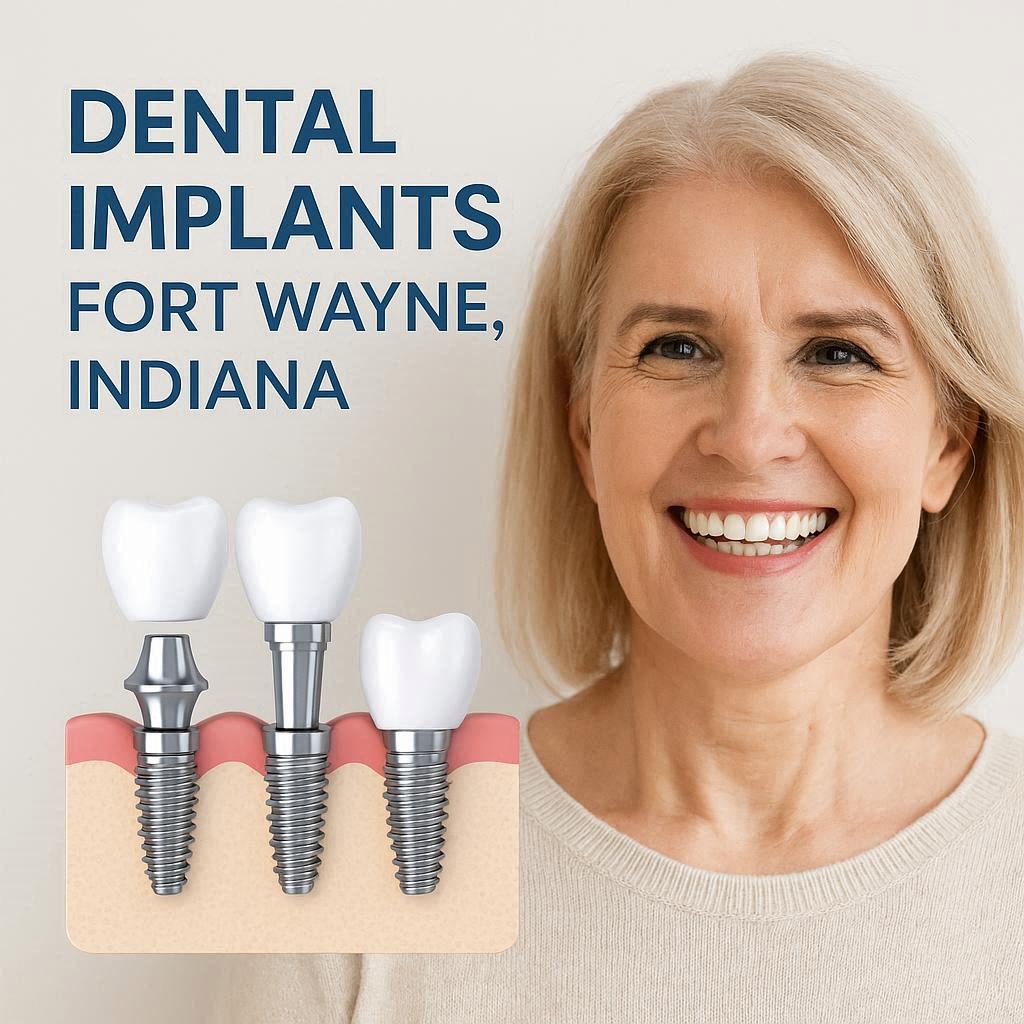
What Exactly Are Dental Implants?
A dental implant is a small, screw-like post made of titanium. A dentist places it into your jawbone. This post acts like a natural tooth root.
After placement, the bone grows around the implant. This process is called osseointegration. It makes the implant very stable.
Once healed, the dentist attaches a custom-made crown on top. The result looks, feels, and functions like a real tooth.
The Three Main Parts of a Dental Implant
| Part | Description | Function |
|---|---|---|
| Implant fixture | Titanium screw inserted into the jaw | Acts as the artificial root |
| Abutment | Connector piece | Joins the implant to the crown |
| Crown | Visible, tooth-colored cap | Restores chewing and appearance |
Important note: Implants can also support bridges or dentures. You don’t need one implant per missing tooth in all cases.
Why Choose Dental Implants Over Other Options?
You have alternatives: dentures or dental bridges. But implants offer unique advantages.
Benefits of Implants
- Natural look and feel. No one will notice the difference.
- Long-lasting. With good care, implants can last 20+ years or a lifetime.
- Protect jawbone. Implants prevent bone loss that happens after tooth loss.
- No damage to nearby teeth. Bridges require shaving down healthy teeth. Implants do not.
- Comfort and stability. No slipping like dentures. Eat apples and corn on the cob again.
A Quick Comparison
| Feature | Dental Implants | Traditional Bridge | Removable Dentures |
|---|---|---|---|
| Bone preservation | Yes | No | No |
| Adjacent teeth affected | No | Yes (shaved down) | No |
| Stability | Very high | High | Low to moderate |
| Average lifespan | 20+ years | 7–15 years | 5–10 years |
| Requires surgery | Yes | No | No |
Honest reality: Implants cost more upfront. But they often save you money in the long run because they rarely need replacement.
Who Is a Good Candidate for Dental Implants?
Most healthy adults are candidates. However, some conditions can affect success.
Ideal Candidate Checklist
- One or more missing teeth
- Healthy gums (no active gum disease)
- Enough jawbone density to support the implant
- Non-smoker or willing to quit during healing
- Committed to good oral hygiene
- No uncontrolled chronic diseases (e.g., severe diabetes)
What If You Lack Bone?
Do not worry. Many Fort Wayne dentists offer bone grafting. This procedure adds bone material to your jaw. After a few months of healing, you can get implants.
Note: Bone grafting adds time and cost. But it makes implants possible for almost everyone.
The Step-by-Step Procedure for Dental Implants in Fort Wayne Indiana
Understanding the process reduces fear. Most implant treatments follow these steps.
Step 1: Initial Consultation (Day 1)
Your dentist examines your mouth. They take X-rays or a 3D CT scan. This shows bone level and nerve locations.
You discuss medical history and goals. The dentist creates a custom treatment plan.
Time: 30–60 minutes.
Step 2: Preparatory Work (If Needed)
Some patients need extractions, bone grafts, or gum disease treatment. These are done first. Healing takes weeks or months.
Step 3: Implant Placement (Surgery Day)
The dentist numbs your mouth with local anesthesia. You are awake but feel no pain. Some clinics offer sedation if you are anxious.
The dentist makes a small cut in your gum. They drill a precise hole in the bone. Then they place the titanium implant. Finally, they stitch the gum closed.
Time: 1–2 hours per implant.
Step 4: Osseointegration (Healing Period)
Your jawbone grows around the implant. This takes 3 to 6 months. During this time, you wear a temporary partial denture or bridge if needed.
Step 5: Abutment Placement
Once healed, the dentist reopens the gum and attaches the abutment. This small metal piece sticks out above the gum line.
Time: 15–30 minutes.
Step 6: Crown Fabrication and Placement
Your dentist takes impressions of your mouth. A dental lab creates your custom crown. This takes 2–4 weeks.
At your final visit, the dentist screws or cements the crown onto the abutment. You walk out with a complete smile.
Total treatment time: 4 to 9 months on average. Complex cases may take over a year. Patience pays off.
Cost of Dental Implants in Fort Wayne Indiana
Let’s talk money. Implants are an investment. Prices vary based on:
- Number of implants needed
- Need for bone grafting or extractions
- Type of crown material (porcelain, zirconia)
- Dentist’s experience and location
Average Price Ranges in Fort Wayne
| Service | Low Estimate | High Estimate |
|---|---|---|
| Single implant (all-inclusive) | $3,500 | $6,000 |
| Implant-supported bridge (3–4 teeth) | $7,000 | $15,000 |
| Implant-retained denture (per arch) | $8,000 | $20,000 |
| Full mouth implants (All-on-4 per arch) | $15,000 | $30,000 |
| Bone graft (per site) | $500 | $2,500 |
Important: These are estimates. Always request a written treatment plan with all fees.
Does Insurance Cover Implants?
Some plans cover part of the cost. Many do not. However, you can use Flexible Spending Accounts (FSA) or Health Savings Accounts (HSA).
Check with your provider. Even if implants are excluded, your plan may cover the crown or extractions.
Payment Options in Fort Wayne
Many local dental offices offer:
- In-house financing (pay over 6–24 months)
- CareCredit (medical credit card)
- LendingClub or Alphaeon (patient financing)
Do not let cost scare you away. Talk to your dentist. They can help find a solution.
Top Clinics for Dental Implants in Fort Wayne Indiana
Fort Wayne has many skilled implant dentists. Here are reputable clinics known for quality care.
1. Northwoods Dental Group
- Location: Northwest Fort Wayne
- Specialty: Same-day implants (when possible)
- Pros: In-house lab for faster crowns
- Cons: Higher price point
2. Dupont Dental
- Location: Near Dupont Hospital
- Specialty: Full mouth reconstruction and All-on-4
- Pros: Experienced oral surgeons on staff
- Cons: Limited evening hours
3. Aboite Dental
- Location: Southwest Fort Wayne
- Specialty: Gentle approach, sedation options
- Pros: Great for anxious patients
- Cons: May refer complex cases to specialists
4. Jefferson Dental Care
- Location: Downtown Fort Wayne
- Specialty: Affordable implant options
- Pros: Transparent pricing, free consultations
- Cons: Smaller facility
Tip: Schedule consultations with 2–3 clinics. Compare treatment plans, costs, and how comfortable you feel with the dentist.
Recovery and Aftercare: What to Expect
Healing varies by person. But most patients follow a similar timeline.
First 24–48 Hours After Surgery
- Normal: Swelling, minor bleeding, bruising
- Do: Rest, use ice packs, eat soft foods (yogurt, smoothies, soup)
- Avoid: Spitting, using straws, smoking, hot liquids
- Pain management: Over-the-counter ibuprofen or prescribed medication
1 Week After Surgery
Swelling goes down. You can return to work (unless your job is physically demanding). Keep the area clean with salt water rinses.
3–6 Months Healing
You eat normally but avoid chewing directly on the implant site. Your bone integrates with the implant. Attend all follow-up appointments.
Long-Term Care for Your Implants
Implants cannot get cavities. But they can fail due to gum disease (peri-implantitis).
To keep your implant healthy:
- Brush twice daily with a soft toothbrush
- Floss daily (use special implant floss or a water flosser)
- Visit your dentist every 6 months for cleanings
- Do not chew ice or hard candies
- If you grind your teeth at night, wear a nightguard
Quote from Dr. Sarah Mitchell, Fort Wayne implant dentist: “I tell my patients: treat your implant like a natural tooth. But give it a little extra love during cleaning. The gums around implants are more delicate.”
Risks and Complications: An Honest Look
No medical procedure is risk-free. But implant success rates are very high: 95–98% for lower jaw and 90–95% for upper jaw.
Possible Complications
| Risk | How Common? | Prevention |
|---|---|---|
| Infection | Rare (<5%) | Good oral hygiene, antibiotics |
| Implant failure to fuse | 2–5% | Non-smoking, healthy bone |
| Nerve damage | Very rare (<1%) | 3D CT scan before surgery |
| Sinus problems (upper implants) | Rare | Sinus lift procedure if needed |
| Gum recession around implant | Uncommon | Gentle brushing, regular checkups |
If an implant fails, your dentist can remove it. After healing, they may try again—often successfully.
Dental Implants vs. Mini Implants
You might hear about “mini implants.” These are smaller, thinner implants. They are less expensive and require less bone.
Comparison Table
| Feature | Standard Implant | Mini Implant |
|---|---|---|
| Diameter | 3.5–5 mm | 1.8–3 mm |
| Best for | Single teeth, bridges, dentures | Stabilizing lower dentures |
| Longevity | 20+ years | 5–8 years |
| Cost | Higher | Lower |
| Can replace a single tooth? | Yes | Not recommended |
Important: Mini implants have their place. But most dentists prefer standard implants for single tooth replacement. For denture stabilization, mini implants can work well.
Frequently Asked Questions (FAQ)
1. Are dental implants painful?
Most patients say the procedure is less painful than a tooth extraction. You are numb during surgery. Afterward, discomfort is mild to moderate for a few days.
2. How long do implants last?
With proper care, 20 years to a lifetime. The crown may need replacement after 10–15 years due to wear.
3. Can I get all my teeth replaced with implants?
Yes. Options include implant-supported dentures or full-arch fixed bridges (like All-on-4).
4. Does smoking affect implants?
Yes. Smoking significantly increases failure risk. It slows healing and reduces blood flow to the bone. If you smoke, quitting or cutting back helps.
5. How do I find the best implant dentist in Fort Wayne?
Look for:
- Advanced training in implantology (not all general dentists have it)
- Before-and-after photos of real cases
- Positive patient reviews on Google or Healthgrades
- A clear, written treatment plan with costs
6. Can implants be done in one day?
Some clinics offer “teeth-in-a-day” for specific cases (like All-on-4). However, the implants still need months to fully fuse. Temporary teeth are placed, then permanent ones later.
7. What if I have gum disease?
You must treat gum disease first. Uncontrolled gum disease leads to implant failure. Your dentist will create a periodontal treatment plan before implant surgery.
8. Are implants covered by Medicare or Medicaid?
Original Medicare does not cover dental implants. Some Medicare Advantage plans (Part C) may offer limited coverage. Medicaid in Indiana typically does not cover implants for adults, only extractions and dentures.
Additional Resource
For verified patient reviews and detailed profiles of Fort Wayne implant dentists, visit:
Indiana Dental Association – Find a Dentist
This official resource lists licensed dentists by city and specialty. It is a trustworthy starting point.
Conclusion
Dental implants in Fort Wayne Indiana offer a reliable, long-term solution for missing teeth. They look natural, preserve jawbone health, and restore your ability to eat and smile with confidence. While the upfront cost and treatment time are higher than other options, the durability and quality of life benefits make implants a smart investment for most people.