Dental Implants in Houston TX
If you are reading this, you have probably already done a little bit of research. Maybe you have a missing tooth that makes you hesitate to smile in photos. Perhaps you have struggled with uncomfortable dentures for years. Or maybe you have been told you need a full mouth reconstruction, and the idea feels overwhelming.
Let us be honest: deciding to get dental implants is a big decision. It involves your health, your appearance, your confidence, and your budget.
But here is the good news: Houston is one of the best major cities in the United States to get dental implants. Why? Because we have an incredible concentration of world-class oral surgeons, periodontists, and restorative dentists. We also have competitive pricing compared to other large metropolitan areas like New York or Los Angeles.
This guide is built to give you everything you need. No fluff. No unrealistic promises. Just real, practical, human advice to help you navigate the process of getting dental implants in Houston TX.
What Exactly Are Dental Implants? (A Simple Explanation)
Before we dive into prices and specific Houston clinics, let us make sure we understand what an implant actually is.
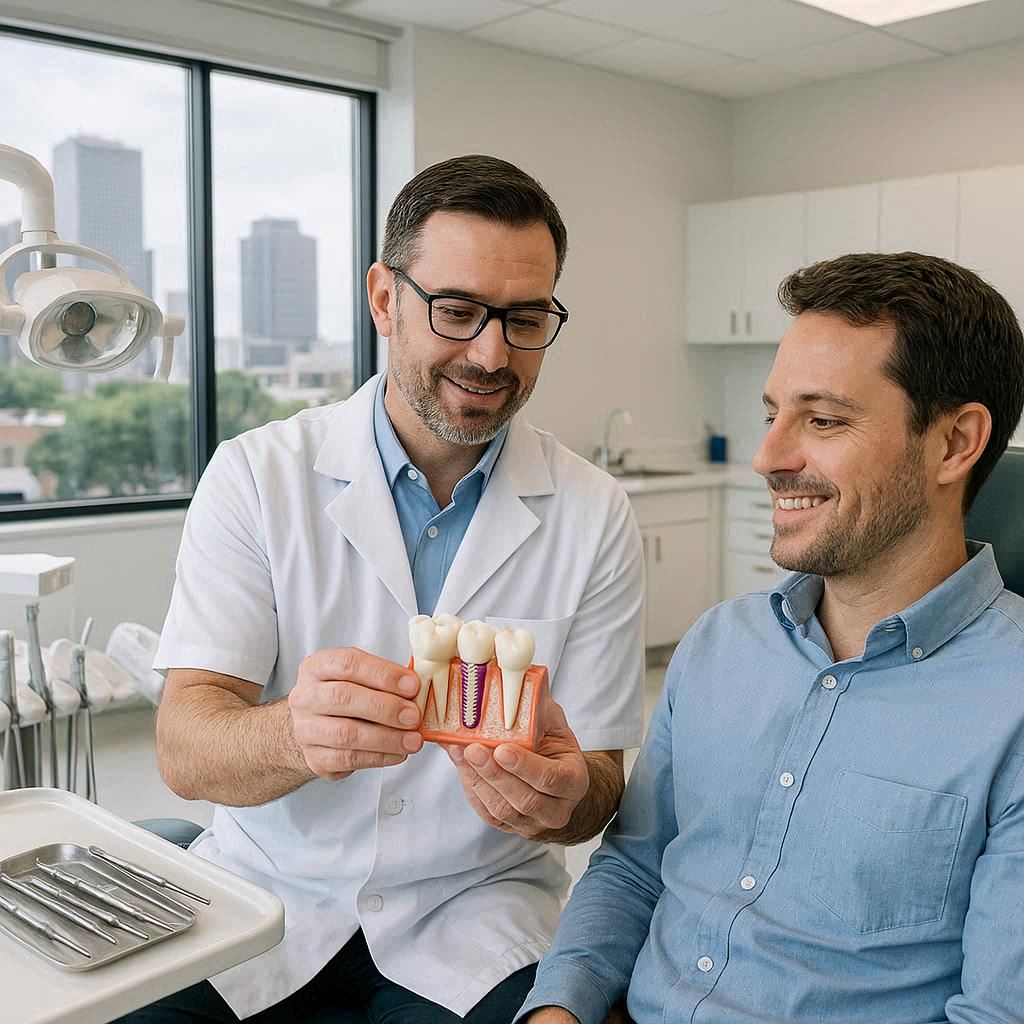
Imagine a natural tooth. It has a root (the part under your gum) and a crown (the part you see). A dental implant replaces the root. The implant itself is a small post, usually made of medical-grade titanium, that a surgeon places into your jawbone. Over time, your bone grows around this post in a process called osseointegration. This creates a foundation that is just as strong as a natural tooth root.
On top of that post, we place a connector called an abutment. Then, on top of the abutment, your dentist attaches a custom-made crown that looks, feels, and functions like a real tooth.
A single dental implant has three parts:
- The implant post (in your jawbone)
- The abutment (connector piece)
- The crown (visible tooth)
You can also replace multiple teeth with implants using bridges or dentures that snap onto several strategically placed posts.
Important note for readers: Dental implants are not for everyone. You need sufficient jawbone density and healthy gums. However, many Houston specialists offer bone grafting procedures that can help if you lack bone.
Why Are So Many Houstonians Choosing Implants Over Dentures or Bridges?
If you live in Houston, you know our city moves fast. You need a solution that keeps up with your life — whether you are grabbing tacos at a food truck, cheering at a Texans game, or presenting to clients in the Energy Corridor. Here is why implants are winning the race.
No More Slipping or Clicking
Dentures rest on your gums. They move when you eat or talk. Implants integrate with your bone. They do not move. Ever.
Preserve Your Facial Structure
When you lose a tooth, your jawbone starts to shrink because it no longer has a root to stimulate it. This can make your face look sunken or older than you are. Implants stop this bone loss because they stimulate the bone just like a natural root.
Eat Whatever You Want
With traditional dentures, steak, corn on the cob, and apples are risky. With implants, you bite with nearly the same force as natural teeth. You can eat without thinking about it.
Protect Remaining Healthy Teeth
A traditional bridge requires shaving down the two healthy teeth next to the gap. Implants do not touch your other teeth. They stand alone.
Long-Term Value
Yes, implants cost more upfront. But a good dental bridge lasts 7–10 years. Dentures need replacement every 5–7 years. A well-maintained dental implant can last 30 years or even a lifetime.
The Complete Process: What to Expect from Start to Finish in Houston
One of the most common fears we hear is: “I don’t know what is going to happen.” Let us walk through the process step-by-step so you feel prepared.
Step 1: The Consultation (1–2 hours)
You will visit a Houston implant dentist or oral surgeon. They will take:
- Digital X-rays (panoramic)
- A 3D CBCT scan (this is critical — it shows your bone density and nerve locations)
- Photos of your smile and teeth
They will review your medical history. Be honest about medications, smoking, and conditions like diabetes or heart disease. These factors can affect healing.
Questions to ask at this appointment:
- How many implants have you placed in your career?
- Do you use 3D-guided surgery?
- What type of implant brand do you use (Nobel Biocare, Straumann, Zimmer)?
- What is the total cost including everything?
Step 2: Preparatory Work (Sometimes Necessary)
Not everyone is ready for implants immediately. You might need:
- Tooth extraction (if a damaged tooth remains)
- Bone grafting (if your jawbone is too thin or soft)
- Sinus lift (for upper back molars)
- Gum disease treatment
Important note for readers: Do not skip this phase. A good Houston implant dentist will tell you the truth, even if it means delaying your implant by a few months. Fast and cheap often leads to failure.
Step 3: Implant Placement Surgery (1–2 hours per arch)
On surgery day, you will receive local anesthesia. You can also request sedation options: nitrous oxide (laughing gas), oral sedation (a pill), or IV sedation (twilight sleep).
The surgeon makes a small incision in your gum, drills a precise hole using a surgical guide, and places the titanium post into your bone. Then they close the gum over the implant or attach a healing cap.
What does it feel like? You will feel pressure and vibration but not sharp pain. Most patients compare it to a standard tooth extraction.
Step 4: Osseointegration (3–6 months of healing)
This is the waiting period. Your jawbone grows around the implant. You will wear a temporary partial denture or flipper to fill the gap. You need to eat soft foods and avoid putting pressure on the implant site.
Step 5: Abutment Placement (30 minutes)
Once your implant is fully fused to the bone, your dentist exposes the top of the implant and attaches a small metal abutment. This is a minor procedure with local anesthesia.
Step 6: Final Crown Delivery (2–3 weeks after abutment)
Your dentist takes impressions or uses a digital scanner to design your custom crown. A local lab (many in Houston produce crowns within 10 days) creates a crown matched to the color, shape, and translucency of your natural teeth.
At your final visit, your dentist screws or cements the crown onto the abutment. You look in the mirror. And just like that — you have a complete, beautiful smile again.
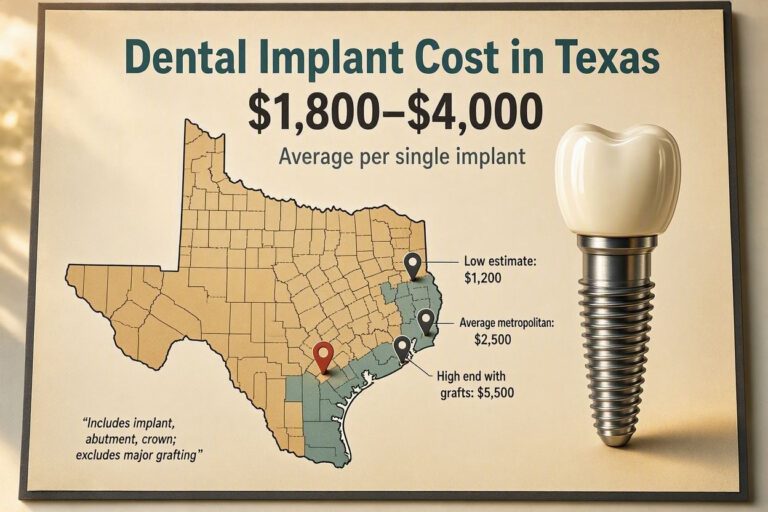
How Much Do Dental Implants in Houston TX Actually Cost?
Let us talk money. This is the number one question, and honest answers are hard to find online. Prices vary widely in Houston due to competition, location, and the provider’s expertise.
Here is a realistic breakdown of costs without insurance at a reputable Houston implant center (mid-range pricing, not discount clinics).
| Procedure | Estimated Cost (Per Unit) | Notes |
|---|---|---|
| Consultation & CBCT Scan | 150–350 | Often free if you commit to treatment |
| Single Implant Post Placement | 1,500–2,500 | Surgeon’s fee |
| Abutment | 300–600 | Titanium or zirconia |
| Custom Crown | 1,200–2,000 | Porcelain fused to zirconia |
| Total Single Implant | 3,150–3,150–5,450 | Complete from start to finish |
| Bone Graft (simple) | 300–800 | Per site |
| Sinus Lift | 1,500–3,000 | For upper premolars/molars |
| Implant-Supported Bridge (3 teeth) | 6,000–12,000 | Uses 2 implants |
| Implant-Supported Denture (per arch) | 7,000–15,000 per arch | 4 to 6 implants (All-on-4 or All-on-6) |
Why The Price Range?
- Discount clinics (under $2,500 total) – Often use lower-quality implants, inexperienced surgeons, or hidden fees for temporary teeth and follow-ups.
- Mid-range (3,500–3,500–5,000) – Reputable specialists, brand-name implants (Straumann or Nobel Biocare), digital workflow.
- Premium ($6,000+) – Renowned prosthodontists, private clinic, concierge service, same-day teeth.
Important note for readers: Avoid anyone offering a “single implant for $999.” You will almost certainly receive a poor-quality implant, a temporary crown that breaks, or no warranty. Good dentistry is not cheap.
Does Insurance Cover Dental Implants in Houston?
Most traditional dental insurance plans do not cover the implant post. However, they often cover portions of the crown, the abutment, and extractions.
What to check with your provider:
- Annual maximum (often 1,000–2,000)
- Missing tooth clause (some plans do not cover teeth missing before your policy started)
- Medical insurance may cover implants if tooth loss resulted from an accident or medical condition (like oral cancer).
Many Houston implant dentists accept CareCredit, Proceed Finance, or in-house payment plans (e.g., 12–24 months interest-free).
Best Types of Dental Implants Available in Houston
Not all implants are the same. Houston dentists offer several types. The right one depends on your bone health, budget, and number of missing teeth.
1. Single Tooth Implant
Best for: One missing tooth.
Pros: Does not affect neighboring teeth. Easy to clean.
Cons: Higher upfront cost than a bridge.
2. Implant-Supported Bridge
Best for: Two or three missing teeth in a row.
Pros: Uses two implants to support three crowns. More stable than a traditional bridge.
Cons: Requires enough bone at two sites.
3. All-on-4 (or All-on-6)
Best for: All teeth missing in one arch (upper or lower).
Pros: Only four implants hold a full fixed denture. Same-day teeth possible. Lower cost than individual implants.
Cons: Harder to clean under the prosthesis. Not removable by the patient.
4. Implant-Supported Denture (Overdenture)
Best for: Patients who want removable dentures but with stability.
Pros: Snaps onto 2–4 implants. Easy to clean. Less expensive than All-on-4.
Cons: Removable (some people dislike this). Plastic base covers the palate on upper dentures.
5. Zygomatic Implants
Best for: Severe bone loss in the upper jaw where sinus lifts are not possible.
Pros: No bone grafting needed. Implants anchor into the cheekbone (zygoma).
Cons: Very complex surgery. Only a few specialists in Houston perform this. Expensive.
How to Choose the Right Implant Dentist in Houston
Houston is enormous. From The Woodlands to Sugar Land, from Katy to Baytown. You have dozens of options. Here is how to filter through them.
Credentials Matter
Look for:
- Oral and Maxillofacial Surgeon (DDS, MD) – Best for complex bone grafting and full-arch cases.
- Periodontist – Gum and bone specialists. Excellent for single implants.
- Prosthodontist – Restoration experts who handle full-mouth reconstruction and aesthetics.
A general dentist can place implants, but specialist training adds a layer of safety, especially for challenging cases.
Questions to Ask Every Houston Implant Provider
- “How many implants have you personally placed in the last 12 months?” (You want hundreds, not dozens).
- “What is your implant success rate?” (Should be 95% or higher for non-smokers).
- “Do you use CBCT 3D imaging and surgical guides?” (If yes, that is a green flag).
- “What happens if my implant fails?” (Reputable clinics offer a replacement warranty, often 5–10 years).
- “Who makes my crown? An in-house lab or an external lab?” (In-house labs are faster).
Red Flags to Avoid
- No CBCT machine (they are using old 2D X-rays only).
- Vague pricing or refusal to give a written treatment plan.
- High pressure to start treatment today for a “limited-time discount.”
- No post-operative care plan or emergency contact.
Important note for readers: Drive to at least two consultations. Houston is big enough that you can compare a periodontist in the Medical Center and a general dentist in Memorial. The right fit is worth the extra hour of driving.
List of Top Areas in Houston to Find Quality Implant Dentistry
You do not need to go downtown if you live in the suburbs. Excellent implant dentists are spread across the city.
- Texas Medical Center / Museum District: Highest concentration of specialists, research hospitals, and advanced bone grafting. Best for complex medical cases.
- The Woodlands / Conroe: Many high-end prosthodontists. Great for cosmetic-focused full mouth reconstructions.
- Katy / Cinco Ranch: Highly competitive pricing due to many new dental offices. Good for standard single implants.
- Sugar Land / Missouri City: Excellent periodontists. Strong patient reviews for patient comfort.
- Energy Corridor / Memorial: Boutique clinics with same-day CAD/CAM crowns. Convenient for professionals.
- Clear Lake / NASA Area: Solid oral surgeons. Military and retiree-friendly pricing near the Johnson Space Center.
Healing, Aftercare, and Long-Term Maintenance
Getting the implant is only half the battle. Keeping it healthy for 30 years is the real win.
What to Expect After Surgery (First 2 Weeks)
- Days 1–3: Swelling, mild bruising, and some discomfort. Use ice packs (20 minutes on, 20 off). Stick to yogurt, smoothies, and scrambled eggs.
- Days 4–7: Swelling decreases. You can transition to soft pasta, mashed potatoes, and fish. No spicy foods.
- Days 8–14: Stitches dissolve or are removed. You can eat most soft-to-medium foods. No crunchy or sticky foods near the implant site.
Long-Term Home Care
Implants cannot get cavities, but they can get peri-implantitis — an infection of the gum and bone around the implant. This is the number one cause of late implant failure.
Your daily routine must include:
- Soft-bristle toothbrush (or electric brush with a sensitive head)
- Water flosser (Waterpik on low pressure) directed around the abutment
- Interdental brushes (tiny brushes to clean under the crown)
- Non-abrasive toothpaste (no baking soda or charcoal)
What to avoid forever:
- Chewing ice, hard candy, or pens
- Using your implant as a tool (opening packages)
- Smoking (dramatically increases failure rates — up to 20% higher)
Professional Maintenance Schedule
See your Houston dentist or hygienist every 6 months for:
- Periapical X-ray (to check bone levels)
- Hand scaling of the implant surface (metal scalers only — plastic or titanium instruments)
- Pocket depth measurements around the implant
“The most successful implant patients treat their implant like a brand new Mercedes. You would not put cheap gas in it or skip oil changes. Do not neglect your maintenance visits.” – Dr. Elena Vasquez, Houston periodontist.
Dental Implant Success Rates: Realistic Expectations
You will see websites claiming a 98% success rate. That is true — but only for healthy, non-smoking patients with good bone and no gum disease.
Here is the honest, real-world breakdown from Houston clinical data:
| Patient Profile | Estimated 10-Year Success Rate |
|---|---|
| Healthy, non-smoker, good oral hygiene | 95 – 98% |
| Controlled diabetic (HbA1c below 7%) | 90 – 95% |
| Light smoker (less than 10 cigarettes/day) | 85 – 90% |
| Heavy smoker (1+ pack/day) | 70 – 80% |
| History of gum disease (treated before implant) | 85 – 90% |
| Untreated gum disease or bruxism (teeth grinding) | Below 70% (not recommended) |
Signs Your Implant Is Failing (What to Watch For)
- The implant feels loose or wiggly
- Persistent pain when biting down (after 2 weeks of healing)
- Bleeding or pus around the gum line
- The gum recedes, and you see metal threads
If you notice any of these, call your Houston implant dentist immediately. Early intervention can save the implant 80% of the time.
Frequently Asked Questions (FAQ) About Dental Implants in Houston TX
1. How painful is getting a dental implant?
Most patients say the pain is a 2 or 3 out of 10 during recovery. The procedure itself is painless due to local anesthesia. Over-the-counter ibuprofen manages post-op discomfort for 2–4 days.
2. How long do dental implants last?
With proper home care and regular checkups, 25–30 years is common. Many patients keep their implants for life. The crown may need replacement after 15–20 years due to normal wear.
3. Can I get dental implants if I have gum disease?
No. Active gum disease must be treated and resolved first. Houston periodontists can manage gum disease with scaling, root planing, or LANAP (laser treatment). Once healthy, you can proceed with implants.
4. Is there an age limit for implants in Houston?
No upper age limit. Healthy 85-year-olds receive implants successfully. The lower limit is usually 18 for males and 16 for females, when jaw growth is complete.
5. Are same-day implants real?
Yes and no. Same-day “teeth in a day” means the implant is placed and a temporary crown is attached immediately. However, you cannot bite with that temporary crown for 4–6 months. A permanent crown comes later.
6. How do I find the best affordable dental implants in Houston?
Contact the UTHealth School of Dentistry (Houston’s dental school). Residents perform implant procedures under specialist supervision at approximately 50–60% of private practice fees. Wait times are longer, but quality is excellent.
7. Will Medicare or Medicaid cover implants in Texas?
Original Medicare does not cover dental implants. Some Medicare Advantage plans (Part C) offer limited dental benefits. Texas Medicaid (CHIP/Medicaid) only covers extractions and dentures for adults — not implants.
8. Can implants be done in one day if I am traveling to Houston from out of town?
Yes, some clinics offer accelerated timelines. For a single implant, you need at least two visits over 4–6 months. For All-on-4, you can have surgery and leave with fixed temporary teeth in 24–48 hours.
Additional Resource
For independent, verified reviews and before-and-after photos of Houston implant dentists, visit the Texas Dental Association’s “Find a Dentist” tool and filter by “Oral Surgery” or “Periodontics.”
Click here to access the Texas Dental Association referral service
(No cost to search. No advertising. Only licensed Texas dentists.)
Final Conclusion
Dental implants in Houston TX offer a permanent, natural-looking solution for missing teeth, but success depends on choosing the right specialist, understanding real costs (3,150to5,450 per tooth), and committing to lifelong maintenance. Houston’s competitive market and top-tier medical talent make it an excellent place for implants, but avoid discount clinics promising unrealistic prices. Start with two consultations, ask about CBCT scanning and implant brands, and treat your new smile like the long-term investment it truly is.