Dental Implants in Jackson Michigan
If you are reading this, chances are you have been living with a gap in your smile. Maybe it is a single missing tooth. Perhaps you struggle with loose dentures. Or you might have a tooth that is damaged beyond repair.
You are not alone. Thousands of people in Jackson County face the same decision every year. The good news? Dental implants have changed the way we replace teeth. They are strong, natural-looking, and designed to last.
But let us be honest. The world of dental implants can feel confusing. There are different types. There are different prices. And there are different opinions.
This guide is here to clear up the confusion. We will walk through everything you need to know about dental implants in Jackson, Michigan. No fluff. No false promises. Just real, practical information to help you make a smart decision for your health and your wallet.
What Exactly Is a Dental Implant? (A Simple Explanation)
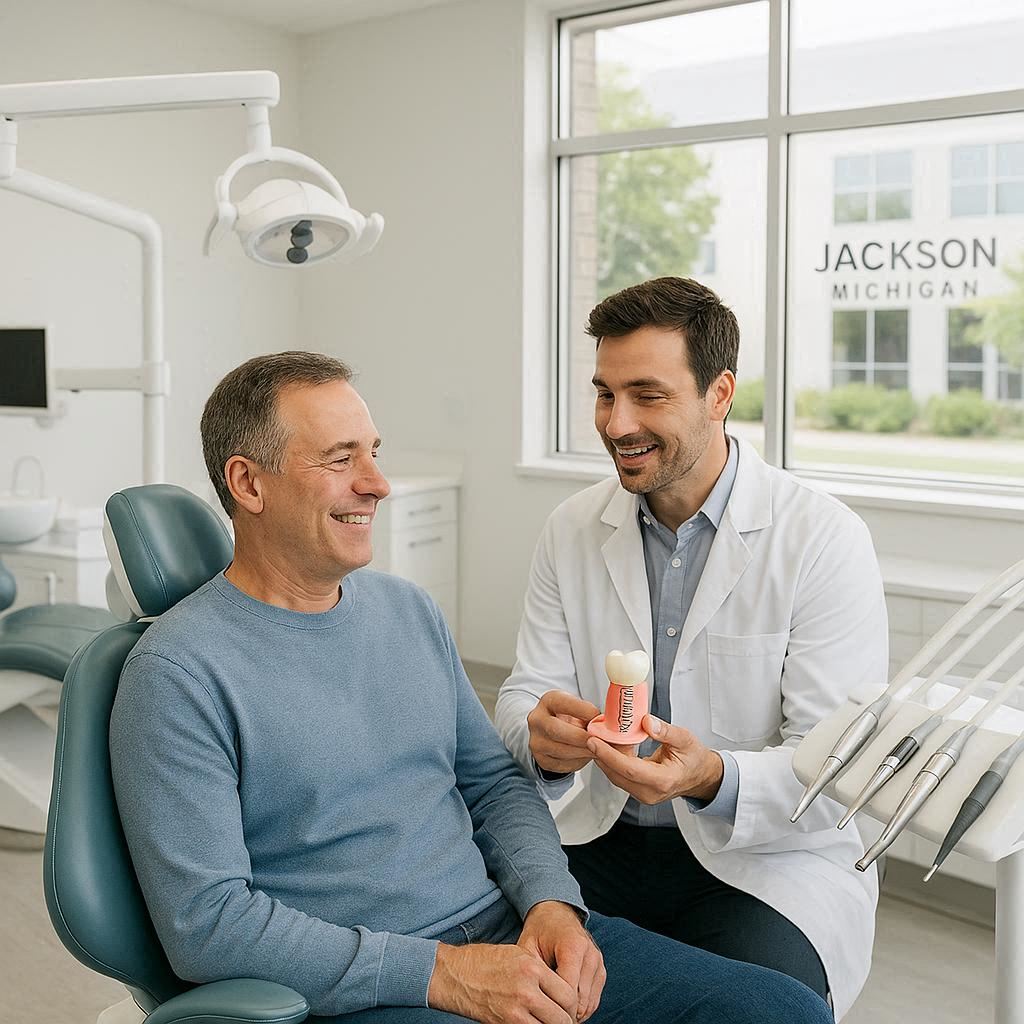
Let us start with the basics. A dental implant is not the tooth itself. Think of it as a man-made replacement for the root of your tooth.
Here is what it includes:
- The implant post: A small screw made of titanium. A surgeon places this into your jawbone.
- The abutment: A connector piece. It sits on top of the implant.
- The crown: The visible, tooth-colored part. Your dentist attaches this to the abutment.
Over time, your jawbone grows around the titanium post. This process is called osseointegration (say that three times fast). It makes the implant incredibly stable. In fact, it becomes as strong as a natural tooth root.
Important note: Not everyone is a candidate for implants right away. We will talk about that later in this guide.
Why Consider Dental Implants in Jackson, Michigan?
You have options. Bridges. Dentures. Or doing nothing at all. So why choose implants?
Let us compare them side by side.
Implants vs. Traditional Bridges
| Feature | Dental Implants | Traditional Bridge |
|---|---|---|
| Affects healthy teeth | No | Yes (shaves down adjacent teeth) |
| Bone loss prevention | Yes | No |
| Lifespan | 20+ years (often lifetime) | 5–15 years |
| Cleaning | Like natural teeth | Special floss required |
| Cost (initial) | Higher | Lower |
Implants vs. Dentures
| Feature | Dental Implants | Traditional Dentures |
|---|---|---|
| Stability | Fixed in jaw | Can slip or click |
| Eating restrictions | None | Avoid hard/sticky foods |
| Bone health | Preserves bone | Accelerates bone loss |
| Comfort | Feels natural | Can cause sore spots |
| Maintenance | Normal brushing/flossing | Removed nightly to soak |
The Jackson, Michigan Factor
Living in Jackson means you experience all four seasons. Cold winters. Hot summers. You need a tooth replacement solution that can handle temperature changes, normal wear, and your daily coffee habit.
Implants do not expand or contract like dentures can. They do not crack like bridges might. For the active Jackson resident—whether you are walking at Cascades Falls Park or enjoying a burger at Schlenker’s—implants simply work like real teeth.
Who Is a Good Candidate for Dental Implants?
Here is the honest truth. Not everyone can get implants right away. A good candidate typically has:
- One or more missing teeth
- A fully grown jawbone (usually age 18 or older)
- Enough bone density to support the implant
- Healthy gums (no active gum disease)
- Good overall health (certain conditions may affect healing)
What If You Do Not Qualify Yet?
Do not lose hope. Many people who are told “no” by one dentist may qualify later.
- Low bone density: Bone grafting can add volume to your jaw.
- Gum disease: Treat the infection first. Then reconsider implants.
- Smoking: Quitting for several months before and after surgery improves success rates dramatically.
- Uncontrolled diabetes: Work with your doctor to stabilize blood sugar first.
Note from a Jackson dentist: “I have seen patients in their 70s and 80s receive implants successfully. Age alone is not a barrier. Overall health matters much more.”
The Step-by-Step Process of Getting Dental Implants in Jackson
Let us walk through what actually happens. This is not a single appointment. The full process usually takes several months.
Step 1: Initial Consultation (1 hour)
Your dentist or oral surgeon will:
- Take X-rays or a 3D CBCT scan
- Examine your gums and remaining teeth
- Review your medical history
- Discuss your goals and budget
- Create a custom treatment plan
What to ask at this visit:
- “Am I a good candidate today?”
- “Do I need any preliminary work like bone grafting?”
- “How many implants do I really need?”
- “What is the total estimated cost?”
Step 2: Preparatory Procedures (If Needed)
Sometimes you need prep work before implants. This could include:
- Tooth extractions (if a damaged tooth remains)
- Bone grafting
- Sinus lift (for upper back molars)
- Gum disease treatment
These procedures add time and cost. But they are essential for long-term success.
Step 3: Implant Placement Surgery (1–2 hours)
On surgery day, here is what to expect:
- Anesthesia: Local anesthesia numbs the area. Sedation options are available for nervous patients.
- Incision: The surgeon makes a small cut in your gum.
- Drilling: A precise hole is made in the jawbone.
- Placement: The titanium post is screwed into place.
- Closing: The gum is stitched over or around the implant.
Most patients report less discomfort than expected. Many say a tooth extraction hurts more.
Step 4: Healing and Osseointegration (3–6 months)
Now the waiting begins. Your jawbone needs time to grow around the implant. During this period:
- You will have a temporary tooth replacement (a flipper or partial denture)
- You should eat softer foods for the first week
- You must avoid putting direct pressure on the implant site
Step 5: Abutment Placement (30 minutes)
Once healing is complete, a second minor procedure exposes the implant and attaches the abutment. This is the small metal piece that will hold your new crown.
Step 6: Crown Fabrication and Placement (2–3 weeks)
Your dentist takes impressions of your mouth. A dental lab creates your custom crown. When it arrives, you return for the final attachment. The crown is screwed or cemented onto the abutment.
Congratulations. You now have a new tooth.
Types of Dental Implants Available in Jackson, Michigan
Not all implants are the same. Here are the most common options you will find locally.
1. Single Tooth Implant
Best for: One missing tooth
Implants used: 1
Restoration: 1 crown
This is the most straightforward case. No adjacent teeth are harmed. Cleaning is as easy as brushing and flossing normally.
2. Implant-Supported Bridge
Best for: Two or more missing teeth in a row
Implants used: 2 (for 3–4 missing teeth) or more
Restoration: A bridge that attaches to implants
Instead of placing one implant per missing tooth, two implants can support a bridge of three or four teeth. This saves money while still avoiding the need to shave down healthy teeth.
3. Implant-Supported Dentures (Overdentures)
Best for: Full arch (all teeth missing on top or bottom)
Implants used: 4 to 6 per arch
Restoration: A removable denture that snaps onto implants
These are a massive upgrade from traditional dentures. They snap into place. No adhesives needed. No slipping when you laugh or cough.
4. All-on-4 or All-on-6
Best for: Full arch replacement
Implants used: 4 or 6 per arch
Restoration: Fixed, non-removable bridge
This is the closest thing to having natural teeth again. The bridge is screwed into place. You never take it out. It feels, functions, and looks like real teeth.
| Type | Number of Implants | Removable? | Approximate Cost Range (Per Arch) |
|---|---|---|---|
| Single Implant | 1 | No | $3,000–$5,000 |
| Implant Bridge (3 teeth) | 2 | No | $6,000–$10,000 |
| Overdenture | 4 | Yes | $12,000–$18,000 |
| All-on-4 | 4 | No | $15,000–$25,000 |
Prices vary significantly by provider. We will talk about costs in detail below.
Finding the Right Dental Implant Provider in Jackson
Jackson, Michigan has several types of dental professionals who place implants. Each has different training and costs.
General Dentists with Implant Training
Many family dentists in Jackson have taken continuing education courses in implant placement. They typically handle straightforward single-tooth cases.
Pros: Often lower cost, convenient location, familiar with your dental history
Cons: Limited to simpler cases
Oral Surgeons
These are specialists in surgical procedures of the mouth and jaw. They place the most implants per year of any provider type.
Pros: Highest level of surgical training, can handle complex cases, offer deeper sedation options
Cons: Higher fees, may refer you to a separate dentist for the crown
Periodontists (Gum Specialists)
Periodontists focus on the gums and supporting bone. They are excellent choices if you have gum disease or need bone grafting.
Pros: Experts in bone and gum health, ideal for complex cases
Cons: Similar cost to oral surgeons
Prosthodontists
These specialists focus on restoring and replacing teeth. They often coordinate the entire implant process from start to finish.
Pros: Focus on aesthetics and function of the final restoration
Cons: May not place the implant themselves (works with a surgeon)
What to Look for in a Jackson Implant Provider
Ask these five questions before booking:
- “How many implants do you place per year?” (Look for 50+)
- “What is your success rate?” (Should be 95% or higher)
- “Do you handle the entire process or do I need to see multiple offices?”
- “What type of imaging do you use?” (CBCT is the gold standard)
- “Can you share before-and-after photos of similar cases?”
Local tip: Drive to a few offices in Jackson before deciding. Pay attention to cleanliness, staff friendliness, and whether they rush you out the door.
The Real Cost of Dental Implants in Jackson, Michigan
Let us talk money. This is often the biggest concern for patients.
Breaking Down the Costs
A single dental implant in Jackson typically costs between $3,000 and $5,000. But that number includes several separate fees:
- Consultation and imaging: $150–$350
- Implant post placement: $1,500–$2,500
- Abutment: $300–$600
- Crown: $1,200–$2,000
- Sedation (if desired): $200–$600 per hour
Full Arch Costs
Replacing a full set of teeth costs more but changes lives completely.
- Implant-supported overdenture (4 implants): $12,000–$18,000 per arch
- All-on-4 fixed bridge: $15,000–$25,000 per arch
- All-on-6: $20,000–$30,000 per arch
Does Dental Insurance Cover Implants?
This is where things get tricky. Most traditional dental insurance plans do not cover implants fully. However, they may cover parts of the process:
| Service | Typical Coverage |
|---|---|
| Consultation | 50–80% |
| Extractions | 50–80% |
| Crown (if called a “bridge”) | 50% |
| Implant post | Often $0 |
Read your policy carefully. Some plans now offer implant benefits, but annual maximums ($1,000–$2,000) mean you will still pay most costs out of pocket.
Financing Options in Jackson
Do not let the price tag scare you away. Many Jackson dental offices offer:
- CareCredit: Medical credit card with 6–12 month interest-free options
- In-house payment plans: Monthly installments directly through the dental office
- LendingClub or Proceed Finance: Third-party medical loans
- Health Savings Account (HSA) or Flexible Spending Account (FSA): Use pre-tax dollars
Ask this question: “Do you offer any discounts for paying in full with cash or check?” Some offices reduce fees by 5–7% for upfront payment.
Common Fears and Concerns (Addressed Honestly)
You have worries. That is normal. Let us address the most common ones directly.
“Does it hurt?”
The procedure itself is painless due to anesthesia. The recovery involves some soreness, similar to a tooth extraction. Most patients manage with over-the-counter ibuprofen. Severe pain is rare and should be reported to your dentist immediately.
“How long does it take?”
From start to finish, expect 4 to 9 months. This includes healing time. Some immediate-load implants (same-day teeth) exist, but not everyone qualifies. Rushing the process increases failure risk.
“Can implants fail?”
Yes. The success rate is 95–98% for lower jaw and 90–95% for upper jaw. Failure usually happens early (first few months) due to infection, poor bone quality, or overloading. Late failures (years later) are rare but possible from poor oral hygiene or teeth grinding.
“What if I grind my teeth at night?”
Grinding (bruxism) puts extra force on implants. Unlike natural teeth, implants have no ligament to absorb shock. Your dentist will likely recommend a custom nightguard to protect your investment.
“Will my insurance cover anything?”
As noted above, most plans offer limited coverage. However, some Michigan Medicaid plans cover extractions and dentures but rarely implants. Always verify before assuming.
Preparing for Your Implant Surgery in Jackson
Good preparation leads to smooth recoveries. Here is a checklist.
One Week Before
- Stop smoking or using nicotine products
- Arrange time off work (2–3 days recommended)
- Fill any prescriptions (antibiotics, pain medication)
- Buy soft foods (yogurt, soup, mashed potatoes, protein shakes)
- Fill an ice pack (frozen peas work great)
The Night Before
- Eat a normal dinner
- Follow pre-surgery fasting instructions if receiving IV sedation
- Lay out comfortable clothes for the next day
The Day of Surgery
- Have a responsible driver if receiving sedation
- Take prescribed medications as directed
- Wear short sleeves (easier for IV access)
- Brush your teeth gently (avoid the surgical area)
What to Expect Immediately After
- First 24 hours: Rest with head elevated. Use ice packs (20 minutes on, 20 off). No spitting or using straws.
- Days 2–3: Swelling peaks then begins to go down. Switch to warm compresses. Rinse gently with warm salt water after 24 hours.
- Days 4–7: Most soreness resolves. Return to normal brushing (avoid surgical site). Eat soft foods.
- Week 2: Sutures may dissolve or be removed. You can usually return to normal activity.
Warning signs to call your dentist: Fever, worsening pain after day 3, heavy bleeding, pus, or inability to open your mouth.
Long-Term Care for Your Dental Implants
Implants cannot get cavities. But they can fail from gum disease. This condition is called peri-implantitis. It is inflammation and bone loss around the implant.
Daily Maintenance
- Brush twice daily: Use a soft-bristled brush. Pay attention to the gumline around the implant.
- Floss daily: Use implant-specific floss or super floss with a stiff end.
- Water flosser: Highly recommended for cleaning under bridges and around implants.
- Avoid: Chewing ice, hard candy, or using your teeth as tools.
Professional Maintenance
- Regular cleanings: Every 6 months. Your hygienist needs special instruments (plastic or titanium scalers) to avoid scratching the implant surface.
- Annual X-rays: Your dentist should check bone levels around each implant once per year.
- Nightguard check: If you grind, have your nightguard evaluated annually.
Lifespan Expectations
With proper care, most implants last 20 years to a lifetime. The crown may need replacement after 10–15 years due to normal wear. This is similar to replacing a crown on a natural tooth.
Alternatives to Dental Implants (And When They Make Sense)
Implants are not always the right choice. Here are honest alternatives.
Traditional Fixed Bridge
Best if: You have healthy teeth on both sides of the gap and a limited budget.
Pros: Faster (3 weeks), lower upfront cost.
Cons: Damages healthy teeth, lasts 5–15 years, does not stop bone loss.
Traditional Removable Partial Denture
Best if: You need a low-cost solution or have many missing teeth spread out.
Pros: Very affordable ($500–$1,500), non-invasive.
Cons: Can be uncomfortable, affects taste and speech, accelerates bone loss.
Complete Conventional Denture
Best if: You are missing all teeth and cannot afford implants.
Pros: Lowest cost ($1,000–$3,000 per arch), no surgery.
Cons: Poor stability, bone loss continues, relines needed every 2–5 years.
Do Nothing
Best if: The missing tooth is not visible and does not affect chewing or neighboring teeth.
Pros: Free.
Cons: Adjacent teeth shift, bone loss occurs, chewing function decreases over time.
A note from a Jackson prosthodontist: “I have seen patients regret waiting too long. A missing molar might not bother you today. But in five years, the tooth above it may drift down and become loose. The teeth next to it may tilt. You end up needing three implants instead of one.”
Frequently Asked Questions (FAQ)
1. How long do dental implants last?
With good oral hygiene and regular dental visits, implants often last 20 years to a lifetime. The crown on top may need replacement after 10–15 years.
2. Can I get dental implants if I have gum disease?
Not until the gum disease is treated and controlled. Active infection dramatically increases implant failure risk. Your periodontist will create a treatment plan to address gum health first.
3. Are dental implants covered by Michigan Medicaid?
Standard Michigan Medicaid (Healthy Michigan Plan) does not cover dental implants for adults. It covers extractions and basic dentures. Some special needs or disability waivers may offer exceptions.
4. How do I clean implants differently than natural teeth?
You clean them the same way, but with gentler tools. Use a soft brush. Floss daily. Avoid metal scrapers. A water flosser is excellent for reaching under bridges.
5. What is the success rate for dental implants in Jackson?
Local success rates match national averages: 95–98% for lower jaw implants, 90–95% for upper jaw. Success depends on your health, bone quality, and how well you follow aftercare instructions.
6. Can I smoke with dental implants?
Smoking significantly increases failure risk. Nicotine reduces blood flow to the gums and bone. Most reputable implant providers will ask you to quit at least two weeks before surgery and during the healing period.
7. How much pain should I expect?
Most patients rate implant surgery pain as 2–4 out of 10 during recovery. The procedure itself is painless. Over-the-counter pain relievers usually suffice. Severe pain is not normal and requires a call to your dentist.
8. Can I get same-day implants in Jackson?
Some offices offer immediate-load implants. However, not everyone qualifies. Same-day implants require excellent bone quality and are typically only for front teeth. Most patients still need the standard healing period.
9. Will my insurance pay for anything?
Possibly for extractions, consultations, and the crown. The implant post itself is rarely covered. Call your insurance provider before your consultation to understand your specific benefits.
10. How do I choose between an oral surgeon and a general dentist?
For single, straightforward implants in healthy bone, an experienced general dentist may be fine. For multiple implants, bone grafting, or complex cases, an oral surgeon or periodontist is the safer choice.
Additional Resource
For a deeper look into implant technology, patient stories, and the latest research, visit the American Academy of Implant Dentistry’s patient education page:
https://www.aaid.com/patients/
This resource includes a searchable directory of implant dentists, a glossary of terms, and detailed guides for different implant types.
Conclusion
Dental implants in Jackson, Michigan offer a permanent, natural-feeling solution for missing teeth—but they require a significant investment of time and money. Success depends on choosing the right provider, following the healing process carefully, and maintaining excellent oral hygiene for life. By understanding your options, costs, and local resources, you can make a confident decision that restores both your smile and your quality of life.