dental implants payment plan interest free
Living with a missing tooth creates a daily struggle that goes far beyond appearance. You feel the empty space every time you eat. You catch yourself hiding your smile in family photos. You notice your face changing shape as the jawbone slowly recedes beneath the gum line. You know the solution stands clear in your mind: dental implants. Yet the price tag makes your stomach tighten every time you research the numbers.
A single implant often costs between $3,000 and $6,000. A full-mouth restoration can easily exceed $25,000 to $50,000. Most people simply do not have that kind of cash sitting in a savings account, ready to spend on a Tuesday morning consultation.
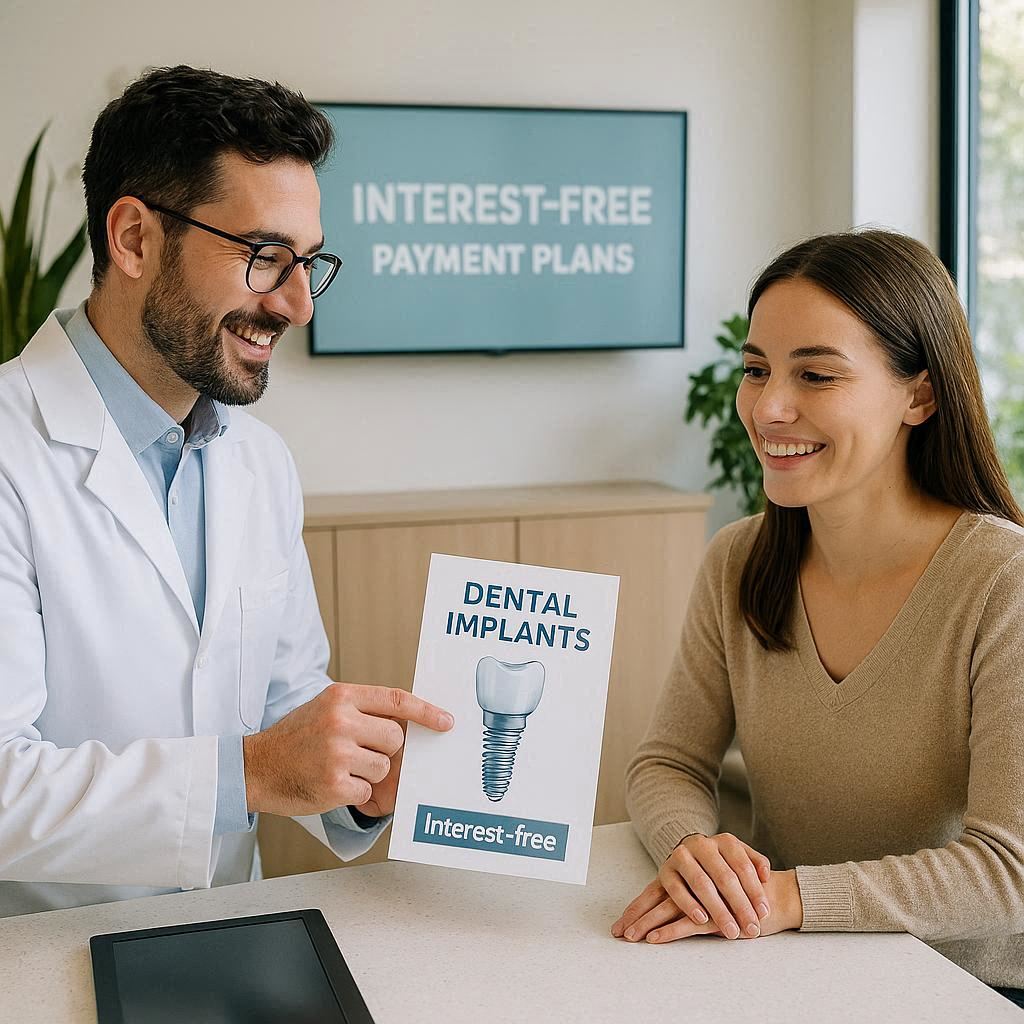
The marketing promises fill your screen with hope. Dental implants payment plan interest free. Zero percent financing. No money down. Smile now, pay later. These phrases sound like the answer to a prayer. But you know enough about finance to feel suspicious. Is this real? What do the dental offices get out of these arrangements? Where do the hidden fees hide?
This guide walks you through every aspect of interest-free dental implant financing with total transparency. You will learn how these plans actually work, which providers offer genuine zero-interest terms, what traps to watch for, and how to walk into a consultation feeling informed rather than vulnerable. No industry jargon. No unrealistic promises. Just clear, actionable information to help you make a smart decision about your health and your money.
Understanding the Real Cost of Dental Implants
Before diving into payment plans, you need a realistic picture of what dental implants cost in today’s market. The numbers vary significantly based on geography, provider expertise, and the complexity of your specific case. Understanding these costs helps you evaluate whether a financing offer truly provides value.
The Breakdown: What You Actually Pay For
A dental implant procedure involves multiple stages, each carrying its own fee. Many practices quote a “bundled” price, while others bill each component separately. Knowing the difference prevents surprise charges from appearing halfway through your treatment.
The implant fixture serves as the artificial tooth root. A specialist surgically places this small titanium post directly into your jawbone. This component typically costs between $1,000 and $3,000, depending on the implant brand and the complexity of placement. Premium implant brands like Straumann or Nobel Biocare cost more, but they offer decades of clinical research backing their long-term success rates.
The abutment connects the implant fixture to the visible crown. This small connector piece generally adds $300 to $800 to your total. Some implant systems include the abutment in the fixture cost, while others charge separately. Always ask for clarification on this point during your consultation.
The crown creates the visible, functional tooth that sits above the gum line. Porcelain or zirconia crowns typically cost between $1,000 and $3,500 per tooth. The material choice, the dental lab’s reputation, and the complexity of the case all influence this price.
Preliminary procedures often catch patients off guard. If you need a tooth extraction before implant placement, add $150 to $600. Bone grafting, which adds volume to a jawbone that has deteriorated after tooth loss, ranges from $400 to $3,000 depending on the graft material and extent of the procedure. A sinus lift for upper back teeth implants adds another $1,500 to $2,500.
Diagnostic imaging including 3D cone beam CT scans adds $250 to $1,000. These scans prove essential for safe implant placement, as they reveal nerve pathways, sinus cavities, and bone density that traditional X-rays miss.
“I thought my implant would cost $4,000 total based on the phone quote. By the time we added the extraction, bone graft, and CT scan, the actual price landed closer to $8,500. The finance terms changed completely once the total loan amount increased.” — Michael, dental implant patient, Portland, Oregon
Regional Price Variations Across the United States
Where you live dramatically affects what you pay. Urban coastal markets command premium pricing, while midwestern and southern practices often offer more competitive rates.
| Region | Single Implant (Complete) | Full Arch (All-on-4) | Bone Graft (Per Site) |
|---|---|---|---|
| Northeast (NYC, Boston) | $4,800 – $7,500 | $28,000 – $45,000 | $800 – $3,000 |
| Southeast (Atlanta, Miami) | $3,200 – $5,500 | $18,000 – $32,000 | $500 – $2,200 |
| Midwest (Chicago, Detroit) | $2,800 – $4,800 | $15,000 – $28,000 | $400 – $1,800 |
| Southwest (Phoenix, Dallas) | $3,000 – $5,200 | $16,000 – $30,000 | $450 – $2,000 |
| West Coast (LA, Seattle) | $4,200 – $6,800 | $25,000 – $42,000 | $700 – $2,800 |
Note: These ranges reflect comprehensive treatment including fixture, abutment, crown, and standard imaging. Complicated cases requiring extensive grafting or multiple extractions will push costs toward the higher end or beyond these estimates entirely.
Why Implants Command Such High Fees
Understanding the value proposition helps you appreciate what your money purchases. Dental implants represent a permanent tooth replacement solution that, with proper care, lasts a lifetime. The upfront cost reflects several factors that directly benefit you as a patient.
Surgical expertise requires years of specialized training beyond dental school. Oral surgeons and periodontists complete four to six years of residency programs focused specifically on surgical procedures. Their skill directly correlates with your outcome and comfort level during recovery.
Material quality matters tremendously for a device that remains in your body permanently. Medical-grade titanium alloy or zirconia must meet stringent FDA and ISO standards. These materials integrate with living bone through a biological process called osseointegration — a remarkable capability that no other tooth replacement option offers.
Technology investment by modern practices improves your safety and results. Cone beam CT scanners cost $50,000 to $150,000. Intraoral scanners, 3D printers for surgical guides, and specialized implant planning software all represent substantial capital investments that translate into more precise, less invasive procedures for you.
Laboratory craftsmanship produces your custom crown. Master dental ceramists spend hours layering porcelain to match your natural teeth’s color, translucency, and surface texture. This artistry costs more than a mass-produced denture tooth but delivers an indistinguishable match to your natural smile.
Dental Implants Payment Plan Interest Free: The Complete Breakdown
The promise of zero-interest financing for medical procedures sounds almost too good to be true in an era of high credit card APRs and rising loan rates. Yet these offers exist legitimately, and thousands of patients use them successfully every year. Understanding how they work protects you from the ones that hide predatory terms behind an attractive headline.
What “Interest-Free” Actually Means in Dental Financing
When a dental practice advertises dental implants payment plan interest free options, they typically refer to a deferred interest arrangement through a third-party healthcare financing company. The patient borrows money to pay for treatment and makes monthly payments over a set period. During this promotional period, the lender charges zero interest — but only if the patient pays the entire balance before the promotional window closes.
The most common structure works like this: You receive treatment costing $12,000. You qualify for a 12-month interest-free plan. You divide the total into 12 equal payments of $1,000. You make every payment on time. After 12 months, your balance reaches zero and you never paid a cent of interest. The system works beautifully for disciplined borrowers.
The risk appears when the promotional period ends with an outstanding balance. At that point, many plans apply retroactive interest — meaning they charge interest on the original loan amount from the original treatment date, not just on the remaining balance. This distinction catches many patients completely unprepared.
“Deferred interest is not the same as 0% APR. With a true 0% APR loan, interest never accrues during the promotional period. With deferred interest, interest accrues from day one and gets waived only if you pay in full by the deadline. Miss that deadline by even one day, and you owe all of it.” — Consumer Financial Protection Bureau, healthcare lending guidance
The Major Healthcare Financing Companies
Three major companies dominate the dental implant financing landscape. Each offers slightly different terms, provider networks, and qualification requirements. Understanding their differences helps you approach the right lender for your situation.
CareCredit stands as the most widely accepted healthcare credit card in the United States, with over 260,000 enrolled providers across medical, dental, and veterinary fields. For dental implants, CareCredit typically offers promotional periods of 6, 12, 18, or 24 months with zero interest on purchases of $200 or more. The exact promotional length available to you depends on the individual provider’s agreement with CareCredit. Some practices offer extended terms up to 60 months, though those longer terms usually carry reduced APR rather than zero interest.
Qualification requirements for CareCredit prove relatively accessible. The company approves borrowers with fair to good credit — generally scores in the mid-600s and above. The application process takes minutes and provides immediate decisions in most cases. CareCredit functions as a revolving credit line, meaning you can reuse it for future healthcare needs without reapplying, provided you maintain the account in good standing.
Alpheon Credit (formerly known as Enhance Patient Financing) focuses specifically on elective medical and dental procedures. Their interest-free promotional periods typically extend 6, 12, 18, or 24 months for qualified borrowers. Alpheon tends to require stronger credit profiles than CareCredit, generally seeking scores above 680 for their best promotional terms. The company offers longer extended payment plans with interest for amounts exceeding $15,000, which makes them relevant for full-mouth implant cases.
LendingClub Patient Solutions (formerly Springstone Financial) provides financing for larger dental treatment plans, often accommodating patients seeking full-arch restorations. Their interest-free promotional periods typically cap at 12 or 18 months, but they offer competitive extended plans with interest for terms up to 84 months. LendingClub considers credit scores, debt-to-income ratios, and employment stability in their approval decisions.
Proceed Finance specializes in high-dollar dental treatment plans, often accepting applications for amounts up to $75,000. Their interest-free promotional periods typically span 12 months, with extended interest-bearing options reaching 96 months. Proceed Finance sometimes works with borrowers who have less-than-perfect credit by evaluating overall financial stability rather than relying solely on credit scores.
In-House Dental Membership Plans vs. Third-Party Financing
A growing number of dental practices now offer their own in-house payment plans as an alternative to third-party financing. These arrangements often provide greater flexibility and may truly carry zero interest, as the practice simply divides your total cost into manageable installments without involving a lender.
In-house plans typically work one of two ways. Some practices offer true installment payments spread over the course of treatment, which naturally spans several months due to healing periods between surgical phases. You pay for each phase as it occurs, effectively creating an interest-free payment schedule without any financing agreement at all. Other practices offer membership clubs where you pay a monthly or annual fee in exchange for discounted treatment rates and the ability to pay for major procedures over time.
The advantage of in-house plans lies in their simplicity and direct relationship with your provider. No third-party lender examines your credit report. No deferred interest traps hide in the fine print. The practice assumes the risk of non-payment rather than transferring it to a finance company, which motivates them to work with you if temporary financial hardship arises.
The limitation involves scale. Small private practices rarely carry the financial capacity to finance a $40,000 full-mouth restoration over five years. They might offer 6 to 12 months of installments on a single implant but refer you to third-party financing for larger cases. Large dental chains and corporate practices more commonly offer robust in-house financing because their capital reserves and patient volume support the risk.
| Financing Type | Typical Terms | Credit Check | Interest Cost | Best For |
|---|---|---|---|---|
| CareCredit Promotional | 6-24 months | Yes | 0% if paid within term | Single implants, good credit |
| Alpheon Promotional | 6-24 months | Yes | 0% if paid within term | Multiple implants, strong credit |
| LendingClub Extended | Up to 84 months | Yes | Reduced APR | Full-arch cases |
| In-House Practice Plan | 6-24 months | No | Usually 0% | Single implants, existing patients |
| Dental Membership Club | Ongoing | No | 0% on pay-as-you-go | Preventive care plus implants |
| Personal Bank Loan | 12-60 months | Yes | Market rate | Any amount, strong credit |
| Credit Card Promotional | 12-21 months | Yes | 0% intro APR | Smaller amounts |
How to Qualify for the Best Interest-Free Dental Implant Financing
Securing approval for a dental implants payment plan interest free arrangement requires preparation. Walking into a consultation and applying on the spot often leads to less favorable terms than approaching the process strategically. Understanding what lenders evaluate and how to position yourself strengthens your application before you ever submit it.
Credit Score Thresholds and What They Mean
Healthcare financing companies use credit scores as a primary screening tool, but their thresholds differ from mortgage or auto lenders. Most dental financing companies consider FICO scores in the mid-600s as their baseline for promotional interest-free offers. However, “approved” does not always mean “approved for the best terms.”
Borrowers with scores above 720 typically qualify for the maximum promotional periods — often 24 months interest-free — and the highest credit limits. These prime borrowers also receive the lowest interest rates on extended payment plans if they choose longer terms. The application process moves quickly, and approval amounts rarely face reductions from the requested figure.
Borrowers with scores between 650 and 719 generally qualify for promotional financing but may receive shorter interest-free periods — often 12 or 18 months instead of 24. They might also face lower credit limits that require combining financing with an out-of-pocket down payment. The approval still delivers genuine value, just with more constraints.
Borrowers with scores between 580 and 649 often receive approval for reduced APR extended plans rather than true interest-free promotions. Some lenders offer co-signer options that allow these borrowers to access better terms by adding a creditworthy co-applicant. In-house practice plans become particularly attractive for this group, as they bypass credit scrutiny entirely.
Borrowers below 580 face significant challenges with third-party healthcare financing. Alternative approaches — saving for a larger down payment, seeking treatment at dental schools, or exploring in-house plans with long-standing dental practices — provide more realistic paths forward.
Required Documentation for a Smooth Application
Preparing your documentation before applying streamlines the approval process and often results in higher approval amounts. Lenders want to verify your identity, income, and ability to repay the requested amount.
Government-issued photo identification proves your identity and matches the name on your credit report. A valid driver’s license, state ID card, or passport satisfies this requirement. Ensure your current address appears correctly, as lenders cross-reference this information.
Proof of income demonstrates your repayment capacity. Recent pay stubs covering the last 30 days work for employed applicants. Self-employed individuals should prepare two years of tax returns and recent bank statements. Retired applicants can provide Social Security award letters, pension statements, or retirement account summaries. Some lenders accept offer letters for new employment starting within 90 days.
Social Security number allows the lender to access your credit report. Most applications require this information upfront, though some prequalification tools perform soft credit pulls that do not affect your score. Know your number rather than carrying your card.
Insurance information matters even when financing out-of-pocket costs. Some lenders prefer to finance only the patient responsibility portion after insurance pays its share. Having your insurance card ready clarifies the total amount you actually need to finance.
Treatment plan documentation from your dentist provides the exact dollar amount for financing. The lender wants to see a formal treatment plan with procedure codes, fees, and the provider’s signature. This document prevents fraud and ensures the loan amount matches your actual treatment needs.
Steps to Improve Your Chances of Approval
Check your credit report before applying. Obtain free reports from the three major bureaus through AnnualCreditReport.com. Dispute any errors you find, as even small inaccuracies can drag your score below qualification thresholds. This process takes 30 to 60 days, so start early if you plan to finance treatment.
Reduce existing credit card balances. The credit utilization ratio — how much of your available credit you currently use — heavily influences your score. Paying down balances to below 30% of your credit limits (and ideally below 10%) often boosts your score by 20 to 50 points within a billing cycle or two.
Avoid applying for other credit in the months before dental financing. Each hard inquiry temporarily reduces your score by a few points. Multiple inquiries in a short period signal potential financial distress to lenders and may trigger denials or reduced credit limits.
Consider a co-signer with strong credit. A spouse, parent, or other trusted family member with excellent credit can apply jointly with you. The co-signer shares legal responsibility for the debt, but their credit profile often secures better promotional terms. This arrangement requires significant trust and clear communication about payment responsibilities.
Build a relationship with the dental practice. Patients with a history of keeping appointments and paying their bills on time often receive more flexible in-house payment options. If you know you will need implants in the future, establish care now for routine cleanings and smaller procedures. The practice sees you as a reliable patient and may extend courtesies not available to new patients walking in for the first time.
The Hidden Traps in Dental Financing Contracts
The dental implants payment plan interest free offers you see advertised carry real risks that deserve your careful attention. Thousands of patients sign financing agreements every year without fully understanding the terms they accepted. The consequences range from expensive to devastating. Reading this section carefully protects you from becoming one of them.
Deferred Interest: The Most Common and Costly Trap
Deferred interest represents the single most important concept to understand before signing any healthcare financing agreement. This mechanism sounds benign in marketing language but carries severe penalties for borrowers who fail to pay off their balance within the promotional period.
Here is exactly how it works: You finance $10,000 in dental implants on a 12-month interest-free plan. The fine print reveals the deferred interest APR is 26.99%. During those 12 months, you see $0 in interest charges on your statements — as long as you make the minimum monthly payments. The promotional clock ticks silently in the background.
If you pay the full $10,000 before the 12-month deadline, you truly pay zero interest. The arrangement works exactly as advertised. You received a $10,000 procedure for $10,000, spread over 12 months of manageable payments.
But if any balance remains after those 12 months — even just $100 — the lender calculates 26.99% interest on the *entire original $10,000* from the original treatment date. That retroactive interest totals approximately $2,699 in this scenario. Your $100 remaining balance instantly becomes $2,799. The shock of this calculation has driven many patients into serious financial distress.
“I thought I had 18 months to pay it off. Turned out the promotional period was 12 months. I missed it by three weeks. The interest charge that hit my account was more than my monthly car payment. I called them crying, but the contract was the contract.” — Patricia, dental implant patient, Sacramento, California
Protection strategy: Circle the promotional end date on your calendar. Set a personal goal to pay off the balance at least two months before the deadline. Calculate your required monthly payment by dividing the total by the number of months in the promotional period minus one. This buffer protects you against any processing delays or unexpected financial hiccups.
Variable APR After the Promotional Period
Some financing agreements advertise “0% interest for 12 months” followed by language about “ongoing low APR.” That ongoing APR often ties to the prime rate plus a margin — and the lender, not you, determines the margin based on your creditworthiness at the time of application.
A patient with excellent credit might receive a post-promotional APR of 12.99%. A patient with fair credit might receive 24.99% or higher. Both patients saw the same advertisement promising “low ongoing rates.” Both signed contracts that felt similar at the time. The difference only becomes apparent when the promotional period ends and the interest clock starts ticking.
Protection strategy: Ask specifically about your approved APR before signing. The lender must disclose this rate in the Truth in Lending disclosure box on your contract. If the number makes you uncomfortable, explore alternatives before committing. You might qualify for a personal loan from your credit union at a fixed rate significantly lower than the variable rate offered by the healthcare financier.
Late Payment Penalties and Default Triggers
Many dental financing agreements contain clauses that revoke the interest-free promotional period entirely if you make a single late payment. This penalty far exceeds typical credit card late fees. One payment arriving three days past the due date can trigger retroactive interest on the entire original balance — even if you otherwise maintained a perfect payment history.
These clauses appear deep in the contract language, often under headings like “Promotional Period Conditions” or “Interest Waiver Requirements.” The marketing materials certainly do not highlight them. Patients discover these provisions only after a problem occurs.
Protection strategy: Set up automatic payments immediately upon opening the account. Ensure the linked bank account maintains sufficient funds to cover the payment. If you face a genuine financial emergency that threatens your ability to pay on time, contact the lender before the due date. Some lenders offer hardship accommodations that preserve your promotional terms, but they rarely extend this courtesy after a payment has already missed its deadline.
Prepayment Penalties
Some healthcare financing contracts penalize you for paying off the balance early. This seems counterintuitive — why would a lender punish you for giving them their money back ahead of schedule? The answer lies in the lender’s business model. They earn revenue when promotional-period borrowers fail to pay in full and trigger retroactive interest. Early payers represent lost profit opportunities.
Prepayment penalties typically appear as a flat fee ($50 to $150) or a percentage of the remaining balance (1% to 3%). These charges diminish the benefit of paying early and may influence your decision about whether to accelerate your payments or follow the original schedule.
Protection strategy: Read the “Prepayment” section of your contract. If a penalty exists, calculate whether paying it still saves money compared to continuing monthly payments through the promotional period. In most cases, avoiding the risk of deferred interest justifies paying a modest prepayment penalty — but you should make that calculation consciously rather than discovering the charge after the fact.
Comparing Interest-Free Plans to Other Dental Implant Payment Options
The dental implants payment plan interest free route offers genuine advantages for disciplined borrowers, but it does not represent the only path to affordable treatment. Understanding the full landscape of payment options helps you choose the strategy that best fits your financial situation, timeline, and risk tolerance.
Traditional Bank Personal Loans
Banks and credit unions offer personal loans with fixed interest rates and predictable monthly payments. These loans carry no deferred interest traps, no promotional period deadlines, and no retroactive interest surprises. You borrow a specific amount, you repay it over a specific term, and the interest cost appears clearly on your loan documents before you sign.
The trade-off involves cost. Even borrowers with excellent credit pay interest from day one on a personal loan. Current rates for well-qualified borrowers typically range from 7% to 13% for unsecured personal loans. A $15,000 loan at 9% APR over 36 months costs approximately $2,160 in total interest — not an insignificant sum, but predictable and transparent.
Credit unions frequently offer more favorable terms than large national banks. Their member-owned structure often translates into lower rates and more flexible underwriting. If you do not belong to a credit union, joining one specifically for a dental loan makes financial sense. Many credit unions accept members based on geographic location, employer, or association membership.
Best for: Borrowers who value predictability over absolute lowest cost; those with credit union relationships; anyone who worries about missing a promotional deadline.
Introductory 0% APR Credit Cards
Several major credit card issuers offer cards with 0% introductory APR on purchases for 12 to 21 months. These cards function similarly to healthcare financing promotional periods but with some important advantages. The 0% rate applies to any purchase, not just healthcare. The application process uses standard credit card underwriting, which many consumers find more familiar than healthcare financing applications.
The advantages include stronger consumer protections under the CARD Act of 2009. Credit card issuers must give 45 days’ notice before changing rates. They cannot apply retroactive interest in the way deferred interest healthcare plans can. Late payments cannot trigger penalty APRs on existing balances until the payment is 60 days past due (though they can on new purchases sooner).
The limitation involves credit limits. A new card may not offer a limit sufficient to cover extensive dental implant treatment. Patients with excellent credit might receive limits of $10,000 to $20,000, while those with fair credit may receive $2,000 to $5,000 — insufficient for anything beyond a single implant or crown.
Best for: Borrowers with strong credit who can secure high limits; single-implant cases; patients comfortable managing credit card accounts responsibly.
Dental Tourism with Cash Payment
Traveling abroad for dental implants allows many patients to pay cash at prices dramatically lower than U.S. rates. Countries including Mexico, Costa Rica, Hungary, Thailand, and Turkey have developed robust dental tourism industries catering specifically to American and Canadian patients seeking affordable implant treatment.
A single implant that costs $4,500 in the United States might cost $900 to $1,500 at a quality clinic in Mexico or Costa Rica. Full-mouth restorations that exceed $30,000 domestically often cost $8,000 to $15,000 internationally. These savings effectively create their own “financing” by reducing the total amount you need to borrow or save.
The trade-offs demand honest consideration. Continuity of care becomes complicated if complications arise after you return home. Many domestic dentists hesitate to manage complications from work performed abroad. Travel costs, time away from work, and the challenge of vetting foreign providers all add complexity. The savings prove genuine, but the risk profile differs from receiving treatment in your home community.
Best for: Cash-paying patients comfortable with travel; those requiring extensive work at total costs they simply cannot afford domestically; patients who thoroughly research and verify international providers.
In-House Payment Plans Through Dental Practices
As mentioned earlier, many private dental practices offer direct payment arrangements that bypass third-party lenders entirely. These plans typically spread payments over the treatment timeline, which naturally extends over several months due to healing periods required between implant stages.
A typical implant timeline unfolds over 4 to 12 months from extraction to final crown delivery. During this period, the practice performs surgery, allows healing, places the abutment, and delivers the crown. Many practices accept payment at each phase rather than demanding full payment upfront. This approach effectively creates a 4 to 12-month interest-free payment schedule without any financing application or credit check.
Some practices formalize these arrangements with written payment agreements specifying due dates and amounts. Others operate more casually, sending invoices as each phase completes. The formal approach protects both parties and provides clear documentation for your records.
Best for: Patients with established dental relationships; those wanting to avoid credit applications; single-implant or small-bridge cases.
| Payment Method | Interest Cost | Timeline | Credit Check | Best Use Case |
|---|---|---|---|---|
| Deferred Interest Financing | 0% if paid within term | 6-24 months | Yes | Disciplined payers, moderate amounts |
| 0% APR Credit Card | 0% during intro period | 12-21 months | Yes | Strong credit, smaller amounts |
| Personal Bank Loan | 7-13% fixed | 12-60 months | Yes | Large amounts, predictable cost |
| Credit Union Loan | 6-10% fixed | 12-60 months | Yes | Members, competitive rates |
| In-House Practice Plan | 0% | 4-12 months | No | Existing patients, phased treatment |
| Dental Tourism Cash | 0% (cash discount) | Immediate | No | Extensive work, travel flexibility |
| Dental School Treatment | 0% (reduced fees) | Extended timeline | No | Budget-constrained, time flexibility |
Step-by-Step Guide: Securing Your Interest-Free Dental Implant Plan
Moving from research to action requires a clear sequence of steps. Following this process systematically positions you to secure the best possible financing terms while protecting yourself from common pitfalls.
Step 1: Obtain a Comprehensive Treatment Plan
Before exploring any financing options, you need a detailed written treatment plan from your chosen dental provider. This document should itemize every procedure code, every associated fee, and the proposed treatment timeline. A vague estimate of “around $15,000” does not provide sufficient information for financing applications.
Schedule a consultation specifically focused on implant treatment. Request the 3D CBCT scan during this visit — it provides essential diagnostic information and demonstrates to lenders that your treatment plan rests on thorough evaluation rather than guesswork. Ask the treatment coordinator to explain the plan in detail, including which procedures are absolutely necessary versus optional.
Request two versions of the plan if possible: the ideal treatment approach and a phased alternative that addresses the most urgent needs first while deferring less critical implants. This flexibility helps you match treatment scope to available financing.
“My dentist gave me three treatment plans: immediate full-mouth restoration, phased quadrant-by-quadrant over two years, and a minimal plan addressing only the teeth causing active pain. Having options empowered me to make a financial decision I felt comfortable with rather than feeling pressured into the most expensive route.” — James, implant patient, Austin, Texas
Step 2: Verify Your Dental Insurance Benefits
Even if your dental insurance excludes implant coverage — many plans still classify implants as cosmetic rather than necessary — your policy may cover portions of the overall treatment. Extractions, bone grafting, and anesthesia often receive partial coverage even when the implant itself does not.
Call the member services number on your insurance card and ask specifically about each procedure code on your treatment plan. Take notes including the name of the representative you speak with and a reference number for the call. Submit a pre-treatment estimate to your insurance company for written confirmation of coverage. This estimate typically arrives within two to four weeks and provides documentation you can reference if coverage disputes arise later.
Reducing your out-of-pocket cost through insurance, even by a few thousand dollars, shrinks the amount you need to finance and improves your chances of paying within a promotional interest-free period.
Step 3: Shop Financing Options Before the Consultation
Most patients apply for financing at the dental office during their consultation, after hearing the treatment cost and feeling emotional pressure to commit. This reactive approach leads to accepting whatever terms the office’s preferred lender offers, without comparison shopping.
Instead, explore financing options independently before your implant consultation. Apply for prequalification with CareCredit, Alpheon, or a traditional lender using their online tools. Prequalification typically involves a soft credit pull that does not affect your credit score, though final approval requires a hard inquiry.
Contact your personal bank or credit union to discuss personal loan options for medical expenses. Some credit unions offer special medical loan products with rates below their standard personal loans. Gather information about rates, terms, and approval requirements from multiple sources.
Important: Multiple hard credit inquiries for the same purpose within a 14-day window typically count as a single inquiry on your FICO score. The credit scoring models recognize that consumers shop for the best loan terms and treat rate-shopping inquiries accordingly.
Step 4: Compare Offers Using Total Cost, Not Monthly Payment
Lenders and salespeople often frame financing in terms of monthly payment amounts because smaller numbers feel more manageable. A $12,000 procedure at “$299 per month” sounds more appealing than the same procedure at “$525 per month” — even if the lower payment extends over 60 months with significant interest while the higher payment clears the balance in 24 months at zero interest.
Create a simple comparison spreadsheet or table for each financing offer you receive:
- Total financed amount
- Promotional period length (if applicable)
- Post-promotional APR
- Required monthly payment to clear balance within promotional period
- Total interest cost if paid exactly as scheduled
- Total interest cost if promotional deadline is missed (for deferred interest plans)
- Late payment penalty structure
- Prepayment penalty (if any)
This comparison reveals the true cost of each option beyond the attractive monthly payment figure. A deferred interest plan requiring $1,000 monthly payments to clear within 12 months might cost $0 in interest but stretch your budget dangerously thin. A fixed-rate personal loan at 9% over 36 months costs $1,400 in total interest but offers payments you can comfortably manage. Only you can weigh these trade-offs for your personal situation.
Step 5: Read the Full Contract Before Signing
The moment of signing represents your last and best opportunity to understand exactly what you agree to. Do not let anyone rush you through this process. A legitimate provider and lender respect your right to read and understand the documents you sign.
Focus specifically on these sections of the contract:
The Truth in Lending disclosure box contains the APR, finance charge, amount financed, total of payments, and payment schedule. These numbers must appear prominently and in plain language under federal law. Verify that every number matches what you discussed verbally.
The promotional terms section explains exactly what conditions you must meet to maintain the interest-free status. Look for language about minimum monthly payments, payment due dates, and what happens if you miss a payment or carry a balance beyond the promotional period.
The default and acceleration clauses describe what triggers a default on your account and what remedies the lender can pursue. Some contracts allow the lender to demand immediate full repayment upon any default — a provision that can prove devastating if triggered.
The late payment and fee schedule lists every possible charge beyond the principal and interest. Late fees, returned payment fees, and annual fees (if applicable) should all appear clearly.
Ask questions about anything unclear. If the dental office staff cannot answer your questions about the financing contract, request to speak with someone at the lending company directly. Sign nothing until every term makes sense to you.
Realistic Timelines: Treatment and Payment Schedules
Dental implant treatment follows a biological timeline that you cannot rush. Understanding this timeline helps you plan your financing strategy, as payment often coincides with treatment phases rather than requiring full payment on day one.
The Standard Implant Timeline
Month 1: Consultation and Planning
Your initial visit includes examination, imaging, and treatment planning. This appointment typically requires payment for the consultation, imaging, and treatment planning fees. Many practices apply these fees toward your total treatment cost if you proceed with implants. Expect to pay $250 to $1,000 at this stage depending on the extent of imaging and planning.
Month 1-2: Extractions and Bone Grafting
If damaged teeth require removal before implant placement, extraction occurs in a separate appointment. Bone grafting, if needed, often happens during the same visit. Healing from extraction and grafting typically requires 3 to 6 months before implant placement can proceed. You pay for these procedures as they occur.
Month 4-7: Implant Placement Surgery
The oral surgeon or periodontist places the implant fixture into your jawbone. This surgical appointment typically lasts one to two hours depending on the number of implants placed. You pay the surgical fee and the implant fixture cost at this stage, often $1,500 to $3,500 per implant.
Month 4-7 to Month 8-11: Osseointegration Healing
The implant integrates with your jawbone during this critical healing period, which typically spans 3 to 6 months. You make no office visits for the implant site during this phase (unless interim restorations require adjustment), and no treatment charges accrue. This natural pause in treatment creates a window where you can save additional funds or make progress on your financing balance.
Month 8-12: Abutment Placement and Crown Impressions
The dentist exposes the implant, places the abutment, and takes impressions for the final crown. This appointment incurs the abutment fee and a portion of the crown fee, typically $500 to $1,500.
Month 9-13: Crown Delivery
The final crown arrives from the dental laboratory and the dentist cements or screws it into place. You pay the remaining crown balance at this appointment, which completes both your treatment and your payment schedule if using phased in-house payments.
Coordinating Payments with Treatment Phases
Smart patients align their financing with this natural treatment timeline. If your practice offers phased payments, you might pay $800 at consultation, $2,500 at extraction and grafting, $3,000 at implant placement, and $2,000 at crown delivery. This spreads $8,300 over 9 to 13 months without any financing arrangement at all.
For third-party financing, consider this strategy: Open the financing account when treatment begins, but draw funds only as each phase occurs rather than financing the entire amount upfront. Some lenders allow multiple draws against a single approved credit line over several months. This approach keeps your balance lower during early phases, making the promotional period payoff more manageable.
Negotiating with Dental Practices for Better Terms
Many patients assume dental fees stand fixed and non-negotiable. This assumption costs them real money. Dental practices operate as businesses in a competitive marketplace, and most possess flexibility on pricing, payment terms, or both — especially for larger implant cases.
Cash Payment Discounts
Practices pay fees of 5% to 15% to third-party financing companies when patients use promotional plans. These merchant fees eat into the practice’s profit margin. When you offer to pay cash (or cash equivalent via check or debit card), the practice saves these fees and often passes a portion of the savings to you.
Simply asking “Do you offer a discount for cash payment?” opens the conversation. Many practices offer 5% to 10% off the total treatment cost for patients who pay in full at the start of treatment. On a $20,000 full-arch restoration, a 10% cash discount saves $2,000 — equivalent to earning a substantial return on your savings with zero risk.
Note: Some practices build the merchant fee into their pricing for all patients and offer a “bookkeeping adjustment” rather than calling it a cash discount. The terminology varies; the savings remain real regardless of what the practice calls it.
Bundled Procedure Pricing
Implant treatment involves multiple procedure codes and fees that can be bundled into a single comprehensive fee. Ask whether the practice offers an “implant package” that includes extraction, grafting, implant placement, abutment, and crown for a single price lower than the sum of individual fees.
Practices often price these packages more aggressively because they secure the entire treatment rather than risking that you might complete some phases elsewhere. The package also simplifies your financing application — one amount to finance rather than tracking multiple procedure payments.
Matching Competitor Offers
If multiple implant providers serve your area, competition works in your favor. Obtain treatment plans and pricing from two or three practices. When you receive a plan you prefer clinically but at a higher price, share the competitor’s quote (with identifying information removed) and ask whether the practice can match or approach the competitor’s pricing.
Frame this conversation respectfully. “I prefer your practice based on our consultation and your credentials, but I received a quote from another provider for $4,500 less for the same treatment plan. Is there any flexibility in your pricing?” Many implant dentists respect patients who comparison-shop and will work to earn your business.
Common Questions Patients Ask About Interest-Free Dental Financing
The following questions arise repeatedly in implant consultations and online forums. The answers here reflect realistic expectations rather than marketing promises.
What happens if I lose my job during the promotional period?
Contact the lender immediately — before missing a payment. Many healthcare financing companies offer temporary hardship accommodations that may extend your promotional period or reduce minimum payments temporarily. These accommodations are never guaranteed, but lenders generally prefer working with borrowers who communicate proactively rather than those who simply stop paying.
Explore whether your state offers medical debt relief programs or whether local nonprofits assist with healthcare financing during unemployment. Some religious and community organizations maintain emergency assistance funds for medical and dental expenses.
Can I use multiple financing sources for one treatment plan?
Yes. Many patients combine a promotional interest-free plan for a portion of treatment with cash or a low-interest personal loan for the remainder. For example, you might finance $10,000 through a 12-month CareCredit plan (manageable to pay off within the promotional period) and pay the remaining $5,000 from savings. This strategy reduces the risk of failing to clear the promotional balance.
Does interest-free financing affect my credit score differently than a regular loan?
The account reports to credit bureaus like any other credit account. Making on-time payments builds positive credit history. High utilization of the credit line can temporarily reduce your score until you pay down the balance. Missing payments or defaulting damages your credit just as any other credit obligation would.
Are there income requirements for approval?
Healthcare financing companies evaluate debt-to-income ratio rather than setting specific income minimums. A borrower earning $40,000 annually with minimal existing debt may qualify more easily than a borrower earning $120,000 with substantial mortgage, auto, and credit card obligations. The lender wants to see that your income comfortably covers your existing obligations plus the proposed new payment.
Can I pay off a deferred interest plan early without penalty?
Most healthcare financing plans allow early payoff without penalty, but you must verify this by reading your specific contract’s prepayment section. Some plans impose prepayment penalties, particularly those offered through smaller regional lenders. CareCredit and other major providers generally permit early payoff without additional charges.
Regional Spotlight: Finding Interest-Free Implant Providers Near You
The availability of dental implants payment plan interest free options varies by region and by individual practice. The following strategies help you locate providers in your area who offer genuine zero-interest financing.
Large Dental Chains and Corporate Practices
National and regional dental chains frequently offer the most robust financing programs because their size allows them to negotiate favorable terms with lenders. Aspen Dental, ClearChoice, Affordable Dentures & Implants, and similar organizations maintain dedicated financing departments that handle the application process for patients.
These corporate practices often advertise their financing prominently and may offer terms not available at smaller private practices. The trade-off involves the clinical experience. Some patients prefer the personalized care of a private practitioner, while others appreciate the efficiency and financing convenience of a larger organization.
University Dental Schools
Dental schools and university hospitals offer implant treatment at reduced fees because residents perform the procedures under faculty supervision. The total cost often runs 30% to 50% less than private practice fees. While dental schools typically do not offer formal interest-free financing, their significantly lower total cost reduces or eliminates the need to borrow.
The trade-off involves time. Dental school appointments last longer, and treatment progresses more slowly because faculty must check every step of the work. Patients who can accommodate extended appointment times and flexible scheduling find excellent value in university settings.
Private Practices with In-House Membership Plans
An increasing number of private implant dentists offer membership plans that include discounts on implant treatment. These plans typically charge a monthly or annual fee ($30 to $50 monthly, or $300 to $500 annually) in exchange for 15% to 25% off standard fees. Members also receive complimentary preventive care and priority scheduling.
If you anticipate needing implants in the future but do not require them immediately, joining a membership plan now can significantly reduce your costs when treatment time arrives. The membership fee pays for itself many times over when applied to implant treatment.
Building a Long-Term Strategy for Dental Health Financing
Dental implants represent a major investment that, with proper care, lasts a lifetime. Viewing this expense within the broader context of your overall dental health strategy helps you make decisions that serve you well into the future.
The True Cost of Delaying Treatment
Postponing implant treatment to save money often costs more in the long run. When a tooth goes missing, the jawbone beneath the empty space begins to resorb — the body reabsorbs bone minerals no longer stimulated by chewing forces. Over time, this bone loss complicates future implant placement and may require extensive bone grafting that would have been unnecessary if the implant were placed sooner.
Adjacent teeth drift into the empty space, creating alignment problems that affect your bite. Opposing teeth supraerupt, growing into the space from the opposite arch. These secondary problems require orthodontic or restorative treatment to correct, adding costs far beyond the original implant expense.
The financial analysis becomes clear in most cases: addressing tooth loss promptly through implant treatment, even with financing costs, typically costs less than waiting years and managing the cascade of secondary problems that develop.
Dental Insurance and Implants: A Shifting Landscape
Traditional dental insurance has historically excluded or severely limited implant coverage. This landscape is gradually changing as implants gain recognition as the standard of care for tooth replacement. Some employer-sponsored plans now include implant benefits, and individual plans increasingly offer implant coverage as an optional rider.
If your employer offers multiple dental plan options during open enrollment, compare the implant benefits carefully. A plan with a higher monthly premium but substantial implant coverage may provide significant net savings if you anticipate implant treatment in the coming year.
Health Savings Accounts and Flexible Spending Arrangements
HSAs and FSAs allow you to pay for dental implants with pre-tax dollars, effectively reducing your cost by your marginal tax rate. A $15,000 implant case paid through an HSA effectively costs $10,500 to $11,000 for someone in the 25-30% combined federal and state tax bracket — a savings of $4,000 or more.
Plan your HSA contributions strategically. If you anticipate implant treatment in the next calendar year, maximize your HSA contributions during the current year’s open enrollment. The funds carry forward indefinitely in an HSA, unlike an FSA which typically requires spending within the plan year.
Combine HSA funds with interest-free financing for maximum benefit: Use HSA dollars for a substantial down payment at the start of treatment, then finance the remaining balance through a promotional plan you can comfortably clear within the interest-free period.
Technology and Innovation Affecting Implant Costs
The dental implant field evolves continuously, with new technologies that improve outcomes and, in some cases, reduce costs. Understanding these innovations helps you evaluate treatment recommendations and their associated fees.
Same-Day Implants and Immediate Loading
Traditional implant protocols require months of healing between extraction, implant placement, and crown delivery. Newer immediate-loading protocols place a temporary crown on the implant the same day as surgery, eliminating months of wearing a removable temporary appliance.
This approach reduces the total number of appointments and may reduce overall costs despite higher per-appointment fees. Immediate loading works well for carefully selected patients with adequate bone quality and primary implant stability at placement. Not every patient qualifies, but those who do appreciate the compressed timeline and reduced overall treatment burden.
Guided Implant Surgery
Computer-guided implant surgery uses 3D CBCT data and intraoral scans to plan implant placement virtually before the surgery date. The dentist or surgeon fabricates a surgical guide that directs implant placement with precision measured in fractions of a millimeter.
Guided surgery reduces surgical time, minimizes postoperative discomfort, and virtually eliminates the risk of damaging nerves or sinus cavities during placement. The technology adds $300 to $800 to the treatment cost but often reduces the overall number of appointments and the risk of costly complications. Patients increasingly view guided surgery as a worthwhile investment rather than an unnecessary expense.
Digital Workflows and Same-Day Crowns
Traditional implant crowns require multiple appointments for impressions, temporary restoration, and final delivery — spread over several weeks. Digital workflows using intraoral scanners and in-office milling units allow same-day crown fabrication in many cases.
The crown cost remains similar to traditional lab-fabricated restorations, but the reduced number of appointments saves time and may reduce the overall treatment fee. Ask your provider whether same-day crown capability exists in their practice and whether it affects your total cost.
Red Flags: When an Interest-Free Offer Is Too Good to Be True
Most dental practices and financing companies operate ethically. However, enough bad actors exist to warrant vigilance. Recognizing warning signs protects you from predatory arrangements disguised as patient-friendly financing.
High-Pressure Sales Tactics
Any dental practice that pressures you to sign financing documents immediately, before you have time to read them, deserves your suspicion. Legitimate providers encourage informed decision-making. They answer questions without defensiveness and respect your request to take documents home for review.
Be particularly wary of practices that offer a “special discount” that expires today. While genuine limited-time promotions exist in dentistry, high-pressure “today only” pricing often masks unfavorable financing terms that you might reject upon careful consideration.
Vague or Evasive Answers About Terms
When you ask specific questions about the financing terms — the post-promotional APR, the deferred interest policy, the late payment penalty — the answers should arrive clearly and quickly. Staff members who cannot explain these basic terms or who change the subject to monthly payment amounts signal that the terms may not favor you.
Ask to speak directly with someone who can explain the contract in detail. If no such person exists at the practice, ask for the lender’s customer service number and call before signing.
Excessive Add-On Fees
Some practices build administrative fees, “financing coordination fees,” or other invented charges into the treatment cost for patients who use third-party financing. These fees compensate the practice for the merchant discount they pay to the financing company, but ethical practices absorb this cost as a business expense rather than passing it to patients through opaque surcharges.
Ask for an itemized breakdown of all fees. Question any charge you do not understand. Compare the total cost using financing against the cash price for the same treatment. If the financed price significantly exceeds the cash price beyond a reasonable administrative fee (perhaps $50 to $100), seek treatment elsewhere.
Patient Stories: Real Experiences with Interest-Free Dental Financing
The following accounts come from real patients who financed dental implant treatment. Their experiences illuminate both the promise and the pitfalls of interest-free dental financing.
Sarah’s Success: Strategic Planning and Early Payoff
Sarah, a 42-year-old teacher in Denver, needed two implants to replace molars she lost in a cycling accident. Her treatment plan totaled $9,200. She applied for a CareCredit card and received a 12-month interest-free promotional offer with a $10,000 credit limit.
“My strategy was simple,” Sarah explains. “I calculated that I needed to pay $767 monthly to clear the balance in 12 months. I set up automatic payments of $800 monthly — slightly more than required — and scheduled them for the day after my paycheck deposited. I never had to think about it. The payments happened automatically, and I never missed one.”
Sarah paid the balance in full after 11 months and paid exactly zero dollars in interest. “The key was being realistic about what I could afford monthly and committing to the automatic payment. I never saw that money in my checking account, so I never missed it.”
Marcus’s Warning: The Missed Deadline
Marcus, a 35-year-old software developer in Atlanta, financed $14,500 in implant treatment through an 18-month deferred interest plan. He made minimum payments for the first 15 months, planning to pay the remaining balance in a lump sum from his annual bonus.
The bonus arrived smaller than expected due to company performance issues. Marcus could not pay the full remaining balance of $6,200 before the promotional period expired. The lender applied 27.99% deferred interest to the original $14,500 balance — approximately $6,300 in interest charges.
“I should have been paying down the principal aggressively from the start instead of making minimum payments and counting on a bonus that wasn’t guaranteed,” Marcus reflects. “The interest charge was more than I would have paid on a traditional personal loan at a reasonable rate. I gambled on my ability to pay a lump sum and I lost.”
Elena’s Alternative: The Dental School Route
Elena, a 28-year-old graduate student in Chicago, needed a single implant but could not qualify for third-party financing due to limited credit history. She sought treatment at the University of Illinois Chicago College of Dentistry’s implant clinic.
The total cost ran $1,800 — roughly 40% of the $4,500 quote she received from a private practice. The treatment took seven months from consultation to crown delivery, with appointments lasting longer than private practice visits. Elena paid for each phase as treatment progressed, using income from her teaching assistantship.
“The time commitment was significant,” Elena acknowledges. “Each appointment ran two to three hours because the faculty checked every step. But I graduated with a functioning implant and no debt. For my situation, the trade-off made perfect sense.”
The Psychology of Dental Financing Decisions
Financial decisions intertwine with emotions, particularly when health and appearance hang in the balance. Understanding the psychological factors that influence dental financing decisions helps you make choices grounded in logic rather than emotional pressure.
Pain, Embarrassment, and Urgency
Living with missing teeth creates genuine psychological distress that can cloud financial judgment. You want the problem solved immediately. The dental office offers a solution. The financing paperwork arrives at the moment when your desire for resolution peaks. This combination leads many patients to sign agreements they would reject under calmer circumstances.
Acknowledge this emotional pressure explicitly. Tell yourself — and perhaps tell the treatment coordinator — that you will take at least 24 hours to review any financing agreement before signing. Create a cooling-off period that allows your rational mind to evaluate the terms without the emotional urgency of the consultation room.
The Monthly Payment Illusion
Lenders and salespeople frame purchases in monthly payment terms because small numbers feel manageable. A $350 monthly payment sounds reasonable. The fact that it continues for seven years and totals $29,400 on a $18,000 procedure receives less attention.
Always multiply the monthly payment by the number of payments to calculate the total cost. Compare this total to the cash price of treatment. Ask yourself whether the difference represents a reasonable cost for the convenience of spreading payments over time.
Social Proof and Testimonials
Dental practices fill their websites and consultation rooms with smiling patient testimonials and before-and-after galleries. These images serve a legitimate purpose — they demonstrate the practice’s capabilities and outcomes. However, they also create social pressure. If all these happy patients financed their treatment, the reasoning goes, financing must be the right decision.
Remember that testimonials represent the best outcomes. The patient who struggled with financing payments or experienced complications rarely appears in the marketing materials. Let the clinical quality evidence influence your choice of provider, but separate the financing decision from the emotional pull of success stories.
Alternative Tooth Replacement Options and Their Financing
While dental implants represent the gold standard for tooth replacement, other options exist at lower price points. Understanding these alternatives helps you make an informed decision based on your clinical needs and financial reality.
Implant-Supported Bridges
When multiple adjacent teeth require replacement, an implant-supported bridge uses fewer implants than replacing each tooth individually. Two implants might support a bridge replacing three or four teeth, reducing the total implant cost while still providing fixed, non-removable replacement teeth.
Financing for implant bridges follows the same patterns as single implants but with smaller total amounts. The lower total cost makes interest-free promotional payoff more achievable within standard 12-month or 18-month windows.
Removable Partial Dentures
Conventional partial dentures replace missing teeth at a fraction of implant costs — typically $800 to $2,500 depending on materials and complexity. These removable appliances clip onto remaining natural teeth and restore chewing function and appearance.
Partial dentures do not prevent bone loss, and many patients find them less comfortable than fixed implant restorations. However, they provide a functional, affordable interim solution while you save for implant treatment or work to improve your credit profile for future financing.
Resin-Bonded Bridges (Maryland Bridges)
For single-tooth replacement in specific situations, resin-bonded bridges offer a minimally invasive option at $1,200 to $2,800. The artificial tooth attaches to adjacent natural teeth with small metal or ceramic wings bonded to the back surfaces, requiring little to no preparation of the supporting teeth.
Maryland bridges do not address bone loss and have lower long-term success rates than implants. However, they provide an affordable, conservative option that preserves the option of implant placement in the future without the bone loss that accompanies complete tooth absence.
Your Rights Under Federal Lending Laws
Federal law provides specific protections for consumers financing healthcare treatment. Knowing these rights empowers you to recognize and report violations.
Truth in Lending Act (TILA)
TILA requires lenders to disclose key loan terms clearly and conspicuously before you sign. The APR, finance charge, amount financed, total of payments, and payment schedule must appear in a standardized disclosure box. Lenders who fail to provide these disclosures face regulatory penalties, and you may have grounds to rescind the agreement.
Fair Credit Billing Act (FCBA)
The FCBA protects consumers from billing errors on credit accounts, including healthcare financing accounts. If you notice an error — an incorrect charge, a payment not credited, or a math error — you have 60 days to dispute it in writing. The lender must investigate and respond within specific timeframes.
Fair Debt Collection Practices Act (FDCPA)
If your dental financing account falls into collections, the FDCPA restricts how collection agencies can contact you. They cannot call before 8 AM or after 9 PM, contact you at work if you ask them to stop, use threatening or abusive language, or misrepresent the amount you owe.
Conclusion
Securing a dental implants payment plan interest free arrangement offers a genuine path to affordable tooth replacement when you understand the terms, respect the deadlines, and choose the right financing partner for your situation. The interest-free promotional plans available through CareCredit, Alpheon, LendingClub, and in-house practice arrangements provide real value for disciplined borrowers who can confidently clear their balance within the promotional window. The key lies in reading every contract thoroughly, calculating your required monthly payment realistically, and never assuming that a promotional deadline will take care of itself. For those who cannot comfortably commit to the payoff timeline, alternative approaches including credit union personal loans, phased treatment payments, and dental school clinics offer transparent, predictable paths to restored oral health without the risk of deferred interest penalties.
FAQ
What is the typical credit score required for interest-free dental implant financing?
Most healthcare financing companies require a credit score of at least 650 for promotional interest-free offers. Borrowers with scores above 720 typically qualify for the longest promotional periods (24 months) and highest credit limits. Some lenders offer reduced APR extended plans for borrowers with scores between 580 and 649.
Can I finance the entire implant treatment including bone grafting and extractions?
Yes. The financing applies to your total treatment cost as documented in your dentist’s treatment plan. This typically includes extractions, bone grafting, implant placement, abutments, and crowns. Some lenders require that all financed procedures appear on a single treatment plan document.
What happens to my financing if I move to another state during treatment?
Your financing agreement remains with the lender regardless of where you live. If you relocate during treatment, you may need to transfer your care to a new provider. Contact the lender to discuss how this affects your account. Some lenders allow you to use remaining funds at a different provider within their network.
Do dental insurance and interest-free financing work together?
Yes. Dental insurance typically pays its portion directly to the practice, reducing the total amount you need to finance. You finance only your patient responsibility — the amount insurance does not cover. Submit a pre-treatment estimate to your insurance company before securing financing so you know your exact out-of-pocket cost.
Can I use CareCredit or similar financing for implant complications or future maintenance?
Yes. CareCredit functions as a revolving credit line. Once you establish the account, you can use available credit for future dental expenses including implant maintenance, crown replacement, or additional implants. New promotional offers may apply to these subsequent charges.
Additional Resource:
For a detailed breakdown of dental implant costs, financing options, and insurance considerations, visit the American Academy of Implant Dentistry’s patient education portal at www.aaid.com/patient-resources. This nonprofit professional organization provides evidence-based information free from commercial influence.
Disclaimer: This article provides general information about dental implant financing options and does not constitute financial, legal, or medical advice. Financing terms, rates, and availability vary by lender, provider, geographic location, and individual credit profile. Consult with a qualified dental professional for treatment recommendations and a licensed financial advisor for personalized guidance about healthcare financing decisions. The patient stories included represent real experiences shared with permission, but individual results and experiences vary.