dental plan no waiting for cleanings
Few things are as frustrating as signing up for a health benefit only to discover you cannot use it when you need it most. When you buy a new smartphone plan, you expect to make calls immediately. When you subscribe to a streaming service, you expect to watch videos that night. Yet, for decades, traditional dental insurance has operated on a different framework, often requiring members to wait months—or even a full year—before stepping foot inside a clinic for routine care.
If you are currently searching for a dental plan no waiting for cleanings, you are likely trying to solve a very specific, time-sensitive problem. Perhaps you have missed your bi-annual checkup, your teeth feel rough or stained, or you are starting a new job and want to maximize your wellness options right away.
The excellent news is that the dental insurance landscape has shifted dramatically. Today, finding a policy that grants instant access to diagnostic and preventive services is not only possible—it has become the industry standard for high-quality coverage.
This comprehensive guide will demystify how these immediate-access plans work, break down the structural differences between various insurance models, analyze top national providers, and give you the exact tools you need to secure a plan that takes effect on day one.
What Does “No Waiting Period” Actually Mean?
To understand why a dental plan no waiting for cleanings is so valuable, we must first pull back the curtain on how insurance companies manage financial risk.
The Industry Standard Waiting Period
In classic insurance models, a waiting period is a set window of time that must pass after your policy becomes active before the insurance company will pay for specific treatments. Historically, these windows looked something like this:
- Preventive Care (Cleanings, Exams, X-rays): 0 to 6 months.
- Basic Procedures (Fillings, Simple Extractions): 6 months.
- Major Procedures (Crowns, Bridges, Root Canals, Dentures): 12 months.
Insurance companies designed these rules to prevent a phenomenon known as “adverse selection.” In simple terms, they wanted to stop people from signing up for a plan on a Monday, getting $3,000 worth of dental work done on a Tuesday, and dropping the policy on a Wednesday.
The Modern Shift to Immediate Preventive Care
Fortunately, actuaries and dental professionals realized that delaying routine cleanings is incredibly counterproductive. When an insurance company forces you to wait six months just to get your teeth scraped and examined, a microscopic cavity can grow into a major infection requiring a root canal.
“Preventive dentistry is the cornerstone of long-term oral health. By removing barriers to routine cleanings, we prevent minor plaque buildup from escalating into complex, costly periodontal disease.”
— Dr. Aris Thorne, DDS
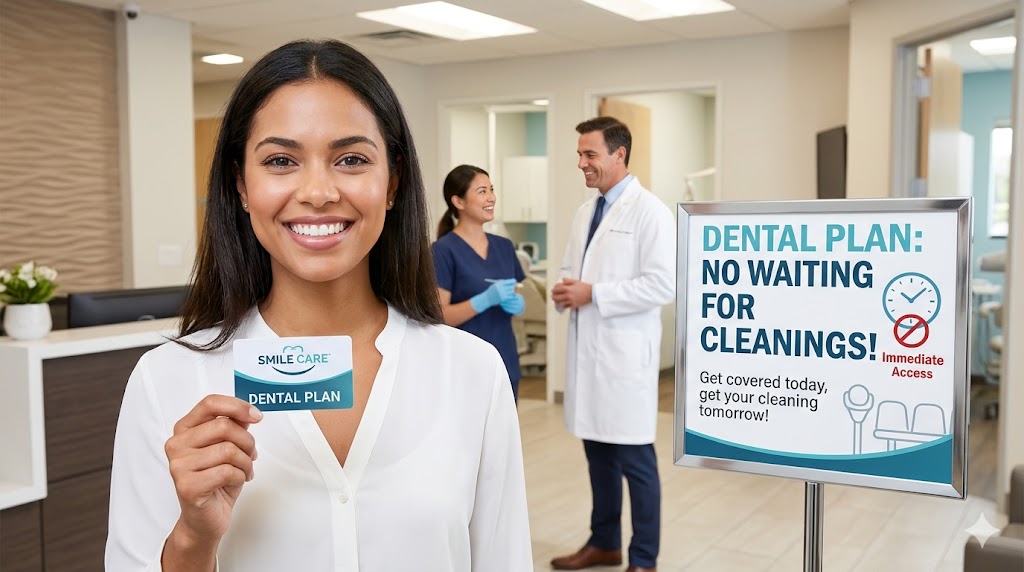
Today, when a policy advertises a dental plan no waiting for cleanings, it means that the moment your policy’s official effective date arrives (usually the first day of the calendar month after you sign up), you can visit an in-network dental hygienist for a professional cleaning, and the insurer will cover their agreed-upon portion immediately.
The True Cost of Skipping Dental Cleanings
It is tempting to view a dental cleaning as a cosmetic luxury—a way to make your breath smell minty and your teeth look a bit whiter. However, from a clinical standpoint, professional dental cleanings (prophylaxis) are vital medical interventions.
When you skip your routine six-month cleanings due to a lack of insurance or an ongoing waiting period, several hidden processes damage your mouth and your wallet:
1. Tartar Calcification
No matter how thoroughly you brush and floss at home, you cannot remove 100% of the plaque in your mouth. Within 24 to 72 hours, unremoved plaque absorbs minerals from your saliva and hardens into a rock-like substance called tartar (calculus). Only a dental hygienist using specialized ultrasonic scalers and hand instruments can safely remove tartar. If left on your teeth, tartar acts as a breeding ground for destructive bacteria.
2. The Progression of Gum Disease
Tartar along and below the gumline irritates the delicate soft tissues. This leads to gingivitis, characterized by red, swollen, and bleeding gums. If you continue to skip cleanings because you are waiting for an insurance policy to kick in, gingivitis matures into periodontitis. At this stage, the bacteria begin destroying the bone structures supporting your teeth, eventually causing tooth loss.
3. The Financial Escalation of Care
An out-of-pocket dental cleaning without insurance typically costs between $100 and $200. If you avoid the dentist because of a waiting period, you save that small fee in the short term, but you open the door to massive future expenses.
| Stage of Oral Health | Necessary Clinical Procedure | Estimated Out-of-Pocket Cost (Without Insurance) |
| Early Prevention | Routine Prophylaxis (Cleaning) & Exam | $150 – $250 |
| Mild Neglect | Basic Composite Filling (1-2 surfaces) | $200 – $400 |
| Moderate Damage | Root Canal Therapy (Molar) | $1,000 – $1,600 |
| Severe Advanced Destruction | Porcelain-Fused-to-Metal Crown | $1,200 – $2,000 |
| Full Tooth Loss | Single Dental Implant & Abutment | $3,500 – $5,000 |
As the table clearly illustrates, investing a modest monthly premium into a dental plan no waiting for cleanings pays for itself almost instantly by preventing the slide into high-cost tier treatments.
Types of Dental Plans Offering Immediate Cleaning Coverage
Not all dental plans are structured the same way. When shopping for immediate coverage, you will generally choose between four distinct categories of benefits. Understanding how these models operate will prevent surprise bills at the dental office office.
1. Preferred Provider Organizations (DPPO)
DPPO plans are the most popular type of dental coverage. They utilize a vast network of dentists who have agreed to provide services at pre-negotiated, discounted rates.
- How the No-Wait Feature Works: Almost all premium DPPO plans completely waive the waiting period for Category A (Preventive) services. You can get your cleanings on day one. However, they will still hold you to a 6- or 12-month wait for fillings or crowns unless you can prove you had prior continuous coverage.
- Pros: Massive networks, freedom to see out-of-network dentists (though at a higher cost), robust coverage for major work down the road.
- Cons: Higher monthly premiums, annual maximum caps (usually $1,000 to $2,000 per year), and deductibles that must be met.
2. Dental Health Maintenance Organizations (DHMO)
DHMO plans operate much like medical HMOs. You are required to select a single Primary Care Dentist (PCD) from their local network, and that dentist manages all of your oral healthcare.
- How the No-Wait Feature Works: DHMOs are famous for having zero waiting periods across the board. Not only do cleanings have no waiting period, but fillings, crowns, and root canals are also accessible on day one. Instead of paying percentages, you pay fixed, pre-determined copayments.
- Pros: Lowest monthly premiums, no annual maximum caps, no waiting periods for any procedure category.
- Cons: Extremely restrictive networks. If you see a dentist outside the network, the plan pays absolutely nothing. Specialist care requires a formal referral from your PCD.
3. Point of Service (PDS) and Indemnity Plans
Indemnity plans are traditional “fee-for-service” arrangements. They do not use networks; you can see absolutely any licensed dentist in the country. You pay the bill upfront, submit a claim to the insurance company, and they reimburse you a percentage of the “Usual, Customary, and Reasonable” (UCR) fee for that zip code.
- How the No-Wait Feature Works: Many top-tier indemnity plans feature no waiting periods for cleanings to encourage immediate wellness visits.
- Pros: Total freedom of choice; zero network restrictions.
- Cons: Expensive premiums, high upfront out-of-pocket costs, complex paperwork submission.
4. Dental Discount Plans (Dental Savings Plans)
While technically not insurance, dental discount plans are an outstanding alternative for individuals seeking a dental plan no waiting for cleanings. You pay an annual or monthly membership fee directly to a discount program network. In exchange, participating dentists agree to cut their normal fees by 10% to 60% for members.
- How the No-Wait Feature Works: Because these are non-insurance programs, there are no waiting periods whatsoever. Your plan is activated within 24 to 48 hours, and you can immediately go in for a deeply discounted cleaning.
- Pros: No claims forms, no annual maximum limits, no exclusions for pre-existing conditions, very low cost.
- Cons: You must pay the dentist the discounted rate directly at the time of service; there is no insurance company picking up the remaining percentage.
In-Depth Analysis of Major Providers Offering No-Wait Cleanings
To assist you in your search, let us closely analyze the specific offerings of the country’s leading dental insurance carriers. Many of these providers have realized that modern consumers demand instant utility from their insurance products.
+---------------------+-------------------+---------------------+-------------------------+
| Provider            | Plan Type         | Cleaning Wait Time  | Preventive Coverage %   |
+---------------------+-------------------+---------------------+-------------------------+
| Delta Dental        | Immediate Choice  | None                | 100% (In-Network)       |
| Humana              | Loyalty Plus      | None                | 100% (In-Network)       |
| Spirit Dental       | Secure Choice     | None                | 100% (In-Network)       |
| Cigna               | Dental 1500       | None                | 100% (In-Network)       |
| Ameritas            | Prime Star        | None                | 100% (In-Network)       |
+---------------------+-------------------+---------------------+-------------------------+
Delta Dental (Immediate Choice Series)
Delta Dental is the largest dental plan provider in the nation, boasting an immense network that includes roughly three out of four practicing dentists. Their specialized “Immediate Choice” and premium PPO tiers are explicitly designed to bypass administrative delays.
- Preventive Framework: Cleanings, routine bitewing X-rays, and comprehensive clinical exams are covered at 100% from your effective date, provided you stay within their PPO network.
- The Fine Print: While your cleanings start immediately, basic restorative work like fillings might feature a graduated coverage scale (e.g., the plan pays 50% in year one, 70% in year two, and 80% in year three).
Humana (Loyalty Plus PPO)
Humana has engineered an innovative solution to the waiting period dilemma with their “Loyalty Plus” program. Instead of forcing members to wait out a clock, they reward long-term membership by increasing coverage amounts each year.
- Preventive Framework: Zero waiting period for routine cleanings. You can book an appointment the day your policy goes live.
- The Fine Print: In your first year, the plan might pay a maximum annual benefit of $1,000. By year three, that maximum increases to $1,500, and your out-of-pocket copays for non-preventive services drop significantly.
Spirit Dental
Spirit Dental is highly regarded in the independent web-broker ecosystem because they boldly advertise no waiting periods on any plan for any service.
- Preventive Framework: Cleanings are completely covered on day one with a 100% coinsurance rate for network providers.
- The Fine Print: Because they take on the risk of covering major services (like root canals and bridges) without a waiting period, their monthly premiums can be higher than competitors, and they rely on a graduated payout system to protect their financial reserves.
Decoding the Language of Your Policy
When reading through an insurance brochure or a Summary of Benefits document, insurers use highly specific legal and medical jargon. To ensure your dental plan no waiting for cleanings performs exactly how you expect, you must familiarize yourself with these terms.
Coinsurance
Coinsurance is the percentage of the medical bill that you are responsible for paying after you meet your deductible. For preventive services under a no-wait plan, the coinsurance breakdown is typically 100/0. This means the insurance company pays 100% of the negotiated network fee, and you owe exactly $0 at the receptionist’s desk.
The Standard Deductible
A deductible is the dollar amount you must pay out-of-pocket for dental procedures before your insurance benefits kick in. For example, a plan might have a $50 individual annual deductible.
CRITICAL NOTE FOR READERS:
The vast majority of high-quality dental insurance policies completely waive the deductible for diagnostic and preventive services (Category A). This means you do not have to pay your $50 deductible before getting your free routine cleaning. Always verify this “deductible waived for preventive” clause in your policy documents.
Frequency Limitations
Just because a plan offers immediate coverage for cleanings does not mean you can get your teeth cleaned every week. Every contract includes strict frequency clauses. The most common variations include:
- Twice per Benefit Year: You can receive two cleanings within a calendar year, regardless of the time spacing between them.
- Once Every Six Months: Exactly 180 days must elapse between appointment A and appointment B before the system will approve the second claim.
Step-by-Step Guide: How to Buy and Use Your Plan Immediately
If you need a professional cleaning soon, follow this step-by-step roadmap to avoid administrative delays and maximize your coverage.
Step 1: Confirm the Enrollment Cutoff Date
Dental insurance policies almost always go into effect on the first day of the upcoming month. If you enroll on June 14th, your coverage will begin on July 1st. If you wait until June 30th to sign up, it will still usually start on July 1st. However, if you miss the enrollment window by even a day (e.g., signing up on July 2nd), your coverage will not start until August 1st. Time your enrollment carefully.
Step 2: Use the Provider Directory Tool
Before purchasing a policy, visit the carrier’s website and open their “Find a Dentist” portal. Input your zip code and filter specifically by the exact name of the network you are considering (e.g., Delta Dental PPO vs. Delta Dental Premier). Call your favorite local dental clinic and say: “I am looking at the Humana PPO network. Are you an in-network provider for this specific plan?” Never rely solely on the insurer’s online directory, as doctor networks change frequently.
Step 3: Purchase the Plan and Download Your Digital ID Card
Complete your enrollment online. The insurance company will email you a confirmation package along with a member portal login. Log into your dashboard immediately and download a digital copy of your insurance card to your smartphone. You do not need to wait for a plastic card to arrive via physical mail to use your benefits.
Step 4: Schedule Your Comprehensive Appointment
When calling the dental clinic to book your slot, notify them that you are a new patient with a new insurance policy. Provide them with your Member ID and Group Number over the phone. This allows their billing department to run an electronic “Eligibility Verification” before you arrive, ensuring a smooth checkout process after your cleaning.
Advanced Knowledge: Understanding ADA Procedure Codes for Cleanings
When you look at the final statement or Explanation of Benefits (EOB) sent by your insurance provider, you will not see the word “cleaning.” Instead, you will see alphanumeric codes designed by the American Dental Association (ADA). These are known as Current Dental Terminology (CDT) codes.
Knowing these basic codes helps you confirm that your clinic is billing your dental plan no waiting for cleanings accurately:
- D0150 (Comprehensive Oral Evaluation): Used for new patients during their initial visit. It involves a complete look at your teeth, gums, jaw health, and an oral cancer screening.
- D0120 (Periodic Oral Evaluation): The standard exam given to established patients during their six-month checkup.
- D1110 (Prophylaxis – Adult): This is the official code for a standard preventative cleaning for an adult with healthy bone levels. It focuses on clearing away plaque and calculus above the gumline.
- D4341 / D4342 (Periodontal Scaling and Root Planing): Also known colloquially as a “deep cleaning.”
CRITICAL WARNING:
If a dentist discovers that you have deep pockets in your gums and advanced bone loss, they cannot legally or ethically perform a standard D1110 cleaning. They must perform a deep cleaning (D4341). Deep cleanings are classified as a Basic or Major treatment, not a preventive service. Consequently, they will be subject to waiting periods and deductibles under standard PPO plans. Always ask your dentist if your teeth require a standard cleaning or a periodontal intervention before treatment begins.
Frequently Asked Questions (FAQ)
Can I buy a dental plan today and get my teeth cleaned tomorrow?
In most cases, no. Even though the plan features “no waiting period,” insurance policies almost always have an official effective date tied to the first day of the following calendar month. If you sign up on June 15th, your coverage becomes active on July 1st.
Will a no-wait dental plan pay for a deep cleaning right away?
Generally, no. Standard insurance policies separate routine preventive cleanings (D1110) from therapeutic deep cleanings (scaling and root planing). Deep cleanings are classified as basic or major restorative care, meaning they are usually subject to a 6-to-12-month waiting period unless you choose a DHMO plan or a dental discount program.
Are dental X-rays included in the no-waiting-period clause?
Yes. Routine diagnostic procedures, including bitewing X-rays and full-mouth radiographic series, are classified alongside regular cleanings as Category A preventive care. They are typically covered at 100% immediately upon your plan’s effective date.
What is the difference between a dental insurance plan and a dental savings plan?
Dental insurance pays a percentage of your dental bills after you pay premiums, meet deductibles, and abide by network limits. A dental savings plan is a membership model where you pay an annual fee to unlock flat, pre-negotiated discounts directly with participating dentists, featuring zero waiting periods and zero paperwork.
Can I get an immediate-access plan if I have a pre-existing condition like missing teeth?
Yes. Your eligibility for a preventive plan cannot be denied due to your current oral health status. However, if a plan has a “missing tooth clause,” it will refuse to pay for a bridge or implant to replace any tooth that was lost before your policy’s effective date.
Additional Resource
For readers who want to verify the licensing status of a dental provider or research regional oral health data, the American Dental Association (ADA) Consumer Portal provides comprehensive directories, state-by-state regulatory updates, and evidence-based breakdowns of clinical preventive guidelines. You can access these public tools at ada.org.
Conclusion
A dental plan with no waiting period for cleanings allows you to bypass standard insurance delays and access professional preventive care immediately on your policy’s effective date. By choosing the right plan structure, verifying that your preferred dentist is in-network, and confirming that preventive deductibles are waived, you can comfortably protect both your oral health and your financial peace of mind.