Denton Dental Implants: Your Complete 2026 Guide to a Lasting Smile
Losing a tooth can feel like a small disaster. You might worry about your smile. You might find it hard to chew your favorite foods. But here is the good news: you have options. And one of the best options today is the dental implant.
If you live in or near Denton, Texas, you are in luck. The city has grown fast over the last ten years. With that growth came excellent dental care. Today, Denton dental implants are more accessible and affordable than ever.
This guide is for you. Maybe you are missing one tooth. Maybe you are missing several. Or maybe you just want to learn before you need one. Either way, you will find clear, honest answers here. No fluff. No fake promises. Just real talk about what implants are, how they work, and where to get them in Denton.
What Is a Dental Implant? A Simple Explanation
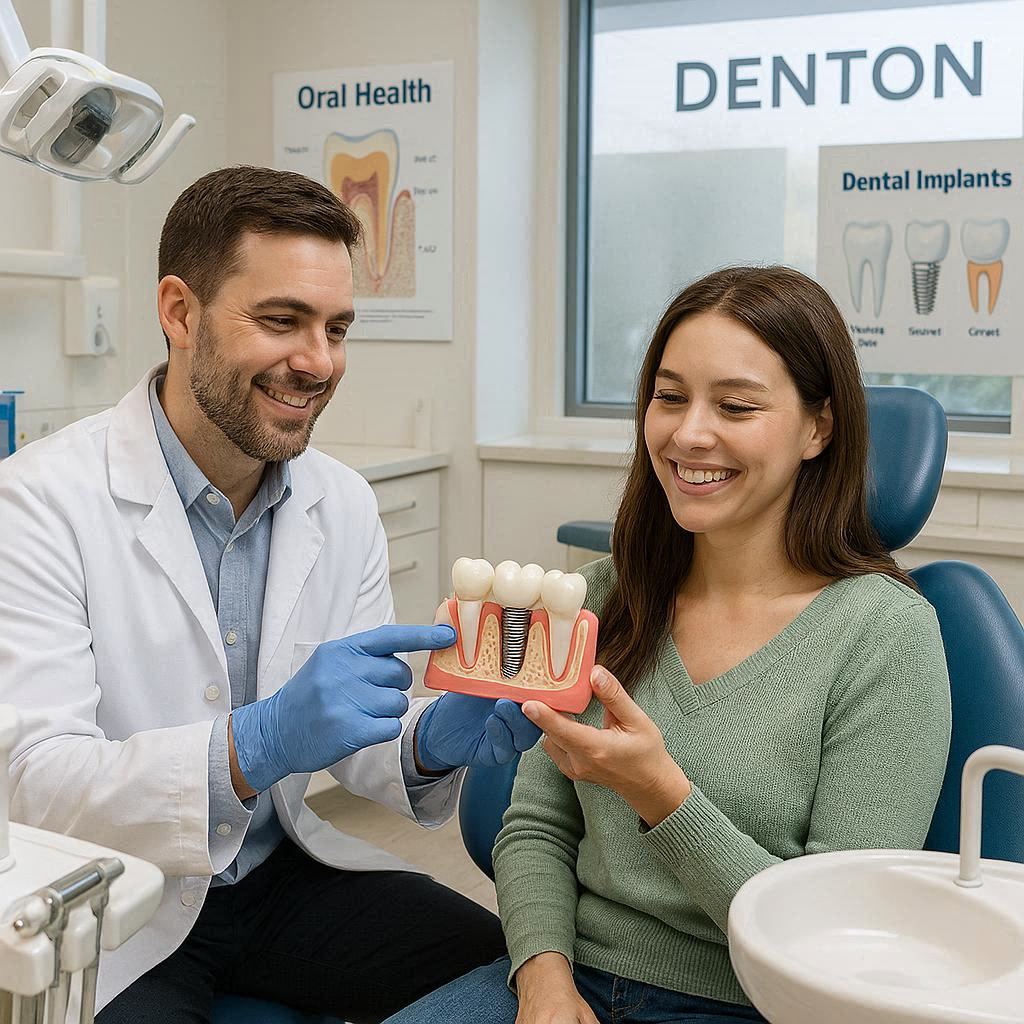
A dental implant is a man-made tooth root. It is usually made of titanium. That metal is special because your body accepts it. Your jawbone actually grows around it. That process is called osseointegration. It sounds complicated, but it just means the implant becomes part of you.
Once the implant is secure, your dentist places a crown on top. That crown looks and works like a natural tooth. The result is strong, stable, and beautiful.
Here is what a full implant looks like:
- The post (implant fixture): A screw placed into your jawbone.
- The abutment: A small connector on top of the post.
- The crown: The visible, tooth-like part.
You can also get implants for multiple teeth. Some people get implant-supported bridges. Others get full dentures held in place by implants. So the same basic idea works for one tooth or a whole mouth.
Why Choose Denton Dental Implants Over Other Options?
You might wonder: why not a bridge? Why not regular dentures? Those are fair questions. Many people use them. And they work fine for some situations. But implants offer clear advantages.
Let us compare them side by side.
| Feature | Dental Implant | Traditional Bridge | Regular Denture |
|---|---|---|---|
| Looks like a real tooth | Yes | Sometimes | Rarely |
| Stops bone loss | Yes | No | No |
| Lasts 20+ years | Yes | 5–10 years | 5–8 years |
| Needs special cleaning | No | Yes | Yes |
| Feels natural | Yes | Fair | Poor |
| Affects nearby teeth | No | Yes (shaving them) | No |
Three Big Reasons People Choose Implants
1. They protect your jawbone.
When you lose a tooth, the bone that held it starts to shrink. That is bone resorption. Over time, your face can change shape. Your lips might sink in. Implants stop that because they act like real roots.
2. They last a long time.
A bridge might need replacement after seven years. A good implant, with proper care, can last thirty years or a lifetime. That makes the higher upfront cost worth it.
3. They feel like your own teeth.
You do not have to take them out at night. You do not need special glue. You just brush and floss like normal. Many patients forget they even have an implant.
Note: Not everyone is a candidate for implants. But most healthy adults are. Your Denton dentist will do a full exam first.
The Step-by-Step Process of Getting Dental Implants in Denton
The process takes time. That is normal. Do not trust anyone who promises you a permanent implant in one visit. Good work takes patience.
Here is what a typical timeline looks like in Denton.
Step 1: Initial Consultation (1 hour)
You meet with your dentist. They take X-rays or a 3D CT scan. That shows the health of your jawbone. They also check your gums and remaining teeth. Then you talk about your goals and budget.
Step 2: Treatment Planning (1–2 weeks)
Your dentist creates a custom plan. They decide how many implants you need. They also check if you need a bone graft. That is common. Do not panic if they mention it. Many people have lost some bone over time.
Step 3: Bone Graft (if needed)
This adds bone material to your jaw. It comes from a donor or a synthetic source. Then you wait 3–6 months for it to heal and fuse. Yes, that is a long time. But it is essential for a strong implant.
Step 4: Implant Placement (1–2 hours)
This is the surgery day. Your dentist numbs the area. Some use sedation if you are nervous. Then they make a small cut in your gum. They drill a tiny hole into the bone. The implant post goes in. Then they stitch the gum closed. You go home the same day.
Step 5: Healing and Osseointegration (3–6 months)
During this time, your jawbone grows around the implant. That makes it rock-solid. You can eat soft foods. You may wear a temporary tooth if needed. But you wait for the bone to do its work.
Step 6: Abutment Placement (1 hour)
Once you are healed, your dentist places a small metal connector on the implant. This is the abutment. It sticks up above your gum line. Then you wait another 2–4 weeks for your gums to heal around it.
Step 7: Crown Placement (1 hour)
Finally, the best day. Your dentist attaches your permanent crown. They check the fit and color. They make sure your bite feels right. Then you walk out with a new tooth.
Total time: Usually 6–9 months. Sometimes longer. That is normal and good. Rushing leads to problems later.
Types of Dental Implants Available in Denton
Not all implants are the same. Your Denton specialist will choose the right type for your situation.
1. Endosteal Implants (Most Common)
These go directly into your jawbone. They look like small screws. They are the gold standard. Over 95% of implants are this type. They work for one tooth or many.
2. Subperiosteal Implants
These sit on top of your jawbone but under your gum. Your dentist uses them if your jawbone is too thin for endosteal implants. They are less common today. But they are still a good option for some patients.
3. Zygomatic Implants
These are very rare. They anchor into your cheekbone (zygoma) instead of your jaw. Only a few specialists in Denton perform these. They are for people with severe bone loss who cannot get a bone graft.
4. Implant-Supported Dentures
This is a popular choice for people missing all their teeth on one arch. You get 4 to 6 implants. Then a special denture snaps onto them. It does not move or slip. It is life-changing for many people.
5. All-on-4® (or All-on-6)
This is a specific technique. Your dentist places four implants at angles. Then they attach a full set of fixed teeth on the same day. You leave with a temporary set of teeth. After healing, you get your permanent set. It is faster than traditional full-mouth implants.
How Much Do Denton Dental Implants Cost?
Let us talk money. This is the number one question people ask. And the answer is not simple. Prices vary based on many factors.
Here is a realistic breakdown for the Denton area in 2026.
| Procedure | Average Cost in Denton |
|---|---|
| Single implant (post only) | 1,500–2,500 |
| Abutment | 300–500 |
| Crown | 1,200–2,000 |
| Single implant complete | 3,000–3,000–5,000 |
| Implant-supported bridge (3 teeth) | 6,000–10,000 |
| Implant-supported denture (per arch) | 7,000–15,000 |
| All-on-4 (per arch) | 15,000–30,000 |
| Bone graft | 500–3,000 |
| Sinus lift | 1,500–3,000 |
Important Note: These are estimates. Your actual cost depends on your specific case. Always get a written quote before starting.
Why Do Prices Vary So Much?
- Dentist experience: Specialists charge more than general dentists. But they also have higher success rates.
- Materials: A porcelain crown costs more than zirconia. Titanium implants are standard. Some clinics offer zirconia implants (metal-free) for more money.
- Location: Denton is more affordable than Dallas or Plano. But prices are higher than in rural Texas.
- Insurance: Some plans cover part of the crown but not the implant. We will talk more about that later.
Does Insurance Cover Denton Dental Implants?
This is tricky. Most medical insurance does not cover implants. Dental insurance sometimes covers the crown portion. But not the implant itself.
However, there are exceptions:
- If you lost teeth in an accident, some medical plans help.
- If you have a medical condition that requires implants, your plan might contribute.
- Always call your insurance company first. Ask: “Does my plan have a dental implant benefit?” Get their answer in writing.
Many Denton dentists offer payment plans. CareCredit is a popular option. Some clinics have in-house membership plans. Those are excellent for people without insurance.
Who Is a Good Candidate for Dental Implants in Denton?
Not everyone can get implants right away. But many people can become good candidates with a little prep work.
Ideal Candidate Checklist
- ✔️ Healthy gums (no active gum disease)
- ✔️ Enough jawbone density
- ✔️ Non-smoker or willing to quit during treatment
- ✔️ No uncontrolled chronic illness (diabetes, heart disease)
- ✔️ Committed to good oral hygiene
- ✔️ Realistic expectations about timeline
What If You Do Not Meet These Criteria?
Do not lose hope. Here is what your Denton dentist can do.
Low bone density: Get a bone graft. Most people heal fine. Then you can have implants.
Gum disease: Treat it first. That means deep cleaning and possibly antibiotics. Once your gums are healthy, you can proceed.
Smoking: This is a tough one. Smoking slows healing. It increases failure rates. Many dentists will still place implants. But they will warn you about the risks. Quitting for 2–4 weeks before and after surgery makes a huge difference.
Diabetes: Well-controlled diabetes is usually fine. Your dentist will work with your doctor. Uncontrolled diabetes is a problem because healing is poor.
Age: There is no upper age limit. Healthy 80-year-olds get implants. But children and teens cannot because their jaws are still growing.
Finding the Best Denton Dental Implants Specialist
You have choices. Denton has general dentists who place implants. It also has specialists. Which one should you pick?
Types of Implant Providers
| Provider Type | Training | Best For |
|---|---|---|
| General dentist with implant training | Weekend courses | Simple, single implants |
| Oral surgeon | 4–6 years surgical residency | Complex cases, bone grafts, full arch |
| Periodontist | Gum and bone specialist | Patients with gum disease or thin bone |
| Prosthodontist | Advanced restorative training | Full mouth reconstruction, All-on-4 |
Questions to Ask Before Choosing
Call or visit the office. Ask these five questions:
- “How many implants do you place each year?” (Look for 50+)
- “What is your success rate?” (Over 95% is good)
- “Do you use 3D CT scanning?” (Yes – non-negotiable)
- “What happens if the implant fails?” (They should offer a warranty)
- “Can I speak to a past patient?” (Many happy offices will arrange this)
Top Signs of a Trustworthy Denton Implant Clinic
- They do not pressure you. They explain all options.
- They show you before-and-after photos of real patients.
- They give you a written treatment plan with costs.
- They explain the risks honestly. (Yes, implants can fail. That is rare but real.)
- They have good online reviews. Check Google and Yelp.
Pro Tip: Avoid any clinic that offers “same-day implants” for every case. That is a marketing gimmick. Real implant dentistry takes time.
The Pros and Cons of Dental Implants: An Honest Look
You deserve both sides of the story. Implants are wonderful. But they are not perfect for everyone.
Pros
✅ Natural look and feel. Most people cannot tell you have an implant.
✅ Preserves jawbone. This prevents facial collapse over time.
✅ No damage to neighboring teeth. Bridges require shaving down healthy teeth.
✅ High success rate. Over 95% for lower jaw, 90–95% for upper jaw.
✅ Permanent solution. With good care, they can last a lifetime.
✅ Eat normally. Bite into an apple. Chew steak. No restrictions.
Cons
❌ Higher upfront cost. More expensive than bridges or dentures.
❌ Long treatment time. Six months or more from start to finish.
❌ Surgery required. Some people are nervous about any procedure.
❌ Possible complications. Infection, nerve damage, or implant failure (rare).
❌ Not for everyone. Heavy smokers or uncontrolled diabetics have higher risks.
Dental Implant Success Rates: What the Research Says
Let us get real about numbers. You want to know: will it work?
The research is clear. Implants are one of the most successful medical devices ever made.
| Location | 5-Year Success Rate | 10-Year Success Rate |
|---|---|---|
| Lower jaw (mandible) | 98% | 95% |
| Upper jaw (maxilla) | 95% | 90–93% |
Why is the upper jaw lower? The bone is softer. There are also sinus cavities nearby. That makes it trickier.
But even 90% is excellent. Most dental work does not come close.
What Causes Implant Failure?
- Peri-implantitis: This is gum disease around the implant. It is the number one cause of late failure.
- Failed osseointegration: The bone never grows around the implant. This usually happens in the first 3–6 months.
- Overloading: Putting too much pressure on the implant before it heals.
- Poor oral hygiene: You must clean implants like real teeth.
- Smoking: Doubles or triples failure rates.
The good news? You control most of these factors. Choose a great dentist. Follow their instructions. Brush and floss. Do not smoke. Your odds of success are excellent.
Recovery After Dental Implant Surgery: A Day-by-Day Guide
Recovery is easier than most people expect. But you need to be prepared.
The First 24 Hours
- Bleeding: Minor oozing is normal. Bite on gauze for 30 minutes.
- Swelling: Expect some. Use an ice pack on your cheek (20 minutes on, 20 off).
- Pain: Usually mild to moderate. Take prescribed or OTC pain relievers.
- Food: Only cold or room-temperature soft foods. No hot drinks.
- No: Spitting, using straws, smoking, or rinsing vigorously.
Days 2–3
- Swelling peaks around day 2. Then it starts going down.
- You can switch to warm compresses to help healing.
- Stick to soft foods: yogurt, mashed potatoes, smoothies (no straw).
- Start gentle saltwater rinses (1 tsp salt in 8 oz warm water).
Days 4–7
- Most pain is gone. Some soreness remains.
- You can eat slightly more solid foods. Think scrambled eggs, pasta, soft bread.
- Avoid the surgical site when chewing.
- Keep cleaning the rest of your teeth normally.
Weeks 2–4
- You feel mostly normal.
- The gum tissue heals over the implant.
- You can return to a normal diet. But still avoid very hard or sticky foods near the site.
- Follow up with your dentist for a check.
Months 3–6 (Osseointegration)
- You cannot feel this process. It happens inside your bone.
- You live your normal life. Eat normally. Brush carefully.
- Your dentist takes X-rays to confirm integration.
Foods to Eat and Avoid After Implant Surgery
Your recovery diet matters. Eat right, heal faster.
Safe Foods (First Week)
- Greek yogurt
- Applesauce
- Smoothies (no seeds, no straw)
- Mashed potatoes
- Creamy soups (not hot)
- Scrambled eggs
- Cottage cheese
- Pudding
- Bone broth
Foods to Avoid (First 2–3 Weeks)
- ❌ Popcorn (husks get stuck)
- ❌ Nuts and seeds
- ❌ Chips and hard crackers
- ❌ Steak or tough meat
- ❌ Sticky candy (caramel, taffy)
- ❌ Very hot foods and drinks
- ❌ Spicy foods (they can irritate)
Foods to Avoid Permanently (For Your Implant)
You can eat almost anything with an implant. But two things are risky:
- Hard candy or ice: You can crack your crown.
- Sticky, hard foods: Think jawbreakers or beef jerky. Use common sense.
Your implant is strong. But the crown on top can still chip or break. Treat it like a real tooth. Do not use it as a bottle opener.
How to Care for Your Dental Implants Long-Term
Here is the secret to making your implant last a lifetime: treat it like a real tooth.
Daily Cleaning Routine
- Brush twice a day: Use a soft-bristle brush. Pay attention to where the gum meets the crown.
- Floss daily: Use unwaxed tape or super floss. Some people like water flossers (Waterpik). They are great for implants.
- Interdental brushes: These tiny brushes clean hard-to-reach spots.
Special Tools for Implant Care
Your dentist may recommend:
- Titanium or plastic scalers: For cleaning without scratching.
- Implant-specific floss: One end is stiff, one end is fluffy.
- Low-abrasive toothpaste: Avoid baking soda or “whitening” formulas.
Professional Maintenance
See your Denton dentist every 6 months. During these visits, they will:
- Check the crown for chips or looseness.
- Take X-rays to check the bone level.
- Clean around the implant with special instruments.
- Check for signs of peri-implantitis.
Note: Regular dental hygienists cannot use metal tools on implants. Metal scratches the surface. Bacteria love scratches. So your dentist will use plastic or titanium tools. Ask about this.
Signs of a Problem
Call your dentist if you notice:
- Bleeding when you brush around the implant
- Bad taste or smell from the area
- The implant feels loose
- Pain when chewing
- Swelling or redness in the gum
Catch problems early. They are almost always fixable.
Bone Grafts and Sinus Lifts: What You Need to Know
Many patients hear “bone graft” and get scared. Do not be. It is routine. About half of all implant patients need one.
What Is a Bone Graft?
Your dentist adds bone material to your jaw. That material can come from:
- Your own body (usually from your chin or hip)
- A human donor (safe and sterilized)
- A cow or synthetic source
The material acts as a scaffold. Your body grows new bone into it. After 3–6 months, you have enough bone for an implant.
What Is a Sinus Lift?
This is for upper back teeth (molars). The sinus cavity sits above your jawbone there. If you do not have enough bone height, the implant could poke into your sinus. That is bad.
A sinus lift pushes the sinus membrane up. Then your dentist adds bone graft material underneath. It sounds scary. But it is a common, safe procedure. Recovery is similar to a standard bone graft.
Signs You Might Need a Bone Graft
- You lost the tooth years ago (bone shrinks over time)
- You have periodontal disease
- You wear traditional dentures
- You have a thin jaw naturally
Again, your dentist will tell you after the CT scan. Do not skip the CT scan. It is the only way to know for sure.
Alternatives to Denton Dental Implants
Implants are great. But they are not for everyone. Maybe your budget is tight. Maybe you cannot have surgery. Or maybe you just want something simpler.
Here are your alternatives.
1. Traditional Dental Bridge
How it works: Your dentist shaves down the teeth on either side of the gap. Then they place a three-piece crown (the bridge) over them.
Pros:
- Faster (2–3 weeks)
- Cheaper upfront (2,000–4,000 for three units)
- No surgery
Cons:
- Damages healthy teeth
- Lasts only 5–10 years
- Does not stop bone loss
- Harder to clean
2. Removable Partial Denture
How it works: A plastic or metal base holds one or more false teeth. It clips onto your remaining teeth.
Pros:
- Least expensive (500–2,000)
- No drilling or surgery
- Quick to make
Cons:
- Uncomfortable for many people
- Can damage adjacent teeth
- Does not stop bone loss
- Must be removed for cleaning
3. Complete Traditional Denture
How it works: A full set of false teeth on a plastic base. It rests on your gums.
Pros:
- Affordable (1,000–3,000 per arch)
- No surgery
Cons:
- Can slip and click
- Reduces chewing power by 80%
- Accelerates bone loss
- Changes your face shape over time
Which One Should You Choose?
| If you want… | Choose… |
|---|---|
| The longest-lasting solution | Implant |
| The cheapest option | Partial or full denture |
| No surgery | Bridge or denture |
| To preserve bone | Implant |
| Fastest treatment | Denture (2 weeks) |
| Most natural feel | Implant |
Financing and Insurance for Denton Dental Implants
Let us be honest. Implants are an investment. But you have options to make them affordable.
Dental Insurance Tips
Most PPO plans offer some coverage. Here is what to look for:
- Implant coverage: Some plans cover 50% of the crown and abutment. Rarely the implant post.
- Annual maximum: Most plans pay up to 1,000–2,000 per year. That is not much for implants.
- Waiting periods: Some plans make you wait 6–12 months before implant coverage starts.
- In-network vs out-of-network: Staying in-network saves money.
Action step: Call your insurance company. Ask these exact questions:
- “Does my plan have a dental implant benefit? If yes, what percentage is covered?”
- “Is there a missing tooth clause?” (Some plans will not replace teeth missing before you joined.)
- “What is my annual maximum?”
- “Can I use my medical insurance for the surgery portion?”
Payment Plans and Financing
Most Denton implant dentists offer:
- CareCredit: A healthcare credit card. 6–24 months interest-free if you pay on time.
- LendingClub or Proceed Finance: Medical loans with fixed rates.
- In-house membership plans: Pay a monthly fee (20–50). Get discounts on all services. Great for people without insurance.
- Clinic payment plans: Some dentists let you pay over 6–12 months with no interest.
Tax-Advantaged Accounts
Use these if you have them:
- HSA (Health Savings Account): Pre-tax dollars. Covers implants.
- FSA (Flexible Spending Account): Use it or lose it by year end. Covers implants.
Pro Tip: Ask for a “treatment plan” in writing. Then submit it to your insurance for a pre-determination. That tells you exactly what they will pay before you start.
Common Myths About Dental Implants (Debunked)
Let me clear up some things you may have heard.
Myth 1: “Implants are painful.”
Truth: The surgery hurts less than a tooth extraction. You are numb. Most patients feel pressure, not pain. Afterward, over-the-counter pain relievers work fine. The “pain” is mostly in your imagination.
Myth 2: “They look fake.”
Truth: Modern crowns are amazing. Your dentist matches the color, shape, and translucency. Even dentists cannot tell which tooth is an implant without an X-ray.
Myth 3: “Implants fail often.”
Truth: The success rate is over 95%. That is better than bridges (85% at 10 years) or root canals (85–90%). Implants are incredibly reliable.
Myth 4: “You must be young to get them.”
Truth: Age does not matter. Healthy 90-year-olds get implants. The only age limit is growing children (under 18–20).
Myth 5: “They are too expensive.”
Truth: Look at the long-term cost. A bridge costs 4,000butlasts7years.Thatisabout570 per year. An implant costs 4,500butlasts25+years.Thatis180 per year. Implants are cheaper over time.
Myth 6: “Insurance never covers them.”
Truth: Some plans cover 50% of the crown. Others cover the whole thing if you lost the tooth in an accident. Always check.
Emergency Situations: What Can Go Wrong?
Most implant patients have zero emergencies. But things can happen. Here is what to do.
Your Implant Crown Cracks or Chips
Do not panic. The implant post is still fine. The porcelain crown is the weak point. Call your dentist. They can usually make a new crown.
The Implant Feels Loose
This is rare. It could mean the abutment screw came loose. Or the implant failed. Do not wait. Call your dentist immediately. Do not try to tighten it yourself.
You Have Persistent Pain or Swelling
Months or years after placement? That could be peri-implantitis (infection around the implant). See your dentist as soon as possible. Early treatment can save the implant.
You Cannot Stop Bleeding After Surgery
Normal bleeding stops within 12 hours. If you are still soaking through gauze after 24 hours, call your dentist. Go to an emergency room if it is severe.
Your Dentist’s Emergency Protocol
Every good Denton implant dentist has an emergency number. Save it in your phone before surgery. Ask them: “What do I do if I have a problem on a weekend?”
Real Patient Stories from Denton (Case Examples)
Let me share realistic examples. Names changed for privacy.
Case 1: Single Missing Molar
Patient: Mark, 52, non-smoker
Problem: Lost tooth #19 (lower left first molar) 10 years ago
Treatment: Single implant with bone graft
Time: 8 months
Cost: $4,800
Outcome: Mark says he forgets which tooth is the implant. He eats steak and corn on the cob normally. Follow-up X-rays at 2 years show perfect bone levels.
Case 2: Full Upper Arch (All-on-4)
Patient: Linda, 67, former smoker
Problem: Upper denture for 15 years. Could not taste food. Denture moved constantly.
Treatment: All-on-4 upper arch with sinus lift on both sides
Time: 10 months
Cost: $22,000
Outcome: Linda cries happy tears. She eats her first apple in 15 years. Her face looks fuller. She says it gave her life back.
Case 3: Lower Implant Overdentures
Patient: Robert, 72, diabetic (controlled)
Problem: Lower denture floated up. Could not eat or speak clearly.
Treatment: Two implants in lower jaw. Denture snaps onto them.
Time: 6 months
Cost: $8,500
Outcome: Robert still uses the same denture. But now it does not move. He gained 12 pounds because he can eat again.
How to Choose the Right Dentist in Denton: A Step-by-Step Plan
You have many options. Here is a simple system to find the best one.
Step 1: Make a Shortlist
Search Google Maps for:
- “Denton dental implants”
- “Oral surgeon Denton”
- “Periodontist Denton TX”
Look for 4.5+ star ratings with at least 50 reviews. Read the 3-star reviews. Those are often the most honest.
Step 2: Check Their Credentials
Visit the Texas State Board of Dental Examiners website. Verify their license. Look for:
- DDS or DMD (both are the same)
- Board certification (optional but good)
- Years in practice
Step 3: Visit 2–3 Offices
Do not choose the first one. Go to consultations at 2–3 places. Most offer free or low-cost (50–100) initial exams.
Step 4: Compare Treatment Plans
Each dentist should give you a written plan. Compare:
- Number of implants recommended
- Need for bone graft or sinus lift
- Total cost
- Length of treatment
- Warranty (some offer 5–10 years on implants)
Step 5: Trust Your Gut
Do you feel rushed? Does the dentist explain things clearly? Do they answer your questions? Good dentists have good bedside manner. If something feels off, walk away.
The Future of Dental Implants: What’s Coming to Denton?
Dental technology changes fast. Here is what is on the horizon for Denton patients.
3D Printed Implants
Custom implants printed for your exact jawbone. This is already happening in research centers. Expect it in Denton within 3–5 years. Benefits: faster surgery, better fit.
Smart Implants
Researchers are working on implants with sensors. They would detect infection or pressure changes. They could alert your phone and your dentist. Very cool. Still experimental.
Same-Day Zirconia Implants
New materials allow scanning, designing, and milling a crown in one visit. Some Denton clinics already offer this for simple cases. Not for everyone yet.
Regenerative Medicine
Scientists are growing bone using stem cells. That could eliminate bone grafts. Early trials are promising. Probably 10+ years away for routine use.
For now, traditional titanium implants remain the gold standard. Do not wait for future technology. Today’s implants work beautifully.
Frequently Asked Questions (FAQ)
How long do dental implants last?
With proper care, 20–30 years or a lifetime. The crown may need replacement after 10–15 years. But the implant post can last forever.
Are dental implants safe?
Yes. Titanium implants have been used since 1965. Millions of people have them. Serious complications are rare (under 2%).
Can I get a dental implant if I have gum disease?
Not directly. You must treat gum disease first. Once your gums are healthy, you can proceed. Your dentist will guide you.
Do dental implants hurt?
Not during surgery. You are completely numb. Afterward, most people take ibuprofen for 2–3 days. It is less painful than a tooth extraction.
How much do Denton dental implants cost?
3,000–5,000 for a single tooth. 15,000–30,000 for full arch All-on-4. Get a written quote from your dentist.
Does insurance cover implants?
Sometimes partially. Many plans cover 50% of the crown. Some cover nothing. Call your insurance company to check your specific plan.
Can smokers get dental implants?
Yes, but with higher risk. Smoking slows healing and doubles failure rates. Quitting for 2 weeks before and after surgery helps significantly.
How do I clean my dental implant?
Brush twice daily. Floss daily with implant-specific floss. See your dentist every 6 months for professional cleaning. Use a water flosser if you like.
What is the failure rate?
About 5% over 10 years. Most failures happen in the first year. Success rates are highest in healthy non-smokers who practice good oral hygiene.
Can I get implants on the same day as extraction?
Sometimes. This is called immediate implant placement. It works if you have no infection and enough bone. Your dentist will decide if you are a candidate.
Additional Resource
For a deeper look at dental implant science and global research, visit the American Academy of Implant Dentistry (AAID) patient education page:
🔗 https://www.aaid.com/patients/index.html
This resource offers:
- A “Find an Implant Dentist” tool
- Patient education videos
- Real cost surveys
- Latest research summaries
Disclaimer
This article is for informational purposes only. It does not constitute medical or dental advice. Always consult a licensed dentist in Denton, Texas, for a professional evaluation and treatment plan. Individual results vary. The author and publisher are not responsible for any actions taken based on this content.
Conclusion
Denton dental implants offer a permanent, natural-looking solution for missing teeth, with success rates over 95% and potential to last a lifetime. While the upfront cost and treatment time are higher than alternatives, implants preserve jawbone health and eliminate the daily hassle of removable dentures. For most healthy adults in Denton, implants are the gold standard—just choose an experienced specialist, commit to good oral hygiene, and enjoy your smile for decades to come.