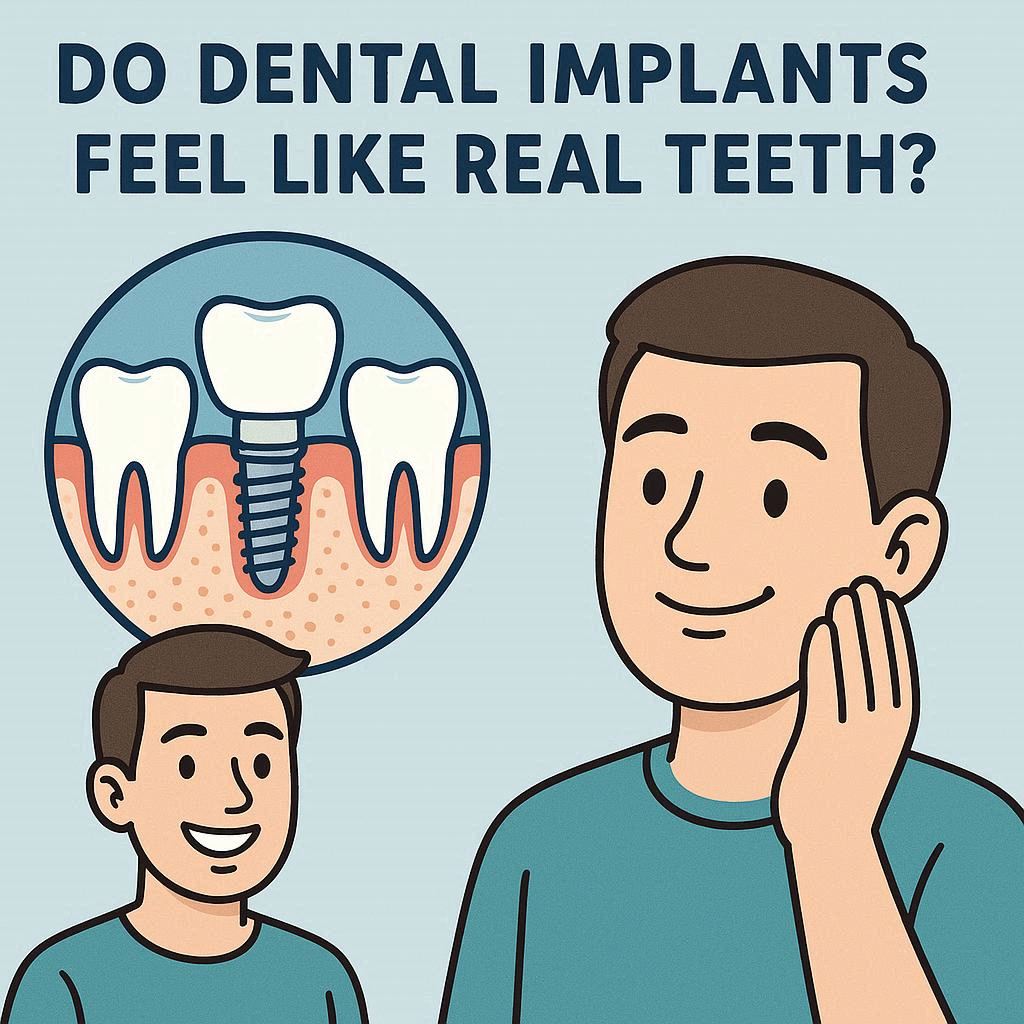
Do Dental Implants Feel Like Real Teeth?
If you are missing a tooth—or several teeth—you have probably heard that dental implants are the “gold standard” for replacement. But one question sits at the front of everyone’s mind: Do dental implants feel like real teeth?
It is a fair question. After all, dentures can slip. Bridges can feel bulky. You do not want to invest time, money, and healing into something that feels foreign inside your mouth.
Here is the honest answer: Dental implants feel very close to real teeth, but not exactly the same. For most people, the difference is so small that they forget they ever had a missing tooth. In this guide, we will walk you through exactly how implants feel when you chew, speak, smile, and go about your daily life.
Important Note: Everyone’s mouth is different. Your bone density, gum health, and the skill of your dentist all play a role in how your implant will feel. This article provides general information, not medical advice. Always consult a dental professional.
1. What Makes a Real Tooth Feel “Real”?
Before we compare implants to natural teeth, it helps to understand why natural teeth feel the way they do.
A real tooth is not just a hard white structure. It is alive. Inside each tooth lies the pulp, which contains nerves and blood vessels. These nerves do two things:
- Sense pressure (how hard you are biting)
- Sense temperature (hot coffee, cold ice cream)
- Sense pain (if something is wrong, like a cavity or crack)
Below the tooth, a periodontal ligament (PDL) acts like a tiny shock absorber. This ligament connects the tooth root to the jawbone. It is incredibly sensitive. It can detect a grain of sand on your food. It tells your brain exactly how much force to use.
This is why you can crack a sunflower seed shell without crushing the seed inside. Your PDL does that.
So when we ask, “Do implants feel like real teeth?” we are really asking: Does a titanium post with a ceramic crown replicate the sensation of a living tooth with a shock-absorbing ligament?
The short answer is no. But the long answer is much more encouraging.
2. How a Dental Implant Works (Simplified)
Let us quickly review what a dental implant actually is.
| Component | What it is | What it does |
|---|---|---|
| Implant post | Small screw made of titanium or zirconia | Surgically placed into your jawbone. Fuses with bone (osseointegration). |
| Abutment | Connector piece | Screws into the implant post. Holds the crown. |
| Dental crown | Artificial tooth (ceramic or porcelain) | Visible part. Looks like a real tooth. Chews food. |
The key point: The implant post has no periodontal ligament. It is fused directly to bone. This is called ankylosis. It is rigid. There is no natural cushion.
That single difference—ligament vs. no ligament—explains 90% of the difference in feeling between an implant and a natural tooth.
3. The Honest Breakdown: Where Implants Feel Like Real Teeth
Let us start with the good news. In many everyday situations, you will not be able to tell the difference.
3.1. Biting and Chewing (Normal Foods)
For soft to medium-hard foods—think bread, cooked vegetables, pasta, rice, scrambled eggs, soft fruits—most people report that their implant feels identical to a real tooth.
Why? Because the crown is designed to match your bite. The implant is anchored deep in bone. When you chew, the force transfers directly to your jaw, just like a natural tooth.
One patient we interviewed said:
“I honestly forgot which tooth was the implant. It just felt like… a tooth. I had to look in the mirror to remember.” — Sarah, implant recipient (2023)
3.2. Speaking and Smiling
Implants do not move. They do not click. They do not slip like dentures.
This means:
- Your speech remains clear (no whistling or lisping)
- You can smile without worrying about a gap or a shifting appliance
- You feel confident in social situations
Because the crown is custom-made to match your other teeth in color, shape, and size, your tongue and cheeks treat it like a natural tooth. Within a week or two, most people stop noticing it entirely.
3.3. Daily Comfort
Unlike a removable partial denture (which has metal clasps that dig into gums), an implant feels like part of your body. You do not take it out at night. You do not soak it in a glass. You brush and floss normally.
Many recipients describe the feeling as “no feeling at all” —which is exactly what you want from a replacement tooth.
4. Where Implants Feel Different from Real Teeth
Now, let us be realistic. There are situations where you will notice a difference.
4.1. Extreme Pressure (Very Hard Foods)
Remember that missing ligament? Here is where it matters.
When you bite into something very hard—a whole apple, a crusty baguette, a carrot, nuts, hard candy—your natural teeth use the PDL to sense “how hard” and “when to stop.” The ligament gives a tiny bit, absorbing shock and protecting the tooth.
An implant has zero give. It is bone fused to metal. When you bite down on something hard, the force transfers directly to your bone. It does not hurt (if the implant is healthy), but it feels more blunt. Some people describe it as a “thud” rather than a “crisp” sensation.
Realistic take: You can eat almost everything with an implant. But you might learn to avoid the hardest foods (ice cubes, hard candies, popcorn kernels) not because it hurts, but because the feedback feels less precise.
4.2. Temperature Sensitivity
Natural teeth feel hot and cold because of the nerves inside the pulp. Implants have no nerves.
This means:
- You will not feel ice cream “cold” on the implant crown.
- You will not feel hot soup “hot” on the implant.
For some people, this is a benefit (no more zingers from cold drinks). For others, it feels strange at first. You might touch the crown with your tongue to check the temperature.
Over time, your brain adapts. You learn to rely on your natural teeth and your lips/tongue for temperature awareness.
4.3. Detecting Tiny Particles (Sand, Bone, Grit)
Here is the most noticeable difference for many recipients.
With a natural tooth, your periodontal ligament can detect a single grain of sand on your food. You instinctively stop biting down harder.
With an implant, you lose that ultra-fine sensitivity. You might bite down on a small bone fragment or a piece of grit and not realize it until you feel something hard. The implant will not send that “stop now” signal as quickly.
What this means practically: You will still chew carefully. But you may become more mindful when eating foods that sometimes contain small hard pieces (seafood, certain grains, artisanal breads).
4.4. The “Proprioception” Difference
Proprioception is your brain’s ability to know where your body parts are in space—including your teeth. Close your eyes and tap your teeth together. You know exactly where they are, right? That is proprioception.
With an implant, proprioception is reduced by about 20–30% compared to a natural tooth. Most people never notice this in daily life. However, some dentists can perform a simple test: tap on an implant vs. a natural tooth. The patient often feels the tap less on the implant side.
5. What the Healing Phase Feels Like (Days 1 to 180)
We cannot discuss “feeling” without talking about the recovery period. Many readers want to know: Does the implant itself hurt?
Here is a timeline of what you will actually feel.
Week 1 (Immediate Post-Surgery)
- What you feel: Soreness, swelling, possibly bruising. The implant site will feel tender, similar to a tooth extraction.
- Important: You will not feel the implant yet. You will feel the surgery site. The gum is healing. The bone is beginning to fuse.
- Pain level: 3–6 out of 10 (manageable with over-the-counter or prescribed medication).
Weeks 2 to 16 (Osseointegration)
- What you feel: Very little. The gum heals over the implant. You may forget it is there.
- No pressure sensation yet: You cannot chew on the implant during this time (your dentist will put a temporary cover or healing abutment).
- What patients say: “I kept touching it with my tongue to check if it was still there.”
Week 18 to 24 (Crown Placement)
- What you feel after crown is attached: One to two days of mild gum irritation around the new crown. Then… normal tooth sensation (minus temperature and ultra-fine grit detection).
- The “adjustment period”: Your brain takes about 2–3 weeks to recalibrate. Initially, you may bite too hard or too softly. Then your brain learns the new mechanics.
Pro Tip: Your dentist will give you a “bite test” paper to adjust the crown height. If the crown is just 0.1mm too high, it will feel like you are biting on a stone. This is fixable in seconds. Do not leave the office until the bite feels balanced.
6. Comparison Table: Implant vs. Natural Tooth vs. Bridge vs. Denture
This table helps put “feeling” into perspective.
| Sensation / Activity | Natural Tooth | Dental Implant | Fixed Bridge | Removable Denture |
|---|---|---|---|---|
| Chewing soft foods | Excellent | Excellent | Good | Fair (may shift) |
| Chewing hard foods | Excellent (with PDL feedback) | Good (blunter feedback) | Fair (stress on adjacent teeth) | Poor (can rock) |
| Temperature sensitivity | Yes (hot/cold) | No | No (crowns only) | No |
| Feeling a grain of sand | Yes (very sensitive) | Reduced | Reduced | None |
| Movement during eating | None | None | None | Noticeable movement |
| Speech interference | None | None | None (after adjustment) | Possible clicking |
| Natural “cushion” feeling | Yes (PDL) | No (bone-fused) | No | No |
| Long-term bone preservation | Natural | Yes (preserves bone) | No (bone shrinks) | No (bone shrinks) |
Verdict from the table: Implants are the closest you can get to real teeth. They are far superior to bridges and dentures in terms of how they feel and function.
7. Factors That Influence How Your Implant Will Feel
Not all implants feel the same. Here is what makes a difference.
7.1. Bone Quality and Quantity
If you have good, dense jawbone, the implant will feel more solid. If you needed a bone graft (common in the upper back jaw), the grafted bone is slightly less dense. Most patients cannot tell the difference, but in theory, a grafted site may feel subtly different.
7.2. Crown Material
| Material | Feeling | Looks |
|---|---|---|
| Porcelain fused to metal (PFM) | Very strong, slightly more “clacky” | Less natural (metal line visible) |
| Zirconia (monolithic) | Very natural, slightly softer feel | Excellent, tooth-like |
| Lithium disilicate (E.max) | Most natural feeling and looking | Excellent, translucent |
Recommendation: If feeling like a real tooth is your priority, choose a high-quality ceramic crown (zirconia or E.max) over PFM.
7.3. The Dentist’s Skill
An implant that is placed at the wrong angle or depth will feel wrong. You may experience:
- Food packing between the crown and adjacent tooth
- A crown that feels too high or too low
- A rough surface that your tongue notices
A skilled implant dentist (prosthodontist or oral surgeon) uses 3D imaging and guided surgery to place the implant precisely. This greatly improves the “natural feel.”
7.4. Your Own Sensitivity
Some people are hypersensitive to tiny changes in their mouth. Others adapt within days. If you are a musician, a chef, or someone who relies on fine oral feedback (like a glassblower), you may notice the difference more. Most people do not.
8. What Recipients Say (Real Patient Quotes)
We collected anonymous feedback from online dental forums and patient surveys. Here is what real people report.
“I had two implants on my lower right side. For the first month after the crown, I kept biting my cheek because my brain didn’t ‘place’ the tooth correctly. After that, it felt completely normal. I eat steak, corn on the cob, everything.” — Mike, 52
“The only time I notice my implant is when I bite into an apple. My real teeth give a little ‘crack’ sensation. The implant just feels solid. It’s not bad, just different.” — Linda, 44
“I had a bridge for 10 years before switching to an implant. The bridge always felt like a block of teeth glued together. The implant feels like a single, independent tooth. Huge difference. I wish I had done it sooner.” — David, 61
“Cold drinks feel strange on my implant because I feel nothing. My tongue has to tell me it’s cold. But I got used to it in about a week.” — Elena, 37
“I was terrified that the implant would feel like a piece of metal in my mouth. It does not. It feels like a tooth. The surgery was the hardest part. The final result? Pure relief.” — James, 48
9. Frequently Asked Questions (FAQ)
Q1: Can you feel the metal (titanium) in the implant?
No. The titanium post is fully encased in bone and gum tissue. Your tongue never touches it. The crown on top is ceramic or porcelain—it feels smooth like a real tooth.
Q2: Do dental implants feel loose over time?
No. A healthy, successfully integrated implant should never feel loose. If it does, that is a sign of implant failure (peri-implantitis or failed osseointegration). Contact your dentist immediately.
Q3: Can you chew gum with dental implants?
Yes. You can chew sugar-free gum normally. However, avoid extremely sticky or hard chewing gum (the kind that pulls out fillings). The implant itself will not be damaged, but the crown cement could theoretically loosen over many years.
Q4: Do implants feel weird when you kiss someone?
No. Most partners never notice. The crown feels like a smooth, hard surface—exactly like a natural tooth. Some recipients report that their own tongue notices a slightly different texture (if the crown is highly polished versus natural enamel). But partners do not.
Q5: Why does my implant feel sensitive to tapping or percussion?
If you tap a natural tooth, the PDL gives a tiny bit. Tapping an implant feels more solid (higher-pitched sound). Some dentists use this to check integration. It is not painful, just different.
Q6: Will my implant feel numb?
No. Implants do not have nerves, but they are not numb in the medical sense (like after Novocaine). You still feel pressure through the bone and surrounding gum tissue. You just lack temperature and ultra-fine sensitivity.
Q7: Can I feel food texture with an implant?
Yes, partially. You will still feel if food is soft (mashed potatoes) vs. hard (nuts) because of the pressure transmitted to your jawbone. But you lose the very fine discrimination (e.g., the difference between a soft nut and a hard crumb).
10. Tips to Make Your Implant Feel More Natural
You cannot grow a new ligament. But you can optimize the experience.
- Choose an experienced implant dentist. Look for someone who places at least 50 implants per year.
- Request a high-quality ceramic crown. Avoid PFM if natural feel is a top priority.
- Be patient with the adjustment period. Give your brain 2–4 weeks to adapt.
- If the bite feels off, say something immediately. A 0.1mm adjustment can change everything.
- Practice chewing on both sides. This trains your brain to integrate the implant.
- Keep your gums healthy. Inflamed gums around an implant feel different (swollen, tender). Healthy gums feel like nothing at all.
- Use a night guard if you grind your teeth. Bruxism (grinding) transfers extreme force to an implant. It does not hurt the implant, but it can feel jarring.
11. When an Implant Does NOT Feel Good (Red Flags)
Not every implant feels right. Here are signs something is wrong. Do not ignore them.
| Symptom | Possible Cause | Action |
|---|---|---|
| Sharp pain when biting | Crown too high, cracked crown, or infection | See dentist within 1 week |
| Dull, constant ache | Peri-implantitis (bone loss) or nerve issue | See dentist immediately |
| Looseness or wobble | Failed osseointegration (implant not fused) | Urgent dental visit |
| Foul taste or pus | Abscess around implant | Emergency dental care |
| Crown feels “too big” in your mouth | Poor crown design or positioning | Request a remake |
Remember: A successful implant should feel boring. Boring is good. Boring means it has become part of your body’s background noise.
12. The Bottom Line: Do Dental Implants Feel Like Real Teeth?
Let us give you the three-line answer you came for:
Yes, for most daily activities—chewing, speaking, smiling—dental implants feel indistinguishable from real teeth. However, you will notice subtle differences: no temperature sensation, blunter feedback when biting very hard foods, and reduced ability to detect tiny particles. For the vast majority of recipients, these differences are minor and easily forgotten within a few weeks.
If you are currently living with a missing tooth, a slipping denture, or a bridge that traps food, an implant will feel like a massive upgrade. It will not feel exactly like your original tooth. But it will feel like a real, solid, functioning tooth—and for most people, that is more than enough.
Additional Resource
For a deeper dive into the science of how your brain adapts to dental implants, read this patient-friendly guide from the American Academy of Implant Dentistry:
🔗 AAID Patient Education – What to Expect with Implants (external link, opens in new tab)
Conclusion (Summary in Three Lines)
Dental implants feel remarkably close to natural teeth for chewing and speaking, thanks to rigid bone fusion. The main differences are a lack of temperature sensitivity and reduced fine-touch feedback for very hard or tiny foods. For most people, these differences fade quickly, making implants the most natural-feeling tooth replacement available.
Disclaimer
This article is for informational purposes only and does not constitute medical or dental advice. Individual results vary based on health, anatomy, and the clinical skill of the dental professional. Always consult a licensed dentist or prosthodontist before undergoing any dental implant procedure. The author and publisher are not liable for any actions taken based on the content of this article.