Denture Implantation: A Complete Guide to Stable, Natural-Looking Teeth
Losing teeth can feel like losing a part of yourself. You might avoid smiling in photos or struggle to enjoy a simple apple. Traditional dentures have helped millions of people, but they come with their own set of problems: slipping, clicking sounds, and sore spots.
That is where denture implantation changes everything.
Imagine having teeth that feel solid when you bite into a sandwich. Imagine not needing messy adhesives. This guide walks you through everything you need to know about implant-supported dentures. We will cover how they work, what they cost, the surgery process, and whether you are a good candidate.
Let us start from the beginning.
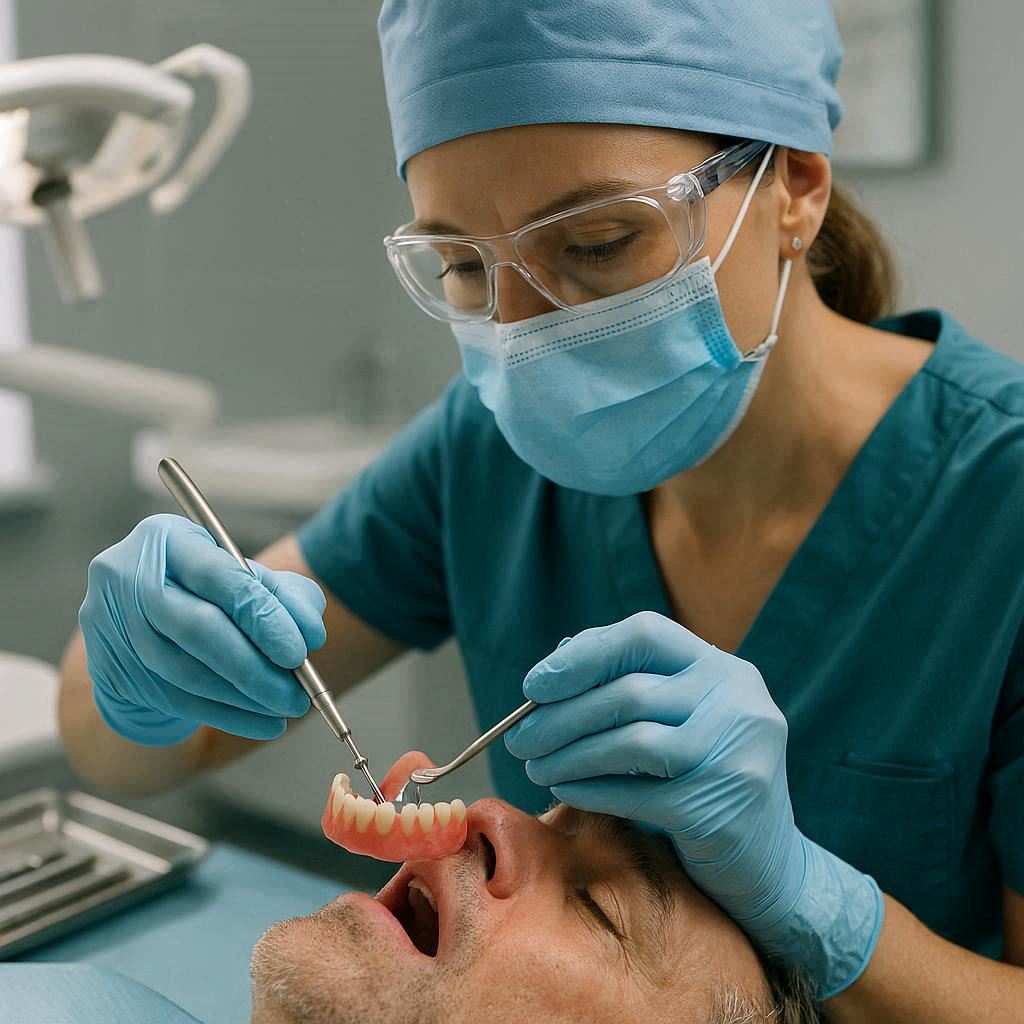
What Is Denture Implantation? (And How It Differs from Regular Dentures)
Many people confuse standard dentures with implant-supported ones. The difference is more than just a few metal posts.
Traditional dentures rest directly on your gums. They rely on suction or adhesive creams to stay in place. This works, but it is never perfect. Your jawbone actually shrinks over time without tooth roots to stimulate it. That means your dentures will eventually become loose.
Denture implantation involves placing small titanium posts into your jawbone. These posts act like artificial tooth roots. After they heal and fuse with your bone, a special denture clicks onto them.
Think of it like installing anchors in a wall before hanging a heavy shelf. The shelf will not fall, slip, or wobble.
Key Differences at a Glance
| Feature | Traditional Dentures | Implant-Supported Dentures |
|---|---|---|
| Stability | Moderate (can slip) | Very high (locked in place) |
| Chewing power | 20-30% of natural teeth | 70-90% of natural teeth |
| Bone health | May accelerate bone loss | Preserves jawbone density |
| Adhesive needed | Often yes | No |
| Speech clarity | Some clicking possible | Clear, natural speech |
| Removability | Fully removable | Removable by you or fixed |
Note from the editor: Implant dentures do not work for everyone. Your bone health, budget, and health conditions all play a role. Always consult with a prosthodontist or an oral surgeon.
Types of Implant-Supported Dentures
Not all implant dentures are the same. Dentists have developed different systems to match different needs and budgets. Let us break them down.
1. Ball-Retained (Stud-Attachment) Dentures
This is one of the most common types. The implants have ball-shaped ends. The denture has sockets with rubber O-rings that snap over the balls.
How it works: You press the denture down until it clicks. The O-rings hold it firmly, but you can still remove it for cleaning.
Best for: People who want removable dentures but with excellent stability. Also good for those with moderate bone loss.
2. Bar-Retained Dentures
A thin metal bar follows the curve of your jaw. Dentists attach this bar to two to four implants. The denture then clips onto the bar.
How it works: The bar distributes chewing pressure across all implants. This creates exceptional stability. Your denture slides onto the bar and locks into place.
Best for: Patients getting four or more implants. Also ideal for people who want the most rigid support possible.
3. Fixed (Non-Removable) Implant Dentures
These are sometimes called “hybrid dentures” or “fixed-detachable.” Only your dentist can remove them.
How it works: Technicians screw the denture onto your implants using small screws. You cannot take it out at night. You clean around it like natural teeth.
Best for: People who do not want to handle a removable appliance. Also excellent for full-arch replacements (all teeth on top or bottom).
4. Overdentures (2-Implant Support)
A more affordable entry point. Two implants support a full denture, usually on the lower jaw.
How it works: The denture snaps onto two ball or locator attachments. It still covers your palate (roof of your mouth) for the upper arch.
Best for: Lower jaw replacement. The lower denture is traditionally the hardest to keep stable.
Quick Comparison Table
| Type | Number of Implants | Removable? | Relative Cost | Stability Rating |
|---|---|---|---|---|
| Overdenture (2 implants) | 2 | Yes | $ | ★★★☆☆ |
| Ball-retained | 2-4 | Yes | $$ | ★★★★☆ |
| Bar-retained | 4-6 | Yes | $$$ | ★★★★★ |
| Fixed (hybrid) | 4-8 | No (dentist only) | $$$$ | ★★★★★ |
Who Is a Good Candidate for Denture Implantation?
You might be wondering: “Can I get these?” The honest answer is: not everyone. Let us go through the requirements.
Ideal Candidates
- Have adequate bone density. Implants need enough bone to hold them. If you have worn dentures for years, you may have lost significant bone.
- Are in good general health. Uncontrolled diabetes, autoimmune diseases, or heavy smoking can complicate healing.
- Do not have active gum disease. Treat this first.
- Are committed to oral hygiene. Implants can fail if you neglect cleaning.
- Have realistic expectations. These are not natural teeth. They are the next best thing.
Challenging Cases (But Not Impossible)
Some conditions make implantation harder, but not impossible:
- Moderate bone loss: You may need a bone graft first.
- Smoking: It slows healing. Many dentists require you to quit during treatment.
- Older age: Age alone is not a barrier. Many people in their 80s get implants successfully.
- Bruxism (teeth grinding): You may need a night guard to protect your implants.
Important note: A thorough examination is non-negotiable. Your dentist will take 3D scans (CBCT) to measure your bone precisely. Do not accept treatment without this step.
The Step-by-Step Denture Implantation Process
Let us walk through what actually happens, from your first visit to your final smile. The entire process typically takes four to nine months.
Step 1: Initial Consultation and Planning
Your dentist will:
- Review your medical history
- Take digital X-rays and a CBCT scan
- Discuss your goals and budget
- Explain which implant system fits your case
This is also when you ask questions. Bring a notepad. Ask about timing, pain management, and what happens if something goes wrong.
Step 2: Preparatory Procedures (If Needed)
Not everyone needs these, but many do.
Bone grafting: If your jawbone is too thin or soft, your dentist adds bone material to build it up. Healing takes four to six months.
Sinus lift: For upper molars, the sinus cavity may be too low. Lifting it creates space for implants.
Tooth extractions: Any failing teeth come out now. Sometimes, dentists place implants immediately after extraction.
Step 3: Implant Placement Surgery
This is the main event. You will receive local anesthesia. Sedation options (like laughing gas or oral sedatives) help you relax.
What happens:
- Your dentist makes small incisions in your gums.
- They drill precise holes into your jawbone.
- The titanium implants go into these holes.
- They place a healing cap or cover screw on top.
- They stitch your gums partially or fully over the implants.
How long? One arch takes about one to two hours. Both arches take longer.
Does it hurt? Not during the procedure. After anesthesia wears off, expect soreness like a tooth extraction. Most people manage with over-the-counter pain relievers.
Step 4: Osseointegration (The Healing Phase)
This is the most critical part. Osseointegration means your bone grows tightly around the implant surface. It bonds like a welded anchor.
Timeline: Three to six months for the lower jaw. Four to six months for the upper jaw (less dense bone).
What you do: Eat soft foods. Avoid smoking. Do not chew on the healing site. Wear your temporary denture if you have one.
Realistic warning: Skipping healing steps leads to failure. Do not rush this phase.
Step 5: Uncovering and Abutment Placement
Once healing is complete, your dentist exposes the implants. They attach small metal connectors called abutments. These stick out above your gum line. They serve as the attachment point for your new denture.
This is a minor procedure. Local anesthesia only. You might feel pressure but not sharp pain.
Step 6: Denture Fabrication
Your dentist takes impressions of your mouth, including the abutments. A dental lab builds your custom denture.
This takes two to four weeks. You may get temporary teeth during this time. The lab pays attention to:
- Tooth color and shape
- Gum color (pink acrylic)
- Bite alignment
Step 7: Final Attachment
Your final visit is exciting. Your dentist places your new denture onto the abutments. For removable types, they check the snap fit. For fixed types, they tighten small screws.
They will teach you how to remove, clean, and reinsert your denture. Do not skip this lesson.
Cost of Denture Implantation: Real Numbers
Let us talk money. This is often the biggest barrier.
Implant dentures are an investment. Think of them as buying 20+ years of quality of life versus replacing cheap dentures every 5-7 years.
Average Price Ranges (USD, without insurance)
| Procedure | Low End | High End | Average |
|---|---|---|---|
| Single implant (just the post) | $1,000 | $3,000 | $1,500 |
| Implant-supported overdenture (2 implants, lower) | $3,500 | $8,000 | $5,500 |
| Bar-retained denture (4 implants, one arch) | $7,000 | $15,000 | $11,000 |
| Fixed hybrid (All-on-4, one arch) | $15,000 | $30,000 | $22,000 |
| Full mouth (both arches, fixed) | $25,000 | $60,000 | $40,000 |
These prices typically include:
- Surgery fees
- Implant components
- The final denture
- Follow-up visits
They do NOT include:
- Bone grafts ($300 – $3,000 per site)
- Extractions ($75 – $400 per tooth)
- CT scans ($200 – $500)
- Temporary dentures ($500 – $1,500)
How to Save Money
- Dental schools: Teaching clinics offer reduced rates (often 40-60% less). Supervised students perform the work.
- Dental tourism: Mexico, Costa Rica, and Thailand offer quality work at lower prices. Factor in travel costs and follow-up care.
- Dental insurance: Some plans cover part of implant costs. Check your maximum annual benefit.
- Payment plans: Many offices offer CareCredit or in-house financing.
Honest advice: Be careful with “cheap implants.” Extremely low prices often mean low-quality materials, inexperienced providers, or no warranty. You do not want to redo this work.
Benefits of Choosing Implant-Supported Dentures
Why go through all this trouble? The benefits go far beyond cosmetics.
1. Eat Normally Again
Foods that are impossible with regular dentures become enjoyable:
- Steak
- Corn on the cob
- Nuts
- Raw vegetables
- Apples
Implant dentures restore about 70-90% of natural biting force. Traditional dentures give you only 20-30%.
2. Preserve Your Jawbone and Face Shape
Your jawbone needs stimulation from chewing forces. Without tooth roots, your body resorbs (dissolves) the bone. This happens quickly in the first year after tooth loss.
Over time, bone loss causes:
- A collapsed, sunken look to your lower face
- Premature wrinkles around your mouth
- A shorter distance between your nose and chin
Implant dentures send signals to your brain that teeth are still there. Your body preserves the bone. You look younger for longer.
3. No More Adhesives or Soaking
Say goodbye to:
- Messy creams that ooze out
- Slipping dentures during a conversation
- Soaking your teeth in a glass overnight
Most implant dentures can be brushed normally. Some are fixed and never come out.
4. Speak Confidently
Traditional dentures cover your palate (upper denture). This affects your tongue movement. Words with “s” and “th” sounds become difficult.
Implant dentures often have a horseshoe shape (no palate coverage). Your tongue moves freely. Your speech sounds natural.
5. Long-Term Value
A quality set of implant dentures lasts 20+ years with proper care. The implants themselves can last a lifetime. Compare that to traditional dentures, which need relining or replacement every 5-10 years.
Risks and Complications (Be Honest With Yourself)
No medical procedure is risk-free. Let us talk about what can go wrong.
Common (But Usually Minor)
- Swelling and bruising: Normal for one to two weeks.
- Minor bleeding: Resolves within days.
- Sore spots: Your gums may need adjustments to the denture base.
Less Common But Serious
- Implant failure (5-10%): The implant does not fuse with bone. Smoking, uncontrolled diabetes, or infection cause most failures.
- Nerve damage: Can cause numbness in your lip, chin, or tongue. Rare with modern 3D planning.
- Infection (peri-implantitis): Like gum disease but around an implant. It can destroy bone and loosen the implant.
- Sinus problems: Upper implants can protrude into the sinus cavity. Proper planning prevents this.
Signs You Need to Call Your Dentist
- Fever over 101°F (38.3°C)
- Bleeding that will not stop with pressure
- An implant feels loose
- Pus or foul taste (signs of infection)
- Numbness that lasts more than 24 hours
Important disclaimer: This information is for educational purposes. It does not replace professional medical advice. Always consult a licensed dentist for your specific situation.
Caring for Your Implant Dentures
Good care makes your investment last. Here is your daily routine.
For Removable Implant Dentures
Daily:
- Remove your denture. Rinse it under lukewarm water.
- Brush the denture with a soft brush and non-abrasive cleaner. (No regular toothpaste – it scratches.)
- Brush around each implant abutment in your mouth. Use a small interproximal brush.
- Rinse your mouth and reinsert the denture. You should hear or feel it click.
Weekly:
- Soak the denture in an effervescent cleaner. Follow the product instructions.
Never:
- Use hot water (warps the denture)
- Use bleach (damages metal parts)
- Sleep with a removable denture in place (your gums need rest)
For Fixed (Non-Removable) Implant Dentures
Treat them like natural teeth:
- Brush twice daily with a soft brush
- Floss under the denture using super floss or a water flosser
- Visit your hygienist every six months for professional cleaning
Professional Maintenance
See your dentist every 6-12 months for:
- Checking the O-rings or clips (they wear out every 1-2 years)
- Examining the implants for signs of bone loss
- Deep cleaning around the abutments
Recovery Timeline: What to Expect Week by Week
Let us be realistic about healing.
Day 1-3:
- Moderate swelling and discomfort
- Eat only cold or lukewarm soft foods (yogurt, smoothies, mashed potatoes)
- No rinsing, spitting, or using straws
Day 4-7:
- Swelling peaks then starts going down
- Switch to warm soft foods (soup, scrambled eggs, oatmeal)
- Start gentle salt water rinses
Week 2-4:
- Most soreness gone
- Return to normal soft diet
- Sutures may dissolve or be removed
Month 1-3:
- Healing continues beneath the surface
- You can slowly add firmer foods
- Avoid chewing directly over implant sites
Month 4-6:
- Bone is fusing (osseointegration)
- Most patients forget the implants are there
- You receive your final denture
Six months plus:
- Full function restored
- Eat whatever you want (within reason)
- Enjoy your new smile
Denture Implantation vs. Other Tooth Replacement Options
How do implant dentures compare to alternatives? Let us lay it out.
| Option | Pros | Cons | Best For |
|---|---|---|---|
| Implant dentures | Stable, preserves bone, long-lasting | Expensive, surgery required, takes months | Patients wanting permanent solution |
| Traditional dentures | Affordable, no surgery, fast | Unstable, bone loss, needs adhesives | Budget-conscious or frail patients |
| Dental bridges | Fixed, no surgery for teeth | Requires grinding healthy teeth, doesn’t replace roots | Replacing 1-3 missing teeth in a row |
| Single implants | Best for single tooth, preserves bone | Expensive per tooth, surgery required | Replacing 1-2 missing teeth |
| Do nothing | Free | Bone loss, shifting teeth, bite collapse | Not recommended for most |
Frequently Asked Questions (FAQ)
Q: Does insurance cover denture implantation?
A: Some plans cover part of the cost, typically 15-50% for implants. Many have a $1,000-$1,500 annual maximum. Check your specific policy. Medicare does not cover implants (except in rare cases). Some Medicare Advantage plans may offer limited coverage.
Q: How long do implant dentures last?
A: The implants themselves can last 30+ years or a lifetime. The denture (teeth and pink acrylic) lasts 10-20 years with good care. The O-rings or clips need replacement every 1-2 years (a quick, inexpensive fix).
Q: Are implant dentures removable?
A: Some are, some are not. Overdentures and bar-retained dentures are removable for cleaning. Fixed hybrid dentures are only removable by your dentist. Discuss your preference during the planning phase.
Q: Can I get implant dentures if I already have regular dentures?
A: Often yes. Your existing denture can sometimes be converted into an implant-supported one. Your dentist will evaluate if the denture is in good condition or if you need a new one.
Q: Will my dental implants set off metal detectors?
A: Usually not. Titanium is non-ferrous and rarely triggers airport or building security detectors. Even if it does, you can explain you have dental implants (many people do).
Q: What if an implant fails?
A: Your dentist will remove it, let the bone heal (3-6 months), and place a new implant. Some failures happen early (before the denture is attached) and are covered under warranty. Ask about your dentist’s failure policy before starting.
Q: Is the surgery painful?
A: The surgery itself is not painful due to anesthesia. Afterward, most people rate the discomfort a 2-4 out of 10. It feels like a tooth extraction. Over-the-counter ibuprofen or acetaminophen usually controls it. Severe pain is not normal.
Q: How many implants do I need for a full arch?
A: Typically 4 to 6 implants per jaw. “All-on-4” uses four strategic implants (two straight, two angled). All-on-6 uses six implants for more support. Some systems use 8 implants for maximum stability.
Additional Resources
For more trusted information, visit the American College of Prosthodontists patient education page:
https://www.gotoapro.org/dental-implants
Conclusion
Denture implantation transforms loose, uncomfortable false teeth into a stable, natural-feeling smile. You gain the ability to eat your favorite foods, speak clearly, and stop worrying about slipping dentures. The process requires an investment of both money and time—typically four to nine months and several thousand dollars. However, for the right candidate, the payoff includes preserved jawbone, renewed confidence, and teeth that stay put for decades.
Disclaimer: This article provides general educational information and does not constitute medical or dental advice. Every patient’s situation is unique. Always consult with a licensed dental professional before making decisions about your oral health. The author and publisher are not liable for any outcomes resulting from the use of this information.