Do Dental Implants Have Fake Gums?
You are looking at pictures of beautiful smile makeovers. You notice that some of them look incredibly natural. But then you look closer, and you see a hint of pink. You might wonder: Do dental implants have fake gums?
The answer depends on the type of restoration you receive. Some dental implant restorations include “fake gums” (also called artificial gingiva or pink porcelain/acrylic), while others do not.
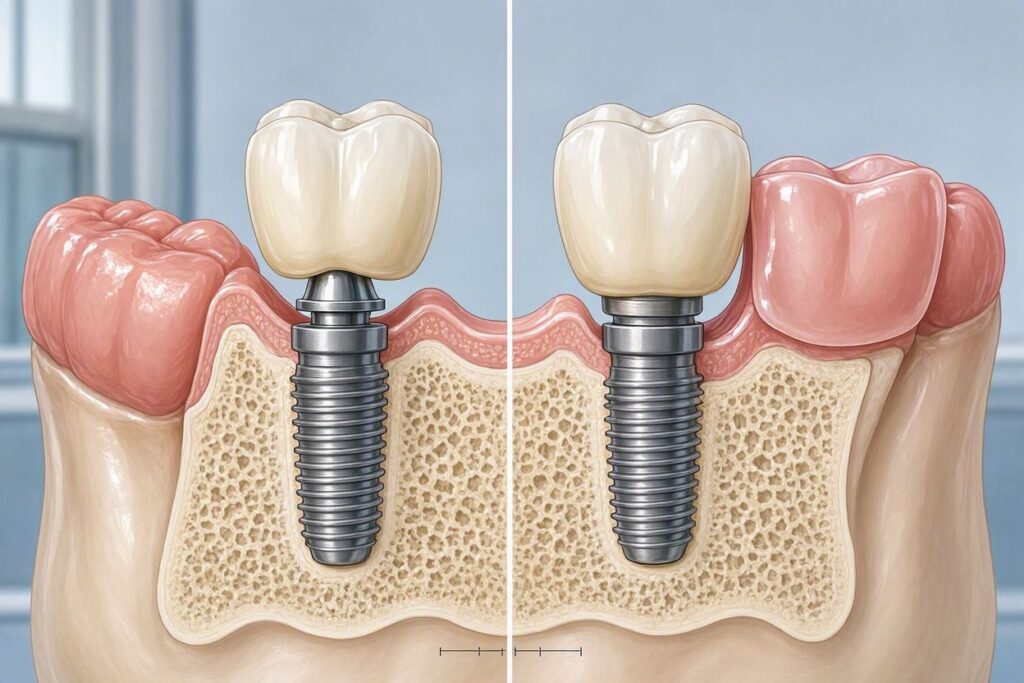
For a single tooth implant, there are usually no fake gums. The crown is designed to emerge from your natural gum tissue.
For full mouth restorations (like All-on-4 or implant bridges), fake gums are almost always included. They are a necessary part of the design to replace the gum tissue and bone that was lost when the teeth were removed.
This guide will explain why fake gums are used, when they are necessary, and how they can look either fantastic or terrible depending on the quality of the lab work.
The Purpose of Fake Gums
Why would a dentist add pink material to a set of teeth? It is not just for looks. It serves specific structural and aesthetic functions.
1. Replacing Lost Bone and Tissue
When you lose teeth, you also lose the bone that supported them. The jawbone shrinks. This means the space between the jaw and the lip changes.
If you only replaced the white teeth and ignored the lost bone, the teeth would look too long. You would show too much gum when you smile.
The Solution:
The pink acrylic or porcelain is shaped to mimic the natural gum line. It fills the vertical space left by the bone loss. It makes the teeth look like they are emerging from healthy, natural gums.
2. Hiding the Transition Line
In a full arch bridge, the titanium implants and abutments are below the surface. The bridge (the teeth) sits on top.
The Problem:
Without fake gums, you would see the gap between the bridge and the actual gum tissue. You would see the metal hardware.
The Solution:
The pink material wraps around the base of the bridge. It hides the abutments and creates a smooth transition between the prosthetic teeth and the patient’s natural gum tissue.
3. Providing Lip Support
The lips rest on the teeth and gums. If the bone and gums have collapsed due to tooth loss, the lips sink inward.
The Solution:
The fake gum flange (the part that extends outward) can be built up to support the upper lip. This restores a youthful facial profile and prevents the “sunken face” look.
When Are Fake Gums Used?
The use of artificial gums depends on the scope of the restoration.
Single Tooth Implant
Fake Gums? Rarely.
When a single tooth is replaced, the dentist usually places the implant and then attaches a custom crown. The crown is shaped to blend seamlessly with the surrounding natural gum tissue.
The Goal:
To make it look like the tooth grew right out of your own gums. No pink material is needed because your natural gums are still intact.
The Exception:
If the gum has receded significantly around the implant site, the dentist might add a small amount of pink porcelain to the base of the crown to hide the exposed metal. This is uncommon but possible.
Multiple Teeth (Implant Bridge)
Fake Gums? Sometimes.
If you are missing three or four teeth in a row, the dentist might create a bridge supported by two implants. If there has been moderate bone loss, a small “gum collar” of pink porcelain might be added to the bridge to mask the loss.
Full Mouth Restoration (All-on-4 or All-on-6)
Fake Gums? Almost Always.
This is where fake gums are most visible. The entire arch of teeth is replaced.
Why It Is Necessary:
- There is usually significant bone loss.
- The lab needs to cover the metal framework.
- The lips need support.
The Material:
- Acrylic (Plastic): The standard material. It is pink, durable, and easy to repair. It is attached to a titanium bar.
- Zirconia with Pink Porcelain: A premium option. The entire bridge is made of white zirconia, and a layer of pink porcelain is baked onto the base. This is extremely strong and natural-looking, but much more expensive.
The “Good, Bad, and Ugly” of Fake Gums
The quality of the fake gums is what separates a masterpiece from a disaster.
The “Ugly” Fake Gums
You have probably seen these. They are the dentures that look like a solid block of pink plastic with white teeth stuck on top.
- Flat and Monotone: The pink is one solid color. There is no texture, no variation, no shine.
- No Stippling: Real gums have a texture called stippling (like the surface of an orange peel). Fake gums without texture look like plastic.
- Obvious Transition: You can clearly see where the plastic ends and the real gum begins. It looks like a shelf.
The “Masterpiece” Fake Gums
High-end dental labs employ ceramists who are artists. They create fake gums that are virtually indistinguishable from real tissue.
- Layered Colors: Real gums are not just pink. They have different shades—coral, red, pale pink, and even brown tones depending on the patient’s ethnicity.
- Texture and Stippling: The ceramist carves tiny stippling into the porcelain to mimic the natural texture.
- Papilla Simulation: The little triangles of gum between the teeth are replicated.
- Custom Shading: The pink is matched to the patient’s existing gum tissue or to a natural, flattering tone.
The Difference:
A cheap full mouth bridge might cost $5,000. The fake gums look like bubblegum. A high-end bridge might cost $30,000. The fake gums are a work of art. They are virtually invisible.
Maintenance of Fake Gums
Fake gums require care, especially acrylic ones.
Acrylic Gums
- Staining: Acrylic is porous. It can stain from coffee, tea, red wine, and smoking.
- Cleaning: You must brush them daily. They can be polished by the dentist to remove stains.
- Wear and Tear: Acrylic gums can wear down over time, especially if you grind your teeth.
Zirconia/Porcelain Gums
- Stain Resistant: Porcelain is much more resistant to staining.
- Durability: It is stronger and less likely to wear.
- Cleaning: Brushing is usually sufficient.
The Verdict
Do dental implants have fake gums?
If you are getting a single tooth, probably not. If you are getting a full set of teeth, yes.
The fake gums are not a sign of a cheap solution. They are a necessary component of a well-made prosthesis. They replace the bone and tissue that was lost, hide the hardware, and support the lips.
The key is to choose a dentist who works with a high-quality dental lab. Ask to see photos of previous cases. Look at the gums. Are they textured? Do they have color variation? Do they look like plastic, or do they look like living tissue?
The difference is remarkable. When done well, no one will ever know you have fake gums. They will only see a beautiful, healthy smile.
Frequently Asked Questions
Q: Can you get implants without fake gums?
A: If you are replacing a single tooth, yes. For full mouth restorations, fake gums are almost always necessary to replace lost bone and tissue. There is a technique called “bone grafting” that can restore the bone, but even so, a small amount of pink material is often still needed.
Q: Do the fake gums hurt or feel different?
A: The fake gums are part of the bridge. They sit gently on top of your natural gum tissue. They should not cause pain. When you run your tongue over them, they feel smooth and solid.
Q: Can the fake gums be replaced separately from the teeth?
A: In most full mouth bridges, the teeth and the gums are fused together. If the gums wear out or stain badly, the entire bridge usually needs to be remade. This is a significant expense.
Q: How do I clean fake gums?
A: Brush them just like you brush the teeth. Use a soft-bristled brush. Floss under the bridge with superfloss or use a water flosser to remove food debris from the area where the fake gum meets your real gum.
Additional Resource:
For more information on the art and science of dental prosthetics, visit the American College of Prosthodontists: https://www.prosthodontics.org/.