Are Dental Implants Becoming More Affordable?
For decades, dental implants have been viewed as a luxury. They were the expensive option, reserved for the wealthy or those with premium insurance plans. But the landscape is shifting. You may have noticed more advertisements, more financing offers, and more dentists talking about implants. This raises the question: Are dental implants becoming more affordable?
The short answer is yes, but slowly and unevenly. The cost of dental implants has not plummeted like the cost of a flat-screen TV. However, compared to 20 years ago, they are more accessible to a wider range of patients. This is due to a combination of technology, competition, and financing options.
This guide will explore the economic forces driving the price of implants, why they are still expensive, and what the future holds for patients seeking this treatment.
The Historical Context: The “Luxury” Era
To understand the current trend, we must look back. In the 1990s and early 2000s, dental implants were a niche procedure.
Why Were They So Expensive?
- Limited Providers: Few dentists were trained to place implants. You had to see a specialist (oral surgeon or periodontist), and there were not many of them.
- Proprietary Technology: The implant systems (like Branemark, the pioneer) were patented. This meant the manufacturer could charge high prices for the titanium screws and the specialized tools required to place them.
- High Lab Costs: The crowns and bridges were made by hand by master technicians. This was slow, artisanal work.
- No Competition: With limited providers and high barriers to entry, prices remained high.
The Shift: Why Prices Are Stabilizing or Dropping
Several factors have converged to make implants more affordable today.
1. The Patent Expiration and “Generic” Implants
This is the biggest factor. The patents on the original titanium implant designs have expired. This has opened the door for “generic” or “value” implant manufacturers.
The Effect:
Just like generic drugs, generic implants are chemically identical to the brand-name versions (like Straumann or Nobel Biocare) but cost significantly less. A brand-name implant fixture might cost a dentist $300 to $500. A generic one might cost $100 to $200.
The Savings:
Dentists who are willing to use these value brands can offer lower prices to patients. You might see a “single implant for $999” offer that simply would not have been possible 20 years ago.
2. The Rise of the “Implant Center” and Corporate Dentistry
The dental industry has consolidated. Large corporate chains and dedicated “Implant Centers” have emerged.
The Effect:
These centers operate on volume. They place hundreds of implants per month. This allows them to negotiate lower prices for materials and to streamline their processes. They often have in-house labs and 3D printers, reducing outsourcing costs.
The Trade-Off:
While these centers can be cheaper, the quality can vary. Some are excellent. Others are “mills” that prioritize speed over care. You must do your research.
3. The 3D Imaging Revolution
Technology has actually reduced costs. Cone Beam CT (CBCT) scanners used to be rare and expensive. Now they are common.
The Effect:
Better imaging reduces the risk of surgical failure. It allows dentists to plan the surgery digitally before they ever pick up a drill. This means fewer failed implants, fewer complications, and less wasted time and money.
4. Digital Dentistry and In-House Milling
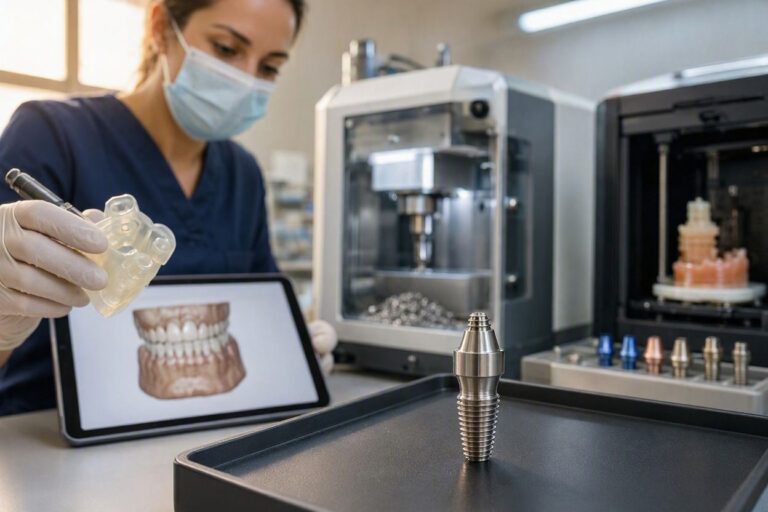
The old way of making a crown involved messy impressions and a dental lab. The new way uses digital scanning and in-house milling machines (CEREC or similar).
The Effect:
The dentist can scan your mouth, design the crown on a computer, and mill it from a block of ceramic in the office—all in a single visit. This eliminates the lab fee and reduces the number of appointments. This efficiency can translate to lower costs for the patient.
5. The Financing Boom
Even if the price has not dropped dramatically, the way we pay for it has changed. Third-party financing companies (like CareCredit, LendingClub, and Sunbit) have made implants accessible to middle-class patients.
The Effect:
Instead of paying $5,000 upfront, you can spread the cost over 24 or 60 months. A $5,000 implant becomes a $150 monthly payment. This “monthly payment” model makes the procedure feel—and effectively be—more affordable for the average person.
The Reality Check: Why Implants Are Still Expensive
Despite these trends, you should not expect implants to become “cheap.” There is a floor to the cost.
The Fixed Costs:
- Surgical Skill: You are paying for the dentist’s education, training, and experience. This is not a commodity.
- The Lab Work: High-quality crowns and bridges are still made by skilled technicians. If you want a natural-looking result, you must pay for artistry.
- The Materials: Even “generic” titanium and high-quality zirconia are medical-grade materials. They are not cheap to produce.
- Overhead: Dental offices have high overhead costs—sterilization, staff, rent, and equipment maintenance.
The Warning:
If you see an implant advertised for an absurdly low price (e.g., $500), be suspicious. This usually means:
- They are using a very cheap, unproven implant brand.
- The price only covers the fixture, not the crown or surgery.
- They are cutting corners on sterilization or surgical time.
Comparing the Cost Over Time (Single Implant, All-In)
This is a rough estimate of how the “all-in” cost (surgery, abutment, crown) has changed.
| Era | Estimated Cost (Single Implant) | Key Drivers |
|---|---|---|
| 1990s | $6,000 – $10,000 | High lab costs, limited specialists, patented tech. |
| 2000s | $4,000 – $6,000 | More providers, competition increasing. |
| 2010s | $3,000 – $5,000 | Generic implants, digital imaging, corporate chains. |
| 2020s | $2,500 – $4,500 | Financing, in-house milling, continued competition. |
The Trend: The price has roughly halved over 30 years when adjusted for inflation, though it remains a significant expense.
The Verdict
Are dental implants becoming more affordable?
Yes. They are more accessible now than at any point in history. The combination of generic implant brands, digital technology, corporate competition, and flexible financing has lowered the barrier to entry.
However, “more affordable” does not mean “cheap.” A quality, long-lasting implant still requires an investment of several thousand dollars.
The best way to make implants affordable for you is to:
- Shop around: Get quotes from multiple dentists (including dental schools).
- Ask about generic implant brands: They are often just as good as name brands.
- Use financing: Spread the cost over time.
- Use your HSA/FSA: Pay with pre-tax dollars.
The trend is moving in the right direction. As technology continues to advance and competition increases, we can expect the cost of dental implants to continue to decrease, making this life-changing procedure available to even more people.
Frequently Asked Questions
Q: Will dental insurance ever cover implants fully?
A: Probably not fully, but coverage is improving. Many PPO plans now offer some benefit for implants. As the evidence of their long-term cost-effectiveness grows, insurance companies are starting to see them as a better investment than bridges or dentures.
Q: Are cheap implants safe?
A: It depends. Many “value” implant brands are perfectly safe and effective. They have the same design and materials as premium brands. However, the surgical skill matters more than the brand. A cheap implant placed by a bad surgeon is dangerous. A good surgeon placing a value implant is often a great outcome.
Q: Is it cheaper to get implants in another country?
A: Often, yes. Dental tourism to Mexico, Costa Rica, or Turkey can save you 50% or more. However, you must factor in travel costs, the risk of complications, and the difficulty of follow-up care.
Q: What is the cheapest way to get dental implants?
A: The cheapest safe option is usually a dental school. You are treated by supervised students. The process takes longer, but the quality is high and the cost is often 50% less than private practice.
Additional Resource:
For more information on dental financing and payment options, visit the National Association of Dental Plans: https://www.nadp.org/.