What Is The Lifespan Of Dental Implants?
The decision to invest in a dental implant is, at its heart, a bet on the future. You are trading the immediate cost and the surgical experience for a promise: that this small titanium post will serve as a silent, reliable tooth root for the rest of your life. The question “What is the lifespan of dental implants?” is therefore the single most important financial and medical question you can ask. The answer, grounded in over fifty years of clinical research, is both remarkable and conditional. The titanium implant body itself has the potential to last a lifetime. The published long-term data from the original Brånemark patients shows implants successfully functioning for over 40 years. However, the overall lifespan of an implant restoration—the combination of the implant, the abutment, and the crown—is a complex equation with two distinct failure modes and a list of variables that are partially under the surgeon’s control, partially under the restorative dentist’s control, and, most critically, partially under your daily control as the patient. This guide will dissect the lifespan of dental implants into its component parts, explaining what can fail, when it is likely to fail, and what you can do to ensure your implant becomes one of the 40-year success stories.
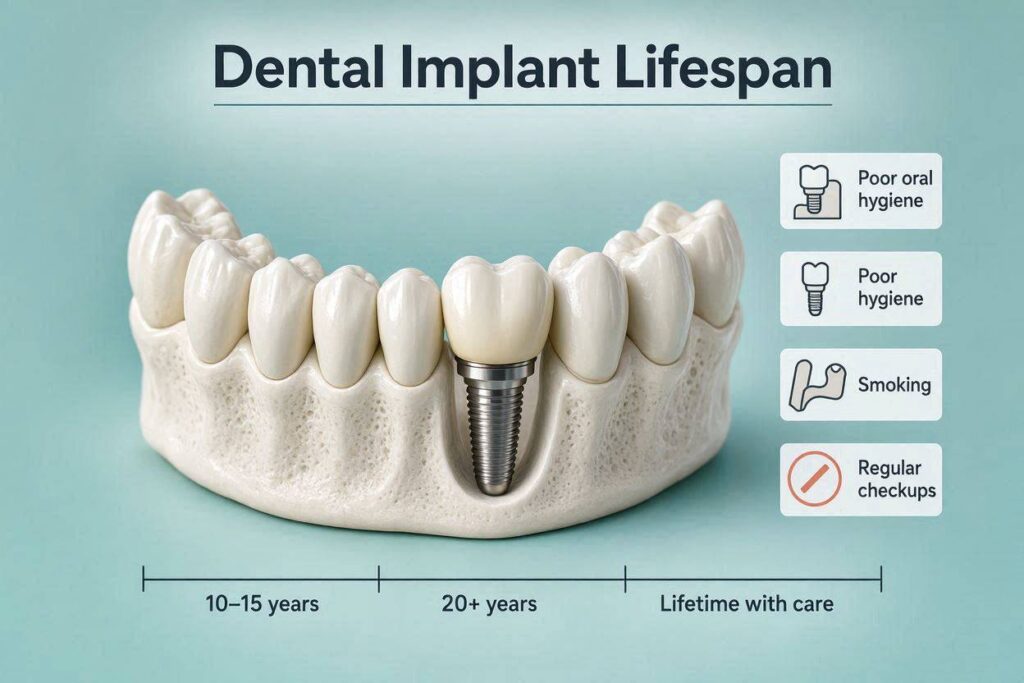
The Implant Body vs. The Implant Restoration: Two Different Lifespans
A fundamental distinction must be made before discussing longevity. A dental implant is not a single entity; it is a system of three parts. The implant body is the titanium or zirconia post surgically placed in the bone. The abutment is the connector that screws into the implant and supports the crown. The crown is the visible, tooth-shaped restoration. Each of these components has a different lifespan and a different primary threat to its longevity.
The implant body, once successfully osseointegrated, has no inherent biological clock. Titanium is a biocompatible, corrosion-resistant metal that does not fatigue under normal physiological loads. The implant body does not “wear out” in the traditional sense. Its lifespan is threatened by a single, specific disease: peri-implantitis. This is a bacterially driven, progressive bone loss around the implant. If peri-implantitis is prevented, the implant body can theoretically remain in function for the patient’s entire life.
The crown, by contrast, is a mechanical device. It is made of porcelain, zirconia, or acrylic, and it is subjected to millions of cyclic loading cycles over decades. It is the part of the implant system that is most likely to require repair or replacement. Porcelain can chip, the occlusal surface can wear, and the esthetics may degrade over time. The crown’s lifespan is typically 10 to 15 years, after which it may need to be replaced, not because the implant has failed, but because the visible tooth has simply worn out, much like the tread on a tire. The implant body beneath is perfectly healthy and can support a new crown. A patient should not interpret the need for a new crown as an “implant failure.” It is a predictable, manageable maintenance event.
The Statistical Reality: What the Long-Term Studies Show
The scientific literature on implant survival is robust and reassuring. When discussing lifespan, it is critical to distinguish between “survival” and “success.” Survival means the implant is still physically in the mouth. Success means the implant is still in the mouth, is functioning without pain, has no radiographic bone loss beyond the accepted physiological remodeling, and has no signs of infection. The success criteria are stricter.
For single-tooth implants placed in healthy patients, the survival rate at 10 years is consistently reported at 95% to 97%. At 20 years, the survival rate remains remarkably high, at 90% to 95%. The landmark studies on the Straumann, Nobel Biocare, and Astra Tech implant systems have tracked patients for multiple decades, demonstrating that a well-placed, well-maintained implant is one of the most predictable procedures in all of medicine. The failures tend to cluster in the first year after placement, representing a failure of the initial osseointegration process. If an implant survives the first year and is successfully loaded with a crown, its chance of surviving another 20 years is exceptionally high.
The factors that negatively influence these statistics are well-established. Smoking is a catastrophic risk factor, with smokers showing a significantly higher rate of late implant failure and marginal bone loss. A history of chronic, untreated periodontitis is another major risk factor, as the same pathogenic bacteria that destroyed the natural teeth will colonize the implant. Patients with poorly controlled diabetes have a higher failure rate. When these modifiable risk factors are controlled—when the patient stops smoking, maintains periodontal health, and manages their systemic disease—their implant survival curve approaches that of a healthy patient.
“I have been placing and restoring dental implants for over three decades. I have seen my early patients come back with the same single-tooth implants, and the radiographs show beautiful, stable bone levels year after year. I have also seen implants fail catastrophically in three years because the patient never flossed. The implant’s lifespan is in the patient’s hands. The surgery gives them a chance; the hygiene gives them a lifetime.” — A Periodontist and Implant Surgeon
The Two Failure Modes: Early and Late
Implant failure is not a single event; it is two distinct clinical problems separated by time and cause.
Early Failure (Before the Crown): This occurs during the healing period, before the implant is restored with a tooth. The implant fails to osseointegrate. Instead of bone fusing to the implant surface, a fibrous scar capsule forms. The implant is mobile, often painless, and must be removed. The causes of early failure include surgical trauma (overheating the bone during drilling), bacterial contamination of the implant site, insufficient bone volume or density to achieve primary stability, and micromotion during healing due to the patient chewing on the site. A patient who smokes heavily during this period is dramatically increasing their risk of early failure. An early failure is a profound disappointment, but it is typically not the end of the road. The site can be grafted, and after a healing period, a new implant can be placed with a high subsequent success rate.
Late Failure (After the Crown): This is the failure of a previously successful, functioning implant. The implant was osseointegrated, the crown was working well, and then bone loss or mechanical fracture caused the loss of the implant. The overwhelming cause of late biological failure is peri-implantitis, a chronic bacterial infection that slowly dissolves the supporting bone, crater by crater, until the implant loses its foundation and becomes mobile. Late mechanical failure is typically a fractured implant body or abutment screw, usually caused by excessive occlusal forces in a bruxer who does not wear a nightguard. Late failure is a more serious event than early failure because the bone loss is often extensive, making reconstruction more complex.
The table below summarizes the survival data and influencing factors.
| Implant Component | Expected Lifespan | Primary Threat | Key Protective Factor |
|---|---|---|---|
| Implant Body (Titanium) | Lifetime (potential) | Peri-implantitis (late biological failure) | Meticulous daily hygiene; professional maintenance every 3-6 months |
| Abutment | 10-20 years (potential lifetime) | Screw loosening or fracture; bacterial leakage at connection | Proper torque; conical connection; passive fit of restoration |
| Crown (Porcelain/Zirconia) | 10-15 years (average) | Porcelain chipping; occlusal wear; material fatigue | Nightguard for bruxers; avoidance of extreme hard foods and ice chewing |
| Full-Arch Hybrid Prosthesis (Acrylic) | 5-10 years (before needing replacement or reline) | Acrylic wear; staining; fracture of acrylic teeth | Regular professional cleaning; replacement of worn teeth as needed |
The Patient’s Role: The Deciding Factor in Lifespan
The single most powerful variable in the lifespan of a dental implant is the daily hygiene and maintenance routine performed by the patient. The implant is a foreign body in a bacteria-laden environment. The mouth is a warm, wet ecosystem, and the implant has no immune defenses. The only defense is the mechanical disruption of the biofilm.
A patient who brushes and flosses around their implant crown with the same diligence as their natural teeth, who uses a water flosser to flush the intaglio surface of a bridge, who uses an interdental brush to clean the concave abutment surface, and who religiously attends professional implant maintenance appointments every three to six months is a patient whose implant has a near-zero risk of peri-implantitis. A patient who never flosses the implant, who misses years of hygiene appointments, and who has active bleeding gums around the implant is on a direct path to bone loss and failure. The implant does not care about your intentions; it responds only to the mechanical reality of whether the plaque is removed. This is the harsh but liberating truth. The implant’s lifespan is not a lottery; it is a direct consequence of a daily action.
The Role of the Restorative Dentist: Occlusion and Precision
The restorative dentist controls the mechanical environment of the implant. A poorly designed crown that places excessive lateral forces on the abutment screw, or an implant placed in a compromised position that requires a bulky, off-axis restoration, will experience a higher rate of mechanical complications. The concept of a passive fit is critical. The crown or bridge must fit the abutment and the opposing teeth without any binding or tension. A misfit creates constant stress on the components, leading to screw loosening, porcelain fracture, or, in the worst case, bone loss from overload.
The occlusion, how the teeth come together, must be meticulously adjusted. The implant crown should have a slightly lighter contact than the natural teeth, allowing the natural teeth to absorb the initial force of chewing. The implant crown should be loaded primarily in the axial direction, straight down its long axis. Regular occlusal checks at maintenance appointments are essential, as teeth shift over time, and an implant crown that was perfectly adjusted five years ago may now be taking excessive force.
Important Note: If you are a clencher or a grinder, known as a bruxer, a custom-fabricated hard acrylic nightguard is not optional—it is an essential part of the implant system. The forces generated during parafunctional grinding are an order of magnitude higher than chewing forces and can fracture a zirconia crown, loosen the abutment screw, or cause crestal bone loss. A nightguard is a small investment that protects the entire implant restoration.
Conclusion
The potential lifespan of a dental implant body is a lifetime, with well-documented, published 20-to-40-year survival rates exceeding 90-95% for the titanium fixture. The implant crown, as a mechanical device subject to millions of chewing cycles, has a functional and aesthetic lifespan of 10 to 15 years before it may require replacement. The single greatest determinant of whether an implant becomes a permanent success or a late failure is the patient’s daily disruption of bacterial biofilm, coupled with a strict professional maintenance schedule, as peri-implantitis is the leading cause of late bone loss and implant loss.
Frequently Asked Questions (FAQ)
Q: Do dental implants last longer than bridges?
A: Yes, in general. A single-tooth implant has a higher 10-to-20-year survival rate than a three-unit tooth-supported bridge. The implant does not rely on the adjacent teeth and is not susceptible to recurrent decay, which is the primary cause of bridge failure.
Q: Can a dental implant be replaced if it fails?
A: Yes, in most cases. A failed implant is surgically removed, the site is thoroughly debrided of any infected or fibrous tissue, and a bone graft is often placed. After a healing period of several months, a new implant can be placed in the grafted site.
Q: How will I know if my implant is failing?
A: The early warning signs include bleeding upon gentle probing around the implant, a bad taste or pus, gum recession exposing the metal abutment, and progressive, deep pocketing around the implant. A truly failing implant will feel mobile. None of these signs should be ignored.
Q: Will dental insurance cover the replacement of an implant crown after 15 years?
A: It depends on your specific plan. If your plan covers major restorative services, it will likely cover a portion of the replacement crown (the abutment and the crown itself), subject to the plan’s annual maximum and waiting periods. The implant body itself is rarely covered under a standard replacement cycle.
Additional Resource:
For an independent, systematic review of the long-term survival rates of dental implants, the Cochrane Database of Systematic Reviews is a trusted source: Cochrane Library – Dental Implants.