How A Person Decides On Dental Implants?
Losing a tooth is a significant event. It affects not only how you chew and speak but also how you feel about yourself. The gap in your smile can be a constant source of self-consciousness. When you are ready to address it, you are faced with a major decision: What is the best way to replace that missing tooth?
For many, the choice comes down to a dental implant versus more traditional options like a fixed bridge or a removable partial denture. This is not a simple choice. It involves weighing your finances, your long-term health, your lifestyle, and your emotional well-being.
This guide is designed to walk you through the decision-making process step by step. We will explore the factors you need to consider, compare your options honestly, and help you determine if a dental implant is the right choice for you.
The First Step: Understanding Your Options
Before you can decide on an implant, you need to understand what you are choosing between. Each option for replacing a missing tooth has a distinct set of pros and cons.
Option 1: The Dental Implant
As you now know, a dental implant is a titanium post that is surgically placed into your jawbone, acting as an artificial tooth root. After a healing period, a custom-made crown is attached to the post.
- The Core Benefit: It is the only option that replaces the root as well as the tooth. This makes it the most stable, natural-feeling, and long-lasting solution. It also helps prevent bone loss in the jaw.
Option 2: The Fixed Bridge
A traditional bridge is a prosthetic tooth (called a pontic) that is fused between two dental crowns. The crowns are placed over the healthy teeth on either side of the gap, literally “bridging” the space.
- The Core Trade-off: To place a bridge, the dentist must significantly file down the two adjacent, healthy teeth to make room for the crowns. This permanently alters those teeth and can make them more susceptible to decay and failure in the future.
Option 3: The Removable Partial Denture
A partial denture is a removable acrylic or metal framework that holds one or more artificial teeth. It is designed to be taken in and out of the mouth. It often has clasps that hook onto adjacent teeth for support.
- The Core Trade-off: This is the most affordable option upfront, but it is also the least stable and comfortable. It can feel bulky, can affect your ability to taste, and can be a source of embarrassment if it shifts or clicks while you speak or eat.
The Decision-Making Framework: Key Factors to Weigh
Choosing an implant is a personal decision. What is right for one person may not be right for another. Here are the most critical factors to consider as you make your choice.
Factor 1: Your Long-Term Oral Health
This is arguably the most important clinical factor. How does each option affect the health of your entire mouth over the next 10, 20, or 30 years?
- Impact on Adjacent Teeth: An implant is a standalone solution. It does not rely on or affect the teeth next to it. A bridge requires the destruction of healthy tooth structure on both sides. A partial denture relies on clasps that can trap food and cause wear on the supporting teeth.
- Prevention of Bone Loss: This is the implant’s superpower. When a tooth is lost, the body begins to resorb the bone in that area because it no longer receives stimulation from the tooth root. An implant replaces that stimulation, halting bone loss. A bridge or partial denture does not. The bone under them will continue to shrink over time, which can change the shape of your face and lead to other problems.
- Longevity: A well-cared-for dental implant can last a lifetime. A bridge typically lasts 10 to 15 years before it needs to be replaced, often because of decay on the supporting teeth. A partial denture may need to be relined or replaced even more frequently as your mouth changes.
Factor 2: The Financial Investment
Let’s be honest: cost is a major driver for most people.
- The Upfront Cost: A dental implant has the highest upfront cost of the three options. A bridge is less expensive, and a partial denture is the most affordable initially.
- The Long-Term Cost: This is where the math gets interesting. Because an implant can last a lifetime, it is often the most cost-effective option over several decades. A bridge that costs less now will likely need to be replaced once or twice in that same timeframe, and each replacement is more expensive than the last because more tooth structure is lost. A partial denture also requires maintenance and eventual replacement. When you factor in the cost of future repairs and replacements, the implant is often the best long-term value.
Factor 3: Function, Comfort, and Confidence
How do you want your replacement tooth to feel? What do you want your daily life to be like?
- Chewing: An implant feels like a natural tooth. You can eat all your favorite foods without thinking about it. A bridge is also fairly strong, but you may be more careful with it. A partial denture can make chewing difficult and uncomfortable for many foods.
- Comfort: An implant becomes a part of you. There is nothing to take out, nothing to clean separately. A bridge feels permanent but can be difficult to floss under. A partial denture is a foreign object in your mouth, which some people never get used to.
- Confidence: An implant is the gold standard for aesthetics. It is designed to look indistinguishable from a natural tooth. It also restores the natural shape of your smile and face. A bridge can look great too, but a partial denture with visible clasps can sometimes be a giveaway.
Here is a direct comparison to help you visualize the differences:
| Factor | Dental Implant | Fixed Bridge | Removable Partial Denture |
|---|---|---|---|
| Effect on Healthy Teeth | None. Stands alone. | Requires filing down 2 healthy teeth. | Uses clasps on other teeth. |
| Prevents Bone Loss | Yes | No | No |
| Longevity | Can last a lifetime. | 10-15 years on average. | 5-10 years on average. |
| Upfront Cost | Highest | Moderate | Lowest |
| Long-Term Value | Often the best. | Can be more expensive over time. | Can be more expensive over time. |
| Stability & Comfort | Feels like a natural tooth. | Fixed and stable. | Can shift, rock, and feel bulky. |
| Aesthetics | Excellent | Excellent | Good, but clasps may be visible. |
The Process of Deciding: A Step-by-Step Guide
Knowing the facts is one thing, but applying them to your own life is another. Here is a practical guide to moving through the decision.
Step 1: Get a Comprehensive Examination
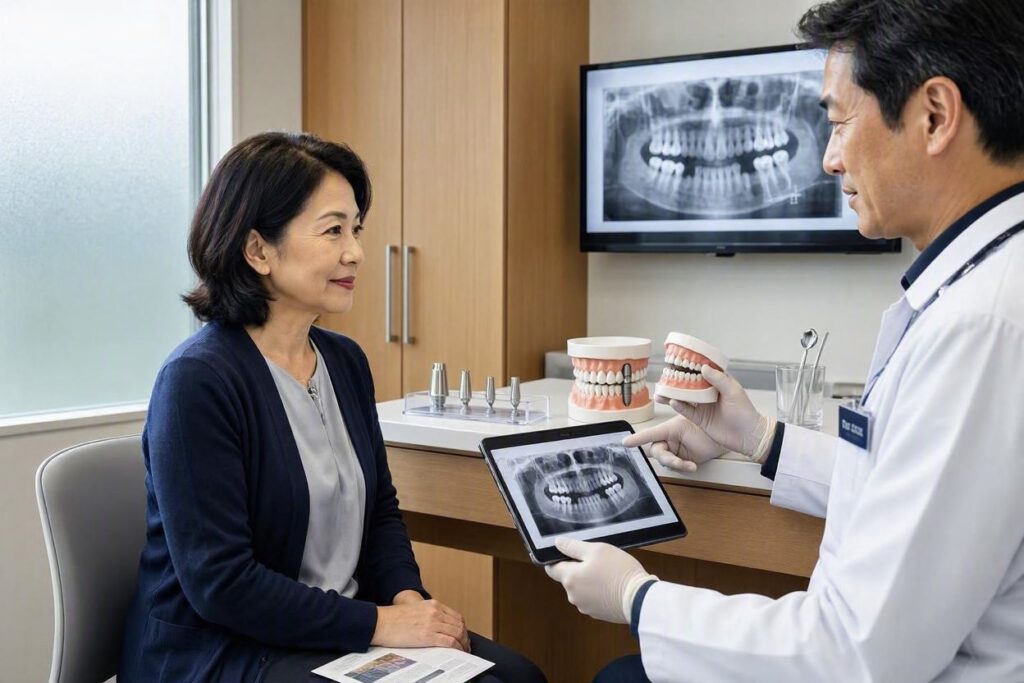
You cannot make a decision in the dark. The first step is to see a qualified dentist for a thorough exam. This will include X-rays, and often a 3D scan, to assess the health of your remaining teeth and the quality of your jawbone.
This is critical because not everyone is immediately a candidate for an implant. You need to have enough healthy bone to support the implant. If you do not, you may require a bone graft, which adds cost and time to the process. Your dentist will also assess if a bridge or partial is even a viable option based on the health of the teeth that would support them.
Step 2: Consult with an Implant Specialist
General dentists can place implants, but many complex cases are best handled by a specialist, such as an oral surgeon, a periodontist, or a prosthodontist. Getting a second opinion from a specialist is wise. They can give you a detailed treatment plan, a timeline, and a very accurate cost estimate.
Step 3: Review Your Insurance and Financing Options
Call your dental insurance provider and find out exactly what they cover for each option. Remember, even if implants are not covered, a bridge or partial might be. You need to know your out-of-pocket cost for each scenario.
If the cost of an implant is a barrier, ask the dental office about financing options. Many offices work with third-party lenders like CareCredit or offer in-house payment plans that break the cost into affordable monthly payments.
Step 4: Reflect on Your Personal Values and Priorities
Ultimately, the decision is yours. Ask yourself these questions:
- How important is it for me to have the most permanent, stable solution?
- Am I willing to sacrifice my healthy adjacent teeth for a bridge?
- How much do I value the comfort and confidence of a solution that feels like my own natural tooth?
- Am I willing to make a larger upfront investment for a better long-term outcome and peace of mind?
- What is my tolerance for the surgical process and the healing time?
Talk to people who have had different procedures done. Their firsthand experiences can be invaluable. Weigh the pros and cons not just in terms of dollars and cents, but in terms of your quality of life.
Important Note: Do not let age be the only deciding factor. Some people think they are “too old” for an implant. In reality, as long as you are in good general health and have adequate bone, you can be a candidate for a dental implant well into your 80s and 90s. The benefits of stability and improved nutrition can be particularly impactful for seniors.
Conclusion
Deciding on a dental implant is a deeply personal choice that requires careful consideration of your oral health, your finances, and your lifestyle goals. While the upfront cost is higher than a bridge or a partial, the implant offers unmatched benefits in terms of preserving your jawbone, protecting your healthy teeth, and providing a permanent, natural-feeling solution.
The best way to make an informed decision is to gather the facts. Get a thorough examination, understand the long-term health and cost implications of each option, and reflect on what you value most. With this knowledge, you can confidently choose the path that is right for you.
Frequently Asked Questions
At what age are dental implants recommended?
Dental implants are typically recommended for adults whose jaws have finished growing, which is usually around age 18 for women and 20 for men. There is no upper age limit, as long as the patient is healthy enough for a minor surgical procedure.
How do I know if I have enough bone for an implant?
Your dentist will take a 3D scan (CBCT) of your jaw. This scan allows them to measure the exact height, width, and density of your bone. This is the definitive way to determine if you have enough bone for an implant, or if you would need a bone graft.
Is a dental implant better than a bridge?
For most people, yes. An implant is superior to a bridge because it does not require damaging healthy adjacent teeth, it prevents bone loss, and it lasts much longer. The main advantage of a bridge is its lower upfront cost and shorter treatment timeline.
What is the success rate of dental implants?
The success rate for dental implants is very high, typically cited at over 95 percent. The most important factors for success are the skill of the surgeon, the quality and quantity of the patient’s bone, and the patient’s commitment to good oral hygiene.
Additional Resource
For a balanced overview of tooth replacement options, including implants, bridges, and dentures, you can visit the American Dental Association’s patient website, Mouth Healthy: https://www.mouthhealthy.org/en/az-topics/i/implants