How Frequently Should Dental Retainers Be Replaced?
You finished orthodontic treatment and received your retainers with instructions to wear them faithfully. Months or years pass, and you notice the plastic looks cloudy, or the wire feels different against your teeth, or you simply wonder whether these appliances have an expiration date. The question of how often retainers should be replaced is practical and important. Retainers are not designed to last forever, and worn or damaged retainers can fail at their essential job: keeping your teeth in their corrected positions.
The frequency of retainer replacement depends on the type of retainer, how well you care for it, and the natural wear it endures from nightly use. Understanding the lifespan of each retainer type and recognizing the signs that indicate replacement is needed protects the investment you made in orthodontic treatment. This guide provides clear, realistic guidance on retainer longevity and replacement.
Why Retainers Need Replacement
Retainers are subjected to mechanical stress, oral bacteria, temperature changes, and the grinding forces some patients exert during sleep. Over time, these factors degrade the retainer material and compromise its fit and function.
Material Fatigue
All materials degrade with use. The acrylic of Hawley retainers can develop microscopic cracks. The thermoplastic of clear retainers loses elasticity and becomes brittle. The wire of Hawley retainers can fatigue with repeated flexing. These changes happen gradually and may not be visible until the retainer fails or stops fitting properly.
Wear from Bruxism
Patients who grind or clench their teeth at night subject their retainers to forces far beyond what they were designed to withstand. A retainer that might last ten years for a non-grinder may wear out in one or two years for someone with significant bruxism. The retainer material abrades, thins, and eventually perforates or cracks.
Biofilm and Calcification
Even with diligent cleaning, retainers accumulate a biofilm of bacteria and salivary proteins over time. The porous surface of acrylic and the micro-scratches in clear plastic provide hiding places that cleaning cannot fully reach. Calcium deposits from saliva can create a cloudy, rough surface that harbors bacteria and irritates the oral tissues. Eventually, cleaning becomes insufficient to maintain hygiene, and replacement is indicated.
Changes in Fit
Retainers can distort if exposed to heat, such as hot water, a clothes dryer, or a hot car interior. They can warp slightly with years of use. A retainer that no longer fits passively is not maintaining the tooth positions it was designed to preserve. Continuing to wear an ill-fitting retainer can actually move teeth in undesirable directions.
Replacement Timelines by Retainer Type
Different retainer types have different expected lifespans. These are general guidelines based on typical use with proper care.
Clear Retainers (Vacuum-Formed or Essix-Type)
Clear retainers are the most commonly prescribed removable retainers today. They are made from a thin, transparent thermoplastic material that is vacuum-formed over a model of the patient’s teeth.
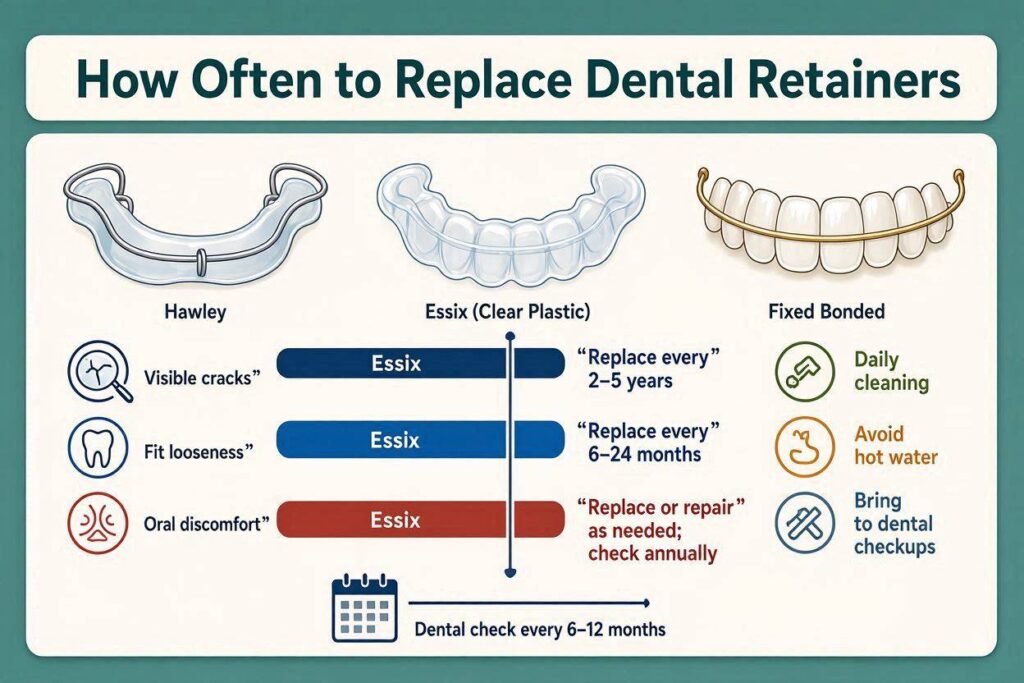
With proper care, clear retainers typically last between six months and two years. Some patients stretch them to three or four years, but the material is progressively degrading throughout that time. The plastic loses its elasticity, becomes brittle, and is more prone to cracking.
Clear retainers are particularly vulnerable to wear in patients who grind their teeth. Even without visible holes, a clear retainer that has been subjected to nightly grinding may be thin and weak after six months. Patients should inspect their clear retainers regularly for thinning, particularly in the areas of the back teeth and any areas that contact opposing teeth during grinding.
Patients who wear clear retainers full-time, twenty-two hours per day as prescribed during the initial retention phase, will wear through them faster than those who transition to nighttime-only wear. Full-time wear means more hours of mechanical stress, more exposure to oral fluids, and more handling, all of which accelerate degradation.
Hawley Retainers
Hawley retainers consist of an acrylic body that rests against the palate or the lingual surfaces of the lower teeth, with a metal wire that crosses the front teeth. The combination of acrylic and wire makes them more durable than clear retainers.
A well-made Hawley retainer can last five to ten years or longer with proper care and no adverse grinding habits. The acrylic body is durable, and the wire, while capable of fatigue over many years, is substantial enough to withstand normal use.
The most common failure point for Hawley retainers is the wire. It can become distorted if the retainer is handled carelessly, sat upon, or stored without a case. A distorted wire does not contact the teeth in the correct positions and can apply unintended forces. The wire can also fracture at the point where it enters the acrylic, a stress concentration point that is vulnerable to repeated flexing.
The acrylic body can crack if dropped. Small cracks may not affect function immediately but can harbor bacteria and eventually propagate. Replacement is indicated for any crack that compromises the structural integrity of the retainer.
Fixed (Bonded) Retainers
Fixed retainers are wires bonded directly to the lingual surfaces of the anterior teeth, usually the lower canines and incisors. They are not removable by the patient and provide continuous retention without relying on patient compliance.
A fixed retainer can last ten to twenty years or even indefinitely if it remains intact and the patient maintains good oral hygiene around it. However, the bonding adhesive can fail at any point, allowing one or more teeth to become detached from the retainer wire.
Fixed retainers require replacement when the wire fractures, when a bond fails and cannot be repaired without replacing the entire retainer, or when significant calculus accumulation makes the retainer a plaque trap that threatens periodontal health. The wire itself does not wear out in the typical sense, but the bonds do, and the wire can break under occlusal forces.
Spring Aligners and Active Retainers
Some retainers are designed with springs or screws that allow for minor tooth movement. These active components have a finite lifespan. Springs lose their force over time. If a spring aligner is no longer providing the intended force, replacement is indicated. The timeline varies based on the specific appliance design.
| Retainer Type | Typical Lifespan | Factors That Shorten Lifespan | Most Common Failure |
|---|---|---|---|
| Clear Retainer | 6 months – 2 years | Bruxism, full-time wear, heat exposure | Cracking, thinning, loss of fit |
| Hawley Retainer | 5 – 10+ years | Dropping, careless handling, wire fatigue | Wire distortion, acrylic crack |
| Fixed Retainer | 10 – 20+ years | Bond failure, wire fracture, poor hygiene | Debonding, calculus buildup |
| Spring Aligner | 1 – 3 years | Force degradation, spring fatigue | Loss of active force |
Signs That Your Retainer Needs Replacement
Rather than relying solely on time, watch for specific indicators that replacement is necessary.
Visible Damage
Cracks, whether hairline or obvious, compromise the retainer’s structural integrity and provide spaces for bacteria. Holes worn through the occlusal surface of a clear retainer mean the retainer is no longer maintaining the correct relationship between the teeth. A wire that is bent, kinked, or no longer sitting passively against the teeth requires professional attention. Distortion, where the retainer no longer fits the model or feels different when inserted, indicates the material has warped.
Poor Fit
A retainer that rocks on the teeth rather than seating firmly, that feels tight in some areas and loose in others, or that causes discomfort or pressure, is no longer fitting correctly. A properly fitting retainer should seat completely with gentle finger pressure and feel passive. If you have to bite the retainer into place, or if it feels like it is actively pushing on teeth, the fit has changed, and the retainer should be evaluated.
Persistent Odor or Discoloration
Despite thorough cleaning, a retainer that retains a foul odor or that has developed deep discoloration may have porous areas where bacteria and fungi have penetrated beyond the reach of cleaning. This is more common with older retainers and with clear retainers that have developed micro-scratches. Replacement restores hygiene.
Calculus Buildup That Cannot Be Removed
Hard, calcified deposits that resist soaking and brushing create a rough surface that irritates the oral tissues and harbors bacteria. If professional cleaning cannot restore the retainer to a smooth, hygienic state, replacement is indicated.
Discomfort or Soreness
A retainer that causes gum soreness, palate irritation, or tooth discomfort when it previously did not may have distorted or may no longer be appropriate for the current position of the teeth. Minor movements of teeth over time, even with retainer wear, can make a retainer fit differently. Discomfort is a signal that the relationship between the retainer and the teeth has changed.
How to Extend the Life of Your Retainers
Proper care significantly prolongs the useful life of retainers, reducing the frequency and cost of replacement.
Clean Daily and Properly
Brush removable retainers gently with a soft toothbrush and clear liquid soap or a dedicated retainer cleaner. Avoid toothpaste, which is abrasive and creates micro-scratches in the plastic. Soak retainers in a retainer cleaning solution or a diluted hydrogen peroxide or vinegar solution as recommended. Rinse thoroughly before placing back in the mouth. Never use hot water, which warps the plastic.
Store in a Case
When retainers are out of your mouth, they belong in their case. Retainers left on napkins are thrown away. Retainers left on counters are knocked to the floor and stepped on. Retainers left in pockets go through the laundry. A brightly colored case that is hard to overlook reduces the risk of loss and damage. Keep the case clean, washing it regularly with soap and water.
Keep Away from Pets
Dogs are inexplicably drawn to retainers. The scent of saliva on the plastic attracts them, and they will chew a retainer to destruction in seconds. Store retainers in a case, and keep the case out of reach of pets.
Avoid Heat Exposure
Clear retainers and the acrylic components of Hawley retainers are thermoplastic. Heat distorts them. Never use hot water for cleaning or soaking. Do not leave retainers in a car, on a sunny windowsill, or near a heat source. Do not boil retainers or place them in a dishwasher.
Handle Hawley Retainers Carefully
When removing a Hawley retainer, use both hands and apply even pressure to the acrylic body, not the wire. Pulling on the wire bends it. When cleaning, support the retainer in your palm rather than holding it by the wire.
Monitor for Signs of Grinding
If you notice that your clear retainer is developing thin spots or small holes, particularly on the occlusal surfaces, you are grinding at night. Inform your dentist or orthodontist. A different retainer material, a thicker clear retainer, or a Hawley retainer with a bite plane may be more durable for your situation.
The Cost-Benefit Analysis of Replacement
Replacing a retainer costs money, but failing to replace a worn or damaged retainer costs more in the long run.
The Cost of Replacement
A single clear retainer typically costs between one hundred and three hundred dollars. A Hawley retainer costs between one hundred fifty and four hundred dollars. Fixed retainer replacement costs between two hundred and five hundred dollars per arch. These are out-of-pocket costs, as most dental insurance plans do not cover retainer replacement.
The Cost of Not Replacing
If a worn or damaged retainer fails, teeth shift. Correcting that shift may require a new round of orthodontic treatment, whether comprehensive braces or aligners costing thousands of dollars, or a new series of active retainers costing hundreds. The cost of timely retainer replacement is a fraction of the cost of retreatment.
Consider retainer replacement as maintenance on a valuable asset. You invested time, money, and discomfort in achieving a straight smile. The retainer is the insurance policy on that investment. Replacing the retainer periodically, like changing the oil in a car, is far less expensive than rebuilding the engine.
Special Situations
Certain circumstances affect replacement frequency.
Full-Time Wear Phase
Immediately after braces or aligners are removed, you may be instructed to wear your retainers full-time for several months. During this phase, clear retainers in particular wear faster. Some orthodontists provide two sets of clear retainers at the start to allow rotation and extend the life of each set. If you are in the full-time wear phase and notice wear, consult your orthodontist.
Dual Retainer Systems
Some patients have both fixed and removable retainers. The fixed retainer provides continuous retention for the anterior teeth, while the removable retainer is worn at night to maintain the position of all teeth. In this system, the removable retainer may last longer because it is worn fewer hours, but it is still subject to material degradation over time.
Replacement Due to Dental Work
If you have a crown, filling, implant restoration, or any dental work that alters the shape of a tooth, your retainer may no longer fit that tooth correctly. In some cases, the existing retainer can be adjusted. In others, a new retainer must be fabricated to match the new tooth contours. Always bring your retainer to dental appointments so the dentist can check the fit after any restorative work.
Pregnancy and Hormonal Changes
Hormonal changes during pregnancy can affect the oral tissues and, in some cases, allow slight tooth movement even with retainer wear. A retainer that fit comfortably before pregnancy may feel tight during pregnancy. After delivery and the normalization of hormones, the fit may return to normal or may require adjustment. Discuss any fit changes with your orthodontist.
Conclusion
Clear retainers typically require replacement every six months to two years, while Hawley retainers can last five to ten years or longer, and fixed bonded retainers may survive ten to twenty years before needing replacement. The actual lifespan depends on care habits, the presence of bruxism, and the material’s natural degradation. Signs that replacement is needed include visible damage, poor fit, persistent odor or discoloration, and discomfort during wear. Timely replacement of worn retainers is a modest investment that protects the far larger investment made in orthodontic treatment.
FAQ
How often should I replace my clear plastic retainers?
Clear retainers typically need replacement every six months to two years. Patients who grind their teeth may need replacement every six to twelve months. Patients without bruxism who wear them only at night may get two to three years from a set.
Can a retainer last a lifetime?
A Hawley retainer can last ten years or more and, in some cases, a significant portion of a lifetime with excellent care and no adverse habits. Clear retainers cannot last a lifetime because the thermoplastic material degrades. Fixed retainers can last decades if they remain bonded and intact.
Do I really need to replace my retainer if it has a small crack?
Yes. A crack compromises the structural integrity of the retainer and provides a space for bacteria that cannot be cleaned effectively. A small crack will likely propagate into a larger one, and the retainer may fail completely at an inconvenient time. Replace it before it fails.
What happens if I stop wearing my retainer because it broke?
Teeth begin to shift within days. The longer you go without retention, the more movement occurs. If your retainer breaks, contact your orthodontist or dentist immediately to arrange a replacement. In the interim, if you have an older set of retainers that still fit reasonably well, wear those rather than nothing.
Will my dental insurance cover retainer replacement?
Most dental insurance plans do not cover retainer replacement, considering it a maintenance expense rather than a covered treatment. Some plans with orthodontic coverage include a benefit for one set of retainers at the completion of treatment. Check your specific plan for details.
Can I use an old retainer that I found in a drawer?
Only if it fits passively without causing discomfort or pressure. A retainer that has been unworn for a significant period may no longer fit because your teeth have shifted, however slightly. Forcing an ill-fitting retainer can cause tooth movement in undesirable directions and can be painful. Have the fit evaluated by your dentist or orthodontist.
How should I store a retainer I am not currently using?
Clean and dry the retainer thoroughly. Store it in its case in a cool, dry place. If you have multiple sets of retainers and rotate them, keep the unused set in a case, not exposed to air and dust.
Is it better to have multiple sets of retainers?
Yes, if your budget allows. Having a backup set means you are not without retention if one set is lost, damaged, or requires cleaning. Some orthodontists offer a discount for ordering multiple sets at the end of treatment. Rotating between two sets of clear retainers also extends the life of each set because each is worn fewer total hours.
Additional Resource
For information about orthodontic retention and retainer care, visit the American Association of Orthodontists at aaoinfo.org. The AAO provides patient education on the importance of retention and proper care of orthodontic appliances.