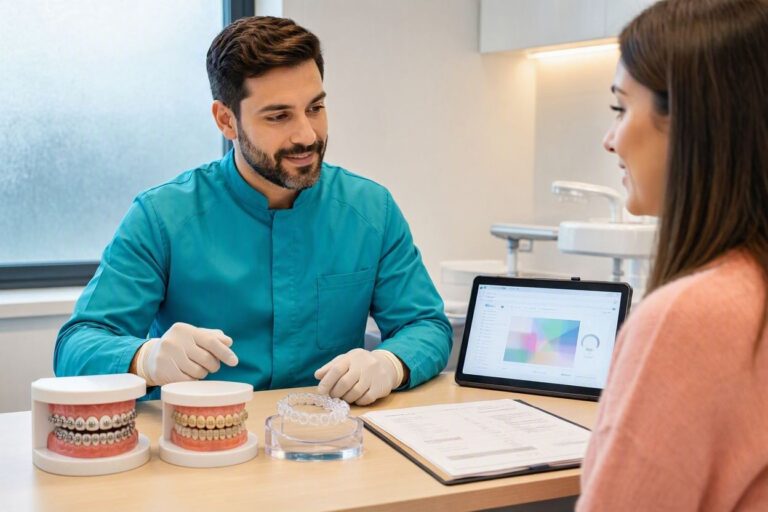
How Much Do Invisalign And Braces Cost?
If you’re thinking about straightening your teeth, you’ve probably narrowed your options down to two main choices: traditional braces or Invisalign. Both can give you a beautiful, healthy smile. But they work differently, look different, and—most importantly for many people—cost different amounts.
So, how much do Invisalign and braces actually cost? The short answer is that braces typically range from $3,000 to $6,000, while Invisalign ranges from $3,000 to $8,000. But those ranges hide a lot of variation. Where you live, the complexity of your case, and the provider you choose all play a role.
This guide will compare the costs of Invisalign and braces in detail. We’ll look at average prices, what affects them, which option is cheaper, and when one might be worth the extra money. By the end, you’ll have a clear picture of what to expect—and how to make the best choice for your smile and your wallet.

What Are Invisalign and Braces?
Before we compare costs, let’s quickly review what each option is.
Traditional Braces
Braces are fixed orthodontic devices. They consist of metal or ceramic brackets bonded to your teeth, connected by wires and bands. You wear them 24/7 for the duration of treatment. They can’t be removed except by your orthodontist.
Types of braces:
- Metal braces (most common, least expensive)
- Ceramic braces (tooth-colored, less visible)
- Lingual braces (placed behind the teeth, hidden)
- Self-ligating braces (no elastic bands)
Invisalign
Invisalign is a brand of clear aligners. They’re custom-made plastic trays that fit over your teeth. You wear each set for one to two weeks, then switch to the next set. You can remove them to eat, drink, brush, and floss.
Types of Invisalign:
- Invisalign Express (minor cases)
- Invisalign Full (moderate to complex cases)
- Invisalign Teen (for teenagers)
- Invisalign Go (for general dentists)
Both options move your teeth gradually. The end result is similar, but the journey—and the cost—can be quite different.
Average Cost Comparison: Invisalign vs. Braces
Let’s get straight to the numbers. Here’s a side-by-side comparison of average costs.
| Treatment Type | Average Cost Range (US) | Average Cost Range (UK) | Average Cost Range (Canada) |
|---|---|---|---|
| Metal Braces | $3,000 – $6,000 | £2,500 – £5,000 | CAD $4,000 – $7,000 |
| Ceramic Braces | $4,000 – $8,000 | £3,000 – £6,000 | CAD $5,000 – $8,000 |
| Lingual Braces | $5,000 – $13,000 | £4,000 – £8,000 | CAD $6,000 – $12,000 |
| Invisalign Full | $4,500 – $8,000 | £3,000 – £5,500 | CAD $5,000 – $8,500 |
| Invisalign Express | $1,500 – $3,500 | £1,500 – £3,000 | CAD $2,000 – $4,000 |
| Invisalign Teen | $4,000 – $7,500 | £3,000 – £5,000 | CAD $4,500 – $8,000 |
Note: These prices are for the full treatment, including aligners or braces, adjustments, and retainers (in most cases). Prices vary by provider and region.
Key Takeaways
- Metal braces are usually the cheapest option.
- Invisalign Full is often comparable to ceramic braces in price.
- Lingual braces are the most expensive option.
- Invisalign Express is the cheapest overall, but it only works for minor cases.
What Affects the Cost of Both Invisalign and Braces?
Several factors influence the price of both treatments. Understanding them helps you compare quotes accurately.
Case Complexity
The more complex your orthodontic issue, the more time and materials required. Complex cases cost more, regardless of which treatment you choose.
- Mild crowding or spacing: $2,500 – $4,000
- Moderate misalignment: $4,000 – $6,000
- Severe misalignment: $6,000 – $9,000+
Note: Invisalign may not be suitable for severe cases. Your orthodontist will advise you.
Geographic Location
Where you live makes a big difference. Big cities have higher overhead costs, so you’ll pay more. Rural areas are cheaper.
| Location | Metal Braces | Invisalign Full |
|---|---|---|
| New York City | $6,000 – $8,000 | $6,500 – $9,000 |
| Small town, Midwest | $3,000 – $4,500 | $3,500 – $5,500 |
| London, UK | £3,500 – £5,500 | £3,500 – £5,500 |
| Rural Canada | CAD $3,500 – $5,000 | CAD $4,000 – $6,000 |
Provider Type
- Orthodontist: Specialized training, higher fees. Usually $1,000 – $2,000 more than a general dentist.
- General Dentist: Can offer Invisalign and sometimes braces. Lower fees, but less specialized.
- Dental School: Reduced rates, supervised students. 30% – 50% savings.
Insurance Coverage
Dental insurance often covers braces and Invisalign, but coverage varies. Most plans cover 50% up to a lifetime maximum of $1,000 – $2,500.
Important: Some insurance plans exclude Invisalign or only cover it for certain cases. Always check your policy.
Treatment Duration
Longer treatment means more visits and higher costs. Braces typically take 18 – 24 months. Invisalign takes 12 – 18 months for many cases. But complex cases can take longer for both.
Retainers
Retainers are essential after treatment. Some providers include them; others charge $200 – $600 extra.
Additional Procedures
Both treatments may require extra procedures:
- Extractions: $150 – $500 per tooth
- Attachments (Invisalign): Usually included
- Palatal expander (braces): $500 – $1,500
- IPR (Invisalign): Usually included
Invisalign vs. Braces: Cost by Case Complexity
Not all orthodontic cases are the same. Here’s how costs compare based on complexity.
| Case Complexity | Metal Braces | Ceramic Braces | Invisalign |
|---|---|---|---|
| Mild | $2,500 – $4,000 | $3,500 – $5,000 | $3,000 – $5,000 |
| Moderate | $4,000 – $5,500 | $5,000 – $7,000 | $4,500 – $7,000 |
| Severe | $5,500 – $7,500 | $6,500 – $9,000 | $6,000 – $8,500 (limited) |
Note: Invisalign may not be able to treat severe cases. In those situations, braces are the better—and sometimes only—option.
Regional Cost Differences: A Closer Look
Prices vary not just by country but by region within a country. Here’s a detailed look at the United States.
| Region | Metal Braces | Invisalign Full |
|---|---|---|
| Northeast (NY, MA, CT) | $5,500 – $8,500 | $5,500 – $8,500 |
| South (TX, FL, GA) | $4,000 – $6,500 | $4,000 – $7,000 |
| Midwest (OH, IL, MI) | $3,800 – $6,000 | $3,800 – $6,500 |
| West Coast (CA, WA, OR) | $5,000 – $8,000 | $5,000 – $8,000 |
In the UK, prices are similar across regions, but London is more expensive. In Canada, Ontario and British Columbia tend to be pricier than Quebec and the Prairies.
Insurance Coverage for Invisalign and Braces
Insurance can significantly reduce your out-of-pocket costs. Here’s what you need to know.
Does Insurance Cover Braces?
Most dental insurance plans cover braces for children and sometimes adults. Coverage is usually 50% up to a lifetime maximum of $1,000 – $2,500.
Does Insurance Cover Invisalign?
Many plans now cover Invisalign, but some still exclude it. Coverage is often the same as for braces—50% up to the lifetime maximum.
How to Maximize Your Insurance Benefits
- Read your policy carefully. Look for the orthodontic section.
- Call your insurance company. Ask specific questions:
- Is Invisalign covered?
- What is my lifetime maximum?
- Do I need pre-authorization?
- Are there age limits?
- Choose an in-network provider. Out-of-network costs more.
- Use FSA or HSA funds. These accounts let you pay with pre-tax dollars.
Example: If your insurance covers $1,500 and you use FSA funds for the rest, a $5,000 treatment could cost you around $2,500 out of pocket.
Hidden Costs of Invisalign and Braces
The quoted price isn’t always the final price. Watch out for these extras.
For Braces
- Retainers: $200 – $600
- Emergency visits: $50 – $150 per visit
- Broken bracket repair: $50 – $100
- Wire replacement: $50 – $100
- Missed appointment fees: $50 – $100
For Invisalign
- Retainers: $200 – $600
- Replacement aligners: $50 – $200 per set
- Lost aligners: $50 – $200 per set
- Missed appointment fees: $50 – $100
- Post-treatment visits: Sometimes extra
Important: Always get a written treatment plan with a full cost breakdown before you start.
How to Save Money on Invisalign or Braces
You don’t have to pay full price. Here are proven strategies.
Get Multiple Quotes
Prices vary widely. Visit at least three providers and compare. Don’t just look at the price—look at what’s included.
Visit a Dental School
Dental schools offer orthodontic treatment at 30% to 50% off. Students work under supervision. It takes longer, but you save a lot.
Use Insurance
If you have dental insurance, use it. It can cover 50% of the cost.
Ask About Payment Plans
Most providers offer interest-free payment plans. You might pay $150 – $300 per month.
Use FSA or HSA Funds
These accounts let you pay with pre-tax dollars, saving you 20% – 30%.
Negotiate
Ask for discounts. Many providers offer:
- Upfront payment discount (5% – 10%)
- Family discount (10% – 20%)
- Referral bonus
- Military or veteran discount
- Seasonal promotions
Choose Metal Braces Over Ceramic
Metal braces are just as effective as ceramic and cost less. If you’re on a budget, choose metal.
Consider Invisalign Express
If your case is minor, Invisalign Express costs less. It uses fewer aligners and takes less time.
Which Is Cheaper: Invisalign or Braces?
The answer depends on your case and your provider.
- For simple cases: Invisalign Express can be cheaper than braces.
- For moderate cases: Metal braces are usually cheaper than Invisalign Full.
- For complex cases: Braces are often cheaper and more effective.
- For aesthetic concerns: Ceramic braces and Invisalign are comparable in price.
Bottom line: Metal braces are generally the cheapest option. Invisalign is often comparable to ceramic braces. Lingual braces are the most expensive.
When to Choose Invisalign vs. Braces
Cost isn’t the only factor. Here’s when each option makes sense.
Choose Invisalign If:
- Your case is mild to moderate
- You want a discreet treatment
- You’re willing to wear aligners 20 – 22 hours a day
- You prefer fewer office visits
- You want to eat whatever you want
Choose Braces If:
- Your case is complex
- You want the most effective treatment
- You don’t mind visible brackets
- You want fewer responsibilities (no need to remember to wear them)
- You want the lowest cost
Note: Your orthodontist will recommend the best option for your specific needs.
Real Quotes from Patients
“I paid $4,500 for metal braces in Texas. My sister paid $5,500 for Invisalign in California. We both got great results.” — Sarah M., Austin, TX
“I chose Invisalign because I’m a teacher and didn’t want metal braces. It cost $6,000, but it was worth it for my confidence.” — James T., London, UK
“I went to a dental school in Toronto and paid $3,200 for ceramic braces. The same treatment at a private clinic would have been $6,000.” — Priya K., Toronto, Canada
These stories show that costs vary widely, but with research, you can find a solution that fits your budget.
Frequently Asked Questions About Invisalign and Braces Costs
Are Invisalign and braces the same price?
Not always. Metal braces are usually cheaper. Invisalign is often comparable to ceramic braces.
Which is cheaper: Invisalign or metal braces?
Metal braces are generally cheaper. Invisalign can be cheaper for minor cases (Invisalign Express).
Does insurance cover Invisalign and braces?
Most dental insurance plans cover both, but coverage varies. Check your policy.
How long do I have to wear braces or Invisalign?
Braces typically take 18 – 24 months. Invisalign takes 12 – 18 months for many cases.
Can I get braces or Invisalign for under $3,000?
Yes. Dental schools, Invisalign Express, and some clinics offer treatment for $2,000 – $3,000.
Are retainers included in the price?
Not always. Some providers include them; others charge $200 – $600 extra.
Can I pay for braces or Invisalign in installments?
Yes. Most providers offer interest-free payment plans.
What if I lose my Invisalign aligners?
You’ll pay for replacements. Costs range from $50 – $200 per set.
Is Invisalign as effective as braces?
For mild to moderate cases, yes. For severe cases, braces are more effective.
Which is better for adults: Invisalign or braces?
Both work well for adults. Invisalign is more discreet; braces are more effective for complex cases.
Conclusion: Making the Right Choice for Your Smile
Invisalign and braces cost between $3,000 and $8,000, depending on the type, provider, and complexity of your case. Metal braces are usually the cheapest. Invisalign is often comparable to ceramic braces. Insurance, payment plans, and dental schools can reduce your costs. Always get multiple quotes and ask what’s included. The best choice is the one that fits your smile and your budget.
Additional Resources
For more information on orthodontic treatment and finding a qualified provider, visit the American Association of Orthodontists at aaoinfo.org or the British Orthodontic Society at bos.org.uk.