How Much Do Veneers Cost In Mexico?
Mexico has become a top destination for dental tourism. Every year, thousands of Americans and Canadians travel south of the border for dental care. Veneers are one of the most requested cosmetic treatments. But how much do they cost?
The answer ranges from $200 to $800 per tooth in Mexico. Compare that to $800 to $2,500 per tooth in the United States. The savings can be 60% to 75%. But price is not the only thing that matters. You also need to consider quality, safety, and convenience.
In this comprehensive guide, we will explore the cost of veneers in Mexico. We will look at different types of veneers, average prices by city, factors that affect costs, and tips to get the best value. By the end, you will know exactly what to expect.
Why Get Veneers In Mexico?
Mexico has a thriving dental tourism industry. Several factors make it a popular choice.
Lower Labor Costs
Dentists in Mexico charge less than their counterparts in the US and Canada. The cost of living is lower, so overhead costs are lower too.
Modern Clinics
Many dental clinics in Mexico use advanced equipment. Digital scanners, CAD/CAM technology, and modern sterilization equipment are common in major cities.
Trained Dentists
Many Mexican dentists train in the US or Europe. They hold international certifications and speak English. Some clinics cater specifically to foreign patients.
Tourism Appeal
Mexico offers beautiful beaches, rich culture, and delicious food. Patients can recover from treatment while exploring the country.
No Waiting Lists
Unlike some countries with public health systems, Mexico offers quick appointments. You can often get treatment within days.
Competitive Market
Hundreds of dental clinics compete for patients. This competition keeps prices low and quality high.
Understanding Dental Veneers
Before we discuss prices, let’s clarify what veneers are.
A dental veneer is a thin shell that covers the front of a tooth. It is custom-made to fit your tooth. It changes the color, shape, size, or length of the tooth. Veneers are usually made of porcelain or composite resin.
Veneers are used to fix:
- Discolored or stained teeth
- Chipped or broken teeth
- Worn-down teeth
- Uneven or misaligned teeth
- Gaps between teeth
- Teeth that are too small or too large
Veneers are different from crowns. A crown covers the entire tooth. A veneer only covers the front surface. This means more of your natural tooth is preserved with veneers.
Types Of Veneers Available In Mexico
Mexican clinics offer several types of veneers. Each has different costs and benefits.
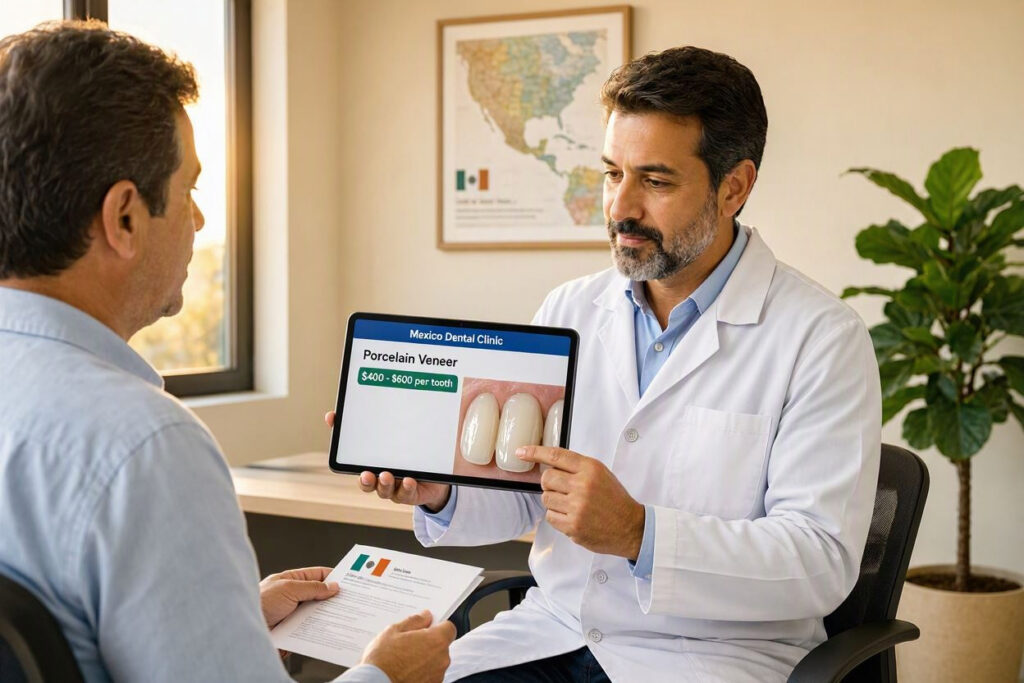
Porcelain Veneers
Porcelain veneers are the most popular type. They are made in a dental lab. They look very natural. They resist stains well. They last 10 to 15 years with good care.
Pros:
- Natural appearance
- Stain-resistant
- Durable
- Long-lasting
Cons:
- More expensive
- Requires removing some tooth enamel
- Takes multiple appointments
Typical cost: $300 – $800 per tooth
Composite Veneers
Composite veneers are made from a tooth-colored resin. They are applied directly to your teeth in one visit. They are less expensive than porcelain. However, they do not last as long and can stain over time.
Pros:
- More affordable
- Can be done in one visit
- Less tooth removal
- Easily repaired
Cons:
- Less durable
- Can stain
- Lasts 5 to 7 years
- Less natural-looking than porcelain
Typical cost: $200 – $500 per tooth
Minimal-Prep Veneers
Minimal-prep veneers are very thin. They require little or no tooth removal. Brands include Lumineers and Durathin. They are a good option for people with healthy teeth.
Pros:
- Preserves more natural tooth
- Less discomfort
- Quick treatment
Cons:
- More expensive than traditional veneers
- Not suitable for all cases
- Limited availability
Typical cost: $400 – $1,000 per tooth
Removable Veneers
Removable veneers are also called snap-on smiles. They are not permanent. You wear them over your teeth. They are cheaper than permanent veneers. However, they are not a true dental treatment. They can affect speech and eating.
Pros:
- Very affordable
- No tooth removal
- Reversible
Cons:
- Not permanent
- Can be uncomfortable
- May affect speech
- Not a substitute for real veneers
Typical cost: $300 – $1,500 for a full set
Average Cost Of Veneers In Mexico
Now, let’s get to the numbers. Here is a breakdown of typical veneer costs in Mexico.
| Veneer Type | Price Range (USD) |
|---|---|
| Porcelain veneers | $300 – $800 |
| Composite veneers | $200 – $500 |
| Minimal-prep veneers | $400 – $1,000 |
| Removable veneers (full set) | $300 – $1,500 |
Important Note: Prices vary by city, clinic, and the specific materials used. Always confirm the price before treatment.
Cost Of Veneers By City In Mexico
Prices differ across Mexico. Here is a comparison of major cities.
| City | Porcelain Veneers (USD) | Composite Veneers (USD) |
|---|---|---|
| Mexico City | $350 – $800 | $220 – $500 |
| Guadalajara | $300 – $700 | $200 – $450 |
| Monterrey | $320 – $750 | $210 – $480 |
| Tijuana | $280 – $650 | $180 – $420 |
| Cancun | $350 – $850 | $230 – $550 |
| Puerto Vallarta | $320 – $750 | $210 – $480 |
| Los Cabos | $380 – $900 | $250 – $580 |
| Merida | $280 – $650 | $180 – $420 |
| Puebla | $270 – $620 | $170 – $400 |
| Queretaro | $290 – $680 | $190 – $440 |
Note: Cancun and Los Cabos have the highest prices due to tourism. Smaller cities offer lower prices.
Cost Of Veneers In Mexico vs. Other Countries
How does Mexico compare globally? Here is a look.
| Country | Porcelain Veneers (USD) |
|---|---|
| Mexico | $300 – $800 |
| United States | $800 – $2,500 |
| Canada | $700 – $2,000 |
| United Kingdom | $600 – $1,500 |
| Australia | $800 – $2,200 |
| Costa Rica | $350 – $900 |
| Thailand | $300 – $800 |
| Vietnam | $250 – $700 |
| Philippines | $250 – $700 |
| India | $200 – $600 |
| Turkey | $250 – $700 |
| Hungary | $300 – $800 |
Key Takeaway: Mexico offers significant savings compared to the US, Canada, and Europe. Prices are similar to Costa Rica and Thailand.
What Affects The Cost Of Veneers In Mexico?
Several factors determine the final price. Let’s examine each one.
Dentist’s Experience
A cosmetic dentist with years of experience charges more. A general dentist may charge less. But experience often means better results and fewer complications.
Clinic Location
Clinics in tourist areas charge more. Clinics in local neighborhoods charge less. Malls and international clinics have higher overhead costs.
Type Of Veneer
Porcelain veneers cost more than composite. Minimal-prep veneers cost more than traditional porcelain.
Number Of Teeth
One veneer costs less than a full set. Most patients get 6 to 10 veneers. The more teeth you treat, the higher the total cost.
Case Complexity
Simple cases cost less. Complex cases with bite problems, gum disease, or significant tooth damage cost more.
Additional Procedures
Some patients need cleaning, whitening, or gum treatment first. This adds to the cost.
Lab Fees
Porcelain veneers require dental lab work. Complex cases need more lab time. This adds to the cost.
Technology
Digital scans, 3D imaging, and CAD/CAM technology improve precision. They also add to the cost.
Payment Method
Paying in full upfront may earn a discount. Payment plans may include interest or fees.
Insurance Coverage
Most dental insurance does not cover cosmetic veneers. Check your policy.
What’s Included In The Price?
Before you book, ask what the price includes. Some clinics charge separately for certain items.
Typically Included:
- Initial consultation
- Treatment planning
- Tooth preparation
- Veneer placement
- Basic follow-up
Often Not Included:
- X-rays
- Dental cleaning
- Temporary veneers
- Lab fees
- Additional procedures
- Follow-up visits beyond the basic
Important Note: A low price may not include everything. Read the fine print. Ask for a written quote.
How Long Do Veneers Last?
Veneers are a long-term investment. How long they last depends on the type and your care.
| Veneer Type | Average Lifespan |
|---|---|
| Porcelain veneers | 10 – 15 years |
| Composite veneers | 5 – 7 years |
| Minimal-prep veneers | 10 – 15 years |
Factors That Shorten Lifespan:
- Grinding or clenching teeth
- Biting nails or hard objects
- Poor oral hygiene
- Smoking
- Excessive coffee, tea, or red wine
Factors That Prolong Lifespan:
- Good oral hygiene
- Regular dental check-ups
- Wearing a night guard if you grind
- Avoiding hard foods and objects
- Regular cleanings
Tip: Ask your dentist about a night guard. It protects your veneers from grinding damage.
Is Teeth Whitening In Mexico Safe?
Safety is a top concern. Here are key points to consider.
Qualified Dentists
Choose a licensed dentist. In Mexico, dentists must graduate from an accredited dental school. They must also register with the local health authority.
Sterilization Standards
Reputable clinics follow strict sterilization protocols. They use autoclaves for instruments. They use disposable materials where needed.
Approved Products
Look for clinics that use high-quality, reputable veneer materials. Brands like Ivoclar, Vita, and Shofu are trusted.
Pre-Treatment Exam
A good dentist examines your teeth before veneers. They check for cavities, cracks, and gum disease. They also take X-rays if needed.
Realistic Expectations
No dentist can promise perfect teeth. Results vary by individual. A good dentist explains what to expect.
Important Note: Avoid cheap, unregulated veneer services. Some beauticians and non-dental providers offer veneers. These are not dentists. They may use unsafe products or improper techniques. In Mexico, only licensed dentists can legally perform veneer treatment.
How To Choose A Veneer Clinic In Mexico
With so many clinics, how do you choose? Follow these steps.
1. Research Online
Read reviews on Google, Facebook, and dental tourism websites. Look for clinics with many positive reviews.
2. Check Credentials
Visit the clinic’s website. Look for dentist profiles, certifications, and photos of the clinic.
3. Ask About Materials
Ask which veneer materials they use. Research the brands. Prefer high-quality, reputable products.
4. Request Before-And-After Photos
Legitimate clinics have photos of past patients. These show real results.
5. Visit The Clinic
If you are in Mexico, visit the clinic. Check cleanliness and organization. Meet the dentist. Ask questions.
6. Get A Written Quote
Ask for a written quote. It should list all services and costs. No hidden fees.
7. Ask About Aftercare
What happens if you have sensitivity? What if a veneer chips? A good clinic offers follow-up care.
8. Trust Your Gut
If something feels off, walk away. There are plenty of clinics to choose from.
Veneers For Tourists: What To Know
Many tourists get veneers in Mexico. Here are tips to make it smooth.
Plan Ahead
Book your appointment before you travel. Popular clinics fill up quickly.
Allow Time
Veneers take multiple appointments. Porcelain veneers take 2 to 3 weeks. Composite veneers can be done in one visit.
Avoid Staining Foods
After veneers, avoid coffee, tea, red wine, and dark sauces. This helps them stay white.
Bring Your Records
If you have dental records, bring them. They help the dentist understand your history.
Check Your Insurance
Most dental insurance does not cover cosmetic veneers. Check your policy before you travel.
Consider Travel Insurance
Travel insurance may cover complications. Read the fine print.
Combine With Other Treatments
Many tourists combine veneers with cleaning, whitening, or other treatments. This saves time and money.
Veneer Costs: What Dentists Say
We spoke with dentists in Mexico about veneer costs. Here is what they shared.
“Patients often ask for the cheapest option. But cheap veneers can look fake and fail early. It is better to invest in quality.” — Dr. Carlos Mendez, Mexico City
“We use only high-quality porcelain veneers. Our prices are higher than some clinics, but our results are natural and long-lasting.” — Dr. Maria Gonzalez, Guadalajara
“Tourists should book a consultation first. We need to check their teeth before veneers. Some patients need cleaning or gum treatment first.” — Dr. Juan Ramirez, Cancun
Important Notes For Readers
Keep these points in mind before getting veneers in Mexico.
Get a dental exam first.
Veneers are not suitable for everyone. Cavities, gum disease, and cracked teeth need treatment first.
Avoid unlicensed providers.
In Mexico, only licensed dentists can legally perform veneer treatment. Beauticians are not dentists.
Ask about tooth preparation.
Porcelain veneers usually require removing some tooth enamel. This is permanent. Ask about minimal-prep options.
Understand the commitment.
Veneers are a long-term investment. They require good oral hygiene and regular dental visits.
Results vary.
Your starting teeth, bite, and habits affect results. No two patients are the same.
Budget for maintenance.
Veneers may need repair or replacement over time. Plan for these costs.
Understand the risks.
Veneers can chip, come loose, or cause sensitivity. A good dentist minimizes these risks.
Alternatives To Veneers
If veneers are not right for you, consider these options.
Dental Bonding
Composite bonding repairs chips and discoloration. It costs $100 to $300 per tooth in Mexico. It is less expensive than veneers but does not last as long.
Teeth Whitening
Professional whitening removes stains. It costs $80 to $250 in Mexico. It does not change the shape or size of your teeth.
Crowns
Crowns cover the entire tooth. They are used for damaged or discolored teeth. They cost $250 to $800 per tooth in Mexico.
Orthodontics
Braces or clear aligners straighten teeth. They cost $1,500 to $4,000 in Mexico. They are a good option if your teeth are misaligned.
Do Nothing
Some people choose not to pursue cosmetic treatment. This is a personal decision. However, untreated dental issues may worsen over time.
Frequently Asked Questions
How much do veneers cost in Mexico?
Veneers in Mexico cost $200 to $1,000 per tooth. Porcelain veneers cost $300 to $800. Composite veneers cost $200 to $500. Minimal-prep veneers cost $400 to $1,000.
Are veneers in Mexico safe?
Yes, if you choose a reputable clinic. Licensed dentists use approved products and follow safety protocols. Avoid unlicensed providers.
How long do veneers last?
Porcelain veneers last 10 to 15 years. Composite veneers last 5 to 7 years. Good care extends their lifespan.
Are veneers painful?
The procedure is usually done with local anesthesia. You should not feel pain during treatment. Afterward, you may have some sensitivity. This usually goes away.
Can I get veneers on just one tooth?
Yes. You can get a single veneer. However, matching the color and shape to your other teeth can be challenging.
How many veneers should I get?
Most patients get 6 to 10 veneers. This covers the teeth that show when you smile. Your dentist will recommend the best number for you.
Do veneers stain?
Porcelain veneers resist stains well. Composite veneers can stain over time. Avoid coffee, tea, red wine, and smoking to keep them looking their best.
Can I whiten my teeth with veneers?
Whitening does not change the color of veneers. If you whiten your natural teeth, your veneers may no longer match. Get whitening done before veneers.
What happens if a veneer falls off?
Contact your dentist. They can reattach it. Do not try to fix it yourself.
How do I find a good veneer dentist in Mexico?
Research online. Read reviews. Check credentials. Ask about materials and aftercare. Visit the clinic if possible.
Conclusion
Veneers in Mexico cost between $200 and $1,000 per tooth, depending on the type, dentist, and location. Porcelain veneers offer the most natural look and longest lifespan. Composite veneers are more affordable but less durable. Mexico offers significant savings compared to the US and Canada. By choosing a licensed dentist, getting a dental exam first, and following aftercare instructions, you can achieve a beautiful smile safely. Always prioritize quality and safety over the lowest price.
Additional Resource
For more information on veneers and dental care in Mexico, visit:
- Mexican Dental Association: https://www.adm.org.mx
- American Dental Association: https://www.ada.org
- World Dental Federation: https://www.fdiworlddental.org