How Much Does A Bottom Brace Set Cost?
A Complete Guide to Lower Braces Prices and What to Expect
So you need braces on your bottom teeth.
Maybe your upper teeth look fine, but your lower teeth are crowded. Perhaps you have a crossbite or an underbite that affects only the bottom arch. You might have had braces before, and your lower teeth shifted back. Or your dentist just told you that you need a bottom brace set to correct your bite.
Whatever the reason, you’re probably wondering: How much does a bottom brace set cost?
The answer isn’t as simple as you might hope. Braces are priced in different ways. Some orthodontists charge one fee for both arches. Others charge separately for upper and lower. Some charge by the number of brackets. And the type of braces you choose—metal, ceramic, lingual, or clear aligners—affects the price significantly.
In this comprehensive guide, we’ll break down everything you need to know about bottom brace set costs. We’ll look at real prices, explain what affects costs, compare options, and help you make an informed decision. We’ll also cover insurance, payment plans, and what to expect during treatment.
What Is a Bottom Brace Set?
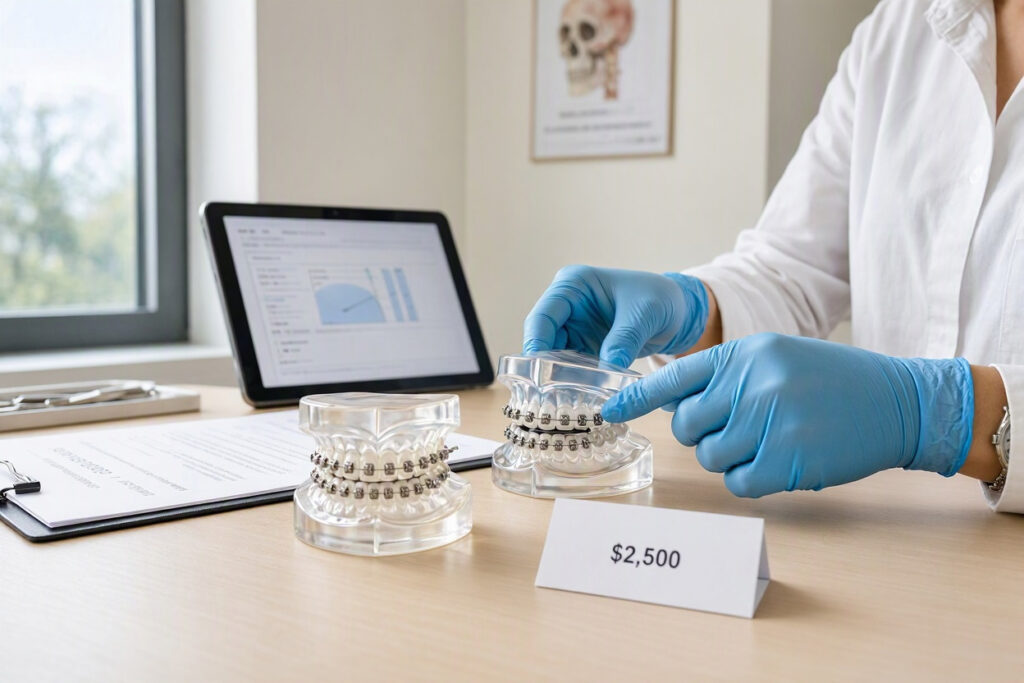
A bottom brace set is simply the braces that go on your lower teeth. It includes:
- Brackets: The small squares attached to each tooth.
- Archwire: The wire that runs through the brackets.
- Bands: Metal rings that go around your back teeth (sometimes).
- Ligatures: The tiny rubber bands or wires that hold the archwire in place.
When you get braces on both upper and lower teeth, it’s called a full set. When you get only the bottom, it’s a bottom brace set. When you get only the top, it’s a top brace set.
Why Would You Need Braces on Only the Bottom?
Many people assume braces are always for both arches. But sometimes, only one arch needs correction.
Common reasons for bottom-only braces:
- Lower crowding: Your bottom teeth are crowded, but your top teeth are fine.
- Lower spacing: You have gaps between your bottom teeth.
- Crossbite: Your lower teeth bite outside your upper teeth on one or both sides.
- Underbite: Your lower jaw protrudes, and only the bottom teeth need alignment.
- Relapse: You had braces before, and your lower teeth shifted back.
- Budget: You can’t afford full braces, so you start with the bottom.
In some cases, treating only one arch can cause problems. Your bite might not align properly. That’s why it’s important to see an orthodontist, not just a general dentist. They’ll tell you if bottom-only braces are a good idea.
As one orthodontist explains, “Treating only one arch is sometimes appropriate. But often, both arches need to work together to achieve a stable, functional bite. We always evaluate the whole mouth, not just the teeth that bother you.”
The Big Question: How Much Does a Bottom Brace Set Cost?
Now let’s get to the numbers. The cost of a bottom brace set varies depending on the type of braces, your location, the orthodontist’s experience, and the complexity of your case.
Here are typical price ranges in the United States:
| Type of Braces | Low End | Average | High End |
|---|---|---|---|
| Metal Braces (Bottom Only) | $1,500 | $2,500-$3,500 | $5,000 |
| Ceramic Braces (Bottom Only) | $2,000 | $3,000-$4,500 | $6,000 |
| Lingual Braces (Bottom Only) | $3,000 | $5,000-$7,000 | $10,000 |
| Clear Aligners (Bottom Only) | $1,500 | $2,500-$4,000 | $5,500 |
These prices usually include:
- Consultation and examination
- X-rays and impressions
- Brackets and wires
- Monthly adjustment visits
- Retainers (sometimes)
- Removal of braces
Some orthodontists charge separately for each component. Always ask for a written treatment plan with itemized costs.
What About Full Braces?
For comparison, full braces (both arches) cost:
| Type of Braces | Low End | Average | High End |
|---|---|---|---|
| Metal Braces (Full) | $3,000 | $5,000-$6,500 | $8,000 |
| Ceramic Braces (Full) | $4,000 | $6,000-$8,000 | $10,000 |
| Lingual Braces (Full) | $6,000 | $8,000-$12,000 | $15,000 |
| Clear Aligners (Full) | $3,000 | $5,000-$7,000 | $9,000 |
As you can see, bottom-only braces cost roughly 50-60% of full braces. That makes sense—you’re treating half the teeth.
What About the UK?
In the UK, bottom brace set costs range from £1,000 to £3,500 for private treatment. NHS braces are available for children under 18 who meet certain criteria, but adults usually pay privately.
| Type | UK Price Range |
|---|---|
| Metal Braces (Bottom Only) | £1,000 – £2,500 |
| Ceramic Braces (Bottom Only) | £1,500 – £3,000 |
| Lingual Braces (Bottom Only) | £2,500 – £5,000 |
| Clear Aligners (Bottom Only) | £1,200 – £2,800 |
What About Canada?
In Canada, expect to pay between CAD 1,800 and CAD 5,000 for bottom-only braces.
| Type | Canada Price Range |
|---|---|
| Metal Braces (Bottom Only) | CAD 1,800 – CAD 3,500 |
| Ceramic Braces (Bottom Only) | CAD 2,500 – CAD 4,500 |
| Lingual Braces (Bottom Only) | CAD 4,000 – CAD 7,000 |
| Clear Aligners (Bottom Only) | CAD 2,000 – CAD 4,000 |
What About Australia?
Australian prices are similar to Canada.
| Type | Australia Price Range |
|---|---|
| Metal Braces (Bottom Only) | AUD 2,000 – AUD 4,000 |
| Ceramic Braces (Bottom Only) | AUD 2,800 – AUD 5,000 |
| Lingual Braces (Bottom Only) | AUD 4,500 – AUD 8,000 |
| Clear Aligners (Bottom Only) | AUD 2,200 – AUD 4,500 |
What Affects the Cost of a Bottom Brace Set?
Many factors influence what you’ll pay. Let’s look at the most important ones.
1. Type of Braces
This is the biggest factor.
- Metal braces: cheapest
- Ceramic braces: mid-range
- Clear aligners: mid-range to high
- Lingual braces: most expensive
2. Orthodontist’s Experience
A board-certified orthodontist charges more than a general dentist. But experience matters. Orthodontics is a specialty. You want someone who does this every day.
3. Your Location
Prices vary by city and region.
| Region | Average Cost (Metal, Bottom Only) |
|---|---|
| Northeast US | $3,000 – $5,000 |
| West Coast | $2,800 – $4,500 |
| Midwest | $2,000 – $3,500 |
| South | $1,800 – $3,000 |
| Rural areas | $1,500 – $2,800 |
4. Complexity of Your Case
A simple case of minor crowding costs less than a complex case involving bite correction. The more work required, the higher the cost.
5. Treatment Duration
Most bottom brace treatments take 6-18 months. Longer treatment means more adjustment visits, which can increase the cost.
6. Additional Procedures
You may need:
- Extractions: $150 – $500 per tooth
- Palatal expander: $1,000 – $2,000
- Rubber bands: usually included
- Retainers: $200 – $500
These add to the total cost.
7. Payment Method
Some orthodontists offer discounts for full upfront payment. Others charge more for monthly payment plans.
8. Insurance Coverage
If you have orthodontic insurance, it may cover a portion of the cost. But coverage varies.
Types of Braces for the Bottom Arch
Let’s look at each type in detail.
Metal Braces
Metal braces are the traditional option. They’re made of stainless steel. They’re strong, effective, and the most affordable.
Cost: $1,500 – $5,000
Pros:
- Most affordable
- Very effective
- Durable
- Smallest brackets available
Cons:
- Most visible
- Can irritate cheeks and lips
Ceramic Braces
Ceramic braces are made of tooth-colored material. They blend in with your teeth, making them less noticeable than metal.
Cost: $2,000 – $6,000
Pros:
- Less visible than metal
- Effective
- Good for adults
Cons:
- More expensive than metal
- Can stain if you drink coffee or smoke
- Slightly larger than metal brackets
Lingual Braces
Lingual braces go behind your teeth. They’re completely hidden from view.
Cost: $3,000 – $10,000
Pros:
- Completely invisible
- Effective
- Custom-made
Cons:
- Most expensive
- Can affect speech
- Harder to clean
- Not suitable for everyone
Clear Aligners
Clear aligners (like Invisalign) are removable trays that straighten your teeth gradually. They’re not technically braces, but they’re a popular alternative.
Cost: $1,500 – $5,500
Pros:
- Nearly invisible
- Removable
- Comfortable
- Easy to clean
Cons:
- Requires discipline (you must wear them 20-22 hours per day)
- Not suitable for complex cases
- Can be more expensive than metal braces
Bottom-Only vs Full Braces: Which Is Right for You?
This is a decision you should make with your orthodontist. Here are some considerations.
| Factor | Bottom-Only | Full Braces |
|---|---|---|
| Cost | 50-60% of full | Full price |
| Treatment Time | Shorter | Longer |
| Bite Correction | Limited | Comprehensive |
| Stability | May relapse | More stable |
| Appearance | Only bottom visible | Both arches visible |
| Best For | Minor lower crowding | Complex bite issues |
As one orthodontist notes, “Bottom-only braces can work for simple cases. But if your bite is off, treating only one arch can cause problems down the road. We always look at the big picture.”
Does Insurance Cover a Bottom Brace Set?
Orthodontic insurance works differently from regular dental insurance. Let’s break it down.
Dental Insurance
Most dental insurance plans have an annual maximum (e.g., $1,000-$2,000). Orthodontic coverage is often separate. It may have a lifetime maximum (e.g., $1,000-$2,000).
Some plans cover 50% of orthodontic costs. Others cover a fixed amount. Some plans don’t cover orthodontics at all.
Orthodontic Insurance
Some insurers offer specific orthodontic coverage. You may need to add it as a rider to your dental plan. It typically covers:
- 50% of treatment cost
- Up to a lifetime maximum
- For children and adults
Medicaid
Medicaid coverage for orthodontics varies by state. Some states cover braces for children with severe malocclusion. Most do not cover braces for adults.
What If You Don’t Have Insurance?
You’ll pay the full cost. But many orthodontists offer payment plans. You can spread the cost over the treatment period, usually 12-24 months.
Payment Plans
Most orthodontists offer in-house financing. You pay a down payment, then monthly installments. Some plans are interest-free.
Example:
- Total cost: $3,000
- Down payment: $500
- Monthly payment: $150 for 16 months
Health Savings Account (HSA)
If you have an HSA or FSA, you can use pre-tax dollars for braces. This effectively reduces your cost by your tax rate.
How to Save on a Bottom Brace Set
You don’t have to pay full price. Here are practical ways to reduce your costs.
1. Get Multiple Quotes
Prices vary. Get at least three quotes before deciding.
2. Consider a Dental School
Dental schools offer discounted orthodontic treatment. Students perform the work under supervision. Savings can be 30-50%.
3. Ask About Payment Plans
Most orthodontists offer in-house financing. Ask about interest-free options.
4. Choose Metal Braces
Metal braces are the cheapest option. They’re not as pretty, but they work just as well.
5. Use an HSA or FSA
If you have a Health Savings Account or Flexible Spending Account, you can use pre-tax dollars.
6. Negotiate
It never hurts to ask. Some orthodontists offer discounts for upfront payment or for multiple family members.
7. Time It Right
If you have insurance with a lifetime maximum, use it before the year ends.
8. Consider Clear Aligners
If you’re a good candidate, clear aligners may be cheaper than lingual braces. They’re also removable, which makes cleaning easier.
9. Look for Promotions
Some orthodontists offer promotions or discounts. Ask about them.
10. Prevent Problems
The best way to save is to avoid needing braces in the first place. But if you already need them, don’t delay. Problems can get worse over time.
The Process: What to Expect When Getting Bottom Braces
Understanding the process helps you plan and budget.
Step 1: Consultation
Your orthodontist examines your teeth. They take X-rays and impressions. You’ll discuss treatment options and costs.
Time: 30-60 minutes
Step 2: Treatment Plan
Your orthodontist creates a custom treatment plan. This includes the type of braces, the expected duration, and the cost.
Time: 1-2 weeks
Step 3: Banding Appointment
The brackets are attached to your teeth. This takes 1-2 hours. You may feel some pressure, but it’s not painful.
Time: 1-2 hours
Step 4: Adjustment Visits
You’ll visit the orthodontist every 4-8 weeks. They’ll adjust the wire and check your progress.
Time: 15-30 minutes per visit
Step 5: Removal
When treatment is complete, the braces are removed. Your teeth are polished to remove any adhesive.
Time: 30-60 minutes
Step 6: Retainers
You’ll receive retainers to wear at night. This prevents your teeth from shifting back.
Time: 1-2 weeks
Total Timeline
Bottom braces typically take 6-18 months. Some cases are faster. Complex cases take longer.
Important Notes for Readers
See an Orthodontist: General dentists can do braces, but orthodontists are specialists. They have 2-3 years of additional training.
Ask About Retention: Braces are only half the battle. Retainers are essential to maintain your results.
Follow Instructions: Wear your rubber bands as directed. Keep your adjustment appointments. Poor compliance can lengthen treatment.
Maintain Good Oral Hygiene: Braces make cleaning harder. Brush after every meal. Use interdental brushes and floss threaders.
Avoid Hard Foods: Don’t chew ice, hard candy, or nuts. They can break your brackets.
Be Patient: Orthodontics takes time. Don’t rush the process.
Ask About Guarantees: Some orthodontists offer guarantees. Ask what’s covered.
Consider the Long Term: Braces are an investment. The results can last a lifetime if you wear your retainers.
Frequently Asked Questions
How much does a bottom brace set cost?
A bottom brace set costs between $1,500 and $5,000, depending on the type of braces, your location, and the orthodontist’s experience. Metal braces average $2,500 to $3,500.
Can I get braces on just my bottom teeth?
Yes. Bottom-only braces are common for minor crowding or spacing issues. However, your orthodontist will evaluate your whole bite to make sure it’s appropriate.
Is it cheaper to get braces on just the bottom?
Yes. Bottom-only braces cost about 50-60% of full braces.
How long do bottom braces take?
Most bottom brace treatments take 6-18 months. Simple cases may take less time. Complex cases take longer.
Does insurance cover bottom braces?
Orthodontic insurance may cover 50% of the cost, up to a lifetime maximum. Coverage varies. Check your policy.
Can I get clear aligners instead of braces on the bottom?
Yes. Clear aligners like Invisalign can treat many bottom-only cases. They cost $1,500 to $5,500.
Are lingual braces available for the bottom arch?
Yes. Lingual braces go behind your teeth. They’re the most expensive option.
Do bottom braces hurt?
You may feel some soreness after each adjustment. This usually lasts a few days. Over-the-counter pain relievers can help.
How do I clean my bottom braces?
Brush after every meal. Use a soft toothbrush and fluoride toothpaste. Use interdental brushes to clean around the brackets. Floss with a floss threader.
What happens if I don’t wear my retainer?
Your teeth can shift back. This is called relapse. You may need braces again to correct it.
Can adults get bottom braces?
Yes. Adults can get braces at any age. More adults than ever are getting orthodontic treatment.
How do I find a good orthodontist?
Look for board certification, years of experience, positive patient reviews, and before-and-after photos. Ask about their treatment approach and pricing.
What if I can’t afford bottom braces?
Consider dental schools, payment plans, or choosing metal braces instead of ceramic or lingual. Some orthodontists offer discounts.
Are bottom braces worth it?
If your lower teeth are crowded, spaced, or misaligned, braces can improve your smile and your bite. They can also make cleaning easier and reduce the risk of gum disease.
Conclusion
A bottom brace set costs between $1,500 and $5,000, with metal braces averaging $2,500 to $3,500. The final price depends on the type of braces, your location, your orthodontist’s experience, and the complexity of your case. Bottom-only braces cost about half of full braces. Insurance may cover a portion, and payment plans can make treatment more affordable. With proper care and retention, bottom braces can give you a healthy, confident smile for years to come.
Additional Resources
For more information on orthodontics and braces, visit the American Association of Orthodontists at aaoinfo.org.