How Much Does It Cost To Be A Dentist?
Becoming a dentist is a dream for many people. It offers a stable career, a good income, and the chance to help people every day. But the path to becoming a dentist is long, challenging, and expensive. Before you can hang your shingle and start treating patients, you need to invest years of your life and tens or even hundreds of thousands of dollars in your education.
If you are considering a career in dentistry, one of the first questions you probably have is: how much does it actually cost to become a dentist? The answer is not simple. It depends on where you study, whether you attend a public or private school, and how much you spend on living expenses. Some dentists graduate with manageable debt. Others owe more than a house mortgage.
This guide will break down the real costs of becoming a dentist. We will look at undergraduate costs, dental school tuition, fees, living expenses, and the cost of setting up a practice. We will also explore financing options and help you understand whether the investment is worth it. By the end, you should have a clear picture of the financial journey ahead.
The Path To Becoming A Dentist
Before we talk about money, let us review the steps to becoming a dentist. This helps you understand where the costs come from.
Step 1: Undergraduate Degree
In most countries, you need a bachelor’s degree before you can apply to dental school. Some students choose pre-dental or biology majors, but any major is acceptable as long as you complete the required science courses.
Typical duration: 3 to 4 years
Step 2: Dental School
Dental school is where you earn your dental degree. In the United States, it is a four-year program that leads to a Doctor of Dental Surgery (DDS) or Doctor of Dental Medicine (DMD). In other countries, the structure varies.
Typical duration: 4 to 5 years
Step 3: Licensure
After dental school, you must pass licensing exams to practice. In the US, this includes the National Board Dental Examinations and a clinical exam. There are fees for these exams.
Step 4: Residency (Optional)
Some dentists choose to specialize. This requires additional training, which can last 1 to 6 years, depending on the specialty. Specialists often earn more but also pay more for their education.
The Cost Of Undergraduate Education
The first expense is your undergraduate degree. If you attend a public university in your home state, tuition can be relatively affordable. Private universities cost more.
Here are average undergraduate tuition costs in the US:
| Type Of Institution | Average Annual Tuition (USD) |
|---|---|
| Public in-state | $10,000 – $15,000 |
| Public out-of-state | $20,000 – $35,000 |
| Private | $35,000 – $55,000 |
Add living expenses, books, and supplies, and the total cost of a four-year degree can range from $60,000 to $250,000 or more.
Many students take out loans to pay for undergraduate education. This debt adds up before they even start dental school.
The Cost Of Dental School
Dental school is the biggest expense. Tuition varies widely depending on the school and whether you are a resident or non-resident.
United States
In the US, dental school tuition ranges from $30,000 to $80,000 per year. Private schools are at the higher end. Public schools are cheaper for in-state residents.
Here is a breakdown:
| Type Of School | Average Annual Tuition (USD) |
|---|---|
| Public in-state | $30,000 – $50,000 |
| Public out-of-state | $50,000 – $70,000 |
| Private | $60,000 – $80,000+ |
Over four years, tuition alone can cost $120,000 to $320,000.
Canada
Canadian dental schools are cheaper than US schools, especially for residents.
| Type Of School | Average Annual Tuition (CAD) |
|---|---|
| Public (resident) | $20,000 – $35,000 |
| Public (non-resident) | $50,000 – $70,000 |
United Kingdom
In the UK, dental degrees are undergraduate programs, usually five years long. Tuition for home students is capped at £9,250 per year. International students pay £20,000 to £40,000 per year.
Australia
Australian dental schools charge domestic students around $10,000 to $15,000 AUD per year. International students pay $50,000 to $70,000 AUD per year.
Other Countries
Costs vary widely. In India, dental school can cost $5,000 to $20,000 per year. In the Philippines, it can cost ₱100,000 to ₱250,000 per year.
Additional Dental School Costs
Tuition is not the only expense. Dental students also pay for:
- Fees: Lab fees, technology fees, student services. $1,000 – $5,000 per year.
- Instruments and supplies: Dental students must buy their own instruments. $3,000 – $10,000 in the first year.
- Textbooks: $500 – $1,500 per year.
- Living expenses: Rent, food, transportation. $15,000 – $30,000 per year.
- Licensing exam fees: $1,000 – $5,000 total.
- Travel for interviews: $1,000 – $3,000.
These add up quickly. Over four years, additional costs can total $80,000 to $150,000.
Total Cost Of Becoming A Dentist
Let us put it all together. Here is an estimate of the total cost of becoming a dentist in the US.
| Expense | Estimated Total (USD) |
|---|---|
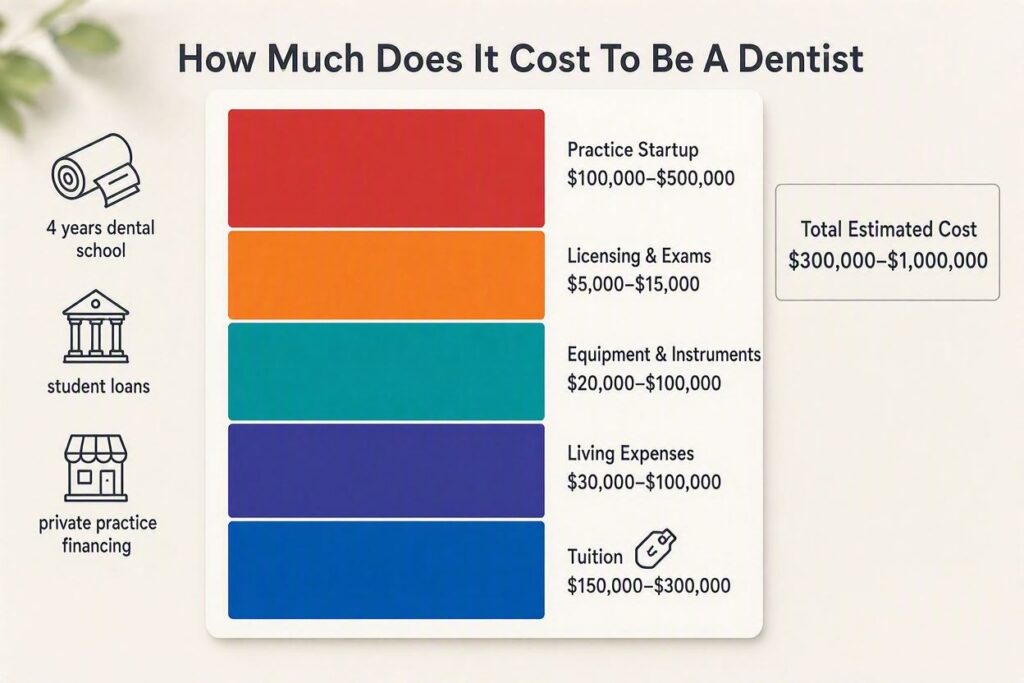
| Undergraduate degree | $60,000 – $250,000 |
| Dental school tuition (4 years) | $120,000 – $320,000 |
| Additional dental school costs | $80,000 – $150,000 |
| Licensing exams | $1,000 – $5,000 |
| Total | $261,000 – $725,000 |
In Canada, the total is lower, around $150,000 to $300,000. In the UK, it is around £50,000 to £100,000 for home students. In Australia, it is around $100,000 to $200,000 AUD for domestic students.
These numbers are staggering. Many dental graduates finish school with $200,000 to $500,000 in debt.
Comparative Table: Cost Of Dental Education By Country
| Country | Estimated Total Cost (Local Currency) | Approx. USD |
|---|---|---|
| United States | $261,000 – $725,000 | $261,000 – $725,000 |
| Canada | $150,000 – $300,000 CAD | $110,000 – $220,000 |
| United Kingdom | £50,000 – £100,000 | $65,000 – $130,000 |
| Australia | $100,000 – $200,000 AUD | $70,000 – $140,000 |
| Ireland | €60,000 – €120,000 | $65,000 – $130,000 |
| Germany | €0 – €30,000 | $0 – $33,000 |
| France | €0 – €20,000 | $0 – $22,000 |
| India | ₹20,00,000 – ₹80,00,000 | $25,000 – $100,000 |
| Philippines | ₱500,000 – ₱1,500,000 | $10,000 – $30,000 |
Note: In some countries, like Germany and France, public university tuition is very low or free, but living costs still apply.
The Cost Of Setting Up A Dental Practice
Becoming a dentist is not just about education. If you want to open your own practice, you need to invest in equipment, office space, and staff.
Here are typical startup costs for a new dental practice in the US:
| Expense | Estimated Cost (USD) |
|---|---|
| Dental chairs and equipment | $100,000 – $300,000 |
| Office build-out | $50,000 – $200,000 |
| Imaging equipment (X-rays, CBCT) | $30,000 – $150,000 |
| Computers and software | $10,000 – $30,000 |
| Furniture and fixtures | $10,000 – $50,000 |
| Initial inventory | $5,000 – $20,000 |
| Marketing | $5,000 – $20,000 |
| Working capital | $20,000 – $50,000 |
| Total | $230,000 – $820,000 |
Alternatively, many dentists buy an existing practice. The cost depends on the location and patient base. It can range from $200,000 to $1,000,000 or more.
Some dentists choose to work as associates for a few years before opening their own practice. This allows them to save money and gain experience.
How Do Dentists Pay For Their Education?
Most dental students rely on a combination of loans, scholarships, and family support.
1. Student Loans
In the US, dental students can take out federal student loans and private loans. Federal loans have fixed interest rates and income-driven repayment plans. Private loans often have higher interest rates.
The average dental school graduate owes around $300,000 in student loans. Some owe much more.
2. Scholarships And Grants
Scholarships and grants do not need to be repaid. They are available from dental schools, professional organizations, and private foundations. They are competitive but worth applying for.
3. Military Programs
The US military offers scholarships that cover tuition and living expenses in exchange for a commitment to serve. This is a popular option for students who want to avoid debt.
4. Loan Repayment Programs
Some government programs offer loan repayment in exchange for working in underserved areas. These can help reduce debt after graduation.
5. Family Support
Some students receive financial help from their families. This reduces the amount they need to borrow.
Is Becoming A Dentist Worth The Cost?
This is a personal question. The answer depends on your goals, your financial situation, and your willingness to take on debt.
Pros:
- High earning potential. Dentists in the US earn an average of $150,000 to $250,000 per year.
- Job security. Dental care is always in demand.
- Flexible schedule. Many dentists work 4 days a week.
- Rewarding work. You help people and improve their health.
Cons:
- High debt. Many dentists owe $200,000 to $500,000.
- Long education. It takes 8 years or more after high school.
- Stressful work. Dentistry is physically and mentally demanding.
- Business challenges. If you own a practice, you also manage staff, finances, and marketing.
For many dentists, the benefits outweigh the costs. But it is important to go in with your eyes open. Speak to practicing dentists. Ask them about their debt, their income, and their quality of life. Make an informed decision.
Quotations From Dental Professionals
“Dentistry has been very good to me. I love my work and I earn a good living. But I graduated with $250,000 in debt. It took me 10 years to pay it off. I would do it again, but I wish I had understood the financial side better.”
— Dr. Michael Ross, General Dentist
“The cost of dental school is scary. But if you are passionate about dentistry, there are ways to manage it. Look for scholarships, consider military programs, and live frugally during school.”
— Dr. Sarah Mitchell, Orthodontist
“I always tell young people to shadow a dentist before they commit. It is a great career, but it is not for everyone. Make sure you know what you are getting into.”
— Dr. James Carter, Prosthodontist
Important Notes For Readers
- Costs in this article are estimates. Actual costs vary by school, location, and personal circumstances.
- Dental education is expensive. Plan your finances carefully before you commit.
- Explore all financing options: scholarships, grants, military programs, and loan repayment programs.
- Consider attending a public dental school in your home state or country to reduce costs.
- Do not forget about living expenses. They add up quickly.
- If you plan to open your own practice, budget for startup costs.
- Speak to practicing dentists about their experiences. They can give you realistic advice.
FAQ
1. How much does it cost to become a dentist?
In the US, the total cost can range from $261,000 to $725,000. In other countries, it is often lower.
2. How long does it take to become a dentist?
It takes 3 to 4 years of undergraduate study, plus 4 years of dental school. Specialists need additional training.
3. Do dentists graduate with a lot of debt?
Yes. The average dental school graduate in the US owes around $300,000. Some owe much more.
4. Are there scholarships for dental students?
Yes. Dental schools, professional organizations, and private foundations offer scholarships. Military programs are also an option.
5. Can I become a dentist without going into debt?
It is possible but difficult. Some students receive full scholarships or have family support. Others attend cheaper schools in their home country.
6. How much do dentists earn?
In the US, dentists earn an average of $150,000 to $250,000 per year. Specialists can earn more.
7. Is dental school harder than medical school?
Both are challenging. Dental students take many of the same science courses as medical students, plus hands-on clinical training.
8. What is the cheapest country to study dentistry?
Countries with low or free tuition, like Germany, France, and some Nordic countries, are the cheapest. However, living costs still apply.
9. Can I work while in dental school?
It is difficult. Dental school is very demanding. Some students work part-time, but it is not recommended.
10. Is becoming a dentist worth it?
For many people, yes. It offers a good income, job security, and the chance to help others. But it requires a significant financial investment.
Additional Resource
For more information on dental education and careers, visit the American Dental Education Association:
https://www.adea.org
Conclusion
Becoming a dentist costs between $261,000 and $725,000 in the US, depending on the school and your living expenses. Most students rely on loans, scholarships, and family support. While the investment is significant, dentistry offers a rewarding career with high earning potential. With careful planning, you can manage the costs and achieve your dream.