How Much Does The NHS Cost For Braces?
Navigating the world of orthodontics can feel like trying to solve a puzzle without all the pieces, especially when you are worried about the price tag. If you live in the United Kingdom, you have likely asked yourself, “How much does the NHS cost for braces?” It is a common question, and the answer is one of the few pleasant financial surprises in the world of healthcare.
Unlike private clinics, where prices can skyrocket into the thousands, the NHS operates on a banded system. This means that for many people, the cost is fixed and significantly lower. However, the low price comes with a trade-off: strict eligibility rules and potential waiting lists.
In this comprehensive guide, we will break down exactly what you can expect to pay, who qualifies for treatment, and how the system works. Whether you are a parent looking to get your child braces or an adult wondering if you can still get them on the NHS, this article has you covered.
The Short Answer: The Current NHS Band 3 Charge
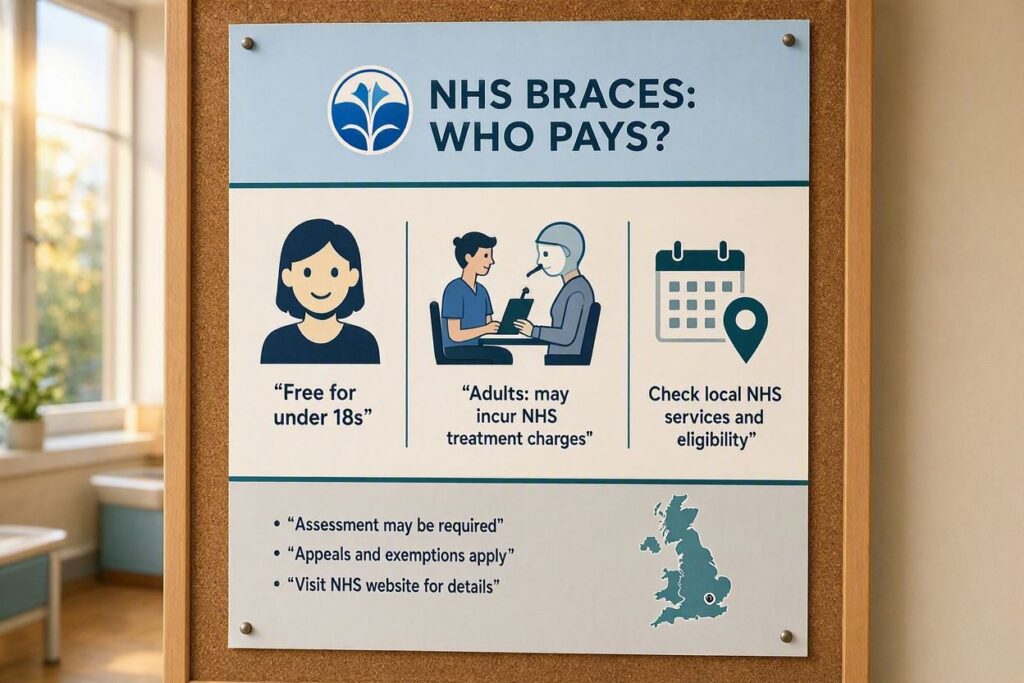
If you qualify for NHS orthodontic treatment, you will pay the Band 3 charge. As of the most recent updates for England, this fee is £306.80. This covers the entire course of treatment, including retainers, provided you start and finish the treatment. It does not matter if your treatment takes six months or three years; the price remains the same.
However, there are exceptions. You might pay nothing at all if you fall into certain categories, such as being under 18 and in full-time education.
Let’s dive deep into the details so you know exactly where you stand.
Understanding The NHS Dental Charge Bands
To understand why braces cost what they do, you need to understand how NHS dentistry is structured. The NHS divides dental treatments into three bands:
- Band 1: Covers examinations, diagnosis, and advice. (Approx. £26.80)
- Band 2: Covers everything in Band 1, plus fillings, root canals, and extractions. (Approx. £73.50)
- Band 3: Covers everything in Bands 1 and 2, plus more complex procedures like crowns, bridges, and orthodontics (braces) . (Approx. £306.80)
When you get braces on the NHS, you are paying the Band 3 charge. This is a flat fee. It doesn’t matter if you need a simple retainer or complex jaw realignment surgery combined with braces; the cost to the patient remains at the Band 3 level.
Note: These prices apply to England. Scotland, Wales, and Northern Ireland have slightly different pricing structures, which we will explore later in this article.
Who Is Eligible For NHS Braces?
This is the most critical part of the puzzle. The NHS does not provide braces for cosmetic reasons alone. They are provided for “dental health” reasons. The National Institute for Health and Care Excellence (NICE) sets the guidelines for who qualifies.
To get NHS braces, your teeth usually need to be severely misaligned. The NHS uses a scoring system called the Index of Orthodontic Treatment Need (IOTN) .
The IOTN Scoring System
The IOTN scores the severity of your teeth from 1 to 5.
- Grade 1: Almost perfect teeth. (No treatment needed)
- Grade 2: Minor misalignment. (Treatment is considered cosmetic)
- Grade 3: Moderate misalignment. (Treatment is borderline)
- Grade 4: Severe misalignment. (Treatment is needed for health)
- Grade 5: Very severe misalignment. (Treatment is urgently needed)
Generally, to qualify for NHS braces, you need a score of 4 or 5. Sometimes, a score of 3 can qualify if there is a specific functional issue, such as an overjet that makes you prone to injury or a crossbite that affects eating.
Age Restrictions
Age plays a massive role in eligibility.
- Under 18: If you are under 18 and your teeth are bad enough (Grade 4 or 5), you are entitled to free treatment on the NHS.
- Over 18: This is where it gets tricky. While adults can get braces on the NHS, it is very rare. The NHS prioritizes children because their jaws are still growing, making treatment easier and faster. Most adults are told they must go private.
How Much Does It Cost for Children?
For children under 18, the cost is usually £0.00.
Wait, isn’t there a charge? The Band 3 charge (£306.80) applies to adults. However, children who are under 18 and in full-time education are exempt from NHS dental charges. This means if your child qualifies for braces, the treatment is free.
How Much Does It Cost for Adults?
If you are over 18, you will likely have to pay the Band 3 charge of £306.80. This is still a massive saving compared to private treatment, which can cost between £2,000 and £5,000.
However, adults rarely qualify for NHS braces unless their case is severe. If you are an adult with mild crowding and you want straight teeth, the NHS will likely reject your application, and you will have to pay privately.
The Hidden Cost: Waiting Lists
The financial cost is low, but the “time cost” can be high. NHS orthodontic waiting lists are notoriously long. In some parts of the UK, the wait for an initial consultation can be months, and the wait to actually start treatment can be a year or more.
Why are the waits so long?
There are fewer NHS orthodontists than private ones. The demand is high, and the funding is limited. When you go private, you are paying for speed and convenience. When you go NHS, you are paying (a little) for patience.
NHS Braces Cost in Scotland
The system in Scotland works slightly differently. NHS Scotland has a different fee structure. While children under 18 are still entitled to free treatment, the banding system for adults differs.
- Scotland: Treatment costs are banded from 1 to 3, but the maximum cost for Band 3 is significantly lower than in England. As of recent guidelines, the Band 3 fee in Scotland is approximately £384.00.
- Exemptions: If you are under 18, or under 26 and in full-time education, you get free treatment.
NHS Braces Cost in Wales
Wales operates on a flat fee system for NHS dental treatment.
- Wales: The charge for a complex treatment like braces is usually a flat fee of roughly £30.00 (this figure is subject to change, but historically it has been much lower than England). It is essentially a nominal charge.
- Exemptions: Same as England; under 18s and those in full-time education get it free.
NHS Braces Cost in Northern Ireland
Northern Ireland uses a banded system similar to England, but the prices are lower.
- Northern Ireland: The Band 3 charge is approximately £106.80.
- Exemptions: Free for under 18s and students under 19.
Comparison Table: NHS vs. Private Costs
To give you a clear picture, here is a comparison of what you might pay for standard metal braces.
| Feature | NHS (Band 3) | Private Orthodontist |
|---|---|---|
| Average Cost | £306.80 | £2,000 – £5,500 |
| Eligibility | Strict (IOTN 4/5 only) | Anyone (Cosmetic or Health) |
| Waiting Time | 6 – 24+ months | Immediate to 2 weeks |
| Choice of Brace | Limited (Usually Metal) | Full (Ceramic, Lingual, Invisalign) |
| Retainers | Included in Band 3 fee | Usually extra (£100 – £300) |
| Missed Appointments | Can be discharged/fined | Flexible, but charges apply |
What Does the NHS Band 3 Charge Cover?
When you pay that £306.80, you are not just paying for the brackets and wires. The fee covers:
- Initial Assessment: X-rays, molds, and photographs.
- The Braces: The actual appliance fitted to your teeth.
- Adjustments: All the monthly visits to tighten the braces.
- Removal: Taking the braces off at the end.
- Retainers: The plastic or wire devices you wear after treatment to keep teeth straight.
- Follow-up: Any check-ups immediately following the removal.
It is a comprehensive fee. You do not pay per visit. You pay once, and the treatment runs its course.
What If I Miss an Appointment?
This is a crucial warning. The NHS is strict about missed appointments. If you fail to turn up to your orthodontic appointments without a valid reason (like illness), you can be discharged from the service. If you are an adult who has paid the Band 3 charge, you may lose your money and your spot. If you are a child, you might be removed from the list, and your parent could face a fine.
“I was warned by my orthodontist that if I missed two appointments in a row, I would be taken off the list,” says Sarah, a mother of two from Manchester. “It puts pressure on you, but you understand why. The slots are precious.”
The Process: From Referral to Braces
How do you actually get the ball rolling? You cannot usually walk into a hospital and ask for braces. You must follow a specific path.
Step 1: Visit Your General Dentist
Your regular dentist is the gatekeeper. They will examine your teeth. If they think you have a case that might qualify for NHS treatment, they will refer you to a specialist orthodontist.
Step 2: The Orthodontic Assessment
You will visit the orthodontist (usually at a hospital or a specialist practice that holds an NHS contract). They will take measurements and X-rays to calculate your IOTN score.
- If you score 4 or 5, you are offered treatment.
- If you score 1, 2, or 3, you are usually told you do not qualify and are offered private treatment instead.
Step 3: The Waiting List
If you qualify, your name goes on a waiting list. This is the hardest part. It can take a long time.
Step 4: Treatment Begins
Once you reach the top of the list, the braces are fitted. You will visit every 4 to 8 weeks for adjustments.
Step 5: Retention
Once the braces come off, you enter the retention phase. You must wear retainers to stop your teeth from moving back.
Is There a Way to Skip the Wait?
If your case is severe enough, you might be treated faster. For example, if you have a tooth trapped in the gum (impacted canine) that is causing damage to other teeth, the NHS may prioritize you. However, for standard crowding, you must wait your turn.
Why Adults Struggle to Get NHS Braces
Many adults want braces but are shocked to find the NHS door is closed to them. The reasoning is simple economics and biology.
- Biology: Adult jaws are fully formed. Treating an adult takes longer and is more complex than treating a growing child.
- Economics: The NHS has a limited budget. Treating one adult might cost the same as treating two or three children. The NHS prioritizes children to get the best “return on investment” for public health.
If you are an adult and you want braces, you should expect to pay private prices. The only exception is if you have a severe skeletal discrepancy that requires jaw surgery. In those cases, the braces are often provided on the NHS as part of the surgical package.
The Cost of Private Treatment (For Comparison)
Since many people have to go private, let’s look at what that costs so you can budget.
- Metal Braces: £2,000 – £3,500
- Ceramic Braces: £2,500 – £4,500
- Invisalign (Clear Aligners): £3,000 – £5,500
- Lingual Braces (Behind the teeth): £5,000 – £8,000
Private treatment usually includes:
- Faster start times (no waiting list).
- More choice in materials (gold, ceramic, clear).
- Better customer service (appointments after school/work).
- Guaranteed results (many private contracts include a warranty on the work).
Are There Payment Plans?
Yes. Most private orthodontists offer payment plans. You might pay a deposit of £500 and then pay £100 per month for 18 months. This makes private treatment more accessible, though it is still much more expensive than the NHS Band 3 fee.
The Importance of Retainers
Whether you go NHS or private, retainers are non-negotiable. Teeth have a memory. They want to drift back to their original position. If you don’t wear your retainers, your expensive (or cheap NHS) treatment will be wasted.
NHS retainers are usually included in the Band 3 fee. You will typically get a removable plastic retainer or a fixed wire retainer glued behind your teeth. If you lose your NHS retainer, you may have to pay for a replacement, or you might be discharged.
Summary: The Real Cost of NHS Braces
So, let’s recap the “How Much Does The NHS Cost For Braces?” question.
- The Fee: It is £306.80 in England for adults (Band 3).
- The Exemption: It is FREE for under 18s (and under 19s in full-time education).
- The Catch: You only get them if your teeth are bad enough (IOTN 4 or 5).
- The Wait: You will likely wait a long time.
- The Alternative: If you don’t qualify, you pay private prices (£2,000+).
The NHS provides an incredible service for those who qualify. For the price of a video game console, you can get a full set of straight teeth. However, the barriers to entry are high. If you are an adult with mild misalignment, the NHS is not an option. If you are a child with severe misalignment, the NHS is a lifesaver.
Frequently Asked Questions (FAQ)
1. Can I get braces on the NHS for free?
Yes, if you are under 18 (or under 19 and in full-time education) and you qualify on medical grounds. Adults usually have to pay the Band 3 charge unless they are on certain benefits.
2. How much do NHS braces cost for adults?
In England, the cost is the Band 3 patient charge, which is currently £306.80. This covers the whole treatment.
3. What is the IOTN score for braces?
You generally need a score of 4 or 5 to qualify for NHS treatment. A score of 3 might qualify in special cases.
4. Can I get Invisalign on the NHS?
Usually, no. The NHS typically offers fixed metal braces. Invisalign is usually a private treatment. There are rare exceptions for mild relapse cases, but this is not standard.
5. How long is the waiting list for NHS braces?
It varies by region. In some areas, it is 6 months. In others, it can be up to 2 years or more.
6. Do I get retainers on the NHS?
Yes, retainers are included in the Band 3 charge. You will usually get them when the braces are removed.
7. What happens if I miss an NHS orthodontist appointment?
You risk being discharged from the service. The NHS has strict rules about missed appointments (DNAs – Did Not Attends). If you miss too many, you may have to go back to your dentist for a new referral.
8. Is it cheaper to get braces abroad?
Sometimes. Countries like Poland, Hungary, and Turkey offer lower prices. However, you must factor in travel costs and the difficulty of attending adjustments. If something goes wrong, you will have to pay a UK dentist to fix it.
9. Can I get braces on the NHS if I am 20?
It is very unlikely unless your case is severe and requires jaw surgery. Most adults are referred for private treatment.
10. Does the NHS cover jaw surgery?
Yes. If you have a severe skeletal problem (like a very receding chin or a severe underbite), the NHS may cover braces and jaw surgery. This is usually free for the patient if deemed medically necessary.
Conclusion
Understanding the cost of NHS braces is about more than just money; it is about eligibility and patience. The NHS offers a world-class treatment for a fraction of the private cost, but it reserves this for those with the greatest clinical need. If you qualify, the £306.80 charge is a small price to pay for a lifetime of dental health. If you don’t qualify, private treatment remains the only path, offering speed and choice at a premium.
Additional Resource:
For the most up-to-date information on NHS dental charges, please visit the official NHS website: