What Is The Cost Of One Row Of Dentures?
Losing your teeth is a difficult experience. It affects how you eat, how you speak, and how you feel about your smile. When you start looking into replacements, you will quickly discover that dentures are a common and effective solution. But then comes the big question: what is the cost of one row of dentures?
The answer is not a single number. It is a range that depends on where you live, what material you choose, and whether you need a simple plastic appliance or a high-tech implant-supported prosthetic. One row of dentures could cost as little as $300 or as much as $30,000. That is a huge difference, and it can feel overwhelming.
This guide will walk you through every factor that influences the price. We will look at full dentures, partial dentures, and implant-supported options. We will compare costs in different countries, explain how insurance works, and share practical tips to save money without sacrificing quality. By the end, you will have a clear picture of what you should expect to pay for one row of dentures.
What Does “One Row Of Dentures” Mean?
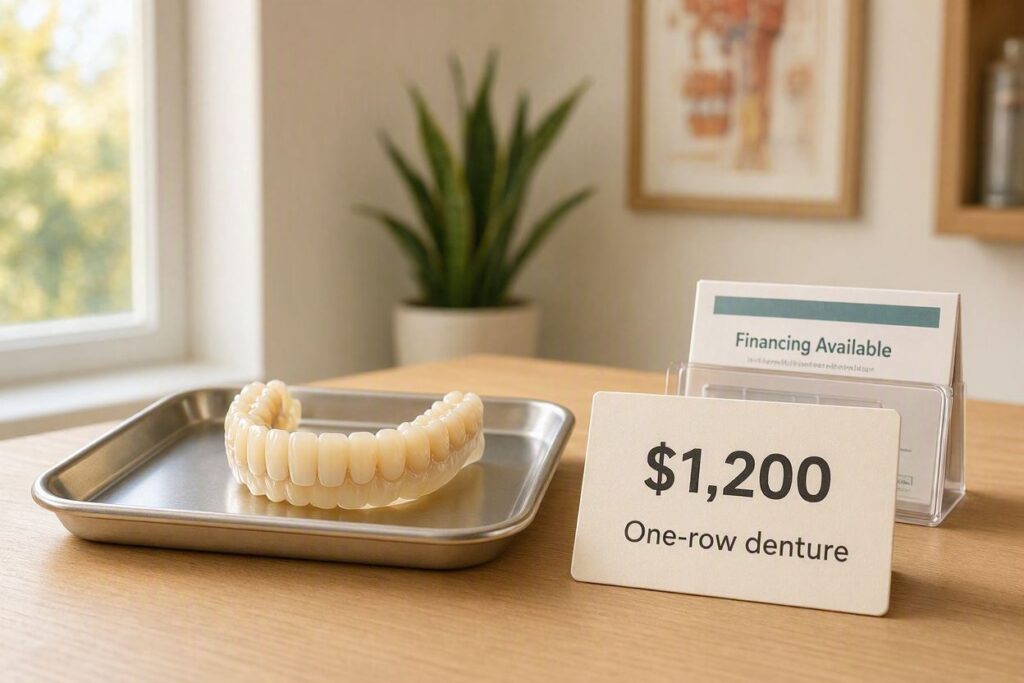
Before we talk about money, let’s define the term. Your mouth has two dental arches: the upper arch (maxilla) and the lower arch (mandible). “One row of dentures” means a prosthesis that replaces all the teeth in just one of those arches. It could be an upper denture or a lower denture.
This is different from a full set, which replaces both arches. Many people only need one row because they still have healthy teeth in the other arch. Others might need both rows, but they start with one to spread out the cost.
There are three main types of one-row dentures:
- Complete Denture: This sits on your gums and replaces all teeth in that arch. It relies on suction and muscle control to stay in place.
- Partial Denture: This fills in gaps when you still have some natural teeth. It clips onto your remaining teeth for support.
- Implant-Supported Denture: This is a denture that snaps onto titanium implants placed in your jawbone. It is much more stable than a regular denture.
Each type has a very different price tag.
The Average Cost Of One Row Of Dentures
Let’s get the numbers out of the way. These are average prices in the United States for a standard plastic denture made in a dental lab.
- Upper or Lower Complete Denture: $1,000 to $3,000 per arch.
- Upper or Lower Partial Denture: $700 to $2,500 per arch.
- Implant-Supported Denture (one arch): $3,000 to $30,000 per arch.
These prices vary wildly based on your location. In a big city like New York or San Francisco, you will pay at the higher end. In a rural area, you might pay less. But these are the typical ranges you should keep in mind.
Why The Price Varies So Much
You might wonder why one dentist charges $800 for a denture and another charges $2,500. The difference is not just greed. It comes down to several factors.
1. The Material Used
Dentures are made from different materials. The cheapest option is a hard plastic called acrylic. It is durable but can feel bulky. A more expensive option is a metal framework with acrylic teeth. The metal makes the partial denture thinner and more comfortable. For complete dentures, some dentists offer premium teeth that look more natural and wear longer.
2. The Lab Fees
Dentists do not make dentures in their back office. They send impressions to a dental laboratory. The lab charges the dentist a fee. Some labs are cheap and produce basic work. Others are high-end and use advanced techniques. The dentist marks up the lab fee to cover their time and overhead. A dentist using a premium lab will charge you more.
3. The Dentist’s Experience
A prosthodontist is a specialist in replacing teeth. They have years of extra training. They will charge more than a general dentist. However, for complex cases, the extra cost is worth it. A poorly fitted denture can cause sores, difficulty eating, and bone loss.
4. Geographic Location
The cost of living affects dental prices. A dentist in Manhattan pays high rent, so they charge more. A dentist in a small town has lower overhead. Dental costs in the US are generally higher than in Mexico, Thailand, or Eastern Europe.
5. Additional Procedures
The denture itself is only part of the story. You might need extractions, bone smoothing, or gum treatment before the denture is made. These add to the total bill.
Complete Dentures: Upper vs. Lower
Does it cost more to get an upper denture or a lower denture? Generally, the price is similar. However, there are some differences.
- Upper Dentures: These cover the roof of your mouth (palate). This creates a suction seal that helps the denture stay in place. They are usually easier to fit and adjust.
- Lower Dentures: These are shaped like a horseshoe to leave room for your tongue. They do not have the same suction. They are more likely to feel loose and require more adjustments.
Because lower dentures are harder to fit, some dentists might charge slightly more for the extra time. But the difference is usually small.
Partial Dentures: The Cost Of One Row
If you still have some natural teeth, you do not need a complete denture. You need a partial denture. This is a removable appliance that fills the gaps.
Partial dentures come in two main types:
- Acrylic Partial: Made of pink plastic. It is cheap but bulky. It sits on your gums and hooks onto your teeth with metal clasps. Cost: $700 to $1,500.
- Cast Metal Partial: Made of a metal frame covered with acrylic and teeth. It is thinner, stronger, and more comfortable. Cost: $1,500 to $2,500.
Some dentists offer flexible partials made of a soft, bendy material. These have no metal clasps. They are very comfortable but expensive. Cost: $1,800 to $3,000.
Implant-Supported Dentures: The Premium Option
If you want a denture that does not slip, you might consider implants. This is a game-changer for many people. Instead of sitting on your gums, the denture snaps onto titanium posts surgically placed in your jaw.
There are two main types:
- Implant-Retained Overdenture: This uses 2 to 4 implants to hold the denture in place. It is removable. You take it out to clean it. Cost: $3,000 to $10,000 per arch.
- Fixed Implant Bridge (All-on-4, All-on-6): This uses 4 to 6 implants to support a fixed bridge. You cannot take it out. It looks and feels like natural teeth. Cost: $15,000 to $30,000 per arch.
Implant dentures are far more expensive. But they preserve your jawbone, improve your ability to eat, and give you confidence. For many people, they are worth the investment.
Cost Of One Row Of Dentures In Different Countries
Dental tourism is popular because prices vary so much. Here is a comparison of average costs for a complete upper or lower denture in different countries.
| Country | Complete Denture (One Arch) | Partial Denture (One Arch) |
|---|---|---|
| United States | $1,000 – $3,000 | $700 – $2,500 |
| Canada | $1,200 – $2,500 | $800 – $2,000 |
| United Kingdom (NHS) | £306.80 (Band 3) | £306.80 (Band 3) |
| United Kingdom (Private) | £600 – £1,500 | £500 – £1,200 |
| Australia | $1,500 – $3,000 | $1,000 – $2,500 |
| Mexico | $300 – $800 | $200 – $600 |
| Thailand | $400 – $900 | $300 – $700 |
| India | $150 – $500 | $100 – $400 |
| Spain | €500 – €1,200 | €400 – €900 |
As you can see, the same denture can cost ten times more in one country than another. This is why many people travel abroad for dental work.
The NHS Cost For One Row Of Dentures
In the United Kingdom, the NHS provides dentures at a fixed price. For adults, the charge is currently £306.80 for a Band 3 treatment. This covers one or both rows of dentures. It does not matter if you need an upper, a lower, or a full set. The price is the same.
However, there are strict rules. You must be deemed medically in need of dentures. You cannot get them purely for cosmetic reasons. Also, the waiting lists can be long. Many people choose to go private to get seen faster or to have more control over the appearance.
If you are under 18, or under 19 and in full-time education, NHS dentures are free. If you are on certain benefits, you may also get them for free.
Private Dentures In The UK
If you go private in the UK, you will pay much more. A private dentist might charge:
- Basic Acrylic Denture: £600 to £900 per arch.
- Cobalt Chrome Partial Denture: £900 to £1,500 per arch.
- Flexible Denture: £1,000 to £1,800 per arch.
Private dentists often offer better aesthetics and a faster service. They also give you more choice in materials.
What Is Included In The Price?
When you get a quote for one row of dentures, you need to ask what is included. Some dentists quote a low price but then charge extra for every step.
A complete denture fee should usually include:
- Initial consultation and examination.
- X-rays (if needed).
- Impressions and bite registration.
- A wax try-in (so you can see how it looks before it is finished).
- The final denture.
- Adjustments after fitting (usually for a set period, like 6 months).
It often does not include:
- Extractions.
- Bone smoothing (alveoloplasty).
- Gum treatment.
- Relines after the first few months.
- Repairs if the denture breaks.
Always ask for a written treatment plan with a full breakdown of costs.
Hidden Costs To Watch Out For
The sticker price is not always the final price. Here are some hidden costs that can catch you off guard.
1. Extractions
If you still have teeth that need to come out, you will pay extra. Simple extractions cost $150 to $300 per tooth. Surgical extractions cost more.
2. Relines
Your gums will shrink after you lose teeth. This means your denture will become loose. You will need a reline to make it fit again. Some dentists include one reline in the price. Others charge $200 to $500 for each reline.
3. Repairs
Dentures can crack or break if you drop them. A repair might cost $100 to $300. If you need a tooth added, it costs more.
4. Adhesives
You might need denture adhesive to keep the denture in place. This is an ongoing cost. A tube costs $5 to $10 and lasts a few weeks.
5. Replacement
Dentures do not last forever. They typically need to be replaced every 5 to 10 years. You should budget for this.
Does Insurance Cover One Row Of Dentures?
In the United States, many dental insurance plans cover dentures. However, coverage varies widely.
- Basic Plans: Might cover 50% of the cost after a deductible.
- Comprehensive Plans: Might cover 50% to 80%.
- Medicare: Original Medicare does not cover dentures. Medicare Advantage plans might offer some coverage.
- Medicaid: In some states, Medicaid covers dentures for adults. In others, it does not.
In the UK, NHS dentures are heavily subsidized. Private insurance plans (like Bupa or Denplan) may cover part of the cost. Always check your policy for the annual maximum and waiting periods.
How To Save Money On One Row Of Dentures
You do not have to pay full price if you are willing to do some research.
1. Go To A Dental School
Dental schools need patients for students to practice on. The work is supervised by licensed dentists. It takes longer, but it costs much less. A denture at a dental school might cost $300 to $600 per arch.
2. Compare Prices
Call several dentists in your area. Ask for a written quote for a complete denture. You will be surprised at the difference.
3. Consider Dental Tourism
Mexico, Thailand, and Hungary are popular destinations for dental work. You can save 50% to 70% even after factoring in flights and hotels. Just make sure you research the clinic thoroughly. Check reviews and ask for before-and-after photos.
4. Negotiate
Some dentists offer discounts for cash payments or for seniors. It never hurts to ask.
5. Choose A Simple Acrylic Denture
If budget is tight, choose a standard acrylic denture. It is not as comfortable as a metal partial or an implant denture, but it is functional and affordable.
6. Use A Payment Plan
Many dental offices offer financing through companies like CareCredit. You can pay monthly instead of all at once. Just be aware of interest rates.
The Process Of Getting One Row Of Dentures
Understanding the process helps you understand the cost. Here is what happens.
Step 1: Consultation
The dentist examines your mouth and takes X-rays. They discuss your options and give you a treatment plan.
Step 2: Extractions
If you need teeth removed, this happens first. You then wait a few weeks for your gums to heal.
Step 3: Impressions
The dentist takes molds of your gums and remaining teeth. These are sent to a lab.
Step 4: Wax Try-In
The lab makes a wax model of the denture. You try it in. The dentist checks the fit, color, and shape. You can request changes.
Step 5: Final Fitting
The final denture is made and fitted. The dentist checks for sore spots and adjusts it.
Step 6: Follow-Up
You will return for adjustments as your gums heal and shrink.
Quotes From Real Patients
“I only needed an upper denture. I went to a dental school and paid $450. It took a few months, but I saved over $1,500 compared to a private clinic.” — Mark, Ohio
“I got an implant-supported lower denture. It cost $8,000. It was a lot of money, but I can eat steak again. It changed my life.” — Linda, Texas
“I went to Mexico for my dentures. The price was $600 for both rows. The dentist was great. I just had to go back for a follow-up, which was a hassle.” — David, Arizona
Important Note For Readers
Prices for dentures change over time and vary by location. The numbers in this article are estimates based on current market data. Always get a personalized quote from a licensed dentist before making a decision. Do not rely solely on online information for your dental care.
Frequently Asked Questions (FAQ)
1. How much does one row of dentures cost without insurance?
Without insurance, a complete denture for one arch costs between $1,000 and $3,000 in the US. A partial denture costs between $700 and $2,500. Implant dentures cost much more.
2. Is it cheaper to get upper or lower dentures?
The price is usually the same. However, lower dentures often require more adjustments, which might add to the cost over time.
3. Can I get just one denture on the NHS?
Yes. The NHS Band 3 charge of £306.80 covers one or both rows of dentures. You pay the same price whether you need one denture or a full set.
4. How long do dentures last?
A well-made denture can last 5 to 10 years. After that, your mouth changes, and the denture may need to be replaced or relined.
5. Are implant dentures worth the extra cost?
For many people, yes. They are more comfortable, stable, and preserve jawbone. But they are a significant investment.
6. What is the cheapest way to get dentures?
Dental schools are the cheapest option. Dental tourism is also cheaper, but you must factor in travel. Standard acrylic dentures are cheaper than metal or implant dentures.
7. Does Medicaid pay for dentures?
In some states, yes. In others, no. Check with your state Medicaid office.
8. Can I make my own dentures?
No. Do-it-yourself denture kits are dangerous. They can cause infection, sores, and permanent damage to your jaw. Always see a professional.
9. How much does a partial denture cost for one tooth?
A partial denture for one tooth is called a flipper. It costs $300 to $800. It is a temporary solution.
10. Will my denture look natural?
Modern dentures look very natural. You can choose the tooth shade and shape. A good dentist will make sure the denture matches your face and smile.
Conclusion
The cost of one row of dentures is not a fixed number. It ranges from a few hundred dollars for a basic acrylic denture to tens of thousands for an implant-supported prosthetic. Your final price depends on the type of denture, your location, the dentist you choose, and any extra procedures you need. Insurance can help, but many people still pay out of pocket. By understanding the factors involved, you can make a smart decision that fits your budget and your health needs.
Additional Resource:
For more information on denture care and options, visit the American Dental Association: