How Much Is Dental Implant In The Philippines
Losing a tooth changes everything. It changes how you smile at a friend. It changes how you bite into a crisp apple. It changes how you pronounce certain words. For many Filipinos, the empty space in their mouth becomes a constant source of anxiety. You cover your mouth when you laugh. You avoid photos. You push food to the other side of your mouth.
Then you hear about dental implants. You see before-and-after photos. You read testimonials from people who say their implant feels exactly like a real tooth. Hope rises. But then comes the inevitable question. The question that stops so many people from even picking up the phone.
How much is a dental implant in the Philippines?
You have probably already searched online. You have likely found confusing price ranges that seem too good to be true or frighteningly expensive. Some ads say “Dental implants for ₱15,000!” Other clinics quote ₱150,000 or more. Who do you believe?
This guide will answer your question honestly. We will break down every cost component. We will expose hidden fees. We will compare prices across different regions and clinic types. We will explain what makes an implant cheap or expensive. We will also tell you what questions to ask before you hand over your hard-earned money.
No sugar-coating. No unrealistic promises. Just the truth you need to make one of the most important decisions for your health and confidence.
Understanding Dental Implants: What Are You Really Paying For?
Before diving into numbers, you need to understand the product. Many patients walk into clinics armed only with price tags. That puts you at a disadvantage. You need to know the technology behind the price.
The Three Components of a Dental Implant
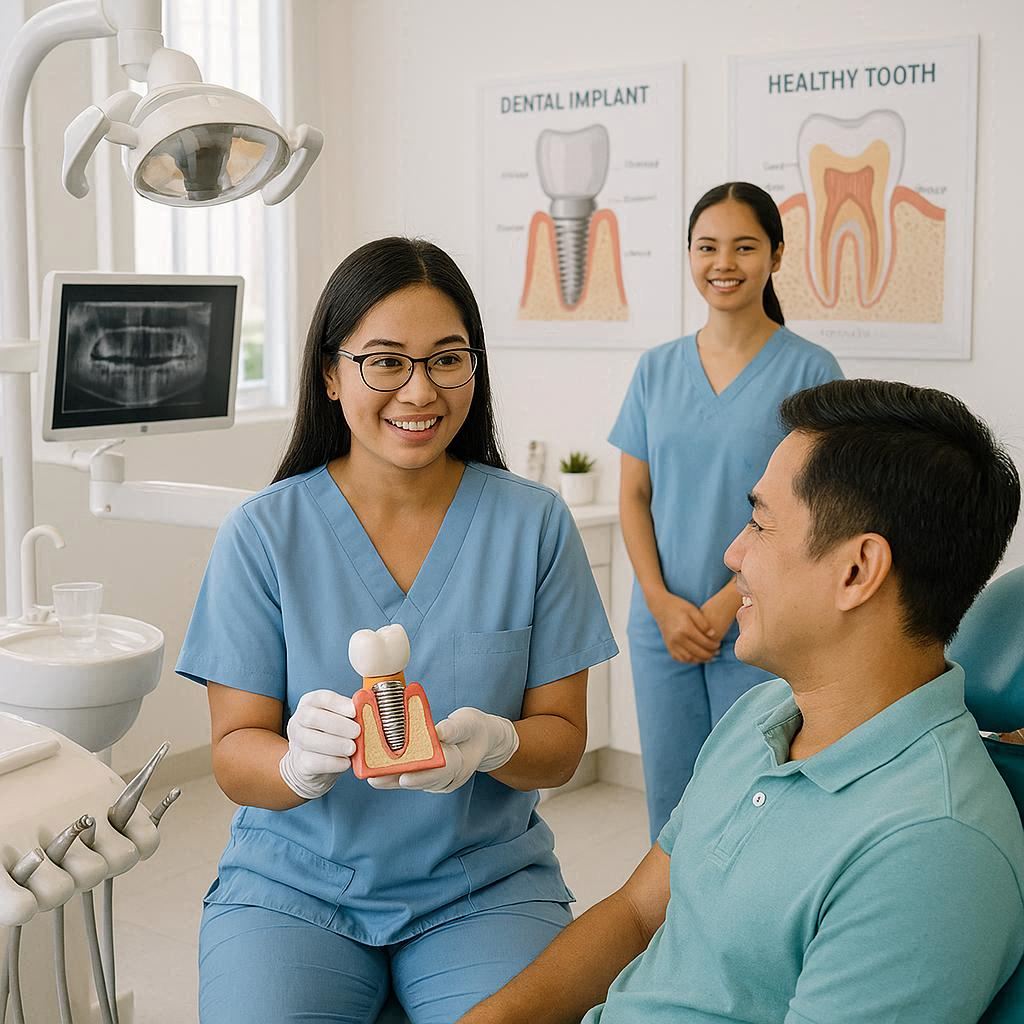
A dental implant is not a single piece of metal. It is a system of three distinct components. Each one costs money to manufacture, sterilize, and place. When a clinic quotes a price, you must ask which parts are included.
The Implant Fixture
This is the titanium or zirconia screw that goes into your jawbone. Think of it as the artificial tooth root. It sits below the gum line, hiding inside the bone. Over time, your bone cells fuse to the implant surface. This natural process, called osseointegration, gives the implant its legendary stability.
Premium implant brands invest decades in perfecting their surface technology. Microscopic textures. Special coatings. Designs that encourage bone cells to attach faster and stronger. This research costs millions of dollars. Naturally, that cost trickles down to the price of the implant.
The Abutment
The abutment is the connector piece. It screws into the implant fixture and protrudes above the gum. Your dentist attaches the visible crown to this abutment. Simple in concept, but precision matters enormously here. A poorly fitted abutment creates micro-gaps where bacteria can hide. Over time, this leads to infection, bone loss, and eventual implant failure.
The Prosthesis (Crown, Bridge, or Denture)
This is the part you see. The pretty white tooth-shaped restoration that completes your smile. Most commonly, dental laboratories craft this from porcelain fused to metal or from solid zirconia. Zirconia offers the best aesthetics but costs more.
The Surgical Phases
Understanding the timeline helps explain why implant treatment stretches over months. Each phase generates its own costs.
Phase One: Assessment and Planning
Your first visit involves examinations. X-rays, often a panoramic or periapical radiograph. Many advanced clinics now require a Cone Beam Computed Tomography scan, commonly called a CBCT. This 3D scan provides a three-dimensional view of your jawbone density, nerve locations, and sinus positions. Skipping this step invites disaster. A dentist who starts drilling without a 3D map is guessing. Never accept treatment without proper imaging.
Phase Two: Surgical Placement
The dentist drills a precise hole into your jawbone and screws in the implant fixture. This sounds terrifying, but local anesthesia makes it painless. The skill required, however, is immense. The dentist must avoid nerves, especially the inferior alveolar nerve in the lower jaw. Severing this nerve causes permanent numbness of the lip and chin. The dentist must also avoid the maxillary sinus in the upper jaw. Perforating the sinus membrane triggers complications that require additional surgery.
Phase Three: Osseointegration Period
You wait. Typically three to six months. During this quiet period, your bone grows around the implant. You wear a temporary denture or flipper if the gap is visible. The implant site heals undisturbed. Rushing this phase causes early implant failure.
Phase Four: Abutment Placement and Crown Delivery
The dentist exposes the implant, attaches the abutment, takes impressions, and the laboratory fabricates your custom crown. Two to three visits spaced over several weeks. Finally, the dentist cements or screws the crown into place. You walk out with a complete smile.
The Complete Price Breakdown: How Much Is Dental Implant In The Philippines
Now we face the core question. You want a number. But a single number does not exist. Instead, we will present price ranges based on real data gathered from clinics across Metro Manila, Cebu, Davao, and other urban centers. These figures reflect the market as of early 2026.
The Budget Segment: ₱20,000 to ₱45,000 per implant
This category exists. However, it requires extreme caution. These prices typically come from dental tourism agencies, aggressive discount promotions, or rural clinics with minimal overhead.
What you might receive for this price includes a basic-grade titanium implant, often manufactured in China, India, or South Korea by lesser-known companies. Some budget Korean implants, such as those from Dio, Osstem, or Dentium, do have reasonable track records. However, several clinics at this price point use truly unproven brands with minimal clinical research.
The crown that accompanies a budget implant usually features a metal core with plastic-like acrylic fused to the outside. It will not match your natural tooth color perfectly. It will wear down faster. It may chip or fracture within a few years.
The dentist providing this service may be a general practitioner with weekend implant training rather than a recognized specialist. Nothing inherently wrong with a general dentist placing implants, provided they have completed a rigorous, accredited training program. A two-day hotel conference does not count as rigorous training.
Important Note: Always verify that your budget clinic uses an implant brand recognized by the Philippine Dental Association or international regulatory bodies. Ask for the exact brand name and serial number. Research that brand. If the clinic hesitates to share this information, walk away.
The Standard Quality Segment: ₱50,000 to ₱90,000 per implant
This range represents the sweet spot for most Filipinos seeking reliable treatment without luxury pricing. Many skilled general dentists and implantologists operate in this bracket.
The implant fixture itself likely belongs to a reputable mid-tier brand. Popular choices include Osstem (South Korea), Megagen, Neobiotech, or sometimes entry lines from premium Swiss or German manufacturers. These companies invest in research, maintain quality control certifications, and provide clinical documentation. Some also maintain local offices in the Philippines for warranty claims and technical support.
The crown at this price point usually comes from a quality dental laboratory. Typically, a porcelain-fused-to-metal (PFM) crown. These provide good aesthetics and decent durability. Some clinics at the higher end of this range offer full zirconia crowns, which deliver superior aesthetics.
The dentist at this level usually possesses solid credentials. Membership in the Philippine College of Oral Implantologists or similar organizations. Continuing education certificates. A portfolio of completed cases that the clinic proudly shows to prospective patients.
This segment offers the best combination of safety, quality, and value. We recommend most readers focus their search here.
The Premium Segment: ₱95,000 to ₱160,000+ per implant
Enter the world of respected specialists. Prosthodontists. Periodontists. Oral surgeons who placed their first implants two decades ago. Clinics in Makati, BGC, or Alabang that feature spa-like environments and German-engineered equipment.
The implant systems used here carry legendary names. Straumann from Switzerland. Nobel Biocare from Sweden. These companies pioneered modern implantology. They maintain massive research databases spanning decades. Their implants demonstrate documented survival rates exceeding 95% over ten years. Every component comes with a serial number tracked in a global database. If you suffer implant complications years later while living abroad, any Straumann-trained dentist can access your records and order compatible parts.
The crown work matches the implant quality. Master ceramists layer porcelain by hand, replicating the subtle translucency of natural tooth enamel. The fit, the bite alignment, the shade matching — everything approaches perfection.
Is the price jump worth it? It depends on your values. If your case presents complexities — poor bone quality, multiple missing teeth, aesthetic zone challenges — the premium you pay buys peace of mind. It also buys biological compatibility. Some premium surfaces encourage faster bone healing, a crucial advantage for smokers or diabetic patients.
Regional Price Variations Across the Philippines
Geography plays a significant role in implant pricing. The following table provides a realistic overview of market rates for a standard single implant with a PFM crown.
| Region | Budget Range (PHP) | Standard Range (PHP) | Premium Range (PHP) | Typical Brand Examples |
|---|---|---|---|---|
| Metro Manila (BGC, Makati) | 50,000 – 70,000 | 80,000 – 120,000 | 130,000 – 180,000 | Straumann, Nobel, Megagen |
| Metro Manila (Quezon City, Pasig) | 40,000 – 60,000 | 65,000 – 90,000 | 100,000 – 150,000 | Osstem, Dentium, Neobiotech |
| Cebu City | 35,000 – 55,000 | 60,000 – 85,000 | 90,000 – 140,000 | Osstem, Dio, Straumann |
| Davao City | 30,000 – 50,000 | 55,000 – 75,000 | 80,000 – 120,000 | Osstem, Megagen |
| Provincial Capitals (Bacolod, Iloilo) | 28,000 – 48,000 | 50,000 – 70,000 | 75,000 – 100,000 | Dentium, Osstem |
| Smaller Provinces | 25,000 – 45,000 | 45,000 – 65,000 | Not commonly available | Various Korean/Chinese brands |
“The cost of living dictates the price of everything, including healthcare. A clinic in BGC pays three times the rent of a clinic in a provincial city. The dentist likely has higher overhead, more expensive training, and a patient base willing to pay for a premium experience. None of that automatically guarantees better implant survival, but it often correlates with more meticulous treatment planning and emergency support.”
— Dr. Maria Lourdes Santiago, Prosthodontist, Quezon City
Additional Procedures That Change the Final Cost
Here lies the biggest trap for unsuspecting patients. The base price of ₱60,000 rarely remains ₱60,000.
You visit the clinic. The dentist takes a CBCT scan. Then comes the bad news. “Your bone is insufficient. You need a bone graft. That will add ₱25,000 to ₱45,000.” Suddenly your budget collapses.
You must anticipate these extras. They are not scams. They are legitimate medical necessities. But you deserve to know about them before you commit.
Bone Grafting: ₱15,000 to ₱55,000 per site
When a tooth disappears, the body resorbs the surrounding jawbone. It is a cruel biological response. No tooth root stimulating the bone means the body decides that bone serves no purpose. Within a year of extraction, you can lose 25% of your ridge width. After several years, the bone may become too thin or too short to hold an implant securely.
Bone grafting rebuilds this lost foundation. The dentist places bone graft material — synthetic, bovine-derived, or your own harvested bone — into the deficient area. Over months, your body converts this graft into living bone. Only then can the dentist place the implant.
Sinus Lift: ₱30,000 to ₱70,000 per side
The maxillary sinuses sit above your upper back teeth. When those teeth disappear, the sinuses often expand downward, invading the space once occupied by tooth roots. Placing an implant into a sinus cavity is like trying to put a screw into a hollow balloon. It fails instantly.
A sinus lift surgery elevates the sinus membrane and packs bone graft material underneath. This creates adequate bone height for implant placement. The cost reflects the surgical skill required. Perforate the delicate sinus membrane, and you create a direct passageway for oral bacteria into the nasal cavity. Chronic sinus infections follow.
Tooth Extraction: ₱800 to ₱8,000
If your damaged tooth still sits in the socket, extraction precedes everything. Simple extractions cost less. Surgical extractions, such as removing a broken wisdom tooth root, cost significantly more.
Temporary Prosthesis: ₱3,000 to ₱20,000
During the months of healing, you need to fill the gap. A temporary removable denture or a bonded bridge keeps you presentable. Some clinics include a basic temporary in their package price. Many do not. Always ask.
CBCT Scan: ₱2,500 to ₱8,000
Panoramic x-rays provide two-dimensional information. A CBCT scan reveals the three-dimensional truth. Most modern implantologists consider CBCT mandatory. Budget clinics sometimes skip it, relying on 2D x-rays alone. This keeps their package price low but raises your surgical risk.
Full Mouth Dental Implant Costs: The All-on-4 and All-on-6 Revolution
The previous sections focused on single-tooth replacement. But what if you have lost most or all of your teeth? The question shifts from “How much is a dental implant in the Philippines for one tooth?” to “How much for a full arch?”
Two dominant full-arch solutions exist. Understanding their differences protects you from marketing confusion.
The All-on-4 Concept: ₱280,000 to ₱550,000 per arch
This technique, pioneered by Portuguese dentist Dr. Paulo Malo and commercialized by Nobel Biocare, uses exactly four implants to support an entire arch of fixed teeth. The rear implants are angled strategically to maximize bone contact while avoiding the sinuses or nerve canals.
The cost appears high. However, compare it to replacing each missing tooth with individual implants. A full arch of twelve individual implants would cost exponentially more and require more bone volume than most patients possess. The All-on-4 provides a functional, permanent smile at a fraction of individual replacement cost.
The prosthesis — the teeth attached to the implants — varies significantly in quality. The base All-on-4 package typically includes a hybrid denture. This features acrylic teeth embedded in pink acrylic gums, reinforced with a metal framework. It looks decent. It functions well. But the acrylic teeth will wear down over five to ten years.
Upgraded options include porcelain teeth on a milled titanium bar. These cost more but resist staining and wear beautifully.
The All-on-6 Concept: ₱350,000 to ₱700,000 per arch
Adding two extra implants improves load distribution, stability, and long-term survival. Clinics often recommend All-on-6 for the upper jaw, where bone is softer and the sinus limits implant placement options. The additional implants also provide backup support. If one implant fails decades later, the remaining five can still support the prosthesis while you seek repair.
Zygomatic Implants: ₱800,000 to ₱1,500,000+ per arch
For patients with severe jawbone loss who cannot undergo bone grafting for medical or personal reasons, zygomatic implants offer a last-resort fixed solution. These extremely long implants anchor not into the jawbone but into the dense cheekbone, or zygomatic bone. The surgery is complex and demands specialized training. Very few clinics in the Philippines offer this service. Those that do charge accordingly.
Full Mouth Cost Comparison Table
| Treatment Type | Implants Per Arch | Typical Total Cost (One Arch) | Time to Teeth | Bone Graft Needed? |
|---|---|---|---|---|
| All-on-4 (Acrylic Teeth) | 4 | ₱280,000 – ₱400,000 | 1-3 days (immediate load) | Rarely |
| All-on-4 (Porcelain Teeth) | 4 | ₱400,000 – ₱550,000 | 1 day usual, or delayed | Rarely |
| All-on-6 (Acrylic) | 6 | ₱350,000 – ₱500,000 | 1-3 days (immediate load) | Rarely |
| All-on-6 (Porcelain) | 6 | ₱500,000 – ₱700,000 | 1 day usual, or delayed | Rarely |
| Zygomatic (specialised) | 2-4 zyg. + 0-4 reg. | ₱800,000 – ₱1,500,000 | Delayed, case-dependent | Almost never |
“A full arch of fixed teeth changes a person’s life overnight. Patients often cry when they see their new smile. The cost seems daunting, but when you calculate the lifespan and compare it to repeated denture adjustments, many find All-on-4 a worthwhile investment.”
— Testimonial from a dental clinic director in Cebu City
Why Do Prices Vary So Wildly?
You have seen prices from ₱25,000 to ₱160,000. The marketing messages all sound convincing. How can the range span such a wide gap for what seems like the same procedure?
Several legitimate factors create this variance.
1. Brand and Origin of the Implant System
A Straumann BLX implant undergoes manufacturing in Switzerland under strict medical device regulations. Every production batch undergoes testing. Researchers at the University of Bern continuously publish peer-reviewed studies on its clinical performance. This infrastructure costs money. A generic implant from an emerging manufacturer may copy the macro-design but lacks the surface technology research and the long-term human data.
2. The Dental Laboratory’s Artistry
Your crown’s quality depends entirely on the dental technician who fabricates it. Master ceramists with twenty years of experience charge premium rates. They spend hours layering porcelain to mimic natural tooth fluorescence. A mass-production lab in a different region uses standardized shades and basic morphology. Your dentist receives a crown at a fraction of the price, and the savings pass to you — along with a visible difference in aesthetics.
3. Digital Workflow vs. Conventional Impressions
Traditional impressions involve goopy, foul-tasting material in your mouth. They work. But slight distortions can create fit issues. Digital intraoral scanners capture your mouth in detailed 3D instantly. The precision improves, and chair time decreases, but the clinic invested hundreds of thousands of pesos in the scanner and software. That investment amortizes into treatment fees.
4. Dentist’s Credentials and Experience
A prosthodontist completed an additional three years of full-time specialty training after dental school. An oral surgeon trained for four to six years in hospital-based surgical residency. General dentists who pursue implantology through short courses possess varying competency levels. Board-certified specialists charge more. Whether their services justify the premium depends on your case complexity.
5. Clinic Overhead
A street-level clinic in a busy commercial area pays premium rent, employs trained treatment coordinators, maintains strict sterilization protocols with weekly biological monitoring, and carries comprehensive malpractice insurance. A home-based dental office with a single staff member and basic equipment passes those savings to patients. Lower price does not always mean lower quality, but it correlates with higher variability in quality control.
The Hidden Cost of Cheap Dental Implants
Everyone loves a bargain. But dental implants represent a medical procedure, not a retail product. The lowest price often hides the highest risk.
Peri-implantitis: The Time Bomb
When bacteria colonize the space around an implant, they trigger inflammation of the surrounding gum and bone. This condition, called peri-implantitis, progresses silently. You might notice bleeding when brushing. Perhaps a bad taste. By the time you feel discomfort, significant bone destruction has occurred.
Poorly designed implant-abutment connections create microscopic gaps. Bacteria proliferate inside these gaps, protected from your immune system. Cheaper implant systems sometimes use imprecise milling tolerances that invite this colonization.
Treating peri-implantitis costs thousands of pesos. Removing a failed implant, grafting new bone, waiting months, and placing a new implant costs even more. The “savings” from a cheap implant evaporate when complications arise.
Nerve Damage: The Permanent Nightmare
The inferior alveolar nerve runs through your lower jaw. When an implant drilled without proper planning invades this nerve canal, the results can include permanent numbness of the lower lip, chin, and gums on that side. Eating becomes messy. You drool without realizing it. Speech slurs slightly.
Repairing nerve damage ranges from difficult to impossible. Prevention through adequate 3D imaging and careful surgical planning costs money upfront but avoids a lifetime of disability.
The Implant Brand That Disappears
Generic implant companies sometimes cease operations without warning. Five years after your treatment, you need a replacement abutment because yours fractured. You discover the company no longer exists. No compatible parts are available. Your dentist must surgically remove the entire implant and start over with a new system. All the money you saved, plus more, disappears.
Reputable brands like Straumann, Nobel Biocare, Osstem, and Dentium have been in the market for decades and maintain robust supply chains. The availability of replacement parts decades into the future justifies part of their price premium.
Dental Tourism: Are You a Candidate for Savings?
Thailand. Vietnam. The Philippines attracts foreigners seeking lower dental costs. But Filipinos themselves sometimes travel to cheaper regions within the country, or from overseas back home, for affordable treatment.
The Philippine dental tourism sector markets aggressively to Overseas Filipino Workers (OFWs) and foreign retirees. The appeal centers on English-proficient dentists, internationally trained specialists, and prices significantly lower than North America, Australia, or Europe.
Advantages of Getting Implants in the Philippines
Significant Cost Savings
A single implant that costs $4,000 in California might cost $1,200 to $2,000 in Metro Manila. For full-mouth rehabilitation, the savings multiply dramatically.
Familiar Environment
OFWs returning home combine medical treatment with family reunions. The language barrier disappears. The food comforts. The emotional support system strengthens.
Quality Training
Top Philippine universities produce dentists who pursue advanced training abroad before returning to practice. Some maintain fellowships with international implant organizations.
Risks and Practical Challenges
Timeline Issues
Osseointegration requires months. If complications arise, the healing extends further. OFWs with limited vacation time face difficult decisions. Do they leave before final crown delivery? Do they extend their stay unpaid? Treatment staged over multiple trips home becomes logistically complex.
Follow-up Care
Who monitors your implant after you return abroad? Post-operative complications — an abutment screw loosening, porcelain chipping, signs of peri-implantitis — require prompt attention. Finding a local dentist willing to address another clinician’s work is not always easy. Often, the warranty offered by the Philippine clinic becomes void when you cannot return for follow-up.
“The best candidate for dental tourism is someone with flexible time and realistic expectations. They plan their trip knowing they might need to extend it. They also research their home-country options for follow-up care before traveling.”
— Statement from the Philippine Dental Association’s advisory on cross-border dental care
Insurance Coverage and Financing Options for Dental Implants
Most Philippine health insurance plans, including PhilHealth, classify dental implants as a cosmetic procedure and exclude coverage. However, the landscape is slowly changing. Some private insurance products now offer partial coverage under specific conditions.
PhilHealth and Dental Implants
PhilHealth provides basic dental benefits through its Primary Care Benefit package. These include oral examinations, basic extractions, and simple fillings. Implants receive no coverage whatsoever.
Private Health Insurance
Several private medical insurance plans in the Philippines offer enhanced dental riders. Maxicare, Intellicare, and ValuCare provide outpatient dental benefits, but these typically cover only preventive and basic restorative care. Implants rarely fall within their scope.
However, some premium insurance plans specifically designed for executives include “major dental” coverage. This might reimburse a portion of implant treatment, especially if the tooth loss resulted from an accident covered under the accident rider. Always read the fine print. Always call the insurance provider and ask specifically: “Is code D6010 for endosteal implant placement covered under my plan? What percentage?”
In-House Financing and Installments
Many dental clinics recognized the demand for affordable payment options. They now offer in-house financing without the paperwork of a bank loan.
A common structure involves an initial down payment — perhaps 30% to 50% of the total treatment cost — with the balance spread over six to twelve months through post-dated checks or automatic bank deductions. Some larger clinics offer even longer terms, up to 24 or 36 months, sometimes with interest rates lower than credit card installments.
Always negotiate the terms openly. Ask about the total contract price versus the cash price. Clinics offering zero-interest installments often build the interest cost into the base price. If you can pay in full, ask for a cash discount. Many clinics will shave 5% to 10% off the total when patients bypass installment administration.
Credit Card Installment Plans
Major credit cards in the Philippines offer installment conversion. You pay the clinic in full using your card, then call the bank to convert that charge into monthly installments. BDO, BPI, Metrobank, and Citibank all provide this service. The interest rates usually range from 0.5% to 1% per month for terms up to 24 months. Some promotional offers provide 0% interest for three to six months.
Step-by-Step Guide: How to Get a Fair Price for Your Dental Implant
You know the costs. You know the risks. Now you need a strategy. Walking into a clinic unprepared puts you at a negotiation disadvantage. Follow this roadmap.
Step 1: Obtain a Definitive Diagnosis Before Shopping for Price
Price shopping only makes sense when you know exactly what you need. Visit a reputable dentist — ideally a prosthodontist or periodontist — for a comprehensive examination and a CBCT scan. Pay for this consultation. It represents the best money you will spend in this entire process.
The treating dentist will measure your bone width and height, assess your gum health, and identify potential obstacles like sinuses or nerves. You will receive a treatment plan document outlining every required procedure and the appropriate implant size and brand.
Armed with this plan, you can now call other clinics and ask intelligent questions: “I have a treatment plan specifying a 4.1mm diameter by 10mm length implant in tooth 36 with no bone graft required. What would your fee be for this specific scenario using a premium Straumann or equivalent implant system, including the custom zirconia crown, abutment, and all surgical fees?”
Step 2: Request a Written, Itemized Quotation
A verbal quote means nothing. Insist on a written treatment plan with fees broken down line by line. The quotation should specify the implant brand and model, the crown material, each surgical procedure code, and the warranty period for each component.
Quotations should also note what the price excludes. Sometimes bone grafting, soft tissue grafting, or temporary prostheses appear missing because the clinic assumes you do not need them. Get that assumption in writing.
Step 3: Compare at Least Three Providers
Visit or call at least three clinics. Do not limit yourself to one geographic area. A clinic in Makati may charge ₱120,000. Another clinic in Mandaluyong, staffed by a dentist with equal or superior training, might quote ₱75,000 for the identical implant system and crown. The difference flows entirely from rent, marketing spend, and target demographic.
Step 4: Verify the Clinician’s Credentials
The Philippine Dental Association maintains a registry. The Professional Regulation Commission verifies licenses online. Specialized societies — the Philippine College of Oral Implantologists, the Philippine Prosthodontic Society, the Philippine Academy of Periodontology — list their members publicly.
Do not be shy about asking the dentist directly: “How many implant cases have you completed? Do you have before-and-after photos of cases similar to mine? What continuing education courses have you completed in the past three years?” Competent, ethical dentists welcome these questions. Insecure or evasive responses represent a warning sign.
Step 5: Secure Your Warranty in Writing
Implants can fail. Crowns can chip. Abutment screws can loosen. A written warranty statement clarifies what the clinic will cover and for how long.
A reasonable warranty for the implant fixture itself spans ten years to life, with the manufacturer typically providing the warranty on the component. The crown warranty usually ranges from two to five years, covering manufacturing defects but not damage from trauma or neglect. Labor costs for warranty repairs are where clinics differ. Some cover all labor within the warranty period; others charge surgical fees even when a defective implant requires removal.
Key Questions to Ask Your Implant Dentist
A good consultation involves mutual discovery. The dentist evaluates your mouth. You evaluate the dentist. These questions will reveal the depth of their planning and the transparency of their practice.
“What brand and specific model of implant do you recommend for my case, and why?”
Listen for rationale based on your bone type, aesthetic demands, or functional needs. A vague “This is what we use for everyone” suggests a one-size-fits-all approach.
“Will you place the implant using a surgical guide fabricated from my CBCT scan?”
Surgical guides improve accuracy. They translate the digital 3D plan into the surgical field. Freehand placement, even by experienced surgeons, introduces more positional variability. Clinics investing in guided surgery demonstrate commitment to precision.
“Who will fabricate my crown? Is it an in-house laboratory or an external partner?”
External laboratory quality varies enormously. If the clinic owns an in-house digital lab with a skilled ceramist, that often streamlines communication and quality control. If they outsource, ask about the laboratory’s credentials and the materials they use.
“May I speak with a former patient who received a similar treatment?”
Privacy regulations may limit this, but some clinics maintain a list of patients willing to share testimonials. A direct conversation with someone who underwent the process provides insights no brochure contains.
The Emotional and Psychological Value: What Price for Confidence?
We have discussed pesos, brands, and surgical protocols. Now we must acknowledge the human dimension. A dental implant is not merely a medical device. It restores something profound.
The patient who stopped attending social gatherings because tooth loss embarrassed them suddenly accepts invitations again. The professional who covered their mouth during presentations now speaks with authority. The parent who could not bite into a mango with their children rediscovers that simple joy.
These transformations carry value beyond any price tag. When calculating whether implants are “worth it,” include the intangible returns. The psychological burden of removable dentures — the clicking, the slipping, the constant concern about adhesive — disappears with fixed implant solutions.
“A patient told me she had not smiled fully in twelve years. Her wedding photos show her with tight, closed lips. After her implant treatment, she handed me a new photo. She was laughing, mouth wide open, completely unselfconscious. She said I had given her back her identity. That moment is why we do this work.”
— Dr. Rafael Buenaventura, Implantologist, Davao City
Frequently Asked Questions About Dental Implant Costs in the Philippines
How much is a dental implant in the Philippines for a single tooth in 2026?
A realistic range for a quality single implant with a porcelain crown spans from ₱55,000 to ₱120,000. The lower end applies to generic Korean implants with metal-ceramic crowns placed by general dentists. The upper end applies to premium Swiss implants with full zirconia crowns placed by prosthodontists or oral surgeons in Metro Manila.
Does PhilHealth cover any dental implant costs?
As of 2026, PhilHealth does not cover dental implant placement, implant-supported prostheses, or related surgical procedures. PhilHealth dental benefits remain limited to basic preventive and simple restorative care.
Can I get a cheap dental implant for ₱15,000 to ₱25,000?
While promotional offers at this price exist, they typically cover only the implant fixture cost, not the abutment, crown, surgical stent, or any necessary grafting. Read the fine print carefully. The total treatment cost almost always escalates beyond the advertised rate once the required components are itemized.
How long do dental implants last in the Philippines?
With proper oral hygiene, regular professional maintenance, and absence of complicating factors like uncontrolled diabetes or heavy smoking, modern dental implants commonly survive twenty years or longer. Studies report survival rates above 95% at ten years for premium implant systems.
Is it safe to travel to the Philippines specifically for dental implants?
Many international patients undergo successful implant treatment in the Philippines. Safety depends on careful clinic selection, verification of credentials, and adequate planning for the required healing timeline. The Philippine Dental Association recommends that dental tourists confirm their home-country access to follow-up care before traveling.
What is the payment process like for dental implants?
Most clinics require a deposit before surgical phases. The typical schedule involves payment at each major stage: consultation and imaging, implant placement surgery, and final crown delivery. Some clinics offer a discount for full upfront payment.
Can implants be placed the same day as tooth extraction?
In carefully selected cases, immediate implant placement after extraction can succeed. However, the site must be free of active infection, and adequate bone must surround the socket to stabilize the implant. Your dentist judges this based on CBCT findings.
How painful is the dental implant procedure?
Most patients report significantly less discomfort than anticipated. The surgical phase occurs under profound local anesthesia. Post-operative pain typically resembles the discomfort of a simple extraction and resolves within days, managed with common oral analgesics.
Additional Resource
For further verification of dental professional credentials, visit the Philippine Dental Association’s official member directory at https://pda.ph. The Professional Regulation Commission also maintains an online verification portal for licensed health professionals in the Philippines.
Conclusion
A dental implant in the Philippines costs between ₱25,000 for basic budget options with significant risk and ₱160,000 or more for premium specialist care with top-tier materials and long-term warranties. The final price depends heavily on implant brand, crown material, clinician expertise, and any additional procedures like bone grafting or sinus lifts that your anatomy requires. We strongly recommend obtaining a definitive diagnosis through CBCT imaging before comparing prices, requesting itemized written quotations from multiple providers, and verifying all clinician credentials and warranty terms before committing to treatment. Your smile anchors your confidence — investing wisely in its restoration pays lifelong dividends in both health and happiness.
Disclaimer: This content is for informational and educational purposes only and does not constitute medical or dental advice. Dental implant treatment requires individualized assessment by a licensed dental professional. Costs cited represent market observations and may vary based on clinical complexity, geographic location, and economic fluctuations. Always consult directly with a qualified dentist or dental specialist for diagnosis and treatment recommendations specific to your case.