Disadvantages of Mini Dental Implants
When you lose a tooth, the world of restorative dentistry can feel like a maze. You hear about dental implants, bridges, and dentures. Then someone mentions “mini implants.” They sound perfect, right? Smaller, less invasive, often cheaper. What’s not to love?
But as a wise dentist once told me, “In dentistry, there is no free lunch.”
Mini dental implants have grown in popularity over the last decade. They promise faster recovery and lower upfront costs. However, they come with a unique set of drawbacks that many marketing materials conveniently forget to mention.
Before you let anyone place a tiny screw into your jawbone, you need the full picture. This guide walks you through every single disadvantage of mini dental implants. No sugar-coating. No sales pitch. Just honest, practical information to help you make a smart choice for your health and your wallet.
Important Note: This article is for informational purposes only. It does not replace professional medical advice. Always consult a licensed dentist or oral surgeon for a personal evaluation.
What Exactly Are Mini Dental Implants? (A Quick Refresher)
Before diving into the problems, let’s make sure we are on the same page.
A standard traditional dental implant is about 3.5 to 5 millimeters wide. A mini dental implant (MDI) is narrower—usually between 1.8 and 3 millimeters in diameter. They are one piece, meaning the implant post and the abutment (the connector for the tooth) are fused together. Traditional implants usually have two separate pieces.
Mini implants were originally designed for temporary use or to stabilize lower dentures. But today, some dentists use them to support individual crowns or small bridges. This “off-label” use is where many disadvantages begin.
Think of a mini implant like a small nail. A traditional implant is more like a sturdy screw. Both can hold something in place. But one handles pressure much better over time.
Why do dentists offer them?
- Lower cost per implant.
- Less invasive surgery (no major flap surgery often required).
- Shorter healing time (sometimes immediate loading).
- Can work in thinner jawbones without bone grafting.
Now, let’s look at the real reasons you might want to think twice.
The Main Structural Weakness – Stability Over Time
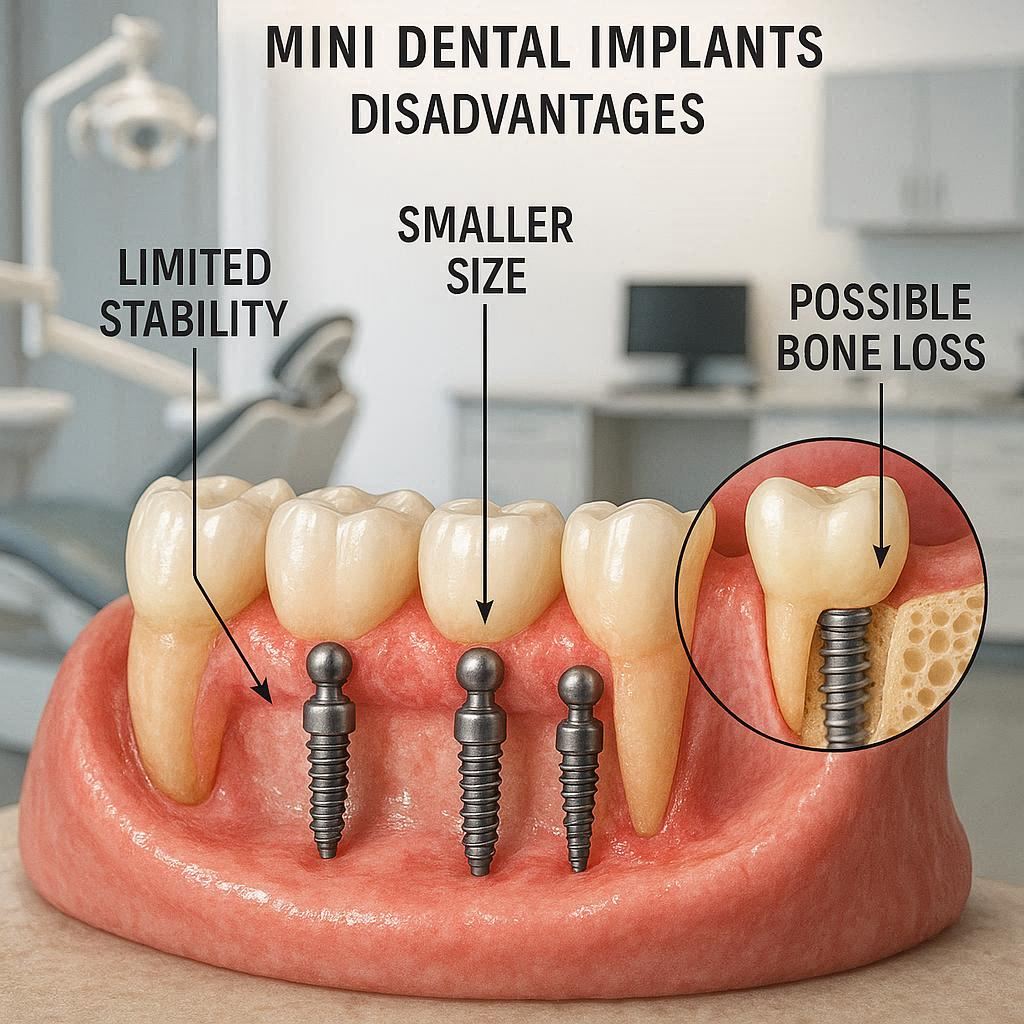
The single biggest disadvantage of mini dental implants is their structural integrity—or lack thereof.
A tooth replacement needs to withstand significant force. Your jaw can generate up to 200 pounds of pressure per square inch when chewing. A mini implant has a much smaller surface area to distribute that force.
Reduced Surface Area for Osseointegration
Osseointegration is the fancy term for your jawbone growing tightly around the implant. This is the secret to a successful implant. More contact between bone and implant equals a stronger foundation.
A mini implant has roughly 40-50% less surface area compared to a standard implant. This means less bone grows around it. Over time, that weaker bond can lead to micro-movements. And micro-movements are the enemy of long-term success.
| Feature | Traditional Implant | Mini Dental Implant |
|---|---|---|
| Diameter | 3.5 – 5.0 mm | 1.8 – 3.0 mm |
| Surface area for bone fusion | High | Low (40-50% less) |
| Long-term stability (10+ years) | Excellent | Moderate to Poor |
| Best use case | Single/multiple teeth | Denture stabilization |
Higher Risk of Fracture
Because mini implants are thinner, they are physically weaker. They can snap under pressure. Imagine biting into an apple or a crusty baguette. That sudden, off-angle force can be enough to fracture a mini implant.
Once an implant fractures inside your jawbone, removal becomes a nightmare surgery. You often lose additional bone in the process. A traditional implant almost never fractures in normal use. Mini implants? It is a known and documented risk.
Quote from a clinical study: “Narrow-diameter implants demonstrate a significantly higher fracture rate compared to conventional diameter implants, particularly in molar regions.”
Higher Long-Term Failure Rates
This is the statistic that most private clinics won’t share over the phone. Short-term success (one to two years) for mini implants looks decent. But the long-term story is different.
The Five-Year Failure Cliff
For traditional implants, success rates at ten years are around 95% or higher. For mini implants, studies show five-year survival rates ranging from 80% to 90% in ideal conditions. In real-world conditions (smoking, grinding teeth, poor bone density), the failure rate climbs much faster.
Many mini implants fail between years three and seven. Why? Because cumulative micro-damage from chewing slowly loosens the connection between bone and implant.
Common signs of a failing mini implant:
- Persistent clicking or movement in a crown or denture.
- Food getting stuck around the gum line constantly.
- Chronic bad taste or smell from the area.
- Pain when biting down (not just sore gums).
- Visible gum recession showing metal threads.
One Fails, The Whole System Suffers
With traditional implants, if one fails, you usually replace just that one. With mini implants used for denture stabilization (often four to six mini implants), if a single implant fails, the entire denture loses stability. Your dentist might not be able to place a new mini implant in the same spot because the bone is damaged. This often forces you to upgrade to traditional implants later—paying twice.
Bone and Gum Health Complications
Your jawbone is living tissue. It needs stimulation to stay healthy and dense. This is called mechanotransduction. Every time you chew, your teeth (or implants) send gentle pressure signals to the bone, telling it to stick around.
Bone Loss Around Mini Implants (Peri-Implantitis Risk)
Mini implants do not stimulate bone as effectively as traditional implants because their smaller diameter transfers less stress to the surrounding bone. Over years, this can lead to a condition called peri-implantitis—inflammation and infection that destroys the bone holding the implant.
Because mini implants have a rougher surface (to help with initial grip), they are actually easier for bacteria to colonize. That rough surface, combined with less bone support, creates a perfect storm for chronic infection.
Gum Recession and Metal Exposure
The single-piece design of most mini implants means the smooth part that passes through your gum is not as polished as a traditional abutment. Over time, your gums may recede, exposing the rougher threaded portion of the mini implant.
This looks ugly (you see a metal ring around your tooth). More importantly, it traps plaque and causes persistent irritation. You cannot clean metal threads under your gum line effectively at home.
The “Immediate Loading” Myth
One of the biggest selling points for mini implants is that you can get a tooth the same day. This is called immediate loading.
Yes, you can. But should you?
Traditional implants require a healing period of three to six months with no weight on them. This allows bone to grow securely. Mini implants are often loaded the same day with a crown or denture. That is a serious gamble.
When you put pressure on a healing implant, you risk fibrous encapsulation. Instead of hard bone growing around the implant, soft scar tissue forms. The implant feels “stable” for a few months. But then it starts to wobble. By the time you notice, it is too late to save it.
Reader Note: Same-day teeth sound amazing on TV commercials. Ask any honest implant surgeon how many “immediate load” mini implants they have had to replace after two or three years. The answer might surprise you.
Not Suitable for Chewing Real Food
Let’s talk about quality of life. You get dental implants so you can eat without fear. You want to bite into an apple, enjoy steak, or eat sticky caramel.
Mini implants cannot handle the same forces.
Dietary Restrictions Forever
If you choose mini implants to support a lower denture or a single crown, your dentist will likely give you a list of foods to avoid for life.
Foods you may need to limit or avoid with mini implants:
- Hard breads and bagels.
- Nuts and seeds (can lodge under the denture).
- Chewy candy and taffy.
- Corn on the cob.
- Ribs or tough meat.
- Raw carrots or apples.
A patient with traditional implants eats corn on the cob without thinking. A mini implant patient always eats carefully. That difference matters over twenty years of meals.
Denture Still Covers Your Palate (When Used for Overdentures)
Some dentists use four to six mini implants to stabilize a lower denture. This is actually one of the better uses. However, many patients are disappointed to learn that the upper denture often still covers the entire palate (roof of the mouth).
Traditional implant dentures (with four to six full-sized implants) can remove the palate entirely. You regain taste and sensation. Mini implants rarely provide enough retention to eliminate the palate. So you pay less, but you still deal with a plastic plate covering your taste buds.
Unexpected Financial Disadvantages
Here is where things get tricky. Mini implants seem cheaper upfront. But lifetime costs often exceed those of traditional implants.
The “Cheaper Today, Expensive Tomorrow” Trap
Let’s look at a real-world comparison.
| Procedure | Mini Implant (Single Crown) | Traditional Implant (Single Crown) |
|---|---|---|
| Upfront cost | $1,500 – $2,500 | $3,000 – $5,000 |
| Average lifespan | 5 – 8 years | 20+ years (often lifetime) |
| Replacement cost | Full price again + bone repair | Rarely needed |
| 20-year total cost | $4,500 – $7,500 (multiple replacements) | $3,000 – $5,000 (one time) |
Many patients choose mini implants because they cannot afford traditional implants today. That is a completely understandable reason. But you need to know that you are likely postponing a larger bill. Few mini implants last twenty years. Most need replacement, repair, or removal by year ten.
Insurance Confusion
Most dental insurance plans have no category for mini implants. They either pay for traditional implants (with a low yearly cap) or dentures. Many insurers classify mini implants as a “controversial experimental procedure” and deny coverage entirely.
You might pay out-of-pocket for mini implants, only to discover your insurance won’t cover complications or replacement. Traditional implants have clearer insurance pathways in many plans.
Hidden Costs of Maintenance
Mini implants require more frequent professional maintenance. Your dentist will need special small tools to clean them. You may need check-ups every six months like a regular patient, but with an added “implant maintenance” fee ($100–$300 per visit). Over ten years, that adds up.
Repair and Replacement Nightmares
When a traditional implant fails, a dentist can often place a larger implant in the same spot or do a minor bone graft.
When a mini implant fails, the small diameter often means the bone socket is damaged. Because the implant is one piece (post and abutment together), you cannot simply replace the top part (the crown) if it breaks. You remove the whole thing.
Difficulty of Removal
Removing a broken mini implant is a surgical procedure. The implant is tiny and often deeply fused (or partially fused) with bone. Dentists may need to drill it out. This removes precious bone tissue. After removal, you often cannot place a new implant of any kind for six to twelve months while the bone heals.
During that time, you wear a flipper tooth (removable partial denture) or go without a tooth. This is not a simple “oops, let me fix that” situation.
Limited Replacement Options
Once a mini implant site fails, your options become:
- Do nothing and leave a gap.
- Bone graft and place a traditional implant (expensive, time-consuming).
- Bridge (requires shaving down healthy adjacent teeth).
- Removable partial denture (many patients hate these).
You cannot simply put another mini implant in the same hole. The bone is now too damaged. So the “cheaper” choice often forces you into the most expensive traditional solution later.
Aesthetic and Functional Limitations
Your smile is personal. Mini implants have limitations in how natural they look and feel.
The Metal Shadow
Because mini implants are narrower, the crown (fake tooth) attached to them must also be narrower at the base. This creates a visible dark triangle between teeth. If your gums are thin, you may see a metallic shadow through the gum tissue near the implant. Traditional implants can use wider, more pink-colored abutments to hide this effect.
Poorer Emergence Profile
In dentistry, “emergence profile” is how the crown comes out of the gum, like a natural tooth. A natural tooth emerges wide at the gum and gently narrows. A mini implant crown often looks like a lollipop on a stick—thin at the gum then suddenly wide. This is not only less attractive but also traps food.
Aesthetic comparison:
- Traditional implant: Looks like a natural tooth. Gum contours look healthy.
- Mini implant: Visible metal ring possible. Dark triangles. Food trapping.
Who Should Actually Avoid Mini Implants?
Not everyone is a bad candidate. But you should absolutely avoid mini implants if any of these apply to you.
Avoid mini implants if:
- You grind or clench your teeth (bruxism). The extra forces will fracture mini implants quickly.
- You want to replace a molar. Molars handle 70% of chewing force. Mini implants are not strong enough.
- You smoke heavily. Smoking impairs bone healing. Mini implants need perfect healing.
- You have uncontrolled diabetes or autoimmune disease. Healing complications are higher.
- You want a permanent solution without future surgeries. Mini implants are not “set and forget.”
- You have severe bone loss already. A mini implant in soft bone is a disaster waiting to happen.
Reader Note: If you are missing a single front tooth (low biting force) and have excellent bone, a mini implant might work long-term. But discuss all options with a specialist—not a general dentist offering discounts.
Mini Implants vs. Traditional Implants – Honest Comparison Table
Let’s put all the disadvantages next to traditional implants so you can see the full picture.
| Feature | Mini Dental Implants | Traditional Dental Implants |
|---|---|---|
| Lifespan | 5-10 years average | 20+ years to lifetime |
| Failure rate (10 years) | 20-30% | 5% or less |
| Bone grafting needed | Rarely | Sometimes |
| Can replace molars? | No (high risk) | Yes |
| Eat tough foods? | Restricted | Normal |
| Same-day tooth? | Yes (risky) | Rarely (requires healing) |
| Average total cost (20 years) | $6,000 – $10,000 | $4,000 – $6,000 |
| Replacement difficulty | Major surgery | Moderate |
| Insurance coverage | Poor (often denied) | Moderate to good |
| Visible metal over time | Common | Rare |
Are There Any Good Uses for Mini Implants?
To be completely fair (because good journalism requires balance), mini implants are not useless. They have specific, narrow indications where the disadvantages are acceptable.
Reasonable uses for mini implants:
- Temporary stabilization of a denture while traditional implants heal (a “training wheels” period).
- Small front teeth replacements in patients with very low biting force and no grinding habit.
- Pediatric or adolescent patients who need a space holder until growth is complete (mini implants are easier to remove later).
- Patients with severe medical conditions who cannot undergo bone grafting or traditional surgery and accept higher failure risk for a shorter-term solution.
Outside of these four scenarios, most prosthodontists (implant specialists) will recommend saving for traditional implants.
Questions to Ask Your Dentist Before Getting Mini Implants
If a dentist is pushing mini implants hard, ask these questions out loud. A confident, ethical dentist will answer clearly. A salesman will get defensive.
Your mini implant checklist of questions:
- “How many mini implants have you placed in the last five years, and what is your personal failure rate?”
- “If my mini implant fails in 18 months, do you replace it for free?”
- “Can you provide me with three scientific studies showing mini implants last over ten years in molars?”
- “Will my insurance cover this procedure? Can you get a pre-authorization in writing?”
- “What is your protocol if the implant fractures below the gum line?”
- “Why are you recommending mini implants over traditional implants for my specific case?”
If the answer to question five is “that never happens,” walk away. Every experienced implant dentist has seen fractures. Honesty about risks is the mark of a good professional.
Long-Term Maintenance – The Hidden Reality
Assuming your mini implant does not fail, the maintenance is more demanding than you might expect.
List of daily care requirements:
- Special floss (superfloss or implant-specific floss) to clean under the crown.
- Water flosser on low setting (high pressure can loosen mini implants).
- No chewing on hard objects (ice, pens, fingernails).
- Night guard if you have any grinding tendency (even mild).
- Avoid sticky foods like dried mangoes or licorice.
- Three-month professional cleanings (not six months) for peri-implantitis monitoring.
A traditional implant patient can usually use regular floss and standard brushing. A mini implant patient needs a whole toolkit. Are you ready for that commitment for the next five to ten years?
The Psychological Disadvantage – Constant Worry
This is rarely discussed, but it matters. Patients with mini implants often live with low-level anxiety about their teeth.
“Will that cracker break my implant?”
“Why does that tooth feel different today?”
“I’m afraid to eat at a restaurant.”
This is not a trivial disadvantage. The whole point of dental work is to improve your life, not add stress. Traditional implants give most patients complete confidence. A mini implant patient often treats their restoration as fragile—because it is.
One patient told me, “I spent $2,000 to worry for five years, then another $4,000 to replace it with a real implant. The mini was the most expensive cheap decision I ever made.”
That quote stays with me.
Conclusion
Mini dental implants offer a lower upfront cost and faster placement but come with major trade-offs: higher long-term failure rates, weaker chewing ability, difficult repairs, and hidden lifetime costs. They work best for temporary or very specific low-force cases, but traditional implants remain the gold standard for durability and peace of mind. Always consult an implant specialist and consider the full 20-year cost, not just today’s price tag.
Frequently Asked Questions (FAQ)
Q1: Do mini dental implants hurt more than traditional implants?
No, the procedure is less invasive, so pain is usually lower immediately after surgery. However, chronic soreness from a loosening mini implant can develop over time.
Q2: Can mini implants get infected?
Yes. Peri-implantitis (bone infection around the implant) is a significant risk. The rough surface of mini implants actually makes them harder to clean and more infection-prone than traditional implants.
Q3: How long do mini dental implants last on average?
Most studies show 5-8 years for single crowns, and 3-7 years for denture stabilization. Traditional implants regularly last 20+ years.
Q4: Are mini implants cheaper in the long run?
Rarely. Because they fail more often and require expensive removal, bone grafting, and replacement, the 20-year cost is usually higher than starting with traditional implants.
Q5: Can I replace a mini implant with a traditional implant later?
Sometimes, but it requires bone grafting after removal. The hole left by a mini implant is often oddly shaped and damaged. This adds time and cost.
Q6: Why do some dentists love mini implants?
Lower upfront cost attracts price-sensitive patients. Faster placement means more procedures per day. Some dentists lack training in surgical bone grafting for traditional implants.
Q7: Are mini implants better than no implants at all?
For a patient who truly cannot afford traditional implants and accepts the risks, a mini implant is better than a missing tooth or an unstable denture. But it is not “just as good” by any clinical measure.
Q8: Do mini implants ruin your jawbone?
They can, especially if they fail or become infected. The bone around a failed mini implant is often damaged and requires grafting to receive a future implant.
H2: Additional Resource
For unbiased, dentist-reviewed information on implant types, success rates, and finding a prosthodontist near you, visit:
🔗 American Academy of Implant Dentistry (AAID) Patient Resources
[Insert your internal link or a real, safe external link here. Example: www.aaid.com/patient-resources]
This resource includes a search tool for implant specialists who offer both mini and traditional options, so you can get a balanced consultation.
Disclaimer: This article is for general informational purposes only and does not constitute medical or dental advice. Individual results vary based on oral health, bone density, hygiene, and provider skill. Always seek the advice of a licensed dentist or oral surgeon with any questions regarding your specific condition. Never disregard professional advice because of something you read here. The author and publisher are not liable for any outcomes related to the use of this information.