Implants and Dentures: A Complete, Honest Guide to Choosing Your Best Smile
Losing a tooth—or several teeth—can feel overwhelming. You might worry about your appearance, your ability to eat your favorite foods, or even your long-term oral health. You are not alone. Millions of adults face this same decision every year.
The good news? Modern dentistry offers two powerful solutions: dental implants and dentures. Both have changed countless lives. But which one is right for you?
This guide gives you a clear, realistic, and friendly map. We will explore costs, comfort, daily care, and even the emotional side of each option. No confusing dental jargon. No hidden sales pitch. Just honest, practical information to help you smile with confidence again.
Understanding the Basics: What Are We Really Talking About?
Before we compare, let us define each option in simple terms. Think of this as your “tooth replacement dictionary.”
What Are Dentures?
Dentures are removable replacements for missing teeth. They come in two main types:
- Full dentures: These replace all teeth on the upper or lower gum line. A flesh-colored acrylic base fits snugly over your gums. The false teeth sit on top. Suction or a mild adhesive holds them in place.
- Partial dentures: These replace one or several missing teeth. They attach to your remaining natural teeth with metal or pink-colored clasps. Think of them like a puzzle piece that clicks into your existing smile.
Modern dentures look much more natural than the ones our grandparents wore. However, they still sit on top of your gums, not in them.
What Are Dental Implants?
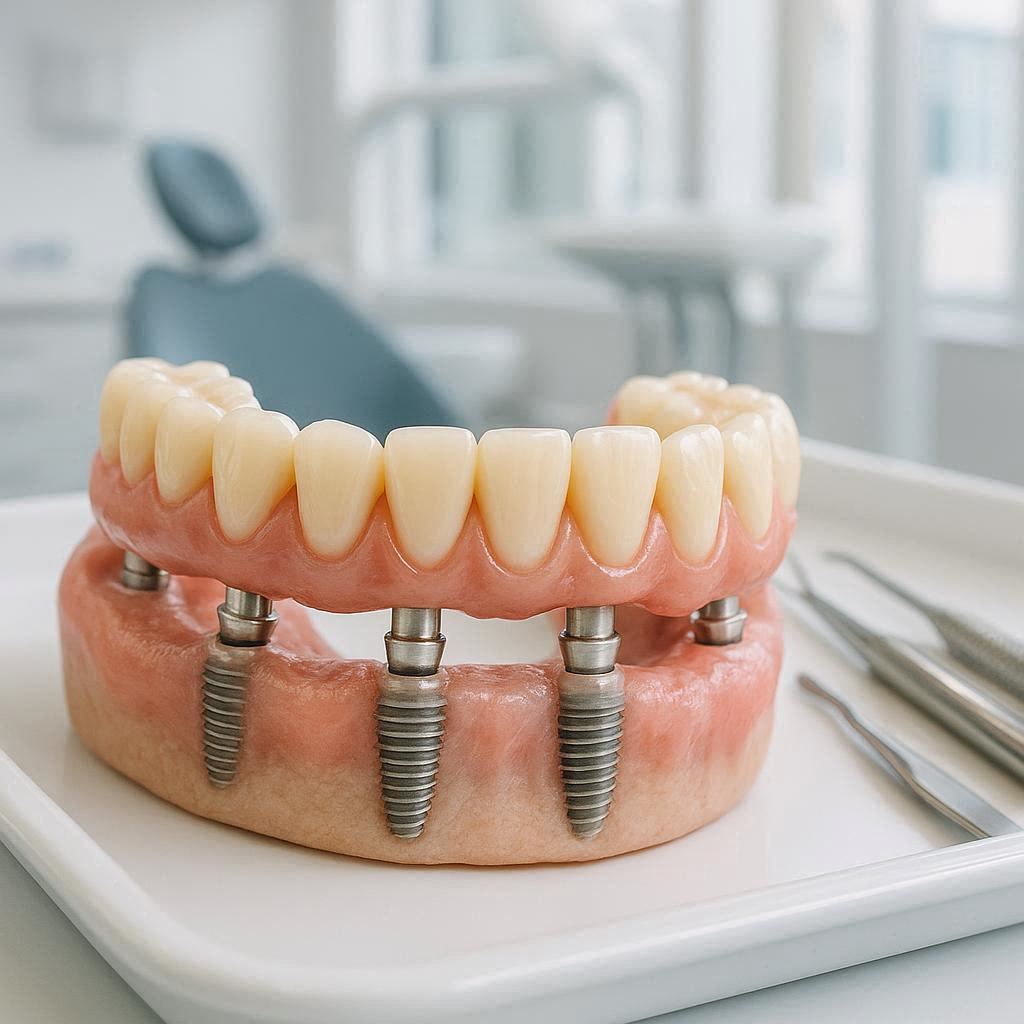
A dental implant replaces not just the visible tooth but also the root. A small titanium post goes surgically into your jawbone. Over time, that bone grows around the post. This creates a rock-solid anchor. Finally, we attach a realistic-looking crown on top.
For multiple missing teeth, you can get:
- Implant-supported bridges: Two implants hold a bridge of several teeth.
- Implant-supported dentures: A removable or fixed denture snaps onto 4–6 implants.
Important note: Implants require healthy bone and healing time. Not everyone is a candidate right away, but many people can become candidates with proper preparation.
The Great Debate: Implants vs. Dentures at a Glance
Let us start with a bird’s-eye view. The table below summarizes the key differences. Use this as your quick reference.
| Feature | Dentures | Implants |
|---|---|---|
| Cost (initial) | Lower (300–3,000 per arch) | Higher (1,500–6,000 per implant) |
| Long-term cost | Adjustments, relines, adhesives, replacements every 5–10 years | Minimal; mostly routine checkups |
| Stability | Can slip or click | Feels like natural teeth |
| Bone health | Does not stop bone loss | Prevents bone deterioration |
| Eating restrictions | Avoid sticky, hard, or tough foods | No restrictions (after healing) |
| Cleaning routine | Remove, brush, soak overnight | Brush and floss like natural teeth |
| Invasiveness | Non-invasive (impressions only) | Surgical procedure required |
| Healing time | Immediate (days) | Several months (3–8 months) |
| Insurance coverage | Often partially covered | Limited or excluded by basic plans |
Deep Dive #1: Dentures – The Tried-and-True Classic
Dentures have helped people smile for centuries. They remain a very valid choice for many. Let’s look under the hood.
The Good Side of Dentures (Pros)
- Affordable upfront cost. If your budget is tight, dentures offer a way to restore your smile without a large financial burden.
- Non-invasive process. No surgery. No needles (except for extractions if needed). Your dentist takes impressions, sends them to a lab, and you try on your new teeth.
- Quick results. From first consultation to wearing your dentures? Often 2–4 weeks. Some “immediate dentures” go in the same day as extractions.
- Repairable. Crack a denture? Many repairs happen in one day. Break an implant crown? That is more complex.
- No waiting for bone healing. Even with severe bone loss, you can wear dentures. They do not rely on bone density.
The Not-So-Good Side of Dentures (Cons)
- Movement and slipping. Dentures rest on gums. When you chew, talk, or laugh, they can shift. Adhesives help, but they do not solve the problem completely.
- Eating adjustments for life. Many people with dentures avoid corn on the cob, whole apples, steak, nuts, and sticky candies. The suction just is not strong enough.
- Bone resorption. When teeth go missing, your jawbone no longer receives stimulation. It slowly melts away. Over years, this changes your face shape. You may look older. Your dentures also become loose and need relining or replacement.
- Sore spots. Dentures rub against gum tissue. Pressure points develop. Most new denture wearers go through weeks or months of soreness and adjustments.
- Daily removal. You must take them out every night. You cannot sleep in dentures safely. You also need special cleaners and soaking solutions.
- Clicking and noise. Partial dentures with metal clasps can click when you eat. Some people find this embarrassing.
A Realistic Denture Timeline
- Week 1: Impressions taken. Lab creates your dentures.
- Week 2–3: Fitting appointment. Adjustments.
- Week 4–8: Learning curve. Sore spots. Follow-up adjustments.
- 3–6 months: Gums shrink. First reline needed.
- Every 2–5 years: Reline or remake dentures due to bone loss.
Quote from a real denture wearer:
“I was happy at first because I could smile again. But after two years, my dentures floated. I couldn’t taste my food properly. And my chin started to look pointy from bone loss. I wish someone had told me the long-term truth.”
Deep Dive #2: Dental Implants – The Modern Gold Standard
Implants are as close as we can get to growing new teeth. But they ask more of you upfront.
The Good Side of Implants (Pros)
- Feels like you. People with implants forget they have them. No slipping. No clicking. No adhesives.
- Eat anything. Bite into an apple. Tear into a steak. Enjoy sticky toffee. Implants handle forces like natural teeth.
- Protects your bone. The titanium post mimics a natural root. Your jawbone stays stimulated and healthy. Your face retains its shape.
- No special cleaning. Brush and floss normally. That is it. No soaking, no overnight removal.
- Long-lasting. With good care, many implants last 20+ years or a lifetime. The crown may need replacement after 10–15 years, but the post stays.
- Preserves adjacent teeth. Partial dentures can wear down the teeth they clasp onto. Implants stand alone. They do not harm neighbors.
The Not-So-Good Side of Implants (Cons)
- Higher upfront cost. One implant can cost as much as a full arch of dentures. For multiple teeth, the price adds up quickly.
- Surgery required. Placing an implant is a minor oral surgery. You need local anesthesia or sedation. Some people feel anxious about this.
- Long healing time. After placement, you wait 3–8 months for bone to fuse to the implant. Only then do you get your permanent crown.
- Not for everyone. Heavy smokers, uncontrolled diabetics, people with certain immune disorders, or those with severe bone loss may not be candidates without additional procedures (like bone grafting).
- Potential complications. Infection, nerve damage (rare), or implant failure (2–5% of cases) can occur.
- Harder to repair. If an implant fails or breaks, fixing it is surgically complex and expensive.
A Realistic Implant Timeline (Single Tooth)
- Day 1: Implant post placed surgically. Temporary tooth or leave space.
- Month 3–6: Healing and osseointegration (bone grows around implant).
- Month 6–7: Impressions for permanent crown.
- Month 7–8: Crown attached. Done.
For a full arch of implant-supported dentures, the timeline can stretch to 12–18 months.
Quote from a dental implant recipient:
“The surgery sounded scary. I almost backed out. Now, three years later, I honestly cannot tell which tooth is the implant. I eat ribs, nuts, everything. The cost was painful once. The denture pain was every single day.”
Head-to-Head Comparison: Real-Life Scenarios
Let us walk through common situations. This will help you see which option fits your actual daily life.
Scenario 1: The Budget-Conscious Retiree
Profile: Fixed income. Missing several lower teeth. Wants to smile for family photos. Does not eat nuts or tough meats anyway.
Recommendation: Lower partial denture. Affordable. Quick. No surgery. However, be prepared for future relines.
Alternative: Save for two lower implants. Even two implants can snap a lower denture in place, greatly improving stability. This “implant-retained denture” costs less than replacing every tooth with individual implants.
Scenario 2: The Active Professional
Profile: Age 45. Lost a front tooth in an accident. Needs to speak, smile, and eat in business lunches. Does not want any “clicking” or embarrassment.
Recommendation: Single implant. The natural feel and appearance are worth the cost and healing time.
Avoid: Partial denture with a visible metal clasp. It will move, click, and may affect your speech.
Scenario 3: The Person with Severe Bone Loss
Profile: Wore dentures for 15 years. Now they float. Gums are sore. Cannot afford bone grafting for implants.
Recommendation: New, well-fitted dentures with a soft reline. Combine with denture adhesive cream. Not ideal, but functional. Start saving for implant-supported dentures long-term.
Scenario 4: The “All-On-4” Candidate
Profile: Missing all upper teeth. Good general health. Has moderate bone but not enough for individual implants. Wants fixed, non-removable teeth.
Recommendation: All-on-4 implants. Four strategically placed posts support a full bridge. You never remove it. It feels like natural teeth. Higher cost but life-changing.
The Financial Reality Check
Money matters. Let’s talk numbers openly. Prices vary by location and dentist, but these figures give you a real-world range (USD, without insurance).
| Procedure | Low range | Average | High range |
|---|---|---|---|
| Full upper denture | $300 | $1,800 | $3,000 |
| Lower partial denture | $400 | $1,500 | $2,500 |
| Single implant (post + crown) | $2,000 | $4,000 | $6,000 |
| Implant-supported denture (2 implants) | $3,500 | $6,000 | $10,000 |
| All-on-4 (per arch) | $12,000 | $20,000 | $30,000+ |
Hidden costs of dentures:
- Adhesives: 5–15/month
- Cleaning tablets: 5–10/month
- Relines: 100–500 every 1–3 years
- Replacement: 300–3,000 every 5–10 years
Hidden costs of implants:
- Bone graft (if needed): 300–1,500 per site
- Sinus lift (upper jaw): 1,500–3,000
- CT scan: 200–500
- Replacement crown (after 10–15 years): 800–2,000
Important note: Many dental insurance plans cover part of dentures but only a small portion (or nothing) for implants. However, some discount plans and dental schools offer affordable implant care. Always ask for a written treatment plan before starting.
Daily Life with Each Option
A Day with Dentures
Morning: Soak dentures in cleaner overnight. Rinse them. Apply adhesive cream. Press firmly into place.
During breakfast: Soft eggs or oatmeal. Avoid biting into a hard bagel.
Midday lunch: Cut food into small pieces. Chew on both sides to prevent rocking.
Afternoon: Notice a sore spot. Remove dentures at home and rinse. Apply benzocaine gel.
Evening dinner: Denture slips slightly while eating pasta. Use tongue to push back.
Night: Remove dentures. Brush them with soft brush. Soak in solution. Gums rest overnight.
A Day with Implants
Morning: Brush and floss like any normal person.
Breakfast: Bite into toast or an apple. No hesitation.
Lunch: Eat a sandwich with crunchy pickles. No special cutting.
Afternoon: Forget you have implants. Seriously. You just live.
Dinner: Steak, corn on the cob, nuts. Everything is fine.
Night: Brush and floss. Go to sleep. No soaking. No removal.
The difference in daily freedom is enormous. Only you can decide if that freedom justifies the cost and surgery.
Who Should Choose Dentures? (Honest Advice)
Dentures are your best bet if:
- You have a very tight budget right now.
- You have medical conditions that prevent surgery.
- You have severe bone loss and cannot afford grafting.
- You are okay with dietary restrictions.
- You prefer a non-invasive, immediate solution.
- You are willing to commit to nightly removal and cleaning.
Dentures are not your best bet if:
- You have a strong gag reflex (the palate coverage of an upper denture can trigger gagging).
- You want to eat all foods without worry.
- You have high standards for stability and comfort.
- You do not want to deal with adhesives and soaking.
Who Should Choose Implants? (Honest Advice)
Implants are your best bet if:
- You can afford the upfront investment or finance the cost.
- You have healthy jawbone density (or can get a bone graft).
- You are a non-smoker or willing to quit for the healing period.
- You have good general health (controlled diabetes, no autoimmune issues).
- You want the closest thing to natural teeth.
- You hate the idea of removable appliances.
Implants are not your best bet if:
- You have uncontrolled active gum disease (treat it first).
- You take certain medications like bisphosphonates (for osteoporosis).
- You are a heavy smoker.
- You cannot tolerate multiple dental visits over 6–12 months.
- You have unrealistic expectations (implants still require maintenance).
The Middle Ground: Hybrid Solutions
You do not have to choose all dentures or all implants. Several hybrid options exist.
1. Implant-Retained Dentures
A removable denture snaps onto 2–4 implants. The denture still covers your palate (upper) or horseshoe shape (lower). But it does not move. No adhesives required.
Best for: People who want better stability without individual crowns for every tooth.
2. Overdentures
A denture that fits over a few remaining natural teeth or implants. The natural teeth (or implants) act as anchors.
Best for: People with a few healthy teeth left but too many missing for a bridge.
3. Fixed Implant Bridges
Two or more implants support a porcelain bridge. The bridge never comes out. It looks and feels like natural teeth.
Best for: Replacing 3–4 consecutive missing teeth.
Comparison of Hybrid Options
| Option | Removable? | Implants needed | Cost range | Stability |
|---|---|---|---|---|
| Traditional denture | Yes | 0 | $ | Poor |
| Implant-retained denture | Yes (snap on/off) | 2–4 | $$ | Good |
| Fixed implant bridge | No | 2–3 | $$$ | Excellent |
| All-on-4 | No | 4 | $$$$ | Excellent |
| Individual implants | No | Per tooth | $$$$$ | Excellent |
Step-by-Step Decision Framework
Follow this simple process. Do not rush.
Step 1: See a dentist for a complete exam.
Ask for X-rays or a CBCT scan to check bone levels. Do not skip this.
Step 2: Get two or three opinions.
Treatment plans and prices vary wildly. One dentist may push implants. Another may prefer dentures. Listen to both.
Step 3: Write down your priorities.
Rank these: cost, comfort, eating ability, convenience, appearance, longevity.
Step 4: Ask about financing.
CareCredit, LendingClub, and dental school clinics can make implants more accessible.
Step 5: Try the “denture test drive” if possible.
Some dentists offer “interim dentures” for a few hundred dollars. Wear them for a month. If you hate everything about them, save for implants.
Step 6: Consider future bone loss.
If you are under 60, implants protect your bone for decades. Dentures will lead to continued bone loss. Factor this in.
Care and Maintenance: Making Your Choice Last
Whichever path you pick, proper care extends the life of your investment.
Denture Care Checklist
- Rinse dentures after every meal.
- Brush dentures daily with a soft brush (not a regular toothbrush, which scratches).
- Use non-abrasive denture cleaner. Avoid toothpaste (too harsh).
- Soak dentures overnight in water or a mild solution.
- Never let dentures dry out.
- Brush your gums, tongue, and any natural teeth with a soft brush.
- See your dentist yearly for a fit check.
- Remove dentures for at least 6 hours every day (gums need rest).
Implant Care Checklist
- Brush twice daily with a soft or extra-soft brush.
- Floss daily. Use implant-specific floss or a water flosser.
- Avoid chewing ice, pens, or hard objects (just like natural teeth).
- Visit your dentist every 6 months for professional cleaning.
- Do not skip checkups. Your dentist will check the implant crown and the bone level.
- Wear a night guard if you grind your teeth (grinding can damage crowns).
Important note: Implants themselves cannot get cavities. But the gum tissue around them can develop inflammation (peri-implantitis). This is like gum disease for implants. It is preventable with good hygiene.
Busting Common Myths
Let’s clear up misinformation you may have heard.
Myth #1: “Dentures are ugly and obvious.”
False. Modern dentures look very natural. However, they may feel bulkier than natural teeth.
Myth #2: “Implants always work.”
Not true. The success rate is high (95%+ for healthy non-smokers), but failure happens. Smoking and poor oral hygiene increase risk.
Myth #3: “Once I get dentures, I’m done.”
No. Dentures require ongoing maintenance, relines, and replacement. They are not a one-time solution.
Myth #4: “Implants hurt terribly.”
Most people report less pain than a tooth extraction. Local anesthesia works well. Post-surgery soreness usually resolves with over-the-counter pain relievers.
Myth #5: “I am too old for implants.”
Age alone is not a barrier. Many people in their 80s and 90s get implants successfully. General health matters more than age.
Myth #6: “Partial dentures will ruin my remaining teeth.”
Partials can increase plaque buildup around clasped teeth. But with excellent cleaning, you can keep those teeth healthy for many years.
Real Patient Stories (Names Changed)
Margaret, 68 – Full Dentures at 60
“I chose dentures because I couldn’t afford implants. The first year was rough. Sore spots, learning to chew, the whole thing. After a few relines, they fit better. I still cannot eat nuts or sticky candy, and I miss that. But I smile again. For my budget, it was the right choice. Just be ready for the limits.”
David, 52 – Single Implant for Front Tooth
“I lost my front tooth playing basketball. The dentist offered a ‘flipper’ (a temporary partial denture). It looked okay but moved when I talked. I felt so self-conscious. I saved for an implant. The process took eight months. Honestly? Worth every penny and every minute. No one ever knows. I completely forget it is there.”
Linda, 74 – Implant-Retained Lower Denture
“My lower denture floated like a boat. I could not keep it down with any amount of glue. My dentist placed two implants. Now the denture snaps onto them. It does not move at all. I can eat a sandwich without holding it down with my tongue. Best $4,000 I ever spent.”
Robert, 45 – All-on-4 Upper
*“I had bad teeth my whole life. When I finally lost them all, I got a standard upper denture. The palate coverage made me gag constantly. I could not wear it. I felt hopeless. Then I learned about All-on-4. It cost $22,000. I financed it over five years. No palate coverage. No removal. It changed my life.”*
Frequently Asked Questions (FAQ)
1. Can I switch from dentures to implants later?
Yes. Many people start with dentures for financial reasons and upgrade to implants years later. The bone may have resorbed, so you might need a bone graft first.
2. How long does the implant surgery take?
A single implant placement takes about 60–90 minutes. Multiple implants may take 2–3 hours.
3. Will my insurance cover any of this?
Some plans pay 50% toward dentures up to a yearly limit. Implant coverage is rarer. Check your policy or consider a dental savings plan.
4. Can I sleep in my dentures?
No. Sleeping in dentures increases your risk of pneumonia, gum infections, and bone loss. Always remove them at night.
5. Do implants set off metal detectors?
Titanium is non-magnetic. You will not set off airport or courthouse metal detectors.
6. What if I have no bone for implants?
Bone grafting can rebuild lost bone. It adds time and cost but works well for most people.
7. Are dentures or implants better for my health?
Implants are healthier for your bone and overall oral function. But dentures are healthier than leaving missing teeth (which causes shifting, decay, and bone loss).
8. How do I clean implant-supported dentures?
Remove them. Brush the denture and the implants. Snap them back in.
9. Can I get implants if I have diabetes?
Yes, if your diabetes is well-controlled. Uncontrolled diabetes impairs healing and increases implant failure risk.
10. Which lasts longer – dentures or implants?
Implants last far longer (20+ years vs. 5–10 years for dentures). However, the crown on an implant will eventually wear out.
Conclusion: Summarized in Three Lines
Dentures offer an affordable, non-invasive way to replace missing teeth but require ongoing maintenance, limit your diet, and do not stop bone loss. Implants feel and function like natural teeth, protect your jawbone, and last decades—but demand a higher upfront investment, surgery, and healing time. Your best choice depends on your budget, health, lifestyle, and how much freedom you want when eating and smiling.
Disclaimer
This article is for informational purposes only and does not constitute medical or dental advice. Always consult with a licensed dentist or oral surgeon to evaluate your specific situation. Individual results vary based on health, bone quality, hygiene, and other factors. The author and publisher disclaim any liability for any decisions made based on this content.