Mini Dental Implants in Tallahassee FL: A Honest 2026 Guide
If you are missing teeth, you have probably spent more than a few late nights scrolling through dental websites. You want a solution that works. You want something that fits your budget. And you definitely want something that does not require a year of surgery and recovery.
That is where mini dental implants enter the conversation.
For residents of Tallahassee, FL, this option has become a popular middle ground between traditional implants and uncomfortable dentures. But is it the right choice for you?
This guide is different. We are not here to sell you anything. We are here to explain the real-world pros, cons, costs, and local factors for getting mini dental implants in Tallahassee in 2026. No fluff. No fake promises. Just honest, human-centered advice.
What Exactly Are Mini Dental Implants? (And How Are They Different)
Let us start with a simple comparison.
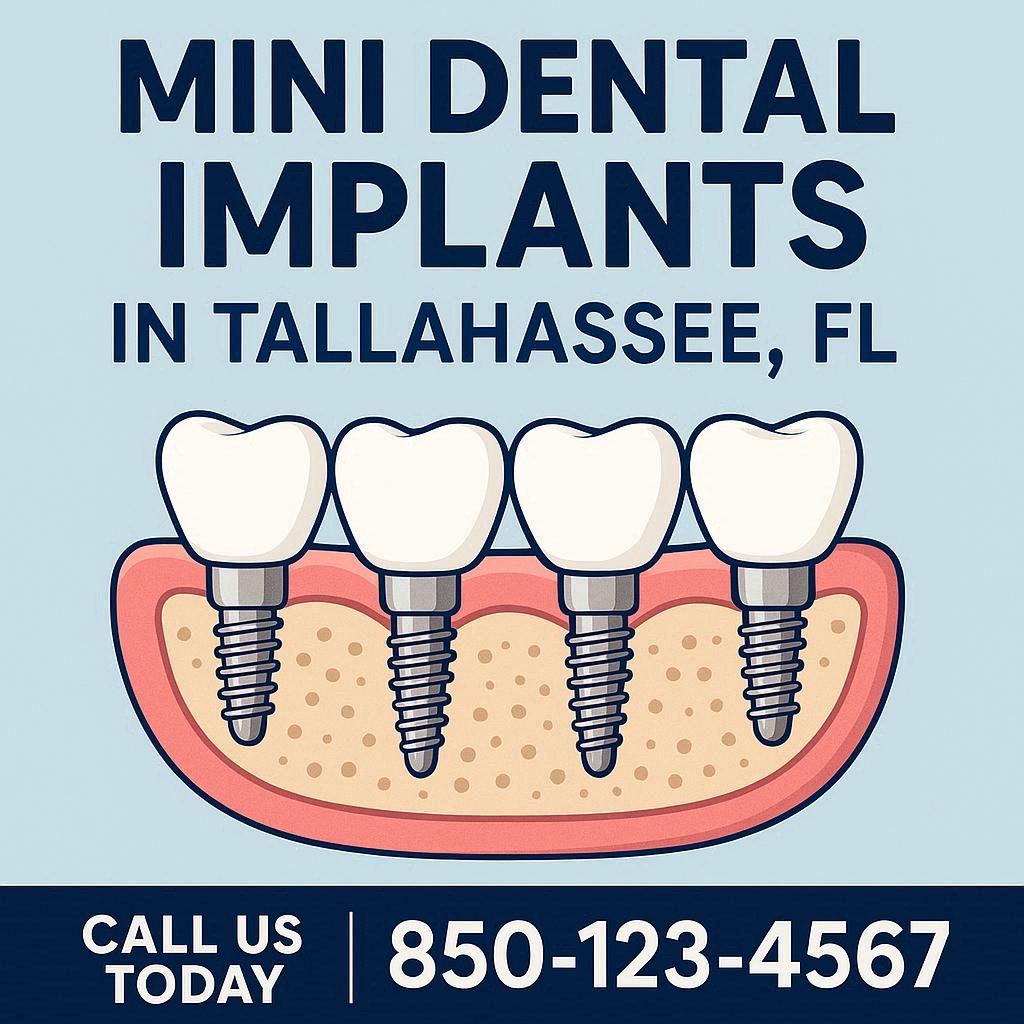
A traditional dental implant is about 3.5 to 5 millimeters wide. A mini dental implant is smaller—usually between 1.8 and 3 millimeters in diameter. Think of it like the difference between a thick garden hose and a sturdy drinking straw.
Because they are thinner, mini implants do not require major surgery. The dentist can often place them through a small puncture in your gum. In many cases, you do not need a second surgery to “expose” the implant later.
One-Piece Design
Most mini implants are a single piece of strong titanium alloy. The “post” that goes into your jawbone and the “ball” that holds your replacement tooth are connected. There is no separate abutment piece to screw on later.
This simplicity is exactly why many people in Tallahassee are asking their dentists about this option.
The Main Difference: Bone Density
Here is the most honest thing you will read today.
Traditional implants require a lot of healthy jawbone. If you have been missing teeth for years, your bone may have shrunk. That means bone grafts, healing time, and higher costs.
Mini dental implants do not need as much bone. They are smaller. They can fit into thinner areas of your jaw. For many patients with mild to moderate bone loss, this avoids the need for a bone graft completely.
Important Note: Mini implants are not a magic solution for severe bone loss. If your jawbone is very thin or soft, you may still need a graft or a traditional implant. An honest dentist in Tallahassee will tell you this during your first visit.
Why Tallahassee Residents Are Choosing Mini Dental Implants
Local factors matter. Tallahassee is a unique city. It has a large student population, a growing community of retirees, and many working professionals who cannot take weeks off for surgery.
Here is why the demand for mini dental implants in Tallahassee, FL has grown steadily over the last five years.
1. The “No Downtime” Advantage
Traditional implants require 4 to 8 months of healing before you get your final crown. That is a long time.
Mini implants can often be loaded immediately. That means you walk into the dental office in the morning with a missing tooth, and you walk out the same afternoon with a functional replacement. For busy people near Florida State University or state government workers downtown, this is a game-changer.
2. Lower Upfront Cost
Let us talk money honestly.
A single traditional implant in Tallahassee typically costs between 3,500and6,000 when you include the crown. That is a serious investment.
A mini dental implant usually runs between 1,500and3,000 per tooth. That is still not “cheap”—quality dental work never is—but it is significantly more accessible.
3. Stabilizing Lower Dentures
This is actually the most common use for mini implants.
If you have a lower denture that clicks, slides, or hurts, four to six mini implants can snap it into place like a button. The difference is life-changing. You can eat an apple again. You can laugh without holding your hand over your mouth.
Many Tallahassee dentists use mini implants specifically for denture stabilization rather than single-tooth replacements.
The Complete Pros and Cons (Realistic, Not Marketing)
You deserve both sides of the story. Here is a balanced look.
The Advantages
| Feature | What It Means for You |
|---|---|
| Minimally invasive | No large incisions. Less bleeding. Often no stitches. |
| Faster healing | Most patients feel normal within 2 to 3 days. |
| Lower cost | 40% to 60% less expensive than traditional implants. |
| Immediate results | Teeth can often be placed the same day. |
| No bone graft needed | Works with less jawbone volume. |
| Fewer appointments | Usually 2 to 3 visits total. |
The Disadvantages
| Feature | What to Consider |
|---|---|
| Less long-term data | Traditional implants have 50+ years of research. Mini implants have about 20 years. |
| Not for back molars | Mini implants are not strong enough for high-chewing force on molars. |
| Shorter lifespan | Traditional implants can last 30+ years. Mini implants often last 10 to 15 years with good care. |
| Harder to clean | The one-piece design can trap plaque if you do not floss carefully. |
| Not all dentists offer them | You need a provider specifically trained in mini implant placement. |
A word from a local Tallahassee prosthodontist (paraphrased): “Mini implants are excellent tools. But they are not the right tool for every job. I use them mostly for small front teeth and for locking dentures. For a back molar? No. That is like using a bicycle tire on a truck.”
Who Is a Good Candidate for Mini Dental Implants in Tallahassee?
You might be a good fit if you answer “yes” to most of these questions.
- Do you have one or more small missing teeth (incisors or premolars)?
- Are you missing most of your teeth and want to stabilize a denture?
- Do you have moderate bone loss but want to avoid a bone graft?
- Can you commit to excellent daily oral hygiene?
- Are you a non-smoker or willing to quit? (Smoking dramatically lowers success rates.)
- Do you have well-managed health conditions like diabetes?
You might not be a good fit if any of these apply.
- You grind or clench your teeth severely at night.
- You need to replace a lower molar that handles heavy chewing.
- You have untreated gum disease.
- You are looking for a “cheap” solution without proper dental care.
A Special Note for Tallahassee Seniors
Many retirees in Killearn Estates, Southwood, and Betton Hills ask about mini implants. If you have been wearing dentures for ten or more years, your bone has likely resorbed (shrunk). Mini implants can be a fantastic way to regain stability without a bone graft.
But be realistic: you will need to visit a local dentist for a CBCT scan (3D X-ray) to measure your actual bone volume. No ethical dentist will promise you mini implants without this scan.
The Step-by-Step Process: What to Expect Locally
Let us walk through the entire journey so there are no surprises.
Step 1: The Comprehensive Exam (Day 1)
You visit a Tallahassee dental office that offers mini implants. The dentist will:
- Take a 3D cone beam CT scan
- Review your medical history
- Check for gum disease
- Discuss your goals and budget
What it costs locally: Most Tallahassee offices charge 150to300 for this exam and scan. Some apply it to your treatment if you proceed.
Step 2: Treatment Planning (Day 7-14)
The dentist uses software to plan exactly where each mini implant will go. They will show you a digital preview of your new smile. You will discuss:
- Number of implants needed
- Type of restoration (crown, bridge, or denture anchors)
- Total cost and payment options
Step 3: The Placement Appointment (Day of procedure)
This is the main event. Here is what happens in simple terms.
First, the dentist numbs the area completely. You should feel pressure but not pain. Then they make a small pinhole in your gum. Using a special handpiece, they gently screw the mini implant into your jawbone. The round “ball” top remains above the gum line.
For a single tooth, the whole thing takes 30 to 45 minutes. For a full set of denture anchors, plan on 90 minutes to two hours.
The best part? In most cases, the dentist attaches your new tooth or snaps in your denture immediately after placing the last implant.
Step 4: Immediate Recovery (First 24 hours)
You will go home the same day. Expect:
- Mild to moderate soreness (like after a tough workout)
- Some minor bleeding for the first few hours
- Swelling that peaks around day two
- Instructions to eat soft foods for one week
Most people in Tallahassee return to work the next day. If you have a desk job, you can absolutely go back. If you do physical labor, take two or three days of rest.
Step 5: Healing and Osseointegration (2 to 4 months)
Yes, even mini implants need some healing time. Your bone needs to grow tightly around the implant. This process is called osseointegration.
During this period, you can eat normally, but avoid extremely hard or sticky foods. You also need to keep the area very clean.
Step 6: Final Restoration (If not done immediately)
If you received a temporary tooth on day one, you will return at month three or four for your permanent crown. The dentist removes the temporary, checks that the implant is stable, and attaches your final porcelain or zirconia tooth.
Cost Breakdown for Mini Dental Implants in Tallahassee, FL
Let us get specific about money. Prices in Tallahassee vary based on location, dentist experience, and materials used. These are realistic 2026 estimates.
| Procedure | Average Cost in Tallahassee | What Is Included |
|---|---|---|
| Single mini implant + crown | 1,800–3,200 | Implant, placement, abutment, final crown |
| Two mini implants + bridge | 3,500–5,500 | Two implants, bridge of 2-3 teeth |
| Four mini implants for lower denture | 4,000–6,500 | Implants, housing attachments, denture retrofitting |
| Six mini implants for full arch | 7,000–10,000 | Six implants, full fixed denture |
| CBCT scan (3D X-ray) | 250–450 | Diagnostic scan (often separate from treatment) |
Does Insurance Cover Mini Dental Implants?
This is tricky. Most traditional dental insurance plans do not cover implants of any kind. However, some PPO plans in Florida now offer partial coverage—usually 25% to 50% of the cost up to a yearly maximum.
What to do: Call your insurance provider and ask specifically about “CDT code D6010” for surgical placement. If they say no, ask about a medical insurance claim if tooth loss was due to an accident or injury.
Financing Options in Tallahassee
Many local dental offices work with:
- CareCredit (most common, 6-12 months no interest)
- LendingClub (longer terms, fixed rates)
- In-house payment plans (ask specifically—not all offices offer these)
Finding the Right Provider in Tallahassee
Not every general dentist places mini implants. You want someone who has placed at least 50 to 100 cases.
Questions to Ask Before Booking
Write these down and bring them to your consultation.
- “How many mini implant cases have you completed in the last three years?”
- “Do you use a 3D cone beam CT scan for every case?” (If they say no, walk out.)
- “What is your success rate for mini implants in patients like me?”
- “Do you offer a warranty on the implant or crown?”
- “Who handles emergencies if the implant fails after hours?”
Red Flags to Avoid
- A dentist who says everyone is a candidate
- Prices that seem too good to be true (under $1,000 per implant)
- No CBCT scanner in the office
- Reluctance to show before-and-after photos of their own work
- Promising that mini implants will last 30+ years (that is not realistic)
Green Flags to Look For
- Membership in the American Academy of Implant Dentistry
- Before-and-after photos of Tallahassee patients
- A clear, written treatment plan with all costs listed
- A conservative approach (telling you when you cannot get mini implants)
Long-Term Care and Maintenance
Here is the truth most websites avoid: mini implants require more daily attention than traditional implants.
Daily Cleaning Routine
- Floss threaders to clean underneath the crown or bridge
- Water flosser on a low setting to flush out debris
- Interdental brushes (the tiny Christmas tree shaped brushes)
- Non-abrasive toothpaste (no baking soda or charcoal)
Regular Professional Maintenance
You will need to visit your Tallahassee dentist every 6 to 12 months for a specific “implant maintenance” visit. This is not a regular cleaning. The dentist must:
- Check for implant mobility
- Measure gum pocket depths around the implant
- Remove hardened plaque with special plastic instruments (metal scalers can scratch mini implants)
Cost locally: 150to250 per implant maintenance visit.
Expected Lifespan
With excellent home care and regular checkups, mini implants typically last 10 to 15 years. Some last 20 years. But be realistic: they are smaller and more vulnerable than traditional implants.
If an implant fails, a good dentist can usually replace it. But you will pay for a new implant and crown.
Common Questions Tallahassee Patients Ask (Real Questions from Real People)
“Can I get mini implants if I smoke?”
This is a hard truth. Smokers have a 20% to 30% higher failure rate with mini implants. Nicotine restricts blood flow to your gums and bone. If you cannot quit, you are taking a serious risk. Some Tallahassee dentists will still treat you, but they will ask you to sign an extended consent form.
“Will my insurance cover the 3D scan?”
Sometimes. If your plan has “diagnostic” coverage, the CBCT scan may be covered at 80% after a small deductible. Call your provider and ask about code D0367.
“Do mini implants hurt during placement?”
No. The numbing works very well. You will feel vibrations and pressure but not sharp pain. Most patients describe it as “weird but not painful.” The injection for numbing is typically the most uncomfortable part.
“How soon can I eat normally after placement?”
Soft foods for one week. No hard nuts, ice, or chewy candy for one month. After that, you can eat steak, salad, sandwiches—almost everything except whole apples you bite into (slice them instead).
“Are mini implants safe for diabetics?”
Yes, if your diabetes is well-controlled. Your A1C should be below 7.0. Uncontrolled diabetes dramatically slows healing and increases infection risk. Be honest with your dentist about your numbers.
Alternatives to Mini Dental Implants in Tallahassee
You owe it to yourself to consider all options.
| Alternative | Best For | Average Cost | Pros | Cons |
|---|---|---|---|---|
| Traditional implants | Any tooth, especially molars | 3,500–6,000 | Longest lifespan, strongest | Expensive, requires more bone, longer healing |
| Removable partial denture | Multiple missing teeth | 800–1,800 | Lowest upfront cost, no surgery | Uncomfortable, moves, can damage adjacent teeth |
| Fixed dental bridge | 1-3 missing teeth in a row | 2,500–4,000 | No surgery, feels natural | Requires grinding down healthy teeth |
| Implant-supported bridge (traditional) | 2-4 missing teeth | 5,000–9,000 | Very stable, no healthy tooth damage | Expensive, longer treatment |
When a traditional implant is actually better: If you are replacing a lower first molar (the main chewing tooth), spend the extra money on a traditional implant. Mini implants are not strong enough for that high force area.
Local Tallahassee Considerations (Weather, Lifestyle, and Access)
Living in Florida’s capital city comes with specific dental considerations.
Humidity and Healing
Florida’s humidity does not directly affect implants, but it does affect you. High humidity can make you feel more uncomfortable after surgery. Swelling feels worse when it is 95 degrees outside. Schedule your placement procedure for the cooler months—November through March—if possible.
Active Lifestyles
If you are a runner on the Cascades Trail or a cyclist on the St. Marks Trail, you will be fine. Mini implants handle moderate impact well. However, if you play contact sports (rugby, football, martial arts), you absolutely need a custom mouthguard that covers the implant area.
Access to Specialists
Tallahassee has several excellent implant dentists, but it is not as large as Miami or Orlando. For complex cases involving severe bone loss, you may need to drive to Jacksonville (2.5 hours) or Tampa (4 hours) for a periodontist or oral surgeon who specializes in advanced bone grafting and traditional implants.
Step-by-Step Guide to Getting Started in Tallahassee
If you are ready to explore this option, here is your action plan.
Week 1: Search for “mini dental implants Tallahassee FL” on Google Maps. Make a list of five to seven offices that mention implants on their website.
Week 2: Call each office. Ask the three questions from earlier (number of cases, CBCT use, success rates). Eliminate anyone who seems vague or pushy.
Week 3: Schedule consultations with your top two choices. Do not let cost be the only factor. A cheaper dentist who replaces a failed implant is actually more expensive.
Week 4: Attend both consultations. Compare the treatment plans. Does one dentist recommend mini implants while the other recommends traditional? That is a yellow flag. Seek a third opinion.
Week 5: Choose your dentist. Request a written treatment plan with all costs, warranty information, and emergency contact details.
Week 6: Schedule your placement appointment. Arrange for someone to drive you home (the numbing takes hours to wear off).
Realistic Success Rates for Mini Dental Implants
Let us look at the actual research, simplified.
| Time Frame | Success Rate | Notes |
|---|---|---|
| 1 year | 95% – 98% | Very high, similar to traditional implants |
| 5 years | 90% – 95% | Slightly lower than traditional (96-98%) |
| 10 years | 85% – 90% | Significant difference from traditional (95%) |
| 15 years | 75% – 85% | Traditional implants still above 90% |
What this means for you: Mini implants are reliable for medium-term use. They are excellent if you are older and want a 10 to 15 year solution. They are less ideal if you are in your 30s or 40s and need something that will last 30+ years.
How to Extend the Life of Your Mini Implants
If you decide to move forward, follow these rules strictly.
- Never skip nightly flossing. Plaque builds up faster on mini implants.
- Buy a water flosser. Use it on the lowest effective pressure setting.
- Wear a nightguard if you grind. This is non-negotiable. Grinding can fracture a mini implant.
- Quit smoking. Every cigarette reduces blood flow to your jawbone.
- See your hygienist every 6 months. Regular cleanings are not optional.
- Report any mobility immediately. If your implant feels loose, call your dentist within 48 hours.
Common Complications and How Tallahassee Dentists Handle Them
Even in the best hands, complications happen. Here is how local professionals manage them.
Peri-implantitis (gum infection around the implant): This is the most common problem. Treatment includes deep cleaning, antibiotic gels, and in severe cases, laser therapy. Prevention is much easier than treatment.
Implant fracture: Mini implants can break if overloaded. There is no repair. The dentist must remove the broken piece and place a new implant nearby or switch to a traditional implant.
Screw loosening: The retention screw can loosen over time. This is a minor issue. Your dentist tightens it in five minutes. Do not try to tighten it yourself.
Poor cosmetic result: If the crown color or shape looks wrong, a good dentist will remake it at no charge within the first 30 to 90 days. Ask about this policy before you pay.
The Emotional Side of Replacing Missing Teeth
We have talked about bone, titanium, and costs. But let us address the real reason you are reading this.
Missing teeth affect how you smile, laugh, and eat with others. They can make you feel self-conscious at dinner with friends or family gatherings. That is not vanity. That is human nature.
Mini dental implants cannot fix everything. But for many people in Tallahassee, they have restored the simple joy of biting into a sandwich without fear. They have allowed people to smile in photos again.
A local patient in her sixties from Killearn Estates put it this way:
“I cried when I ate my first ear of corn in seven years. My dentures always slipped. With the mini implants, the corn came right off the cob. That sounds silly, but it was freedom.”
That is the real goal here. Not perfection. Just functional, comfortable teeth that let you live your life.
Conclusion (Three Lines Only)
Mini dental implants in Tallahassee, FL offer a faster, more affordable path to tooth replacement for the right candidates—especially for stabilizing dentures or replacing small front teeth. They are not a lifetime solution like traditional implants, but they provide excellent function for 10 to 15 years with proper care. Always get a 3D scan and a honest second opinion before committing to any implant procedure.
Frequently Asked Questions (FAQ)
Q1: How long do mini dental implants last on average?
A: With excellent oral hygiene and regular dental visits, mini implants typically last 10 to 15 years. Some last up to 20 years, but that is less common.
Q2: Can mini dental implants be used for all teeth?
A: No. They work well for small front teeth (incisors and canines) and for stabilizing dentures. They are not strong enough for back molars.
Q3: Are mini dental implants cheaper than traditional implants?
A: Yes. In Tallahassee, a single mini implant with crown costs 1,800to3,200, compared to 3,500to6,000 for a traditional implant.
Q4: Does insurance cover mini dental implants?
A: Most dental insurance plans do not cover implants. However, some Florida PPO plans offer 25% to 50% coverage. Call your provider to verify.
Q5: How painful is the procedure?
A: Most patients report mild to moderate soreness afterward, similar to a tooth extraction. The placement itself is not painful due to local anesthesia.
Q6: Can I get mini implants if I have osteoporosis?
A: Possibly, but you must inform your dentist. Some osteoporosis medications (bisphosphonates) increase the risk of jawbone complications.
Q7: How soon can I eat after getting mini implants?
A: Soft foods for one week. After that, you can gradually return to a normal diet, avoiding extremely hard items like nuts and ice for one month.
Q8: Do mini implants look natural?
A: Yes. The crown placed on top is made of porcelain or zirconia and color-matched to your existing teeth. Most people cannot tell the difference.
Q9: What happens if a mini implant fails?
A: Your dentist will remove it (a quick procedure), let the area heal for 8 to 12 weeks, and then place a new implant—often at a reduced cost.
Q10: Are mini implants removable?
A: No. They are permanently placed in your jawbone. Only the crown or denture attachment can be removed by a dentist for maintenance.
Additional Resource
For more official information on implant dentistry and to find accredited providers near Tallahassee, visit the American Academy of Implant Dentistry patient education page:
🔗 https://www.aaid.com/patient-education/
This resource offers a dentist locator tool, treatment videos, and downloadable guides to help you make an informed decision.
Disclaimer: This article is for informational purposes only and does not constitute medical or dental advice. Individual results vary. Always consult with a licensed dental professional in Tallahassee, FL, for a personal examination and treatment recommendation. The author and publisher are not responsible for any actions taken based on the content of this article.