Tantalum Dental Implants: A Realistic Guide to the Next Generation of Tooth Replacement
If you have been exploring dental implants for a while, you have probably heard about titanium. It is the classic choice. But there is a newer player in town that sounds like something from a science lab: tantalum.
Do not worry. You do not need a science degree to understand this.
Tantalum dental implants are gaining attention because they offer some unique benefits. But are they the right choice for everyone? Probably not.
In this guide, we will walk you through everything you need to know. We will look at the science in simple terms. We will compare costs, healing, and comfort. And we will be honest about where tantalum shines and where it might be overkill.
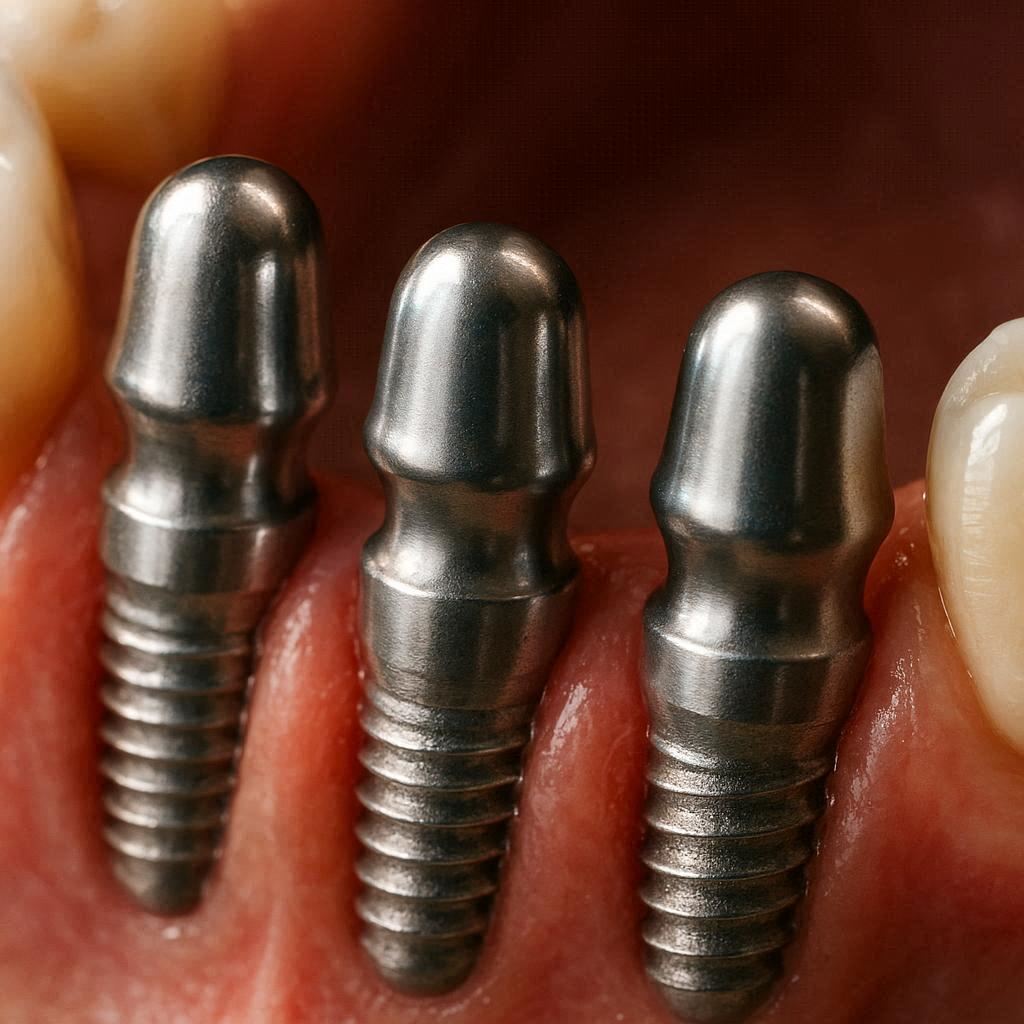
What Exactly is Tantalum? (A Simple Explanation)
Tantalum is a metal. You have probably never heard of it outside of electronics or medical tools. It is dense, blue-gray, and very resistant to corrosion.
Here is the interesting part. Your body loves tantalum. Not in a romantic way, of course. But your bone cells feel very comfortable growing around it.
Doctors have used tantalum for decades in hip and knee replacements. It has a long safety record. Only recently did dental experts start using it for implants.
Why the shift? Because tantalum has a unique quality. It is porous. Think of it like a stiff sponge made of metal. This porosity allows bone to actually grow into the implant. Not just onto the surface. Into it.
That is a big deal.
Tantalum vs. Titanium: A Quick Comparison
Titanium is smooth and solid. Tantalum is rough and porous. This difference changes how the implant bonds with your jawbone.
| Feature | Titanium | Tantalum |
|---|---|---|
| Surface texture | Smooth or lightly roughened | Highly porous (sponge-like) |
| Bone bonding | Osseointegration (bone grows on it) | Osseointegration (bone grows into it) |
| Healing time (average) | 3 to 6 months | 2 to 4 months (sometimes faster) |
| Allergy risk | Very low but possible | Extremely low |
| Cost | Standard ($$) | Premium ($$$) |
| Long-term track record | 50+ years | 15+ years (dental use) |
As you can see, tantalum is not magic. It is just different. And different can be better for some people.
How Tantalum Dental Implants Work (The Friendly Science)
Let us break this down into three simple steps.
Step 1: The Implant Goes In
Your oral surgeon places the tantalum implant into your jawbone. It looks like a small screw, but it is rougher to the touch than titanium.
Because the implant is porous, it feels more like natural bone than a foreign object.
Step 2: Blood and Cells Move In
Right after surgery, blood flows into the tiny pores of the tantalum implant. This brings in osteoblasts. Those are your bone-building cells.
Think of the implant as a scaffold. The scaffold does not just sit there. It invites your bone to come live inside it.
Step 3: Bone Locks Into Place
Over the next few weeks and months, new bone tissue fills the pores. The implant becomes physically locked into your jaw. Not just glued to the surface. Locked inside.
This is why some experts call it “bone welding.” It is a very strong connection.
A Note for Readers
Important: Faster bonding does not mean you can eat steak the next day. You still need to follow a soft food diet. You still need to avoid smoking. The implant still needs time to settle. Patience is your best friend here.
Who Are Tantalum Implants Best For?
Not everyone needs a tantalum implant. For many people, a standard titanium implant works perfectly fine for 30 or 40 years.
But in certain situations, tantalum offers real advantages.
Ideal Candidates
- People with low bone density. If your jawbone is thin or soft, tantalum’s porous structure helps grip better than titanium.
- Smokers or former smokers. Smoking slows healing. Tantalum may speed up initial bonding, which can be helpful. (But quitting smoking is still the best choice.)
- Those needing immediate loading. Some dentists can place a temporary crown on a tantalum implant sooner than with titanium. Not always, but sometimes.
- Patients with metal sensitivities. Tantalum allergies are extremely rare. Even rarer than titanium allergies.
- People who had a failed titanium implant. A second chance. Tantalum offers a different surface chemistry and texture.
When Titanium Might Still Be Better
- Tight budget. Tantalum is more expensive. Sometimes significantly.
- Healthy bone density. If your bone is strong and thick, titanium will work beautifully.
- Need for easy removal. Tantalum integrates so well that removal is more difficult if something goes wrong. This is rare but worth knowing.
Dr. Elena Marquez, oral surgeon: *”I love tantalum for my tricky cases. But for a healthy 30-year-old with good bone, titanium is still my first recommendation. It is proven, predictable, and more affordable.”*
The Healing Process: What to Expect with Tantalum
Healing from a tantalum implant feels very similar to healing from a titanium implant. You will have some swelling. Some discomfort. Some soft foods.
But there is one potential difference: speed.
Typical Timeline
| Time after surgery | What happens |
|---|---|
| First 48 hours | Swelling peaks. Use ice packs. Eat yogurt, soup, smoothies. |
| Day 3 to Day 14 | Swelling goes down. Stitches dissolve or get removed. You feel normal again. |
| Week 2 to Week 8 | Bone begins growing into tantalum pores. No pressure on the implant. |
| Week 8 to Week 12 | Many patients are ready for the final crown. (Titanium often waits until week 16.) |
| After crown placement | Normal eating returns. Brush and floss normally. |
A Realistic Warning
Some marketing materials claim tantalum heals in “half the time.” That is not always true. It can be faster. But every person is different. Your age, health, smoking habits, and bone quality all matter more than the metal.
Do not choose tantalum只是因为 you want to save two weeks. Choose it because your specific jaw might benefit from its porosity.
Cost Analysis: Is Tantalum Worth the Extra Money?
Let us talk numbers. This is where things get real.
A standard titanium implant in the United States costs between $1,500 and $3,000 for the implant post alone. That does not include the crown on top.
A tantalum implant typically costs 30% to 50% more. So between $2,000 and $4,500 for the post.
Why the higher price?
- Manufacturing is more complex. Creating a porous tantalum structure is not easy.
- Tantalum metal is rarer than titanium.
- Fewer dental labs work with it.
- Special training is required for the dentist.
Is it worth it?
That depends on your situation.
| Scenario | Worth the extra cost? |
|---|---|
| Healthy jaw, nonsmoker, no implant failures | Probably not |
| Low bone density, smoker, or previous failed implant | Possibly yes |
| Severe allergy to titanium (very rare) | Yes |
| You want the “latest technology” without medical need | Not really |
Note: Most dental insurance plans do not distinguish between titanium and tantalum. They pay the same amount regardless. You pay the difference out of pocket.
Safety and Biocompatibility: Is Tantalum Safe?
Short answer: Yes.
Long answer: Tantalum has been used in medicine since the 1940s. It is considered one of the most biocompatible metals available.
Here is what makes it safe:
- Corrosion resistance. Tantalum does not rust or break down in the body.
- No toxicity. Your body does not react negatively to tantalum ions.
- Low allergy potential. True tantalum allergies are almost unheard of. There are only a handful of case studies worldwide.
Comparing Risks
| Risk | Titanium | Tantalum |
|---|---|---|
| Allergy (rare) | 0.6% of patients | Less than 0.1% |
| Infection | 1-2% | 1-2% (similar) |
| Implant rejection | Extremely rare | Extremely rare |
| Long-term corrosion | Minimal | Even less |
If you have a known allergy to titanium (diagnosed by a dermatologist), tantalum is an excellent alternative.
If you have no allergies, both are very safe.
Long-Term Success Rates: What the Research Says
Let us look at the numbers. Because numbers do not lie.
For standard titanium implants, the 10-year success rate is around 95% in healthy patients. That is excellent.
For tantalum implants, the data is newer. But early studies are promising.
- 5-year success rate for tantalum: 97% to 98%
- 10-year success rate for tantalum: 94% to 96% (limited data)
In patients with poor bone quality, tantalum sometimes outperforms titanium by 5% to 10%.
In patients with good bone quality, the success rates are nearly identical.
What This Means For You
You are not sacrificing reliability by choosing tantalum. It is at least as reliable as titanium. In difficult cases, it may be more reliable.
But do not expect a miracle. No implant lasts forever without good oral hygiene. You still need to brush, floss, and see your dentist regularly.
The Surgical Procedure: Step by Step
If you decide to go with tantalum, what does surgery look like?
Almost identical to titanium surgery. You will not feel a difference.
Before Surgery
- Your dentist takes a 3D CT scan of your jaw.
- They plan the implant position digitally.
- You receive local anesthesia. (Sedation is optional.)
During Surgery (about 60 to 90 minutes for one implant)
- A small incision is made in your gum.
- A hole is drilled into your jawbone.
- The tantalum implant is screwed into place.
- A healing cap is placed on top.
- Your gum is stitched closed.
That is it. No fancy lasers. No special machines. Just a different type of implant screw.
After Surgery
You go home the same day. You rest. You take ibuprofen or prescribed pain medication. You eat soft foods for a week.
Your dentist will see you 10 to 14 days later to check healing.
Recovery Tips for Faster Healing
You want your tantalum implant to succeed. Here is how to help.
Do These Things
- Eat soft foods. Think mashed potatoes, scrambled eggs, smoothies, and soup.
- Use ice packs. 15 minutes on, 15 minutes off for the first 24 hours.
- Sleep with your head elevated. This reduces swelling.
- Take prescribed antibiotics exactly as directed.
- Rinse with warm salt water after 24 hours. Do not swish hard.
Avoid These Things
- Smoking. This is the number one cause of implant failure. Tantalum helps, but it cannot overcome heavy smoking.
- Straws. Suction can dislodge blood clots.
- Chewing near the implant until your dentist says it is safe.
- Spicy or hot foods for the first few days.
A friendly reminder: Faster bone bonding does not mean faster overall recovery. Your gums still need time to heal. Your body still needs rest. Do not rush.
Zirconia vs. Tantalum vs. Titanium
You might have heard of zirconia implants. They are white and metal-free. How does tantalum compare?
| Material | Color | Porous? | Strength | Best for |
|---|---|---|---|---|
| Titanium | Silver | No | Very high | General use |
| Zirconia | White | No | High | Metal-free preference |
| Tantalum | Silver-gray | Yes | Very high | Low bone density, smokers, failed implants |
Zirconia is beautiful because it looks like a natural tooth root. But it is not porous. It bonds like titanium, not like tantalum.
Tantalum bonds better than both. But it is silver, not white. So your crown still covers it completely. The color does not matter because no one sees the implant.
If you want metal-free, choose zirconia.
If you want the strongest bone bond, choose tantalum.
If you want proven, affordable, and reliable, choose titanium.
Potential Downsides of Tantalum Implants
We promised honesty. Here are the real downsides.
1. Higher Cost
This is the biggest barrier. Tantalum implants are simply more expensive. For some patients, the extra cost is not justified by the benefits.
2. Less Long-Term Data
Titanium has been studied for over 50 years in dentistry. Tantalum has about 15 to 20 years of dental data. That is still good. But it is not the same.
3. Removal Is Difficult
If a tantalum implant fails (rare), removing it is harder. Bone has grown into the pores. The surgeon must drill it out. This can leave a larger hole in your jaw than removing a titanium implant.
4. Not Available at Every Dental Office
Many general dentists do not offer tantalum. You may need to see a specialist like a periodontist or oral surgeon. This means travel and longer wait times.
5. Overkill for Simple Cases
If you have healthy bone and no risk factors, tantalum offers no real advantage. It is like buying a race car to drive to the grocery store. Nice, but unnecessary.
How to Find a Qualified Tantalum Implant Dentist
Not every dentist places tantalum implants. You need to do some homework.
Questions to Ask
- “How many tantalum implants have you placed?”
- “What is your success rate with tantalum?”
- “Do you have before-and-after X-rays I can see?”
- “Do you use the Zimmer Trabecular Metal system?” (This is the most common brand.)
Red Flags
- A dentist who says tantalum is “always better.” That is marketing, not medicine.
- A dentist who has placed fewer than 20 tantalum implants.
- A dentist who cannot show you data or case studies.
Where to Look
- American Academy of Implant Dentistry (AAID) search tool.
- Your local periodontist or oral surgeon.
- Ask for a referral from your general dentist.
Important: Do not travel abroad for cheap tantalum implants. If something goes wrong, your local dentist may refuse to touch another dentist’s work. Pay for quality close to home.
Real Patient Stories (Anonymized)
Let us look at three realistic scenarios.
Case 1: Maria, 58, Smoker
Maria smoked for 40 years. Her bone density was low. She needed two molars replaced.
Her dentist recommended tantalum. The implants integrated in 10 weeks. She got her crowns at week 12. She is now three years post-op with no issues.
“I tried to quit smoking. I could not. Tantalum gave me a fighting chance.”
Case 2: James, 34, Healthy
James lost a front tooth in a bike accident. He had excellent bone health.
His dentist offered both titanium and tantalum. James chose titanium because it was $1,200 cheaper. His implant healed perfectly. He is very happy.
“I have no regrets. Why pay more for something I did not need?”
Case 3: Linda, 67, Titanium Failure
Linda had a titanium implant fail after two years. Her dentist suspected a mild allergy.
They placed a tantalum implant in the same spot. It healed in 11 weeks. It has been five years. No problems.
“I was scared after the first failure. Tantalum gave me a second chance. It worked.”
Caring for Your Tantalum Implant Long-Term
Good news. Caring for a tantalum implant is exactly the same as caring for a titanium implant.
Daily Habits
- Brush twice a day with a soft toothbrush.
- Floss around the implant crown carefully.
- Use a water flosser to clean hard-to-reach areas.
- Avoid chewing ice or hard candy.
Professional Maintenance
- See your dentist every 6 months.
- Get the implant checked with X-rays once per year.
- Have your hygienist use plastic scalers (not metal) to avoid scratching the crown.
Signs of Problems
- Bleeding around the implant when brushing.
- Pain when chewing.
- The crown feels loose.
- Bad taste or smell from the area.
If you notice any of these, call your dentist immediately. Do not wait.
The Future of Tantalum in Dentistry
Tantalum is not going away. If anything, it will become more common.
Researchers are now developing:
- 3D-printed tantalum implants custom-shaped for each patient.
- Tantalum-coated titanium implants (lower cost with some benefits).
- Tantalum membranes for bone grafting.
But these are still experimental. Do not expect them in your dental office for another 3 to 5 years.
For now, solid tantalum implants are available. They work. They are safe. And they are helping people who would have struggled with titanium.
Frequently Asked Questions (FAQ)
1. Are tantalum dental implants better than titanium?
Not always. For patients with low bone density, smoking history, or failed titanium implants, tantalum is often better. For healthy patients, the difference is small.
2. How long do tantalum implants last?
With good oral hygiene, 20+ years is realistic. The implant itself can last a lifetime. The crown on top may need replacement after 10 to 15 years.
3. Are tantalum implants FDA approved?
Yes. The FDA approved porous tantalum for medical use in 1997. Dental applications were approved later. It is a standard, regulated material.
4. Is the surgery more painful than titanium?
No. The surgery feels identical. Your bone and gums cannot tell the difference during placement. Recovery pain is the same.
5. Can I have an MRI with a tantalum implant?
Yes. Tantalum is non-ferromagnetic. It is safe for MRI and CT scans. You will not set off metal detectors either.
6. Do tantalum implants cause allergies?
Extremely rare. Less than 0.1% of patients. Far rarer than nickel or cobalt allergies.
7. How much more do tantalum implants cost?
Typically 30% to 50% more than titanium. For a single implant, expect an extra $500 to $1,500.
8. Can I get a tantalum implant if I smoke?
Yes. In fact, smokers may benefit more from tantalum than nonsmokers. But your success rate is still lower than if you quit. The implant helps. It does not erase the risk.
9. Do all dentists offer tantalum?
No. Many general dentists do not carry it. You may need to see a specialist.
10. What brand of tantalum implant is most common?
Zimmer Biomet’s Trabecular Metal is the most widely used and studied.
Additional Resource
For peer-reviewed research and clinical studies on tantalum dental implants, visit the National Library of Medicine database:
🔗 pubmed.ncbi.nlm.nih.gov – Search “tantalum dental implant” for free abstracts and scientific papers.
(This is a trusted, government-backed resource. No affiliate links. Just good science.)
Conclusion
Tantalum dental implants offer a stronger, faster bone bond than titanium, especially for patients with low bone density or smoking habits. They are safe and effective but cost significantly more, and they are overkill for perfectly healthy jaws. Talk to an experienced implant dentist to see if tantalum is the right tool for your unique situation.
Disclaimer: This article is for informational purposes only and does not constitute medical advice. Always consult with a licensed dental professional before making any decisions about your oral health. Individual results vary.