The Cost Of Replacing A Cavity Filling?
You are eating a crunchy snack, and suddenly you feel it. A sharp edge. A piece of something hard in your mouth. You reach in and realize it is a piece of your filling. Or maybe your dentist told you during your last checkup that one of your old fillings is worn down and needs to be replaced. Either way, you are now facing a common but annoying situation: replacing a cavity filling.
The good news is that replacing a filling is usually a simple, straightforward procedure. It is similar to getting a filling in the first place. The bad news is that it still costs money. And the cost can vary widely depending on what type of filling you need, where you live, and whether you have insurance.
This guide will break down the real costs of replacing a cavity filling. We will explain why fillings need to be replaced, what the procedure involves, how much it costs, and how insurance works. We will also look at how replacement costs compare to other dental restorations and what you can do to avoid needing a replacement in the first place.
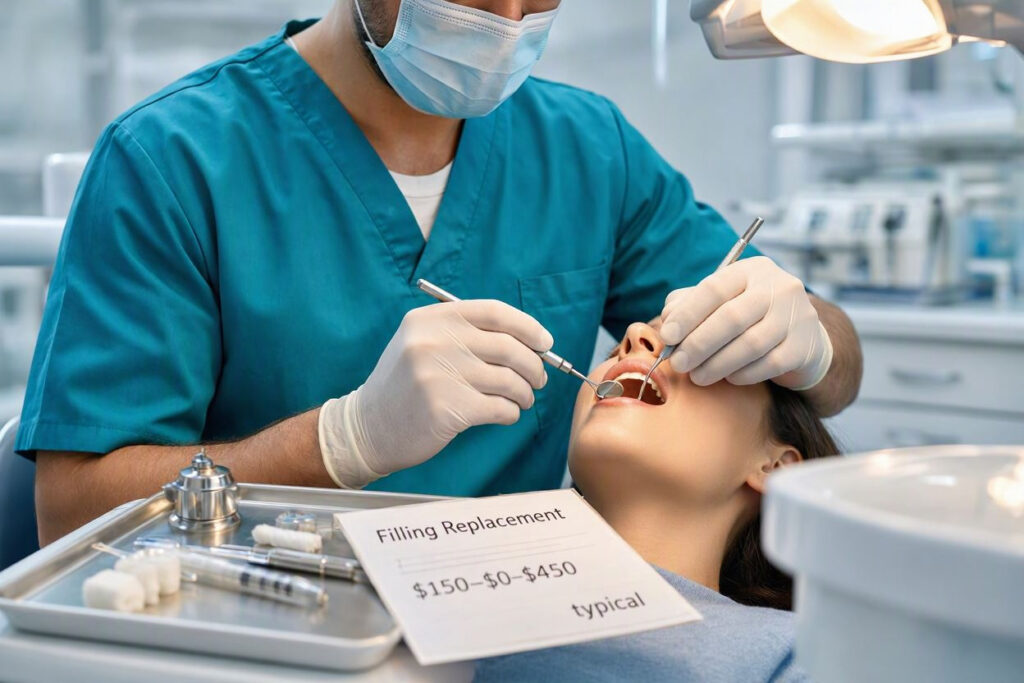
Why Do Fillings Need To Be Replaced?
Fillings are not permanent. They have a lifespan. Over time, they can wear down, crack, or become loose. When this happens, bacteria can seep underneath the filling and cause decay. If the decay is not treated, it can spread to the pulp of the tooth, requiring a root canal or extraction.
Common Reasons For Filling Replacement
- Wear And Tear: Fillings endure a lot of pressure from chewing. Over time, they can wear down, especially on back teeth.
- Cracking Or Chipping: Fillings can crack or chip, creating rough edges that trap food and bacteria.
- Loose Filling: If a filling becomes loose, it can fall out. This leaves the tooth vulnerable to decay.
- Decay Underneath: The most common reason for replacement. Decay forms around the edges of the filling or underneath it.
- Fractured Tooth: Sometimes the tooth around the filling cracks. The filling may need to be replaced with a crown.
- Cosmetic Reasons: Some people replace old silver (amalgam) fillings with tooth-colored (composite) fillings for aesthetic reasons.
How Long Do Fillings Last?
The lifespan of a filling depends on the material, the size of the filling, and your oral habits.
- Amalgam (Silver): 10 to 15 years
- Composite (Tooth-Colored): 5 to 10 years
- Glass Ionomer: 5 to 7 years
If you grind your teeth, chew on ice, or have poor oral hygiene, your fillings will not last as long.
The Cost Of Replacing A Cavity Filling
The cost of replacing a filling is similar to the cost of getting a new filling. It depends on the type of material, the size of the filling, and the location of the tooth.
Table: Average Cost Of Replacing A Filling (Without Insurance)
| Type Of Filling | Average Cost Range (USD) | Notes |
|---|---|---|
| Amalgam (Silver) – 1 Surface | $50 – $150 | Cheapest option |
| Amalgam (Silver) – 2-3 Surfaces | $100 – $250 | Larger filling |
| Composite (Tooth-Colored) – 1 Surface | $90 – $250 | Most common |
| Composite (Tooth-Colored) – 2-3 Surfaces | $150 – $350 | Larger filling |
| Glass Ionomer | $80 – $200 | Often for baby teeth or near gumline |
| Inlay/Onlay | $250 – $600 | For larger replacements |
| Crown (if tooth is badly damaged) | $800 – $2,500 | Full coverage restoration |
Important Note: These prices are per tooth. If you need multiple fillings replaced, the cost multiplies. The prices also do not include the exam or X-rays, which are often separate charges.
What Determines The Cost Of Replacing A Filling?
Several factors influence the price of replacing a filling.
1. Geographical Location
Dental fees are higher in cities with a high cost of living. A composite filling replacement in rural Mississippi might cost $120. The same procedure in San Francisco could cost $350.
2. The Type Of Filling Material
Composite fillings are more expensive than amalgam fillings. This is because the material costs more, and the procedure takes longer. Glass ionomer fillings are usually the cheapest.
- Amalgam: $50 – $250
- Composite: $90 – $350
- Glass Ionomer: $80 – $200
3. The Size Of The Filling
A small, one-surface filling is cheaper to replace than a large, multi-surface filling. The dentist has to remove the old filling, clean the area, and place the new filling. More surfaces mean more work.
4. The Location Of The Tooth
Back teeth (molars and premolars) are harder to reach. The dentist has to maneuver around the tongue and cheeks. This takes more time and skill. Front teeth are easier to access, but they require better aesthetics.
- Front Tooth: $90 – $250
- Back Tooth: $150 – $350
5. The Condition Of The Tooth
If the tooth is badly decayed or cracked, a simple filling replacement may not be enough. You may need a larger restoration.
- Inlay/Onlay: $250 – $600
- Crown: $800 – $2,500
- Root Canal: $700 – $1,500
6. The Dentist’s Experience
A seasoned dentist with decades of experience may charge more than a new graduate. You are paying for their expertise and efficiency.
7. The Type Of Practice
A boutique dental spa with luxury amenities will charge more than a basic family practice. You are paying for the experience and the environment.
Does Insurance Cover Replacing A Filling?
Dental insurance usually covers filling replacements, but there are rules. Most plans classify fillings as “basic restorative care.”
Typical Coverage
- Coverage Percentage: 80% of the cost.
- Deductible: You must meet your annual deductible first (usually $50 to $100).
- Annual Maximum: Your plan has an annual maximum benefit (usually $1,000 to $1,500).
The Replacement Rule
Here is an important caveat: Insurance companies often have a rule about how often they will pay for a filling on the same tooth. This is called the “replacement frequency limit.” It is usually 2 to 5 years. If you need a filling replaced sooner than that, the insurance company may deny the claim.
Why? They want to make sure the original filling was not defective or improperly placed. If it was, the dentist should replace it for free. If the replacement is needed due to new decay, the insurance company may still deny it if it is within the frequency limit.
How The Math Works
Let’s say you need a composite filling replaced. It costs $250. Your insurance covers 80% after a $50 deductible.
- Total Cost: $250
- Deductible: $50
- Amount Subject To Coverage: $200
- Insurance Pays (80%): $160
- You Pay (Deductible + 20%): $90
Table: Example Of Insurance Coverage For A Filling Replacement
| Amount | |
|---|---|
| Dentist’s Fee | $250 |
| Annual Deductible (Unmet) | $50 |
| Amount Subject To Coverage | $200 |
| Insurance Pays (80%) | $160 |
| Your Out-of-Pocket | $90 |
Important Note: If your insurance denies the claim due to the frequency limit, you have the right to appeal. Your dentist can send a narrative explaining why the replacement is medically necessary.
What If You Don’t Have Insurance?
If you are paying out of pocket, replacing a filling can feel expensive. Here are several ways to reduce the cost.
1. Dental Schools
Dental schools offer fillings at reduced rates. A composite filling replacement at a dental school might cost $50 to $100. The work is done by students under the supervision of licensed dentists. It takes longer, but the savings are significant.
2. Dental Membership Plans
Many private practices offer in-house membership plans. You pay an annual fee (e.g., $300 to $400). In exchange, you get cleanings, exams, X-rays, and a discount on other treatments like fillings. The discount is usually 10% to 20%.
3. Payment Plans
Most dentists offer in-house payment plans. You pay a down payment and then monthly installments. Some offer interest-free plans for 6 to 12 months.
4. Third-Party Financing
Companies like CareCredit offer loans for dental procedures. You can apply online and get a decision quickly. Be aware of interest rates.
5. Negotiate
Do not be afraid to ask for a discount. Some offices offer a 5% to 10% discount for cash payment. It never hurts to ask.
6. Consider A Different Material
If composite is too expensive, consider an amalgam filling. It is cheaper and still strong. It may not look as natural, but it can save you money.
The Cost Of Not Replacing A Filling
Skipping a filling replacement to save money can lead to bigger problems.
- Decay Spreads: The decay will grow. It will reach the pulp, causing pain and infection.
- Root Canal Needed: You will need a root canal, which costs $700 to $1,500.
- Crown Needed: After a root canal, you need a crown, which costs $800 to $2,500.
- Tooth Loss: If the tooth cannot be saved, it must be extracted. Replacing it with an implant costs $3,000 to $6,000.
The Math:
- Prevention: $250 for a filling replacement.
- Treatment: $2,000 for a root canal and crown, or $5,000 for an implant.
The Lesson: Replacing a filling early is cheaper and less painful than waiting.
Filling Replacement Vs. New Filling
Is replacing a filling more expensive than getting a new one? Not usually. The procedure is similar. The dentist removes the old filling, cleans the tooth, and places a new filling. The cost is about the same.
However, if the old filling was large, or if there is decay underneath, the replacement may be more complex. You may need an inlay, onlay, or crown instead of a simple filling. This increases the cost.
Table: Filling Replacement Vs. New Filling
| Procedure | Average Cost Range (USD) |
|---|---|
| New Composite Filling (1 surface) | $90 – $250 |
| Replacement Composite Filling (1 surface) | $90 – $250 |
| New Composite Filling (2-3 surfaces) | $150 – $350 |
| Replacement Composite Filling (2-3 surfaces) | $150 – $350 |
| Inlay/Onlay | $250 – $600 |
| Crown | $800 – $2,500 |
What Do Patients Say?
We spoke to three patients about their experiences with filling replacements.
Jennifer, 42, had a composite filling replaced.
“I had a filling that was about 8 years old. It started to feel rough, and food was getting stuck. My dentist replaced it with a new composite filling. It cost $220. My insurance covered 80%. I paid about $44. It was quick and painless.”
David, 58, had an old amalgam filling replaced.
“I had a silver filling that was 20 years old. It cracked. My dentist recommended replacing it with a composite filling. It cost $300. I do not have insurance, so I paid out of pocket. It was worth it. It looks much better.”
Maria, 35, had a filling replaced and needed a crown.
“I had a large filling that was failing. My dentist said there was not enough tooth left to hold a new filling. I needed a crown. The total cost was $1,500. It was a lot of money, but I did not want to lose the tooth.”
Frequently Asked Questions
Q: How much does it cost to replace a cavity filling?
A: It typically costs $50 to $350 per tooth, depending on the material, size, and location. If a crown is needed, the cost is $800 to $2,500.
Q: Does insurance cover replacing a filling?
A: Yes, most dental insurance plans cover filling replacements at 80% after a deductible. However, there may be a frequency limit. If you need a replacement too soon, the claim may be denied.
Q: How long does it take to replace a filling?
A: A simple filling replacement takes about 20 to 30 minutes. A larger filling or a replacement that requires more work may take 45 to 60 minutes.
Q: Does replacing a filling hurt?
A: The dentist will numb the area with local anesthetic. You will feel pressure but not pain. Afterward, you may have mild sensitivity for a few days.
Q: Can I eat after a filling replacement?
A: If you had a composite filling, you can eat as soon as the numbness wears off. If you had an amalgam filling, you should wait 24 hours before chewing on that side.
Q: What happens if I don’t replace a broken filling?
A: The tooth is vulnerable to decay. Bacteria can enter the tooth, causing pain and infection. You may need a root canal or extraction.
Q: Can I replace a silver filling with a white filling?
A: Yes. Many people choose to replace old amalgam fillings with composite fillings for aesthetic reasons. The cost is usually the same as a new composite filling.
Conclusion
Replacing a cavity filling is a common and affordable procedure. The cost ranges from $50 to $350 for a simple replacement. If the tooth is badly damaged, a crown or root canal may be needed, which costs more. Insurance usually covers 80% of the cost, but there may be frequency limits. If you do not have insurance, dental schools, payment plans, and membership plans can help. The most important thing is to replace a failing filling promptly. A small replacement today prevents a major, painful, and expensive problem tomorrow.
Additional Resources
For more information on dental fillings and restorative care, visit the American Dental Association (ADA) at ada.org. They provide patient resources on fillings, crowns, and other common procedures.