What Are Invisalign Bite Rims Used For?
Invisalign bite rims are specialized, temporary structures incorporated into clear aligners during a critical phase of treatment known as bite registration. They are not a standard feature of routine aligner therapy. Their primary purpose is to capture and record the precise three-dimensional relationship between the upper and lower jaws when a patient’s bite requires significant reconstruction or when a new jaw position is therapeutically mandated. An Invisalign bite rim acts as a physical spacer and a registration jig, allowing the orthodontist or dentist to define where the teeth should meet before the final restorations or the final phase of aligner treatment is completed.
The Clinical Context: Why a Bite Rim Is Necessary
Standard Invisalign treatment uses a series of aligners that gradually move teeth into a pre-planned, ideal position. The software predicts the final bite, the occlusion, based on digital models of the teeth. However, there are complex clinical scenarios where the patient’s existing teeth do not provide a stable, reliable, or healthy reference for the bite. The muscles of the jaw and the temporomandibular joints may have adapted to a pathological bite position over many years. Simply aligning the teeth without first capturing and stabilizing a new, therapeutic jaw position would be an incomplete or even harmful treatment.
This is where the bite rim becomes essential. It is used when the clinician needs to deprogram the jaw muscles, establish a new condylar position within the temporomandibular joint socket, and record that position with millimeter precision. The bite rim is the vehicle that communicates this therapeutic jaw relationship directly to the Invisalign laboratory, bridging the gap between the patient’s clinical reality and the digital treatment plan.
Differentiating from Standard Aligner Attachments
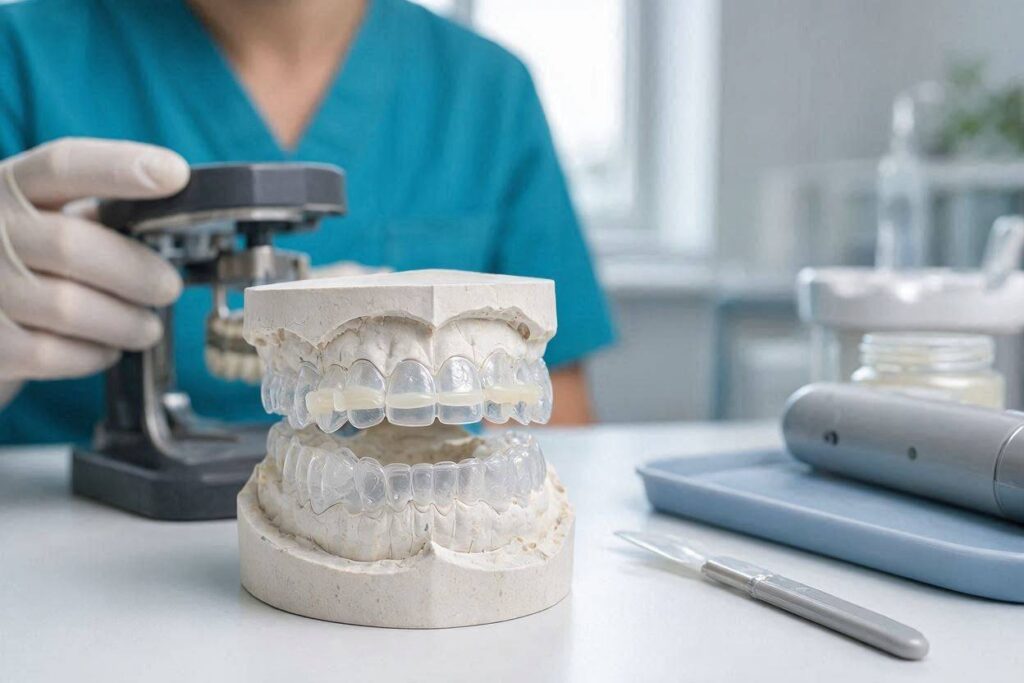
An Invisalign bite rim is not the same as the small, tooth-colored composite attachments bonded to the teeth to help the aligner grip and move them. It is also not the same as the aligner’s own plastic occlusal surface. The bite rim is a distinct, often smooth, flat, or slightly contoured shelf of plastic that extends across the occlusal surfaces of the posterior teeth, and sometimes the anterior teeth, on a specific set of aligners. These aligners, often called bite registration templates or bite registration trays, are a separate, dedicated set fabricated solely to record the bite, not to move the teeth.
The Applications of Invisalign Bite Rims
The clinical indications for using an Invisalign bite rim are specific and advanced. These are cases that sit at the complex intersection of orthodontics, restorative dentistry, and the management of temporomandibular disorders. The bite rim is a precision instrument for cases that cannot be solved by tooth movement alone.
Full Mouth Rehabilitation and Restorative Setups
A primary application is in full mouth rehabilitation. Consider a patient with severely worn, eroded, or broken-down teeth. The patient’s existing bite is collapsed, and they have lost their natural vertical dimension of occlusion, meaning the lower third of their face is shortened, and their jaw over-closes. A restorative dentist plans to rebuild the teeth with crowns or veneers to restore the proper bite height and facial support.
Before any tooth preparation is performed, the dentist must determine the new, ideal jaw relationship at the correct vertical dimension. The Invisalign bite rim is fabricated to this planned new height. The patient wears the bite rim aligner for a period, allowing the jaw muscles and joints to adapt and confirming that the new position is comfortable, physiologically sound, and aesthetically correct. This therapeutic bite position is then scanned with the bite rim in place, and this definitive bite record becomes the precise blueprint for the digital design of the final crowns and the provisional restorations.
Capturing the Centric Relation Position
In patients with significant bite discrepancies, muscle pain, or temporomandibular joint internal derangement, the habitual bite is often a compensatory, pathological position. The therapeutic goal is to find and record centric relation, a specific, reproducible jaw-to-skull relationship where the condyles are seated in the most superior and anterior position in their fossae, and the muscles are relaxed. This is a purely anatomical, ligament-guided position, independent of where the teeth currently meet.
The Invisalign bite rim is used as a bite jig. The smooth, flat plastic surface of the rim prevents the teeth from interlocking in their habitual, pathological grooves. The dentist performs a chairside manipulation, guiding the patient’s relaxed jaw into centric relation. The patient bites gently onto the rim, making contact at a single, stable point. This position is recorded with a bite registration material or an intraoral scan of the bite rim in situ. The bite rim has physically captured the centric relation, a position that the standard tooth-interlocking bite could never record.
Orthodontic-Orthognathic Surgical Planning
For patients undergoing combined orthodontic treatment and orthognathic jaw surgery, the bite rim plays a critical role in surgical prediction and planning. Before surgery, the orthodontist needs to capture a specific, pre-planned bite relationship to send to the oral surgeon and the lab. A bite rim fabricated on the pre-surgical models allows the team to physically simulate the intended surgical outcome, moving the jaw into the planned post-operative position. This simulation is essential for fabricating the surgical splint and for the surgeon to analyze the three-dimensional movements of the maxilla and mandible with absolute precision.
Stabilization and Deprogramming Splints
In some instances, the bite rim aligner functions as a deprogrammer or an anterior bite plane. It is designed so that only the front teeth contact the rim, preventing any posterior tooth contact. This immediately shuts off the powerful elevator muscles that clench and grind. The patient wears this for a period of weeks. This breaks the muscle engrams, or the learned, habitual patterns of jaw movement that are driving the pathological bite. Once the muscles are fully relaxed and deprogrammed, the true, unguarded jaw position can be captured with a new bite record, which is then used to plan the definitive treatment.
The Clinical Protocol and Laboratory Process
The process begins with the dentist taking a precise intraoral scan or polyvinyl siloxane impressions of both arches. A bite record is taken in the desired therapeutic position. The digital file is sent to Invisalign with a specific prescription for a bite registration template, specifying the exact inter-arch relationship and the vertical dimension. The laboratory fabricates a set of passive, rigid aligners with the smooth, integrated bite rim.
The patient returns for a bite registration visit. The dentist checks the fit of the bite rim templates. The patient is guided into the centric relation or the prescribed therapeutic jaw position, and a high-precision bite registration material, such as a fast-set polyvinyl siloxane registration paste, is syringed between the rim and the opposing teeth. The material sets, capturing the exact three-dimensional relationship. Alternatively, an intraoral scanner can capture this relationship digitally. The bite rims, with their definitive bite record, are then sent back to the Invisalign laboratory, or the digital scan is uploaded, to serve as the master articulation file for the fabrication of the next series of aligners or the final restorative prostheses.
Conclusion
Invisalign bite rims are specialized, integrated plastic platforms on dedicated aligners used to capture a precise, therapeutic jaw position, most critically in full mouth rehabilitation to establish a new vertical dimension, in centric relation bite registration for temporomandibular joint stabilization, and in presurgical orthognathic planning. They serve as a physical bite jig that deprograms the jaw muscles and prevents the teeth from interlocking in their pathological habitual bite. This allows the clinician to send a definitive, physiologically correct bite record to the laboratory, forming the foundational blueprint for the final restorative crowns, the surgical splint, or the next phase of complex aligner therapy.
Frequently Asked Questions
Q: Are bite rims part of every Invisalign treatment?
A: No. Bite rims are a specialized feature used only in complex, interdisciplinary cases involving restorative reconstruction, temporomandibular disorders, or jaw surgery. A standard, straightforward Invisalign case does not require them.
Q: Will I wear the bite rim aligners like regular aligners?
A: These specific aligners are typically worn only for a short period, often during the appointment itself for the bite registration, or for a limited number of hours per day as prescribed, to deprogram the muscles before the recording. They are not a full-time, long-term tooth-moving aligner.
Q: Does the bite rim aligner hurt?
A: It should not be painful. Because it has a smooth, flat occlusal surface, it prevents the teeth from hitting in their usual, potentially tender, clenching pattern. Some patients find it immediately relieving, as it disengages the powerful chewing muscles.
Additional Resource
For authoritative clinical guidelines on the diagnosis and management of complex occlusal disorders and the interdisciplinary use of clear aligner therapy, the following specialist organization provides premier resources.
- American Equilibration Society: aes.club